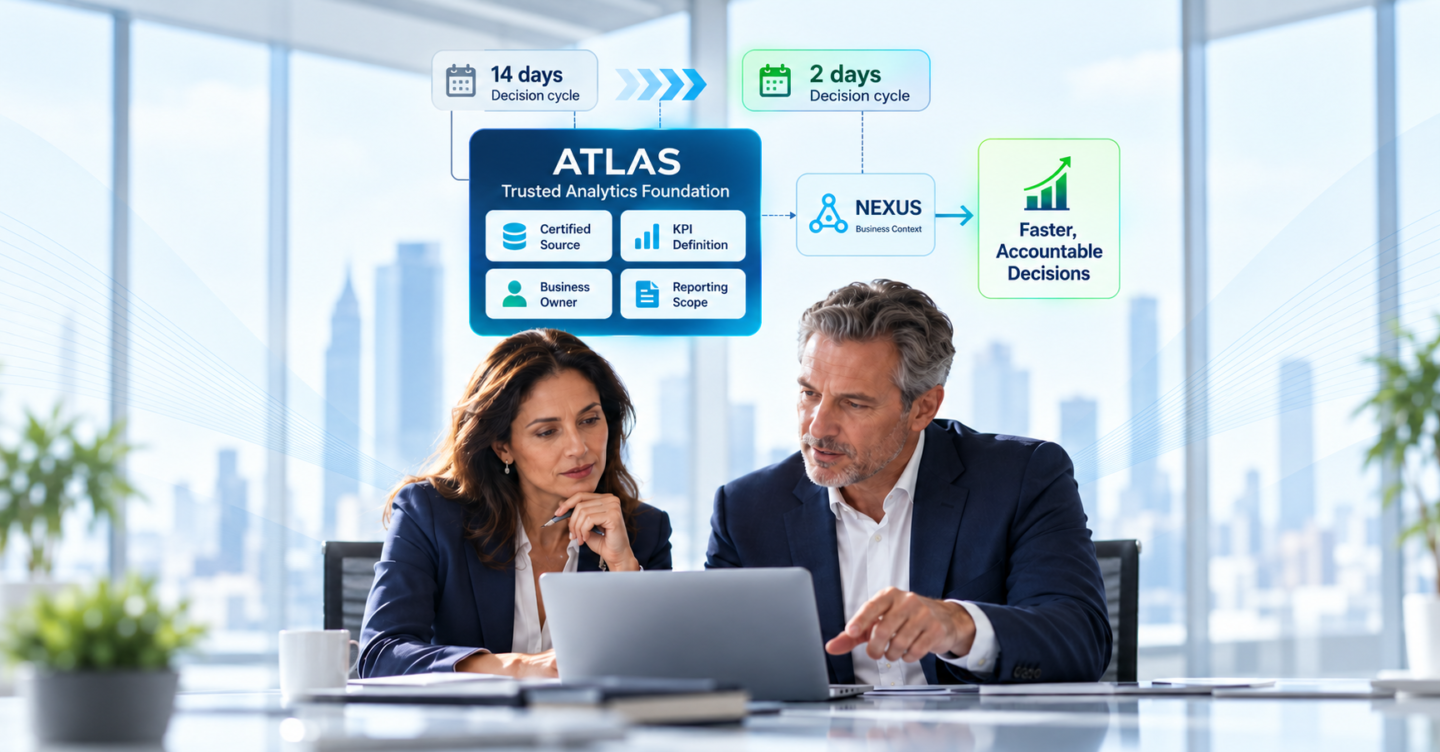
ZenOptics was recognized as a Sample Vendor in Gartner® Hype Cycle™ for Data and Analytics Governance, 2026 | Learn more
Most enterprises are good at producing insights. The harder part is turning those insights into governed, accountable actions. A certified KPI identifies a threshold breach, a BI tool flags a variance, or an AI copilot surfaces a critical metric. But what happens next is often informal: a meeting, an email, or a decision with no clear record of who approved it, what evidence supported it, or what outcome followed.
This is the analytics-to-action gap. The phrase is widely used, but the underlying problem is often misunderstood. Insights may be accessible, but most enterprise operations teams still lack the workflow governance layer needed to convert them into authorized, traceable business actions.
The insight-to-action gap is real, but the standard explanation does not tell the whole story. A common approach is to surface insights inside the business applications where decisions are made. Embed the metric in the CRM. Put the KPI widget in the collaboration tool. Make the dashboard appear inside the ERP. Bringing insights closer to where work happens can accelerate action, but it does not automatically govern that action.
Visibility reduces friction. It does not make the action that follows governed, authorized, or traceable. An analyst who sees a certified variance in a project management tool still decides what to do about it in a meeting, via email, or through an informal directive. The insight may be visible, but the organization can still lack a reliable record of what was decided, who authorized it, which evidence supported it, and what outcome followed.
Decision intelligence connects trusted analytics with structured, accountable business decisions. It requires a workflow layer that defines what should happen after an insight appears—who reviews it, who approves the response, what action is taken, and how the outcome is recorded. This infrastructure is what many enterprise analytics programs are missing.
Embedding analytics in business apps is a real improvement for the visibility layer. It is not a solution to the governance gap, because visibility and governance address different parts of the analytics-to-action chain.
An embedded metric can reduce context-switching, but visibility alone does not establish whether the metric was certified, what decision it triggered, who authorized the response, or what outcome followed. Six months later, when a budget variance requires explanation, when a compliance review asks how a particular action was authorized, when an audit trail is needed for an AI-executed step, there is no governed record.
As AI becomes more involved in enterprise decisions, organizations increasingly need to understand what analytics informed an action, who authorized it, and what happened next. Embedded analytics makes insights more visible, but it does not create the governance record connecting a certified metric with an authorized action and its outcome. Creating that record establishes decision provenance: a traceable connection between the trusted analytics used, the process followed, the authorization provided, and the resulting outcome. A metric surfaced inside a collaboration tool does not produce that artifact regardless of how well the underlying BI is governed.
The gap persists at the workflow execution layer. That is where the solution belongs.
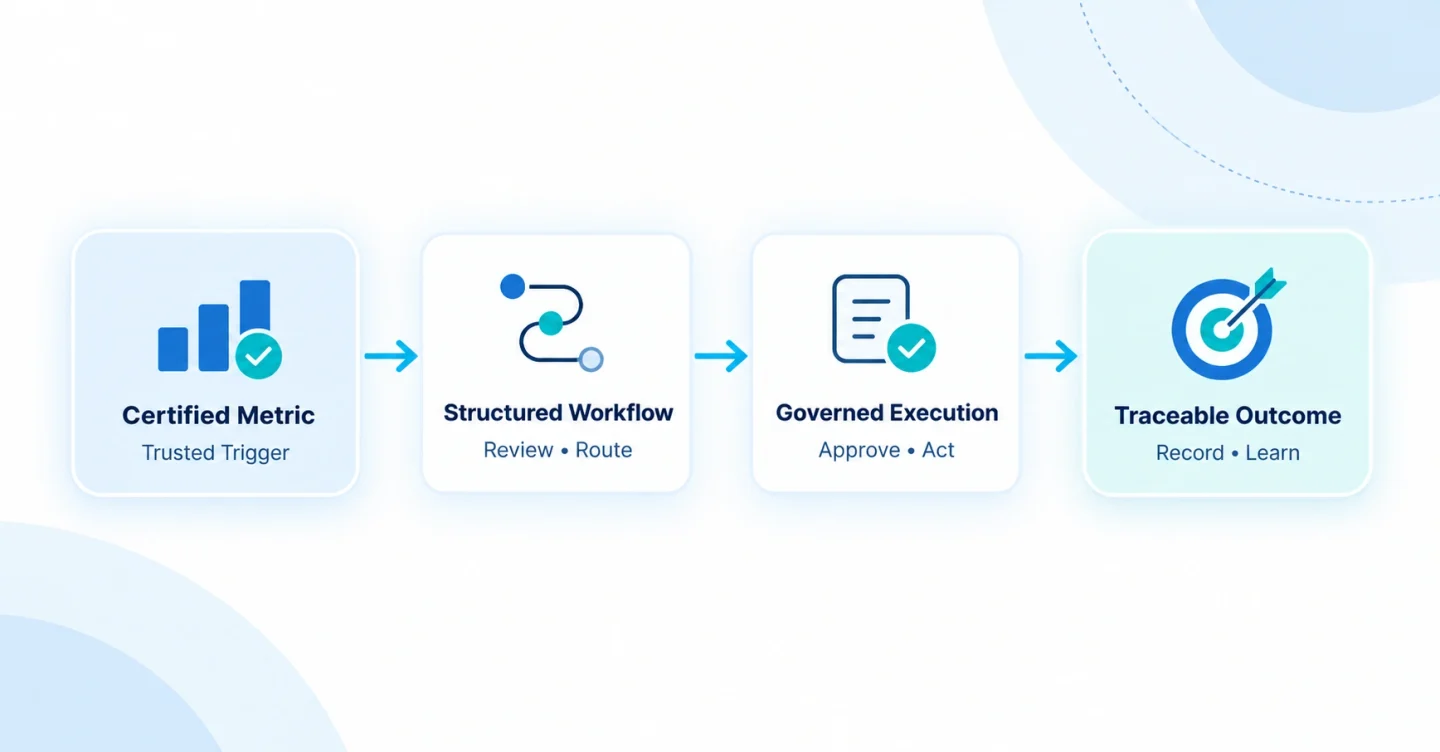
Closing the analytics-to-action gap at the governance layer requires four components working together.
A certified analytics trigger. The metric triggering the workflow should be trusted and certified, with a clear definition, designated owner, current certification status, and established review cadence. What metric certification requires is a formal governance record, not a label. When a certified metric triggers a decision workflow, its certification status can become part of the workflow record. If an uncertified metric drives the workflow instead, that too is a governance signal.
A structured workflow. The process that governs what happens when a certified metric triggers a decision must be defined: who is involved at each step, in what sequence, with what authority. In enterprise operations, this means structured workflows for the repeating analytics-driven processes that run the business: month-end close, budget variance review, CapEx approval, QBR preparation. A structured workflow converts an informal decision into a governed process with defined steps and owners. For example, a budget variance could automatically initiate a review by the finance manager, require approval from the finance director, and record the final adjustment and rationale.
Governance built into execution. Reviews, approvals, and authorizations must be captured as part of the execution record at each step, not added as separate documentation after the workflow runs. Approvals, escalations, supporting evidence, and completed actions become part of the workflow record as the process runs—not documentation assembled afterward.
A decision provenance record that closes the loop. The connection between the certified metric, the authorized action, and the outcome must be captured and retrievable. Without this connection, it becomes difficult to evaluate which decisions worked, understand why they worked, and improve future responses. The analytics context layer provides a governed, machine-readable representation of the certified analytics estate that AI systems can access during the workflow. When AI participates in a governed workflow, its access to certified context is what makes that participation traceable.
Maestro helps organizations turn trusted analytics into structured business action. Its Business Process Workflow Library provides prebuilt workflows across functions such as Finance, Legal, HR, Sales, and IT. Each workflow is structured for the consequential analytics-driven decisions those functions execute: CapEx approval, cash flow forecasting, month-end close, QBR preparation, headcount planning, vendor evaluation.
Maestro workflows can connect relevant process steps with certified analytics governed in Atlas: the analytics system of record that certifies KPIs, governs BI inventory, maintains ownership records, and tracks lifecycle status across the analytics estate. The metric that surfaces in a Maestro workflow step is the same certified metric from the governed BI catalog, with the same certification status and the same ownership record attached. This helps maintain continuity between the analytics governed in Atlas and the business processes managed through Maestro.
Governance is built into each execution step. Reviews, approvals, and escalations are structured into the workflow itself, captured as the step completes, and retrievable as part of the decision provenance record. Governance is the native output of the process, not an afterthought added for audit purposes.
With ZIVA, teams can describe an analytics-driven process in plain language and use AI to generate an initial workflow structure, reducing the manual effort required to design the process from scratch.
When AI agents participate in Maestro workflows, they can operate within a governed structure, using certified analytics from Atlas and governed business context supplied through Nexus: the analytics context layer that makes the certified estate interpretable to AI in machine-readable form. The workflow can capture the analytics referenced, the step completed, the applicable governance condition, and the action taken—creating a traceable record of AI participation. This governed structure helps make AI participation accountable, traceable, and easier to review.
What is the analytics-to-action gap?
The analytics-to-action gap is the absence of a governed connection between a certified analytics insight and the authorized business action it justifies. Most enterprise organizations surface insights well; few have the workflow governance layer that converts those insights into structured, authorized, traceable business decisions. The gap is a workflow architecture problem, not a data quality problem.
Why is embedded analytics not enough to close the analytics-to-action gap?
Embedded analytics reduces the friction of accessing insights by surfacing them inside the business apps where work happens. It does not make the decisions those insights trigger governed, authorized, or traceable. Closing the analytics-to-action gap requires more than insight visibility. It requires a workflow execution layer that captures the decision process, authorization, and outcome as a governed record.
What does a governed analytics-to-action workflow require?
A governed analytics-to-action workflow requires four components: a certified analytics trigger, a structured workflow that governs the decision process, governance built into execution at each step with reviews and approvals captured as the workflow runs, and a decision provenance record connecting the certified metric to the authorized action to the outcome.
What is Maestro’s role in analytics-to-action workflows?
Maestro provides the governed workflow execution layer. Its Business Process Workflow Library contains prebuilt analytics-driven workflows by business function, with governance built into each execution step. Maestro workflows can connect relevant process steps with certified analytics governed in Atlas, helping preserve the analytical basis for each decision. When AI agents participate, the workflow can capture the analytics referenced, the governance conditions applied, and the actions taken.
How does AI participation in analytics-to-action workflows stay accountable?
When AI agents execute steps within a Maestro workflow, they can use governed business context from Nexus and certified analytics from Atlas. The workflow can capture the analytics referenced, the step completed, the applicable governance condition, and the action taken, creating a traceable record of AI participation. This governed structure helps make AI actions accountable, traceable, and easier to review.
Enterprises do not lack insights. They often lack a consistent way to turn those insights into authorized actions and measurable outcomes. Closing that gap requires more than another dashboard—it requires governed workflow execution.
Atlas establishes trusted analytics, Nexus makes that context accessible to AI, and Maestro connects insights with governed business workflows. Together, they help close the analytics-to-action gap by connecting trusted insights with governed, traceable execution—not visibility alone.
See How ZenOptics Turns Trusted Analytics into Governed Action
Many AI agent pilots perform well in controlled environments but struggle to progress into production. The challenge is not always technical. Enterprises must also determine how an agent’s actions will be governed, reviewed and explained once the agent becomes part of a consequential business process.
Much of the discussion about stalled AI agent pilots focuses on technical explanations: models are not reliable enough, evaluation tooling is immature, data quality is insufficient. These are real challenges. They do not explain why AI agent pilots that technically work, that produce accurate outputs in controlled settings, still cannot get organizational approval to scale.
Even after the technical questions have been addressed, another barrier remains: business accountability. Before approving an AI agent for an important business process, operations, finance and legal teams need to understand how its actions will be governed, reviewed and traced.
Gartner projects that 40% of enterprise applications will include task-specific AI agents by the end of 2026, up from under 5% in 2025. Many enterprise organizations are currently experimenting with AI agents in controlled environments.They have AI agents running in controlled settings: routing approvals, flagging variances, executing workflow steps in finance, operations, or HR. Initial results may look promising. The agent may perform well within the pilot’s defined scope, and the underlying data may already be governed.
And then the request to scale hits operations. Or finance. Or legal. And it stalls.
These functions are not only asking, “Is the model accurate enough?” The pilot may provide evidence of performance, but production introduces broader questions about control and accountability. The question is: “When this agent makes a wrong call on a CapEx routing, marks the wrong close step as complete, or flags the wrong variance for escalation, what record do we have of what the agent did, on what basis it acted, and who is accountable for the outcome?”
This is a different question. Model monitoring, evaluation tools and data-governance logs provide important evidence, but they may not capture the complete business context behind an agent’s action. That requires a business decision record showing: what certified analytics the agent referenced, what workflow step governed its action, what authorization condition was satisfied or escalated, and what the measurable outcome was. Understanding the governance requirements for enterprise AI agents makes clear that the accountability question is a governance architecture question, not a model performance question.
Deloitte’s 2026 research found that only 21% of surveyed organizations reported having a mature governance model for autonomous AI agents, while nearly three in four expected to use agentic AI at least moderately within two years. This gap between adoption plans and governance maturity helps explain why some pilots struggle to progress.
Before any consequential automated process reaches production scale, the organizational functions responsible for that process ask a version of the same accountability question. The wording varies. The underlying concern does not.
Finance asks it about budget variance reviews and month-end close steps: if an AI agent marks a reconciliation step complete and the close is later found to be in error, what is the audit record that shows what the agent referenced, what the agent did, and what process governed the action? A clean model output log does not answer this question. An API audit trail does not answer this question. A decision governance record does.
Operations asks it about approval workflows and process exceptions: if an AI agent routes a CapEx request to the wrong approver or at the wrong threshold, what is the governance record that explains why the agent made that routing decision? Operations does not need to know what the model’s confidence score was. Operations needs to know what the agent referenced, what rule or workflow governed the action, and what the record shows.
Legal asks about regulatory compliance and audit readiness. For organizations operating in regulated environments requirements around record-keeping, transparency and human oversight make traceability increasingly important. The EU AI Act, for example, introduces specific obligations for AI systems classified as high-risk. A model card explains how the agent was trained. It does not explain what business decision the agent made, what analytics governed it, and what process authorized it.
What the decision record must contain answers this question at the architecture level: a certified analytics basis, a governed process record, an authorization record, and an outcome connection. From a ZenOptics perspective, a useful business decision record connects four elements: the governed analytics referenced, the process step executed, the applicable review or authorization, and the outcome that followed. These elements may exist across different systems, but they are rarely connected in a single business decision record.
Many enterprise AI governance frameworks focus primarily on system-level controls: access management, API logging, SIEM integration, model monitoring, principle of least privilege, bias auditing, and explainability frameworks. These are appropriate, necessary controls at the system layer. They answer: “What did the agent access? What tools did it invoke? What data did it read? What did the model output?”
These controls are essential, but they may not provide the complete business context that operations, finance and legal teams need. The system-layer audit trail documents agent behavior at the technical level. The business accountability question is at a different layer: what business decision did the agent make, on what certified analytical basis, within what governed process, with what authorization, and with what measurable outcome?
These are different governance objects. An IT audit log documents a tool invocation. A business decision governance record documents a business action: the certified revenue metric that triggered a variance flag, the Maestro workflow step that governed the flagging action, the escalation threshold that was satisfied, and the outcome that followed.
Understanding decision governance for AI agent workflows makes the distinction precise: IT governance addresses the AI system. Decision governance addresses the business decision the AI system makes when it executes a workflow step. Both are necessary. IT governance addresses the system, while decision governance adds the business context needed to review and defend the actions that follow.
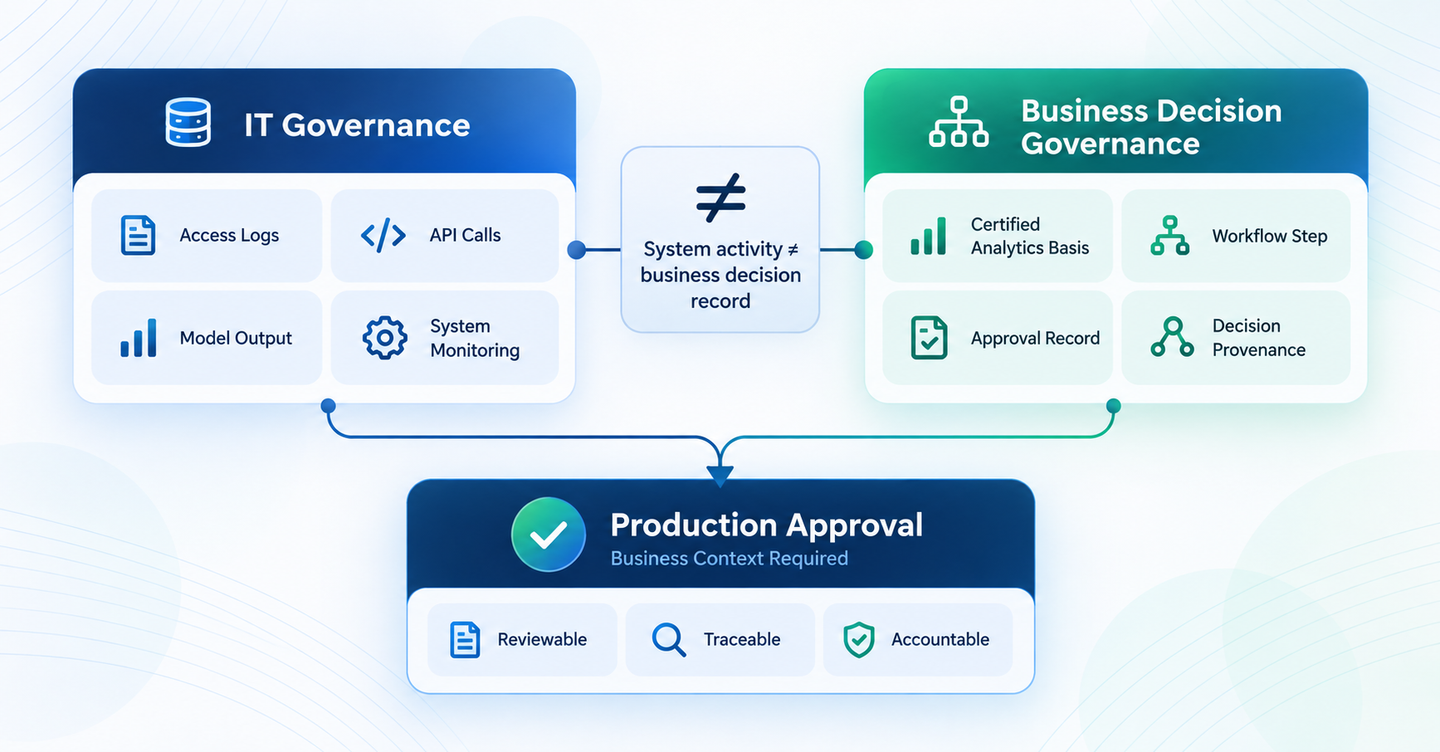
Business decision governance for AI agents operating in enterprise analytics workflows has four components. Together, these four elements can help operations, finance and legal evaluate an agent’s actions with greater clarity. Without this context, obtaining production approval becomes more difficult.
A certified analytics basis. When an AI agent references a metric or analytical threshold during a workflow step, that analytical input must be certified: reviewed and approved by a designated business owner, with a current certification status and a defined scope. What metric certification requires goes beyond data governance. Certification is an analytics governance act that produces an ownership record, a scope definition, and a status. When the agent references a certified metric, the certification becomes part of the decision record. When the agent references an uncertified source, that is a governance signal requiring escalation rather than silent execution.
A structured workflow context. The agent must operate within a defined business process, not autonomously outside a governed structure. An AI agent executing a step within a governed workflow operates under defined process logic, defined ownership, and defined escalation paths. The governed workflow execution layer is what converts an agent action from an autonomous decision into a governed process step. Without a workflow structure, the agent action has no process record and no auditable context.
A governance approval record at each step. Whether a workflow step is completed by a human analyst or an AI agent, the governance condition at that step (the required review, approval threshold, or escalation trigger) must be captured as part of the execution record. A step completed without a governance record is an unaccountable action at the business layer, regardless of what the system-layer audit log captures.
A decision provenance record that closes the accountability loop. The agent’s action must be connected to the certified analytics input that triggered it, the workflow step that structured it, the governance condition that was satisfied, and the measurable outcome that followed. Without this connection, organizational accountability for AI agent decisions rests on assertions: “we believe the agent acted correctly.” With it, accountability rests on records that can be retrieved, reviewed, and defended at audit.
Maestro turns analytics into structured, governed workflows that guide teams from insight to action while preserving the context behind each decision. Its Business Process Workflow Library organizes workflows across functions such as Finance, Legal, HR, Sales and IT. It includes prebuilt and customizable workflows for processes such as CapEx approvals, cash-flow forecasting, month-end close, QBR preparation and vendor payments.
When people and AI agents operate within Maestro workflows, governance and accountability can be built into execution instead of being added as documentation afterward.
The certified analytics foundation at each step is provided by Atlas: ZenOptics’s analytics system of record, where KPI definitions are governed, ownership is assigned, and certification status is maintained across the enterprise analytics estate. Maestro workflows can map decision steps to governed analytics from Atlas, giving teams a stronger foundation for consistent execution. Certification status is part of the context the agent operates within.
Nexus transforms governed metadata from Atlas into business context that AI systems can interpret.This helps agents understand relevant metrics, business terminology and relationships as they participate in Maestro workflows.
Maestro brings governance into execution by allowing reviews, approvals, rejections and escalations to be defined within the workflow. Actions are recorded and steps remain visible, helping teams understand what was done, by whom and when.
By connecting analytics, workflow steps, actions and approvals, Maestro helps preserve the provenance behind a business decision. This gives operations, finance and legal teams a clearer record of the workflow, the actions taken, the people involved and the governed analytics connected to the process.
This does not remove every barrier to production. It does, however, give stakeholders a clearer and more defensible record of how work was executed and governed.
Why do AI agent pilots stall at the production approval stage?
AI agent pilots can stall for several reasons, including technical limitations, security concerns, unclear business value and insufficient governance. Even when technical performance is promising, production approval may be delayed if stakeholders cannot determine how the agent’s actions will be reviewed, governed and traced.
What is the difference between IT governance and business decision governance for AI agents?
IT governance addresses the AI system: access controls, API logs, model monitoring, and system audit trails. It documents what the agent accessed and invoked. Business decision governance addresses the business decision the agent makes: what certified analytics the agent referenced, what workflow step governed the action, what authorization condition was satisfied, and what the outcome was. Both are necessary. Business decision governance complements technical controls by connecting an agent’s actions with the relevant analytics, workflow, authorization and outcome.
What does business decision governance require for AI agents?
Business decision governance for AI agents requires four components: a certified analytics basis at each workflow step, a structured workflow that governs what the agent does at each step, a governance approval record captured as the step completes, and a decision provenance record connecting the certified analytics input to the agent’s action to the measurable outcome.
How does Maestro enable AI agent deployment to reach production?
Maestro provides structured workflows for analytics-driven enterprise processes. Decision steps can be mapped to governed analytics from Atlas, while Nexus provides business context that AI can interpret. Maestro allows reviews, approvals, rejections and escalations to be incorporated into execution, while recording actions and maintaining visibility across workflow steps.
Is this a compliance requirement or an operational requirement?
It can be both. In regulated or high-risk use cases, organizations may face formal requirements related to record-keeping, transparency and human oversight. Even when a specific regulation does not apply, teams still need clear records of actions, approvals and ownership to manage operational risk. Business decision governance can support these requirements, but compliance depends on the use case, jurisdiction and applicable regulation.
Enterprise organizations have spent years building data governance programs: lineage tracking, quality rules, metadata catalogs, policy frameworks. When AI copilots arrived, many enterprise analytics teams assumed their governance investment would carry over, that a well-governed data estate would translate to well-grounded AI analytics answers.
It did not. As enterprises deploy AI copilots and analytics agents, many are encountering a difficult problem: AI can return inconsistent or misleading answers even when the underlying data is clean and governed. Teams blame the model. They revisit data quality. They adjust retrieval configurations. The wrong answers persist.
The problem is not always the underlying data. In many cases, it is the gap between data governance and analytics governance. Many enterprise AI deployments have one without the other.
The instinct when AI returns a wrong metric is to look at the data. If Revenue comes back wrong, check the underlying revenue data. If Headcount is off, audit the HR system. This instinct is understandable, because it works for traditional BI failures. When a report shows the wrong number, it is usually because the data feeding it is wrong.
But not every AI analytics failure follows this pattern. In some cases, the underlying data is clean and the source figures are correct. The revenue figures are correct in the source systems. The headcount data passes every quality rule. And the AI still returns the wrong Revenue number when asked for Q3 performance, or the wrong Headcount figure when asked for organizational strength by region.
The reason is that the AI is not reading wrong data. It is reading the right data through the wrong definition. It retrieved a version of “Revenue” that is accurate in its own context but is not the certified definition the finance team designated as authoritative for Q3 reporting. The data is fine. The analytics context layer (the governed business meaning attached to that data) is absent.
This explains why an organization can have mature data governance and still struggle to produce trusted AI-generated analytics. Governing the data estate does not automatically give AI access to certified metric definitions, business ownership, scope and reporting context.
This distinction is at the core of why enterprise AI analytics deployments fail even in well-governed organizations.
Data governance certifies the data layer: that source data is accurate, complete, consistent across systems, and traceable through its lineage. A mature data governance program ensures that the revenue figures in the data warehouse match the revenue figures in the source transactional system, that field definitions are documented, that access policies are enforced, and that changes to source data are tracked. This work is essential, but by itself it may not govern the dashboards, reports, KPIs and business definitions through which people and AI consume analytics.
Analytics governance certifies the analytics layer: that business metrics (Revenue, ARR, EBITDA, Headcount, Cost per Acquisition) have authoritative definitions, designated business owners, defined scope and calculation rules, and current certification status. “Revenue” in a large enterprise BI estate may exist in multiple forms across four BI tools. Each form draws from governed data. None of those forms is inherently “wrong” at the data layer. But only one is the certified definition for a given reporting context: the one finance designated as authoritative for board reporting, or the one sales operations designated for pipeline analysis.
When AI reads that BI estate without analytics governance context, it cannot distinguish the certified definition from the uncertified one. It may retrieve a definition based on technical relevance rather than business authority because conventional retrieval does not automatically understand certification status or reporting context.
Model Context Protocol can connect AI systems to tools and information, but connectivity alone does not determine which metric is authoritative. AI still needs governed business context to interpret enterprise analytics consistently. For ZenOptics, the missing layer is analytics governance: the certified definitions, ownership and business context surrounding reports, dashboards and KPIs.
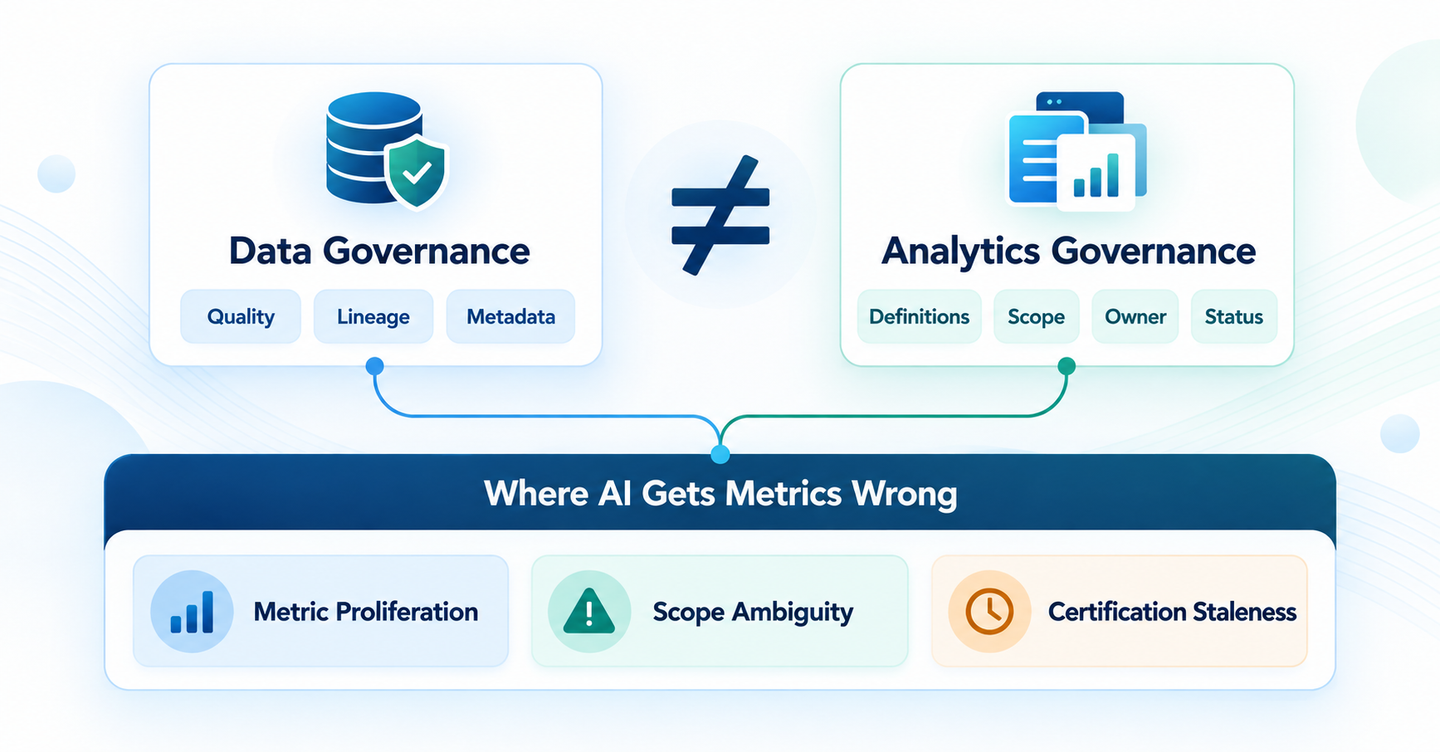
Three common failure patterns help explain why AI can produce inaccurate analytics answers in governed organizations.
Metric proliferation. A large enterprise BI estate accumulates metric definitions over time. Power BI reports built by the finance team define Revenue one way. Tableau dashboards built by sales operations define it another. SAP BusinessObjects reports used by the executive team draw from a third calculation. All of these are reading from governed source data. All of them are “accurate” in their own context. The enterprise has never designated which definition is authoritative across contexts. When AI retrieves “Revenue,” it may select a definition based on technical relevance rather than business authority because conventional retrieval does not automatically understand certification status or reporting context. The answer is data-accurate but analytically wrong.
Scope ambiguity. Even when a metric definition is consistent, its scope varies across reports. Revenue by geography. Revenue by product line. Revenue by GAAP treatment. Revenue excluding discontinued operations. An AI query for “Q3 Revenue” may retrieve any of these scope variants. Without analytics context that maps which scope is canonical for which reporting context, the AI returns a scoped figure without disclosing its scope. The finance director reviewing the answer does not know whether the AI included discontinued operations or excluded them, and neither does the AI.
Certification staleness. Metrics are not static. A definition that was certified in Q1 may be under review for Q2 as the business changed its calculation methodology. AI retrieves metric definitions without certification status timestamps. It returns a metric that was certified but is no longer current, with no indication that the certification is under review. The answer reflects a governance state that no longer applies.
Understanding what metric certification requires makes clear why these failures persist: certification is not a label applied to a metric record. It is a governed process that produces an ownership record, a scope definition, a calculation rule, and a current status. These attributes are not always governed consistently through traditional data governance programs. They require analytics governance infrastructure. The analytics knowledge graph that maps relationships between metrics, scopes, and ownership records is what allows an AI system to navigate a complex BI estate without retrieving the wrong definition.
Closing the enterprise AI analytics accuracy gap requires four components working together. Together, they constitute what “analytics context” means at the enterprise level, and why it is a different, harder problem than data context.
Certified metric definitions. The business must designate, for each analytically significant metric, which definition is authoritative for which reporting context. This is an analytics governance decision made by a designated business owner with documented authority, not a data governance artifact. When AI can reference a certified metric definition, it is better positioned to align its response with the definition the business has approved.
Business ownership records. Certification without ownership is unenforceable. Each certified metric definition requires a designated owner: the business role or individual who has authority to certify, modify, or retire the definition. When AI returns a metric answer, the ownership record is part of the context. The answer is traceable to the person who certified it, not only the data that produced it.
Scope and calculation rules. The metric definition must specify the scope (which business units, time periods, product lines, geographies, and accounting treatments the certified figure includes or excludes) and the calculation methodology that produces it. Without this, AI returns a metric figure without disclosing whether it is GAAP or non-GAAP, consolidated or unconsolidated, trailing twelve months or point-in-time.
Current certification status. A certified metric definition must carry a status indicator: active, under review, or superseded. AI needs to understand whether a metric’s certification is current. A definition that is under review should be flagged as such in the AI’s context so that users understand the certification basis of the answer they receive.
The certified analytics foundation that these four components depend on is Atlas, ZenOptics’s analytics system of record, where KPI definitions are governed, ownership is assigned, and certification status is maintained across the enterprise analytics estate.
Not every inaccurate AI analytics response is a traditional model hallucination. In some cases, the model may be using real information but applying an uncertified, outdated or contextually inappropriate metric definition. This makes it an analytics context problem, rather than simply a model accuracy problem.
How retrieval architecture affects analytics accuracy is a distinct but related question: the retrieval mechanism determines what the AI finds, but without analytics context layer governance, even optimal retrieval cannot distinguish the certified metric definition from an uncertified one.
Nexus is ZenOptics’s analytics context layer: the infrastructure that makes certified analytics context available to AI in machine-readable, governed form.
Atlas and Nexus play complementary roles. Atlas serves as the analytics system of record, where analytics assets, definitions, ownership and certification are governed. Nexus transforms this governed metadata into business context that AI systems can interpret. Nexus has three components, each addressing a distinct part of the analytics context gap.
Metadata and Domain Onboarding consumes governed metadata from Atlas and organizes analytics assets by business domain. It captures structural metadata, identifies gaps such as missing descriptions, incomplete ownership and uncertified assets, and prepares that context for AI consumption. This gives AI the starting point for analytics retrieval: a governed map of the analytics estate rather than a raw connection to BI schema.
Semantic Curation Studio is where technical metadata is transformed into business-meaningful context. Data stewards resolve naming conflicts, curate descriptions, standardize aliases and verify that analytics assets are logically consistent for AI consumption. Working with the governed foundation provided by Atlas, the Semantic Curation Studio enriches technical assets with business-friendly descriptions and human-verified terminology. This reduces the ambiguity that causes AI to misinterpret natural-language analytics questions.
Knowledge Graph connects analytics assets, KPIs, business domains and their relationships, helping AI understand how enterprise analytics fit together. When an AI system encounters a question about revenue or sales performance, the Knowledge Graph helps it understand the relevant business domain, related KPIs, analytics assets and upstream relationships.
Atlas provides the certified analytics foundation that Nexus makes AI-consumable: the analytics system of record where KPI definitions are governed, BI inventory is managed, and ownership records are maintained across tools and business functions.
This gives AI systems access to richer, governed analytics context. They are better positioned to reference certified metrics, understand relevant relationships and align responses with the way the organization measures performance. The underlying data does not change. The analytics context does, from absent to governed.
Why does enterprise AI return wrong analytics answers when data is governed?
Data governance certifies the data layer: accuracy, lineage, and consistency at the source. Analytics governance certifies the analytics layer: which metric definitions are authoritative, who owns them, what scope they apply to, and whether their certification is current. Enterprise AI deployed without analytics governance context retrieves whichever metric definition its retrieval mechanism surfaces, not the certified one. The data is clean. The analytics context is absent.
What is the difference between a data catalog and an analytics context layer?
A data catalog documents the data estate: what data assets exist, where they come from, and who owns them at the data level. An analytics context layer governs the analytics layer: which metric definitions are certified, what their calculation scope is, who certified them, and whether they are current. These are different governance objects. An enterprise can have a mature data catalog and no analytics context layer. When AI operates on that estate, the data catalog does not prevent analytics accuracy failures.
What does analytics context for enterprise AI require?
Analytics context for enterprise AI requires four components: certified metric definitions (which definition of each metric is authoritative for which reporting context), business ownership records (who certified the definition and with what authority), scope and calculation rules (what the certified figure includes and excludes and how it is calculated), and current certification status (whether the certification is active, under review, or superseded).
What is Nexus’s role in enterprise AI analytics accuracy?
Nexus is ZenOptics’s analytics context layer. Its three components (Metadata and Domain Onboarding, Semantic Curation Studio, and Knowledge Graph) build a governed, machine-readable representation of the certified analytics estate. Nexus makes governed analytics metadata from Atlas available as business context for AI. This helps AI systems interpret metrics, relationships and business terminology more consistently.
Is this an analytics hallucination problem?
Not every inaccurate AI analytics response is a traditional model hallucination. In some cases, the model may be using real information but applying an uncertified, outdated or contextually inappropriate metric definition. This is an analytics context problem, not simply a model accuracy problem.
Enterprise copilots are being asked increasingly important business questions: What was our Q2 gross margin? Why did customer churn increase? Which product line drove last quarter’s variance?
Answering these questions reliably requires more than access to reports and dashboards. A copilot must understand which metric definition is authoritative, who owns it, where it came from, and whether it remains approved for the reporting context in question.
BI platforms can provide valuable governance within their own environments. The harder enterprise problem emerges when analytics span Power BI, Tableau, SAP BusinessObjects, and other platforms, each containing overlapping metrics, reports, certifications, and business definitions.This is where a governed analytics context layer becomes essential.
The knowledge-agent framing treats an AI copilot as a system that answers questions by finding and synthesizing relevant information from a corpus. This model can work effectively for enterprise content where authority can be inferred from signals such as the publisher, owner, version, approval status, and publication date. Official policies, product documentation, research reports, and company communications frequently contain these signals in forms that a retrieval system can evaluate.
When a knowledge agent is applied to analytics, it encounters a different kind of content. An enterprise BI estate contains certified KPIs, regional workaround reports, dashboard builds for specific projects, metrics calculated three different ways by three different business units, and certifications from previous governance cycles that may or may not reflect current business logic. These assets may coexist across multiple BI environments and become available through different retrieval paths. Without a unified authority model, the copilot may retrieve a relevant asset without understanding whether it represents the organization’s approved definition for that specific reporting context.
The distinction that matters for analytics is not in the content. A certified enterprise KPI for gross margin and an uncertified regional variant calculated without the corporate finance team’s approval may look nearly identical as documents. Both have a metric name, a formula description, and a dashboard displaying a number. The difference is the governance record: one has been certified by the organization as authoritative for reporting, the other has not. That record is not in the text. It is in the analytics estate’s governance metadata.
The analytics context layer was developed to address exactly this gap: the layer between raw BI content and the AI experiences that consume it, where governance signals must be made available in machine-readable form. Without it, an AI copilot encounters the same ambiguity a new analyst faces when deciding whether to use the finance-approved metric, a regional variation, or a project-specific calculation, but at enterprise scale.
Enterprise documents have authority signals a copilot can reason about: recency, author, revision history, official versus draft status. These signals are imperfect but present in the content structure. An AI copilot has reasonable heuristics for preferring a current document over a five-year-old one, or a final over a draft.
Analytics assets carry a different kind of authority that these heuristics cannot recover. A certified KPI approved last year may be more authoritative for current reporting than a metric definition updated last week, if the recent update was a project-specific workaround that was never submitted for certification review. A dashboard created four years ago as the official executive summary may be more trustworthy than a newer, more polished-looking report built for a regional pilot. Recency does not establish certification. Appearance does not establish governance.
The governance signals that make analytics assets trustworthy for AI are: certification status (is this metric currently certified as authoritative for this reporting context?), ownership accountability (is there a current, named owner responsible for this asset’s accuracy?), and lineage integrity (does this metric’s definition trace cleanly to the underlying data sources it claims to draw from?). When a copilot queries an analytics estate that lacks these signals, it cannot distinguish trustworthy from untrustworthy sources.
This is not a problem unique to copilot deployments: retrieval-only approaches have already demonstrated their limits in enterprise analytics when the underlying governance signals are absent, and whether graph-enhanced retrieval can substitute for governed analytics context resolves the same way. Adding more data to an ungoverned analytics estate does not reduce the ambiguity the copilot inherits. The governance signals must exist in the analytics estate before any query interface can surface them reliably.
This becomes particularly important for organizations using BI-native AI capabilities. Microsoft Power BI Copilot, Tableau Agent, and similar capabilities can use semantic models, certified data sources, endorsements, and other governance signals within their respective environments. However, they do not by themselves establish a unified authority model across the complete enterprise analytics estate.
When certified metrics and competing definitions are distributed across Power BI, Tableau, SAP BusinessObjects, and other platforms, each tool can govern what exists within its own boundaries. The remaining enterprise challenge is determining which definition should be treated as authoritative across platforms, business units, and reporting contexts. Better query interfaces alone do not resolve this cross-platform governance gap.
ZenOptics complements the governance capabilities within individual BI platforms by establishing the cross-platform analytics system of record and context layer needed to make governance signals consistent, machine-readable, and usable across enterprise AI experiences.
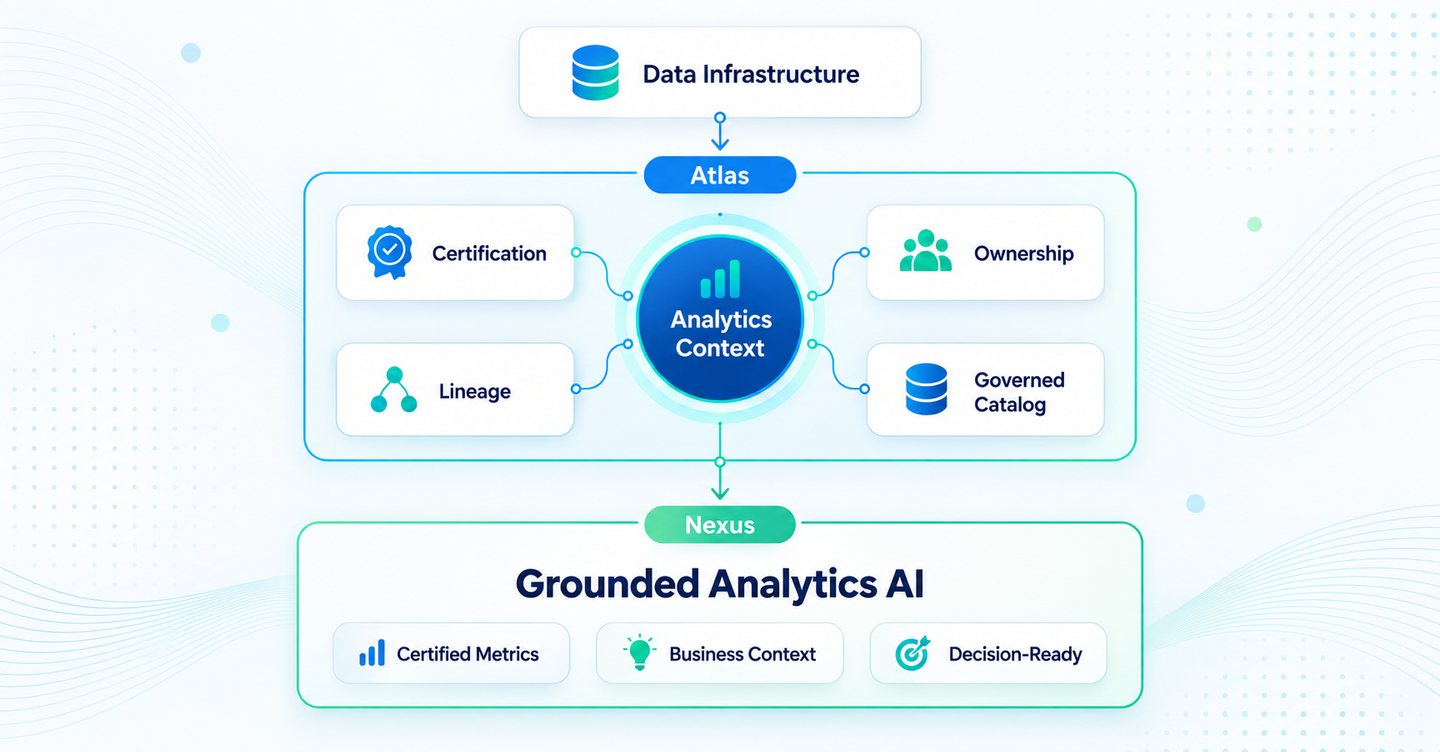
Grounding a copilot in the governed analytics layer requires four specific governance components, each of which addresses a distinct gap in the knowledge-agent model.
Certified metric definitions with designated authority. An enterprise may have multiple definitions of the same business metric in circulation across BI tools, regions, and business units. For a copilot to return an authoritative answer, there must be a designated authoritative definition for each metric in each reporting context, available to the copilot as structured context rather than as raw document text for it to synthesize. What metric certification requires goes beyond labeling: it involves a defined governance process, designated owners, and a review cadence that keeps certifications aligned with current business logic.
Ownership with accountability and review cycles. A metric definition certified eighteen months ago may reflect business logic that has since changed. Governed analytics context requires that each certified metric have a current, accountable owner responsible for keeping the certification current. Review cycles establish when certifications are revisited. Without these, certifications decay over time while the copilot continues to ground on outdated definitions. There is no mechanism for the copilot to detect that the governance record it is reading has not been reviewed since the business logic changed.
A cross-platform analytics catalog that distinguishes authoritative, contextual, and ungoverned assets. A copilot needs to understand which reports, dashboards, semantic models, and metrics are authoritative for a particular decision or reporting context. A governed analytics catalog provides these distinctions as structured metadata, allowing AI systems to prioritize certified assets, recognize contextual variations, and flag assets whose governance status is incomplete or uncertain.
Lineage from certified metrics to data-source dependencies. A certified metric that relies on a data source that has changed because of a schema migration, pipeline update, or source-system replacement may remain logically consistent while producing an unexpected result. Lineage makes these dependencies visible. It connects the certified metric to the datasets, reports, and upstream sources on which it depends. When a dependency changes, governance teams can assess the impact and determine whether the affected metric requires review or recertification. The governance failures that produce different classes of unreliable AI output include lineage breaks that AI systems cannot interpret correctly without explicit governance context.
Together, these four components define what “governed BI context” means in practice for a copilot deployment. They are not features of a BI tool’s Copilot interface. They are properties of the analytics estate the copilot queries.
When an analytics estate contains certified definitions, accountable ownership, lifecycle governance, and traceable lineage, a copilot can operate with clearer authority signals. It can interpret a question using the appropriate certified metric, identify the governed analytics asset associated with that definition, and provide the ownership, certification, and lineage context needed to verify the response.
Instead of relying on whichever BI content appears most relevant, the copilot can interpret the question using the organization’s certified metric definition, query the appropriate governed analytics asset, and connect the resulting answer to its governance context. The output is not simply more confident. It is more traceable.
Model capability alone does not produce this outcome. The quality of the governed context the model receives is equally important. When a copilot produces inconsistent analytics answers, the model may not be the only source of the problem. The underlying analytics estate may lack the governed definitions, relationships, ownership, and authority signals required to interpret business questions correctly..
Atlas establishes the enterprise analytics system of record by cataloging reports, dashboards, KPIs, and metrics across BI platforms. It provides certification and approval workflows, ownership and accountability, lifecycle governance, usage intelligence, lineage, and dependency visibility.
Nexus builds on this governed foundation by transforming BI metadata and governance records into machine-readable business context. Through semantic curation and a knowledge graph, it helps copilots and AI agents interpret metrics, relationships, aliases, and business domains more accurately.
Together, Atlas and Nexus provide the governed analytics foundation that enterprise copilots need to understand not only which analytics assets exist, but also which definitions are authoritative and how they should be interpreted.
Before expanding an enterprise copilot into analytics use cases, leaders should ask:
If the answers are unclear, the organization may have given its copilot access to analytics without providing the context required to interpret them reliably.
Why do BI-native Copilot features (like Power BI Copilot) still leave governance gaps?
BI-native AI capabilities can use semantic models, certifications, endorsements, and other governance signals within their respective platforms. The remaining gap appears when analytics span multiple platforms. Power BI may contain one approved metric, while Tableau or another environment contains a regional or project-specific variation. Without a cross-platform analytics system of record, an enterprise copilot may lack a consistent way to determine which definition is authoritative for a particular business question.
What is the difference between a knowledge agent and a governed analytics context layer?
A knowledge agent retrieves and synthesizes information from a corpus. It is optimized for unstructured content where authority signals are in the text. A governed analytics context layer is structured governance infrastructure: certified metric definitions, ownership records, certification status, and lineage records that make analytics assets trustworthy for AI reasoning. The two serve different purposes and address different problems. An enterprise copilot deployed for analytics use cases benefits from both, but the knowledge-agent layer cannot substitute for the governance layer.
Does governing the analytics estate require replacing existing BI tools?
No. ZenOptics complements the BI and data platforms an organization already uses. Atlas connects to the analytics estate and establishes cross-platform cataloging, certification, ownership, lineage, and lifecycle governance. Nexus converts this governed metadata into business context that copilots and AI agents can consume. Existing BI platforms remain the systems where analytics are created and consumed.
How does metric lineage help a copilot return more reliable answers?
Lineage connects a certified metric to the datasets, reports, and upstream sources on which it depends. When a schema, pipeline, or source system changes, lineage helps governance teams identify the affected analytics assets and determine whether they require review or recertification. Making this context available to a copilot allows the response to be connected to the metric’s definition and supporting dependencies, giving users a clearer basis for verification.
Enterprise organizations have invested heavily in data catalogs, enriched schemas, governed lineage and quality pipelines. Yet their analytics AI can still return inconsistent answers, select the wrong KPI or rely on an outdated report. The instinct is often to add more sources, enrich more metadata or improve retrieval. Those investments matter, but they cannot resolve ambiguity that exists in the analytics layer itself.
The problem is that enterprise analytics AI failures are often not data infrastructure failures. They are analytics layer failures. Closing that gap requires a governed analytics context layer that gives AI access to certified metrics, ownership, lineage and the business relationships behind enterprise decisions.
The pattern is familiar. An AI agent returns an inconsistent metric. A natural-language query produces an answer that no finance team member can reconcile with their own reports. An executive review finds the AI-generated summary used a revenue definition that has not been current for two years. The response: check the pipeline, audit the schema, add more context to the retrieval layer.
For data-layer failures, this is correct. Retrieval techniques and better data infrastructure address the data layer and will help when the underlying problem is there.
But a distinct layer above the data infrastructure often remains inconsistently governed: the analytics layer. This is the estate of reports, dashboards, certified metrics, KPI definitions, business ownership assignments, and certification records that represents how the organization translates data into business decision support. When analytics AI fails because of conflicting metric definitions, stale certifications, uncertified assets or ownership gaps, improvements to the underlying data infrastructure alone cannot resolve those governance conditions.
The analytics layer requires governance that complements data governance. In many enterprises, that governance remains fragmented across BI tools, business units and individual reporting teams. Business units have built their own metric definitions. Certifications from earlier governance cycles have not been reviewed as business logic changed. Reports that were created for specific projects were never retired and now appear alongside authoritative sources in any search or retrieval result. AI reasoning over this estate reads the same ambiguity that human analysts navigate every day, except at scale and with no organizational knowledge of which source to trust. Adding more data to an ungoverned analytics estate does not reduce that ambiguity.
The context that data catalogs, schema registries, and governed lineage provide to AI systems is real and valuable: technical metadata, source-to-destination lineage, data quality signals, schema definitions, and pipeline-level documentation. This data context tells an AI system where data comes from, what it means structurally, and whether it passed quality checks at the infrastructure level.
Data context alone may not establish which metric definition is authoritative for a particular reporting context, whether its certification remains current, who owns the KPI, or whether an analytics asset is certified, outdated or still appropriate for enterprise decision-making. Those signals must come from governance of the analytics estate.
Consider an organization with a well-governed data estate. Schemas are documented. Lineage is tracked. Quality pipelines flag anomalies. But the BI tools on top of that infrastructure contain two hundred dashboards with seventeen different definitions of customer churn, reports built for a specific acquisition scenario that were never retired, and key KPI certifications last reviewed before the company changed its revenue recognition policy. An AI agent querying that estate reads the BI layer, not only the data infrastructure. The well-governed data below does not resolve the ambiguity above it.
Graph-enhanced retrieval can improve how AI discovers and connects information across an enterprise. But retrieval cannot independently establish governance signals (such as certification, ownership and lifecycle status) when those signals have not been defined in the underlying analytics estate. This is the focus of analytics context engineering: the organizational discipline of structuring the analytics layer so AI systems can reason over it correctly.
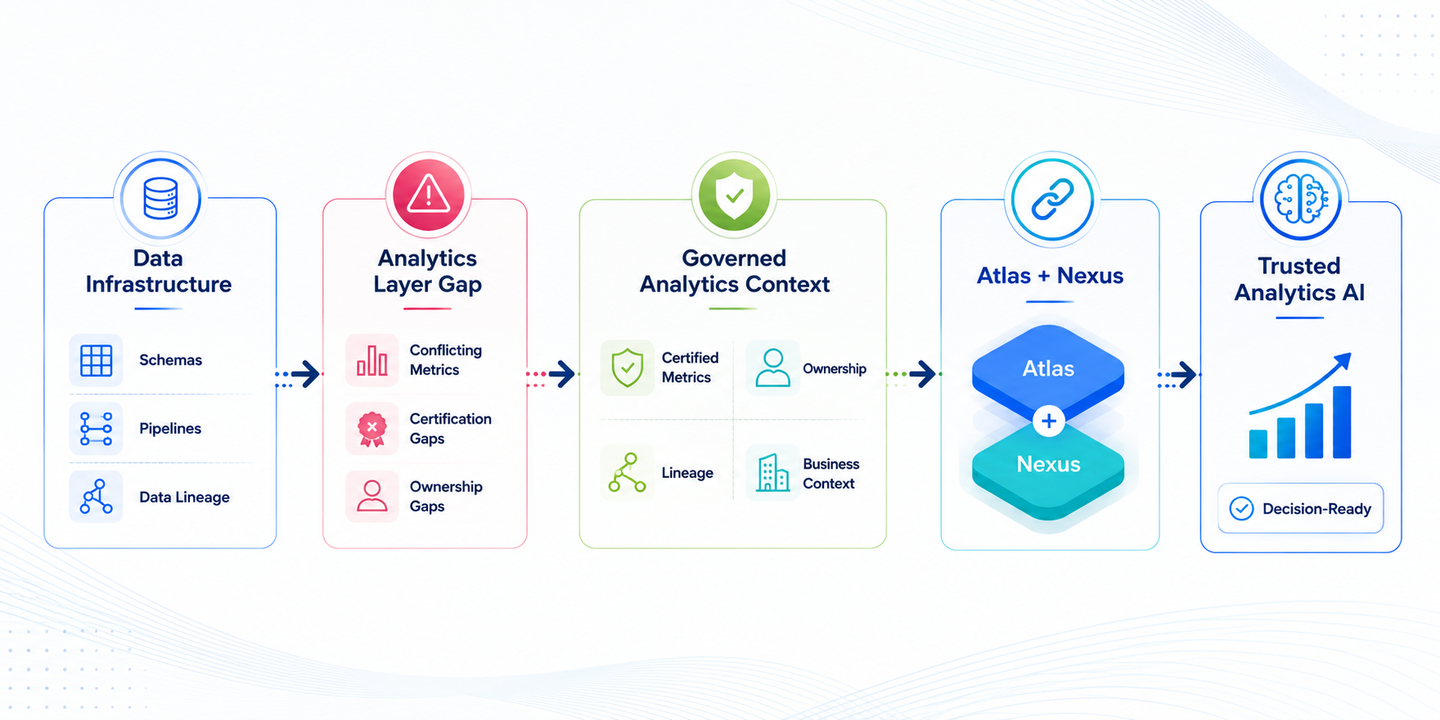
The analytics layer requires its own governance, separate from and in addition to data infrastructure governance. That governance has specific components.
Metric certification with designated authority. An organization may have dozens of definitions of the same metric across teams and tools. Governed analytics context requires an authoritative metric definition for each approved reporting context, expressed in a machine-readable form and supported by current certification status. What metric certification requires goes beyond labeling: it includes ownership, review cadence, and the organizational process that keeps certifications aligned with current business logic.
Ownership with accountability and review cycles. A certified metric reviewed two years ago may reflect business logic that has since changed. Governed analytics context requires that each certified metric have a current, accountable owner responsible for keeping the certification valid. When business logic changes, the certification must be reviewed. Without review cycles and ownership accountability, certifications decay silently while AI systems continue to ground on outdated definitions.
A governed analytics catalog. AI systems querying an analytics estate need to know which assets the organization considers certified for decision support and which are shadow reports or legacy content. A governed analytics catalog provides that distinction as a governance signal in the metadata, so AI reasoning paths can weight certified sources appropriately.
Lineage from certified metrics to data source dependencies. A certified metric that references a data source that has since changed (schema migration, pipeline deprecation, source system update) may be internally consistent while computing against the wrong underlying data. The governance failures that produce each class of wrong AI output include exactly this category: lineage breaks that AI systems cannot detect without explicit governance records.
Together, these four components describe what “better context” means for enterprise analytics AI. They are not features of the data infrastructure. They are features of the analytics governance layer.
When organizations certify metric definitions, maintain accountable ownership, govern analytics assets and track lineage to underlying dependencies, AI systems can operate with clearer authority signals and more consistent context.
This can improve consistency by reducing ambiguity between metric versions. It strengthens auditability by making certification records, ownership assignments and lineage paths traceable. It also helps sustain trust over time by connecting certifications to accountable owners and review cycles.
Model capability alone cannot resolve these governance gaps. The improvement is in the context the models receive. Governed analytics context is machine-readable: certified definitions, ownership records, certification status, lineage dependencies. AI systems that receive this context do not need to infer which version of a metric to trust. They read the governance record.
ZenOptics addresses this gap through Atlas and Nexus. Atlas establishes the governed analytics system of record across BI and analytics tools, bringing together asset inventory, certification workflows, ownership, lifecycle governance, usage intelligence, lineage and dependency visibility. Nexus builds on that governed foundation by curating business meaning and transforming analytics metadata into machine-readable context for copilots, agents and other AI experiences. Together, they address the analytics context gap that data infrastructure investment alone cannot close.
Why doesn’t improving data infrastructure fix enterprise analytics AI?
Data infrastructure improvements address the data layer: schemas, pipelines, quality, technical lineage. Enterprise analytics AI failures often occur at the analytics layer above the data infrastructure: conflicting metric definitions, stale certifications, uncertified sources, and governance gaps in the BI estate. These conditions exist regardless of the quality of the data underneath them. An organization can have a well-governed data estate and still have an ungoverned analytics layer, and AI systems reasoning over that layer will read the same ambiguity that human analysts navigate.
What is analytics context and how is it different from data context?
Data context is technical: schemas, lineage, quality scores, documentation at the pipeline or table level. Analytics context is organizational: certified metric definitions with designated authority, ownership and review cycles that keep certifications current, a governed catalog that distinguishes certified from uncertified analytics assets, and lineage from certified metrics to their data source dependencies. Data context and analytics context address different layers and require different governance interventions.
What does governing the analytics layer actually involve?
Governing the analytics layer involves four interconnected capabilities: certifying authoritative metric definitions with designated authority for each reporting context; assigning accountable owners with responsibility for keeping certifications current through review cycles; maintaining a governed analytics catalog that distinguishes certified assets from uncertified and legacy content; and tracking lineage from certified metrics to their data source dependencies. Each of these is an organizational governance process, not a data infrastructure capability.
How do Atlas and Nexus address the analytics context gap?
Atlas governs the analytics layer: cross-tool certified inventory, certification and approval workflows, ownership and accountability tracking, analytics asset lifecycle governance, and lineage and dependency records. Nexus converts that governed analytics estate into machine-readable context for AI systems, making certified definitions, ownership records, certification status, and lineage available to AI agents in a structured form. Together, they provide the governed analytics context AI systems need to interpret enterprise metrics with greater consistency, traceability and alignment to approved business definitions.
Do organizations need to choose between data infrastructure and analytics context?
No. Data infrastructure investment and analytics context investment address different layers and are both necessary. Data infrastructure addresses the quality, provenance, and accessibility of the underlying data. Analytics context addresses the governance of the certified analytics layer that sits on top of that data. Organizations that have invested heavily in data infrastructure and are still seeing analytics AI failures have typically addressed the data layer without addressing the analytics layer.
Enterprise AI teams exploring how to ground AI in organizational knowledge are increasingly evaluating GraphRAG alongside semantic layers, knowledge graphs, and analytics context architectures. The technique adds graph structure to retrieval-augmented generation by extracting entity-relationship maps from unstructured document corpora, enabling multi-hop reasoning across large knowledge bases. It addresses a real limitation of standard RAG and has earned attention from enterprise architecture teams. The architectural question is not whether GraphRAG can support analytics-related use cases, but whether retrieval over text-derived relationships can provide the governed business context enterprise analytics AI requires.
The distinction matters because it determines which infrastructure gap actually gets closed. An organization that applies GraphRAG to analytics-related content may improve discovery and cross-document reasoning while still leaving critical trust questions unresolved: Which metric is authoritative? Is the asset certified? Who owns it? Is it current? What are its upstream and downstream dependencies? Understanding what each approach does, and what each was designed to solve, is what allows enterprise analytics teams to make the right architecture choice.
GraphRAG, introduced by Microsoft Research and supported through a growing ecosystem of graph and AI frameworks, extends retrieval-augmented generation by organizing text-derived entities and relationships into a graph that can support broader, multi-step reasoning across a corpus.
Standard RAG retrieves text chunks most similar to a query and passes them to a language model. For questions that require connecting ideas across many documents, standard RAG often misses the connections between relevant pieces. GraphRAG addresses this by first extracting entity-relationship maps from the document corpus, then using that graph structure to surface both individual documents and the relationships between them.
GraphRAG is primarily designed to improve reasoning across text-rich datasets, including enterprise knowledge bases, research archives, contract libraries, internal communications, and other document collections. The source of truth is whatever documents are in the corpus. GraphRAG can extract relationships from those documents, but it reads what it is given. If the corpus contains accurate information alongside misleading information, GraphRAG surfaces relationships between both. GraphRAG does not, by itself, establish enterprise-specific governance authority. Signals such as certification, ownership, approval status, and lifecycle state must be introduced through the underlying sources, metadata, or an integrated governance framework. That distinction must come from the documents themselves or from a separate governance layer applied to the source material.
This is a description of what GraphRAG was designed to do, not a critique of it. For unstructured document intelligence, GraphRAG is a meaningful advance over standard RAG. The problem arises when it is evaluated as a solution for a different problem: enterprise analytics AI.
The analytics context layer is not a retrieval technique. It is governed BI metadata infrastructure: a layer that sits on top of the certified analytics estate and makes structured enterprise analytics understandable to AI.
Where GraphRAG operates on unstructured documents, an analytics context layer operates on structured BI metadata: certified KPIs, metric definitions, dimensional hierarchies, ownership records, certification status, lineage dependencies, and business domain mappings. Its foundation is the governed metadata of the analytics estate: the inventory, definitions, ownership, certification status, lineage, usage, and business relationships associated with enterprise analytics assets.
Nexus, ZenOptics’s analytics context layer, is organized around three capabilities. Metadata and Domain Onboarding consumes governed analytics metadata from Atlas, which connects to BI and data platforms across the enterprise, while also identifying gaps such as missing descriptions, incomplete ownership, and uncertified assets. The Semantic Curation Studio resolves naming conflicts, manages business aliases, and maintains a curation health index across the estate. The Knowledge Graph maps analytics assets, KPIs, metrics, dimensions, and dependencies to business domains and ontologies. This enables AI systems to interpret analytics using curated business definitions and relationships rather than relying only on associations inferred from text.
Nexus addresses a foundational challenge in enterprise AI: enabling copilots, conversational interfaces, and intelligent agents to understand how the organization defines metrics, connects KPIs, structures business domains, and determines which analytics can be trusted. That distinction is not in the documents. It is in the governance records of the analytics estate. An analytics context layer makes those governance records available to AI in a machine-readable form. The Nexus Knowledge Graph is built from governed analytics metadata sourced through Atlas and enriched through semantic curation, business-domain mapping, ontology development, and human verification. This is what separates it from a graph built by extracting entity co-occurrences from a document corpus. The analytics context layer also differs from the semantic layer in that it adds certification status, ownership, lineage, and business relationships on top of the translation layer a semantic layer provides.
Consider applying GraphRAG to documents and descriptions associated with a typical enterprise analytics estate. Those sources may reference certified dashboards alongside regional workarounds, current KPI definitions alongside outdated versions, and authoritative reports alongside project-specific assets that were never formally retired. GraphRAG extracts entity-relationship maps from all of these and surfaces the relationships between them.
Unless governance signals are explicitly supplied, GraphRAG cannot reliably determine which relationships represent approved business logic and which reflect duplication, outdated definitions, or other analytics debt accumulated across the BI estate. The governance failures that produce enterprise analytics AI trust problems, including metric authority gaps, stale certifications, uncertified source contamination, and lineage breaks, are not retrieval problems. They are governance problems. Improving retrieval without strengthening the underlying governance can make unsupported or outdated answers easier to retrieve and harder for users to recognize as unreliable. Each of these four governance failures requires a specific governance intervention that retrieval alone cannot substitute for.
This is the same limitation RAG without a governance layer has already demonstrated in enterprise analytics deployments. GraphRAG extends RAG’s capabilities for unstructured corpora but does not change this fundamental relationship between retrieval and governance. Governance signals must be present in the source material for any retrieval technique to surface them. If those signals are absent from the analytics estate, the retrieval technique reads whatever it finds. What metric certification requires describes the governance foundation that makes those signals reliable.
One further distinction is worth drawing precisely. Both GraphRAG and the Nexus Knowledge Graph use graph structures, and the terminology can create an impression of equivalence where none exists. GraphRAG uses language models and text-analysis techniques to identify entities, extract relationships, organize them into communities, and generate graph-based representations of a text corpus. The Nexus Knowledge Graph is built from governed analytics metadata in Atlas (including definitions, ownership, certification status, dimensions, lineage, and dependencies) and is enriched through semantic curation and business-domain ontology mapping. It encodes relationships the organization has explicitly established through governance, not relationships inferred from what documents happen to say.
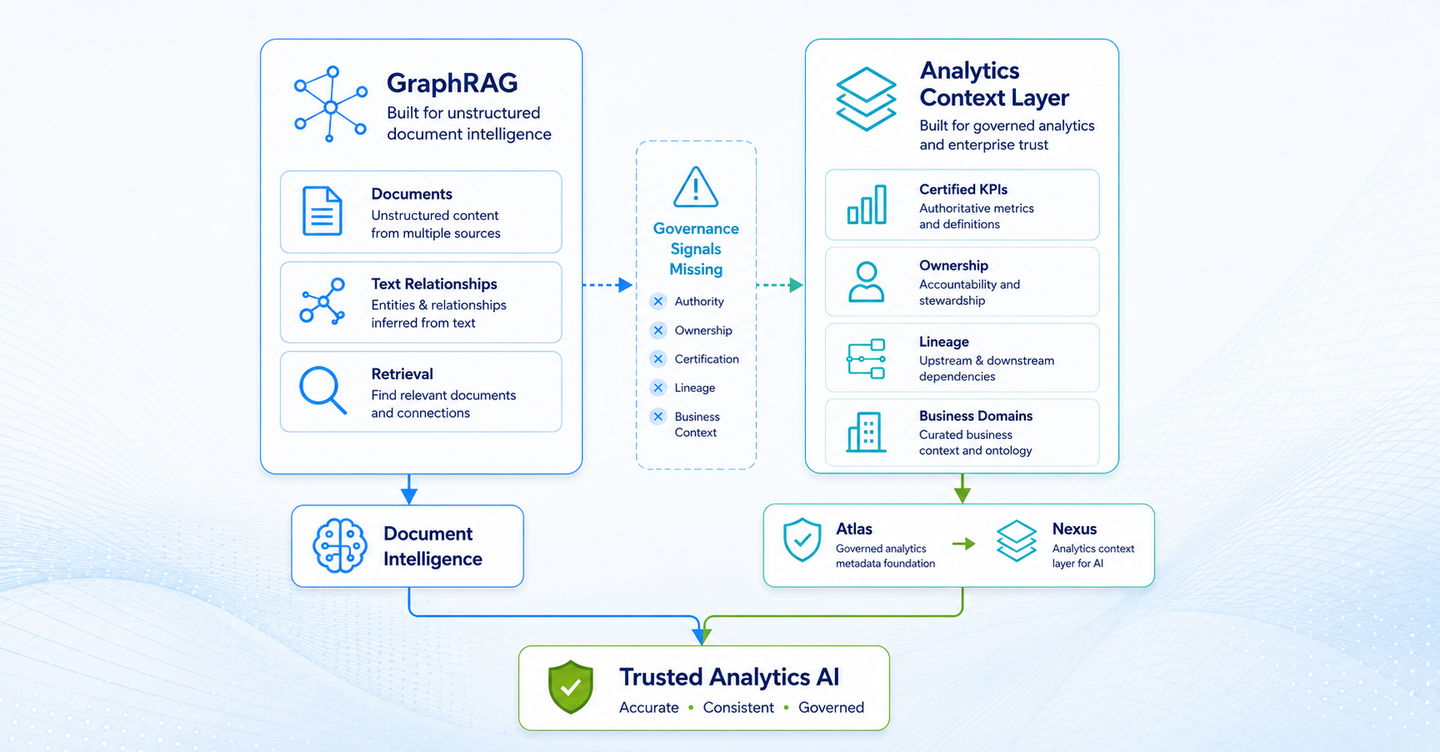
The question is not whether GraphRAG or an analytics context layer is better. They are built for different kinds of knowledge and different categories of AI use case.
GraphRAG is appropriate where the intelligence is in unstructured text: enterprise knowledge bases, research archives, policy documents, and communications. An analytics context layer is designed for AI use cases that require governed understanding of enterprise analytics: metric definitions, business KPIs, dimensions, ownership, certification, lineage, dependencies, and the relationships that explain how the organization measures performance.
A mature enterprise AI architecture may include both. Document intelligence against internal knowledge sources is a different AI capability from governed analytics reasoning against the certified BI estate. The risk is not deploying GraphRAG. The risk is treating GraphRAG as the analytics context solution and discovering, when AI trust problems persist, that the governance layer was never built.
Atlas provides the foundation as the enterprise analytics system of record, cataloging analytics assets across tools and supporting discovery, certification, ownership, lifecycle governance, usage intelligence, lineage, and dependency visibility. Nexus builds on that foundation by transforming governed BI metadata into a living analytics context layer that gives AI systems the semantic clarity needed to interpret metrics, understand relationships, and align responses with the way the organization measures performance. Together, they address the governance gap that retrieval techniques (including GraphRAG) are not designed to fill.
What is GraphRAG and how is it different from standard RAG?
GraphRAG is an extension of retrieval-augmented generation that adds graph structure to document retrieval. Standard RAG retrieves text chunks most similar to a query. GraphRAG first extracts entity-relationship maps from a document corpus, then uses that graph to enable multi-hop reasoning, surfacing both individual documents and the relationships between them. It was developed by Microsoft Research and is implemented across multiple frameworks. The primary use case is unstructured document intelligence: knowledge bases, research archives, contracts, and similar text-heavy corpora.
Can GraphRAG be used for enterprise analytics AI?
GraphRAG can be applied to an analytics estate, but doing so treats the enterprise analytics AI problem as an unstructured retrieval problem. It is also a semantic and governance problem that retrieval alone does not solve. An analytics estate contains certified and uncertified assets, current and stale definitions, authoritative and shadow reports. Without explicit governance metadata, GraphRAG may represent relationships across both authoritative and non-authoritative sources without knowing which definitions the organization has approved. The governance signals that make that distinction (certification status, ownership, lineage) must come from a separate governance layer that GraphRAG does not provide.
What is an analytics context layer and how does it differ from GraphRAG?
An analytics context layer is governed BI metadata infrastructure that makes structured enterprise analytics understandable to AI. It operates on certified BI metadata: KPIs, metric definitions, ownership records, certification status, and lineage dependencies, not on unstructured documents. Where GraphRAG extracts relationships from text, an analytics context layer encodes the governance relationships the organization has explicitly established through certification and ownership processes. Nexus, ZenOptics’s analytics context layer, is built on top of the certified analytics estate that Atlas governs.
Are the Nexus Knowledge Graph and GraphRAG the same thing?
No. Both use graph structures, but they are built from different sources and serve different purposes. GraphRAG extracts entity-relationship graphs from unstructured document text through entity recognition and relationship inference. The Nexus Knowledge Graph is constructed from certified governance metadata in Atlas: ownership records, certification status, dimensional hierarchies, and lineage dependencies. It encodes relationships the organization has explicitly established, not relationships inferred from document content.
Does deploying GraphRAG remove the need for analytics governance?
No. The governance failures that produce enterprise analytics AI trust problems, including metric authority gaps, stale certifications, uncertified source contamination, and lineage breaks, are not retrieval problems. A better retrieval technique cannot establish which metric definition is authoritative, whether a certification is current, or whether a data source dependency has changed. These are governance conditions that must be addressed at the analytics estate layer. GraphRAG and an analytics context layer can coexist in an enterprise AI architecture, but GraphRAG does not substitute for the governance layer.
When enterprise AI returns an analytics answer that no one can reconcile, the instinctive diagnosis is often a model failure. But trace the answer back through the analytics estate and a different pattern often appears: conflicting metric definitions, stale certifications, uncertified assets, or broken lineage. These failures may look like AI hallucinations at the interface, but the root cause sits in analytics governance. The more useful diagnostic question is: which governance failure produced the answer?
Four distinct analytics governance failures produce AI trust problems in enterprise environments. Each has a different mechanism, a recognizable pattern in AI outputs, and a specific governance intervention that resolves it. A certification program does not fix a lineage break. A governed catalog does not resolve a metric authority gap. Investing in the right governance capability requires diagnosing the right failure, and that diagnosis is not possible when all four failure types are grouped under “AI hallucination” or treated as a single undifferentiated governance problem.
The hallucination label accurately describes one class of model behavior: a language model generating plausible content with no grounding in the source data it was given. In generative language tasks such as content summarization and research synthesis, this is a real failure mode that warrants model-level attention.
In enterprise analytics AI, however, the hallucination label does not always describe the underlying failure accurately. What enterprise analytics AI does when it returns a wrong answer is often different: it reads from an analytics estate and returns what the governance conditions in that estate allow. In many enterprise analytics use cases, the model may not be fabricating the answer at all. It may be reasoning over contradictions, conflicting definitions, stale assets, or incomplete governance signals already present in the analytics estate. What appears to be a hallucination at the interface may therefore originate in the environment the AI was asked to trust. Applying the hallucination label to this class of failure leads organizations toward model-level remediation that cannot touch the source condition. Prompt engineering improvements, model version upgrades, and retrieval-tuning efforts address model behavior in a well-governed environment. They do not address the estate condition that produced the wrong answer.
What changes when the governance failure is named correctly is that the fix becomes visible, ownable, and executable by the analytics organization. The case that enterprise analytics failures are governance problems rather than model failures covers how to make that initial diagnosis. The distinction matters because identifying governance as the root cause is only the first step. The next step is determining which governance failure is present. Different failure types create different patterns in AI outputs and require different governance interventions.
| What you see in the AI answer | Likely failure | Governance response |
| Different teams recognize different versions of the answer | Metric Authority Gap | Certification + authority |
| Answer reflects an old business definition | Stale Certification | Ownership + review cycle |
| Answer traces to an abandoned or uncertified report | Uncertified Source Contamination | Catalog + lifecycle governance |
| Metric logic looks correct but underlying data is wrong | Lineage Break | Lineage + dependency governance |
A metric authority gap exists when no certified authoritative version of a metric has been designated for a specific reporting context. Multiple definitions of the same metric coexist in the analytics estate, each built by a different team and each reflecting a different interpretation of the business standard. None has been designated as the version the organization treats as final for a given purpose.
When AI agents query the estate for a metric with an authority gap, they encounter multiple definitions carrying equal status. Without governance signals identifying which definition is authoritative for a specific reporting context, the agent may select, combine, or reason across competing definitions without knowing which one the organization considers authoritative. The output reflects the estate’s distribution of variants rather than the organization’s correct business logic. The observable symptom is that every team partially recognizes the AI’s answer: the commercial team sees a reflection of their definition, finance sees a reflection of theirs, and neither can fully reconcile the output with either version.
Prompt engineering addresses individual sessions by encoding one definition into the instruction context. It does not remove the other definitions from the estate. Each new session, the same definition variants enter the agent’s context, and the authority gap produces the same class of output. What resolves the authority gap is certification: a designated authority confirming which version of a metric governs which reporting context, with a record of who confirmed it and when. Certified metrics and what certification requires is the governance foundation this failure type demands.
A stale certification failure occurs when a metric was certified as authoritative at a point in time and the underlying business logic has since changed. Revenue recognition policy was revised. A customer segment definition was reorganized. A product line was reclassified. The certification record still shows the metric as authoritative. The AI reads that record and grounds its output on a definition that was correct when it was certified but no longer reflects the current business standard.
The observable symptom of stale certification is that the AI’s answer corresponds to what was accurate 12 to 24 months ago. Finance or operations recognizes the calculation logic as a prior policy rather than the current one. If certification status is exposed without review dates, ownership, lifecycle state, or other freshness signals, an AI system may have no reliable way to distinguish a metric reviewed last month from one certified under a business standard that has since changed.
What resolves stale certification is not a better model but a review cycle: an organizational process that schedules certification review at defined intervals, flags the certification when the underlying standard changes, and suspends it when the definition is under active review. Current owner tracking ensures there is an accountable person to initiate or respond to that review. Without both, a certification that was meaningful at initial review becomes a governance liability as time passes. Both the review cycle and ownership tracking are components of the metric lifecycle governance covered in the certified metrics framework.
Uncertified source contamination occurs when an ungoverned analytics catalog presents certified authoritative assets and uncertified shadow assets with equal status. AI agents traversing an estate where all reports and dashboards appear equivalent have little basis for excluding legacy dashboards, regional workarounds, or retired reports from their reasoning paths. Organizations implementing ZenOptics typically find that 30 to 40 percent of their analytics estate consists of duplicate or conflicting reports. These assets can create additional risk for AI when ownership, certification status, and lifecycle context are unclear or unavailable.
The observable symptom of this failure type is that the AI’s answer traces to a specific report or asset that no current team owns or recognizes as authoritative. Often the source is a report that was never formally retired: still technically present, still indexed, still readable, but reflecting a definition or data pipeline that has not been maintained.
This failure type is what governed analytics catalogs address when they go beyond metadata. Certification status, current ownership, and lifecycle governance surfaced as context give AI agents the signals needed to weight certified authoritative sources above uncertified ones. Without a governance layer above the catalog inventory, source quality is invisible to the model.
A lineage break occurs when a metric definition references a data source that has changed since the definition was written: a schema migration, a pipeline restructuring, a source system deprecation. The metric calculation logic is internally consistent. The data it reads is no longer what the definition assumed. The result is an answer that is structurally sound but grounded in the wrong underlying data.
The observable symptom of a lineage break differs from the three failure types above. The AI’s answer is internally consistent and confident, but contradicts other governed sources in ways that do not map to the definition variant pattern. The inconsistency traces below the metric layer to the data pipeline beneath it. The analytics knowledge graph is the structure that encodes relationships between metrics and their underlying data sources, making lineage breaks visible before they propagate into AI reasoning paths.
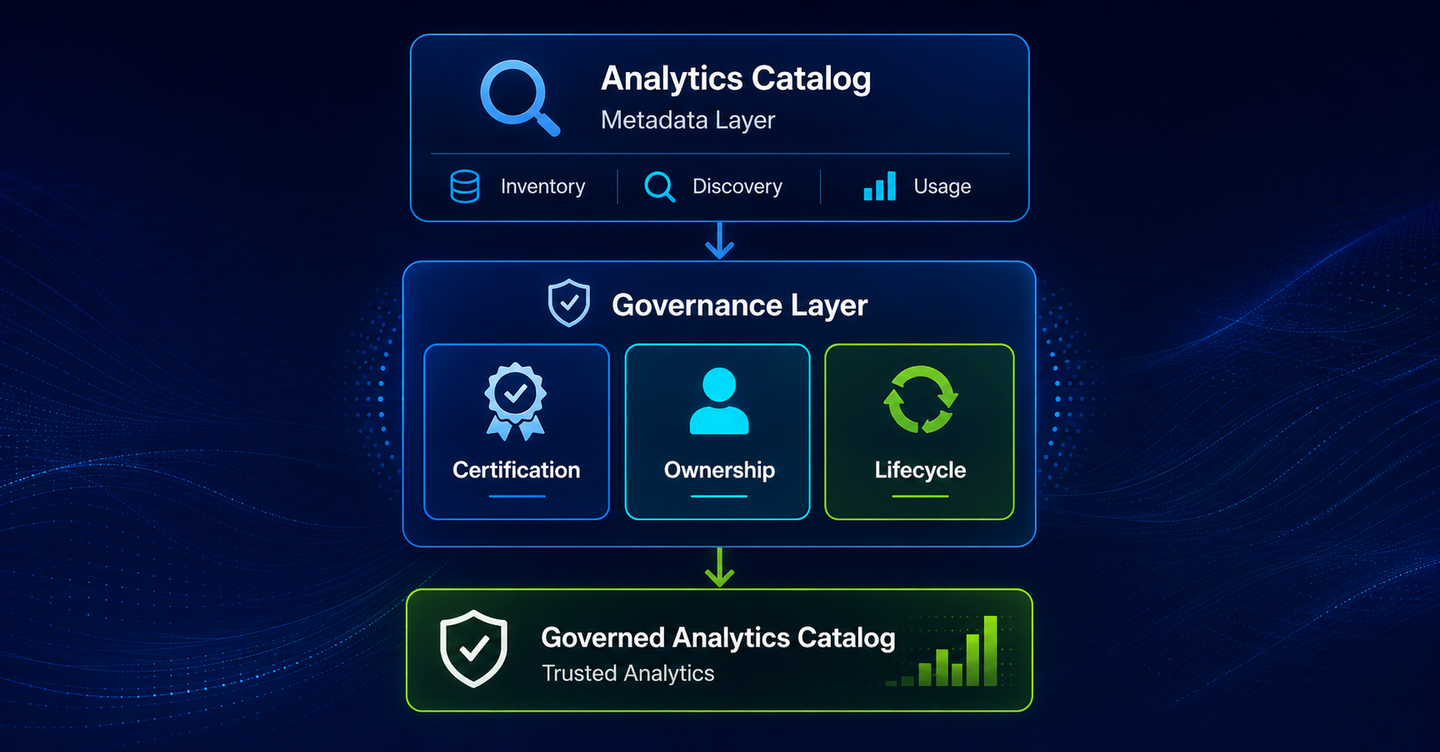
The four failure types share one characteristic: model improvements or prompt engineering alone cannot resolve them. Each originates in a condition within the analytics estate that must be addressed at the governance layer. Better models may improve reasoning, but they cannot independently establish which metric is authoritative, whether a certification is current, which asset should be trusted, or whether an underlying dependency has changed.
The governance interventions differ by type. Metric authority gaps require certification with designated authority: a process that confirms which version of a metric governs which context and records that designation so AI agents can follow it. Stale certification requires ownership tracking and a review cadence: organizational accountability that keeps certification current as business logic changes. Uncertified source contamination requires a governed catalog with certification status, current ownership, and lifecycle records surfaced above the inventory layer. Lineage breaks require lineage tracking: a maintained record of which data sources each certified metric depends on, and a governance process that flags or suspends certification when those dependencies change.
Data governance and analytics governance are related but distinct programs. The four failure types above are analytics governance failures: they live at the metric, report, and estate layer, above the data layer where data governance operates. Analytics context engineering is the organizational practice that builds and maintains the governance processes producing certified, current, and accountable analytics assets. Each of the four failure types has a defined intervention within that practice.
Atlas, the ZenOptics Analytics System of Record, provides a governance foundation for addressing these failure types across the analytics estate. Atlas brings analytics assets across tools into a governed inventory and supports certification and approval workflows, ownership and accountability, lifecycle governance, and lineage and dependency visibility. This gives organizations a consistent way to distinguish authoritative analytics from conflicting, outdated, or uncertified assets before those assets become inputs to AI.
Nexus, the ZenOptics Analytics Context Layer for AI, converts certified KPIs, metric definitions, ownership, lineage, and business relationships into governed context that AI systems can understand. Instead of exposing AI to metric definitions in isolation, Nexus helps provide the business and governance context surrounding those metrics: what they mean, how they relate to other business concepts, who is accountable for them, and which analytics can be trusted. This gives AI systems stronger grounding for interpreting enterprise analytics consistently.
This shifts the enterprise AI problem from trying to make every model compensate for an ungoverned analytics estate to creating governed analytics context that AI systems can consume consistently. Atlas establishes what exists and what can be trusted; Nexus makes that governed business context understandable to AI. The failure classification in this post makes the path from AI trust problem to specific governance investment visible. Each type points to a different governance capability. Each is resolvable through governance rather than model replacement.
Reliable AI grounding is only part of the governance challenge. As AI-generated insights begin influencing workflows, recommendations, and actions, governance must extend from analytics context into decision execution. Maestro extends this foundation by helping organizations govern how trusted insights move into decisions and actions, connecting governed analytics, AI context, and decision intelligence.
What is the difference between AI hallucination and an analytics governance failure?
AI hallucination refers to a model generating plausible content with no grounding in the source data it was given. An analytics governance failure occurs when the source data the model reads is ungoverned: conflicting metric definitions, uncertified assets, stale certification records, or broken lineage. In these cases, the apparent hallucination may originate not from fabrication by the model, but from the conflicting, stale, uncertified, or incomplete analytics context the model was given. The two failure types require different fixes. The diagnostic for which type applies is whether the AI’s answer can be traced to a specific asset or definition in the analytics estate. If the answer can be traced to a conflicting, stale, uncertified, or incorrectly connected analytics asset, that is strong evidence that analytics governance contributed to the failure.
How do I know which of the four governance failures I have?
Each type has a recognizable symptom. A metric authority gap produces outputs where every team partially recognizes the answer but cannot fully reconcile it with their version of the metric. Stale certification produces answers that correspond to a prior business standard rather than the current one. Uncertified source contamination produces outputs traceable to reports or dashboards no current team owns or recognizes as authoritative. A lineage break produces outputs that are internally consistent but contradict other governed sources in ways that do not trace to a definition conflict. These patterns distinguish the failure types even before a full governance audit.
Can the same AI output result from more than one failure type?
Yes. In estates with significant governance gaps, multiple failure types can be present simultaneously. An AI agent may encounter a metric authority gap for one KPI and an uncertified source in the reasoning path for a related one, producing an output that reflects both conditions. Governance programs that address only one failure type while leaving others unresolved will see partial improvement. The four failure types are distinct but not mutually exclusive, and an estate-level governance program typically needs to address all of them as coverage expands.
Why doesn’t prompt engineering fix these governance failures?
Prompt engineering addresses a specific session by encoding context into the instruction the model receives. It works for controlled use cases where the metric and source environment are known and bounded. It does not scale to enterprise analytics environments where hundreds of metrics across dozens of business units all need consistent, governed definitions. A prompt can instruct an AI system to use one definition of revenue within a controlled interaction, but it does not resolve the competing definitions that continue to exist across the analytics estate. New queries, different AI tools, and multi-metric reasoning tasks all encounter the ungoverned conditions that the prompt did not address. Governance builds the infrastructure that makes the estate reliable for every session rather than patching one session at a time.
What does Atlas do for each of the four failure types?
For metric authority gaps, Atlas supports certification and approval workflows that help establish authoritative analytics. For stale certification, ownership, accountability, and governance workflows help organizations maintain trusted assets as business definitions change. For uncertified source contamination, Atlas provides a governed cross-tool inventory that surfaces certification, ownership, usage, and lifecycle context. For lineage breaks, lineage and dependency visibility helps teams understand how analytics assets connect to underlying sources and where changes may affect trusted outputs.
Semantic layers have made a compelling case for themselves as the foundation for enterprise AI analytics. Define your business metrics once: the right SQL, the correct business rules, the appropriate grain. AI agents then reason from those definitions rather than reconstructing calculation logic from raw schema on every query. The case is accurate. Metric definition solves a real problem.
The limitation is that “defined” is not the same as “certified.” A metric that has been accurately defined can still carry the wrong calculation if the definition was never validated against the organization’s authoritative business standard. It can reflect outdated logic if the analyst who wrote it has since left and no one has reviewed it. It can drift from current standards if the underlying business rule changed and the definition was not updated. AI grounding on an uncertified definition does not hallucinate in the generative sense. It returns precisely what the definition says, consistently and without deviation. If the definition is wrong, the AI can reproduce that error consistently and confidently. Unless governance signals such as certification status, ownership and review history are supplied as context, the agent has little basis for determining whether the definition is still authoritative.
For enterprise organizations building AI analytics on top of semantic infrastructure, certified metrics for AI grounding are not an optimization. They are the condition under which AI analytics answers can be trusted.
A semantic layer addresses one specific failure mode in AI analytics: inconsistency from re-derivation. Without a layer that encodes what “revenue” means, an AI agent constructing queries against a raw data warehouse will derive its own interpretation each time, drawing on schema structure, column names, and whatever context the query carries. Different agents, different sessions, different phrasings of the same question produce different revenue numbers. The semantic layer eliminates that class of failure by specifying the calculation once, making every query use the same definition.
This is a meaningful improvement for enterprise AI analytics. Consistent metric definitions prevent the most common source of AI analytics inconsistency. By centralizing calculation logic, governed semantic layers can make AI-generated analytical outputs more consistent than approaches that require agents to reconstruct metrics directly from raw schemas.
But repeatability is not accuracy. A metric definition that consistently encodes the wrong logic produces consistent wrong answers. A definition written to match last year’s revenue recognition policy produces repeatable outputs that diverge from this year’s audited P&L. A definition written by an analyst who has since moved to a different team may reflect that analyst’s interpretation of the metric rather than the finance function’s authoritative standard. Semantic layers store and enforce metric definitions, and some platforms also support approval or certification features. The enterprise gap appears when certification must remain accountable, current and discoverable across multiple BI tools, semantic environments and business domains, not only within the platform where the metric was defined.
Gartner’s broader warning about ungoverned AI decision-making reinforces the need for accountable grounding inputs. Gartner’s 2026 Data and Analytics Trends identified AI agent decision governance as a top priority, noting that as AI agents execute more strategic and operational decisions, “ungoverned decision-making increases exposure to legal, operational and reputational risk.” For analytics leaders, ZenOptics believes that principle extends to the metrics agents use when generating answers and supporting decisions. Most enterprise AI analytics failures traced to governance gaps begin at exactly this point. The semantic layer did its job. The definition it stored was the problem.
Three distinct gaps separate a defined metric from a certified metric. Each produces a class of AI grounding failure that metric definition cannot prevent.
The first is the validation gap. A metric definition records what someone believed the metric should be when they wrote it. A certified metric has been reviewed by a designated authority who confirmed that the definition aligns with the organization’s current business standard: that the revenue calculation matches the finance team’s audited methodology, that the churn definition matches customer success’s authoritative measure, that the calculation grain is appropriate for the reporting context in which the metric will be used. Validation is an organizational act. It requires authority, a review process, and a record of what was confirmed and when. A stored definition, or even a certification label, is not automatically evidence that the metric was validated by the appropriate business authority. Trust requires a recorded validation process showing who approved the metric, what was reviewed, where it applies and when it must be reviewed again.
The second is the ownership gap. A defined metric has an author: the person or team who wrote it. A certified metric has a current owner: a designated person accountable for its accuracy today, responsible for flagging when the underlying business logic changes, and reachable when an AI output based on that metric needs to be investigated. When an AI analytics answer is questioned, “who wrote this definition” is the wrong question. “Who is accountable for this metric right now” is the governance question. Ownership is a responsibility that must be tracked, transferred, and maintained as the organization changes. The metric definition does not update when the original author changes roles or leaves. Analytics catalogs face the same gap when they record creation history rather than current accountability.
The third is the lifecycle gap. Business logic changes. Revenue recognition policies are revised. Customer definitions are reorganized. Product lines are reclassified. A metric definition that was accurate when written drifts from organizational standards as the business evolves. Without a review cycle, that drift goes undetected until AI answers based on a stale definition reach decision-makers, which is the worst possible moment to discover the grounding input was outdated. A certified metric has a review cadence: a scheduled process that confirms the definition remains aligned with the current standard, or triggers an update when it does not. A defined metric persists as written until someone notices something is wrong.
These three gaps compound each other. An unvalidated definition with no accountable owner and no review cycle is not a reliable AI grounding input. It is an assertion that AI will treat as authoritative because the semantic layer presented it as such.
| Defined metric | Certified metric |
| Contains calculation logic | Validated against an authoritative business standard |
| Has an author | Has a currently accountable owner |
| May remain unchanged indefinitely | Has a review or recertification cycle |
| Creates calculation consistency | Creates governance evidence and accountability |
| May be platform-specific | Can be governed across the analytics estate |
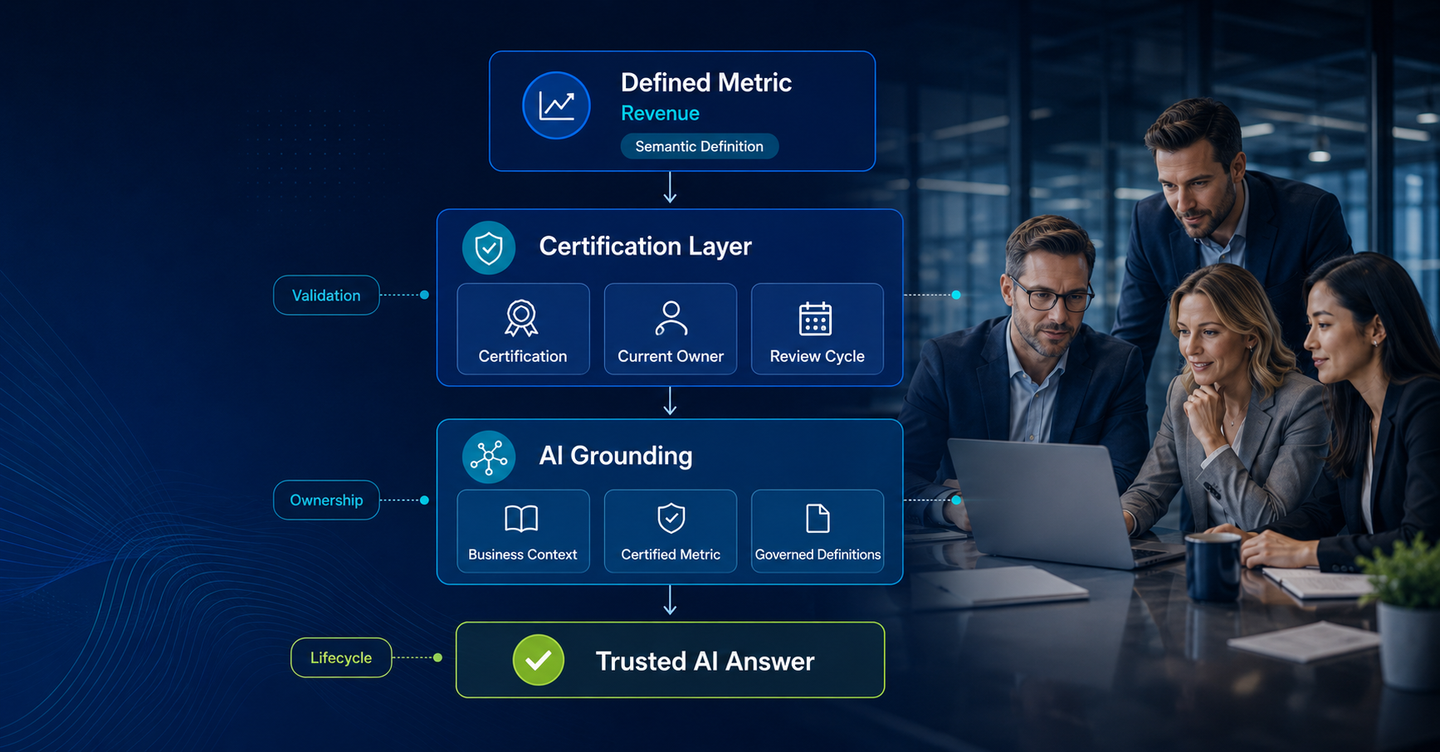
Certification is a governance process, not a quality label applied to a definition. Gartner’s Zero-Trust Data Governance prediction forecasts that 50% of organizations will implement a zero-trust posture for data governance by 2028, driven by the proliferation of unverified AI-generated data. ZenOptics believes the same principle applies to the metrics AI systems consume: trust in a definition should be established through an explicit governance process, not assumed from its presence in a semantic layer. Three elements distinguish a certified metric from one that has only been defined.
A designated certification authority is the first requirement. Someone with organizational standing must be able to declare that a metric definition is authoritative for a specific reporting context. This is not the analyst who wrote the definition. It is the finance lead who confirms the revenue calculation aligns with the audited P&L methodology, or the analytics governance function that validates KPI definitions before they enter the governed analytics layer. Authority is what makes certification meaningful. Without it, a certification status is self-certification, which provides no governance guarantee.
A recorded validation act is the second requirement. The certification record must capture more than the metric definition itself: it must document who validated it, what was confirmed, including definition correctness, data lineage alignment, and the reporting contexts the metric governs, and when the validation occurred. This record is what makes an AI grounding input traceable. When an AI analytics answer is questioned, the certification record is the governance trail that shows the answer was derived from a validated, accountable source. Context engineering builds the organizational processes that generate and maintain those records: who certifies, what the review confirms, and how certification status flows to the AI systems that consume certified metrics as grounding inputs.
An ownership and review cycle is the third requirement. A current owner holds ongoing accountability for the certified metric. A defined review cadence confirms the definition remains accurate as business logic evolves. When a review reveals that the underlying standard has changed, the certification is updated or suspended until the definition is corrected. Without these two elements, even a metric that was correctly certified at initial review can carry stale logic within months.
Atlas, the ZenOptics Analytics System of Record, provides the governance layer that operates above the semantic layer: supporting metric review workflows, organizational accountability structures, validation records, and ownership tracking. Atlas does not replace the semantic layer. It provides the governance process that helps make semantic layer definitions more trustworthy as AI grounding inputs.
Nexus, the ZenOptics AI context layer, grounds AI reasoning in governed metrics rather than in raw semantic layer definitions. Nexus makes governed business context, including certified metrics, definitions, ownership, relationships and lineage, available in a machine-readable form that AI systems can use for more trustworthy analytical reasoning.
This is where ZenOptics extends beyond platform-specific metric governance. Atlas creates a governed inventory across the enterprise’s distributed BI environment, connecting Power BI, Tableau, SAP BusinessObjects, Qlik, and other platforms. Nexus converts that governed analytics estate into context AI systems can understand. The analytics context layer is the infrastructure that makes this connection between governed metrics and AI reasoning practical at enterprise scale.
The distinction this post opened with becomes operational here. Semantic layers deliver calculation consistency. Certified metrics deliver governance accountability. Enterprise AI analytics requires both. Nexus is where those two requirements meet.
What is the difference between a defined metric and a certified metric?
A defined metric specifies the calculation logic in a semantic or metric layer tool: the SQL, the business rules, the grain, the applicable filters. A certified metric has also been validated by a designated authority who confirmed the definition aligns with the organization’s current authoritative business standard, with a current owner assigned and a validation record maintained. Defined metrics provide calculation consistency across queries. Certified metrics provide governance accountability for what those calculations represent.
Can a semantic layer provide certified metrics for AI grounding?
Some semantic-layer platforms support elements of metric governance. However, enterprises still need a governance system that can coordinate validation authority, ownership, review history and certification status across the broader analytics estate. Atlas provides that cross-platform governance layer while the semantic layer continues to manage calculation logic.
Why does metric lifecycle governance matter for AI grounding specifically?
AI agents use metric definitions as grounding inputs across every session, query, and workflow. If a metric definition was accurate when written but has since drifted from the organization’s current business standard, the AI will continue grounding on the outdated definition until someone corrects it. Unlike a human analyst who might notice that something seems off, an AI agent operating without governance context has little basis for questioning whether a definition it was given is still current or authoritative. A review cycle catches definition drift before stale grounding inputs reach decision-makers.
What does Nexus do that a semantic layer does not?
Nexus provides AI agents with the governance context surrounding each metric: the Atlas certification record, ownership, lineage, and the relational structure connecting certified metrics across business domains. A semantic layer tells an AI agent what a metric means. Nexus tells it whether that meaning has been validated, who is accountable for it, and whether the certification is current. That governance context is what makes an AI analytics answer traceable to an accountable source.
Which metrics need to be certified first?
Certification matters most for the metrics AI agents use in high-stakes analytical reasoning: KPIs that appear in executive reporting, measures that drive financial or operational decisions, and metrics used in regulatory or compliance contexts. Organizations typically begin metric certification programs with tier-one KPIs and expand governance coverage over time. Nexus can surface certification status for every metric an AI agent accesses, so analysts understand the governance standing of every grounding input behind each AI answer.
An analytics catalog is a genuine improvement over ungoverned BI sprawl. It inventories reports, dashboards, and KPIs across platforms, surfaces metadata about each asset, and enables discovery across what was previously invisible or fragmented. For organizations managing a multi-platform analytics estate spanning Power BI, Tableau, SAP BusinessObjects, and Qlik, a catalog is a meaningful first step toward visibility.
The limitation emerges at the second step. Metadata can tell you what an analytics asset is, where it came from, and how it has been used. It cannot, on its own, determine whether that asset should be trusted for a business decision. Certification requires a governance decision, not a metadata field. Ownership requires current accountability, not creation history. Retirement requires a recorded organizational decision, not a usage flag. An analytics catalog that stops at metadata gives the organization a description of its estate. A governed analytics catalog provides the processes that make that description actionable.
Analytics catalogs solve the visibility problem. They index reports, dashboards, and KPIs from connected BI platforms and surface search results from a single interface, making it possible for analysts to find content across environments without logging into each platform separately. For organizations where cross-platform visibility was previously nonexistent, this is a meaningful capability.
Good catalogs surface more than inventory. They capture usage signals: how often a report is accessed, when it was last viewed, which teams interact with it most. This context is genuinely useful. A report accessed by forty people every Monday morning presents a different governance question than one that has not been opened in two years.
Metadata also supports basic accountability tracking. An analytics catalog records who created each report, the platform it lives on, and when it was last modified. For organizations that previously managed their analytics estate without a governed cross-platform record, this represents measurable progress toward reducing the cost of analytics sprawl. For organizations evaluating how an analytics catalog differs from a data catalog in the first place, the distinction starts at this metadata layer.
But the catalog’s metadata layer describes. It does not govern. And analytics governance is what the estate actually requires.
Three specific governance gaps remain in organizations that have an analytics catalog without a governance layer above it.
The first is the certification gap. Metadata can include a field labeled “certified.” Without the governance process behind it, including a defined authority, a review workflow, and a record of what was validated and when, the field is a label, not a governance record. Certification is the act of a designated person or team reviewing a report, confirming that the metric definitions align with business standards, validating the data lineage, and recording that decision as an accountable outcome. Metadata alone cannot establish governance authority. Automation can support the certification process, but certification still requires defined accountability, validation criteria, and an auditable governance process. Without it, analysts searching the catalog have no reliable basis for distinguishing content that has been validated from content that has merely been tagged.
The second is the ownership succession gap. Analytics catalogs record who created a report. Creation is a historical fact that does not change. Accountability is not. When the analyst who built a quarterly revenue report moves to a different team or leaves the organization, the catalog metadata still shows their name. An analyst who finds the report and needs to know whether the underlying data source is being maintained has no reliable contact. Ownership is a governance responsibility that must be tracked, transferred, and maintained as the organization changes. Metadata can preserve the history of an asset. Governance establishes who is accountable for it today and ensures that accountability evolves as the organization changes.
The third is the retirement governance gap. Catalog metadata surfaces usage signals that identify candidates for retirement: reports with low view counts, assets with no active users in recent months. These signals are informative inputs to a governance process. They are not retirement decisions. Retiring a report requires determining whether it carries regulatory or audit dependencies, notifying the teams that relied on it, documenting the retirement rationale, and preventing re-creation by an analyst who does not know the report was already reviewed and closed. Metadata identifies the candidate. A governance process closes the loop.
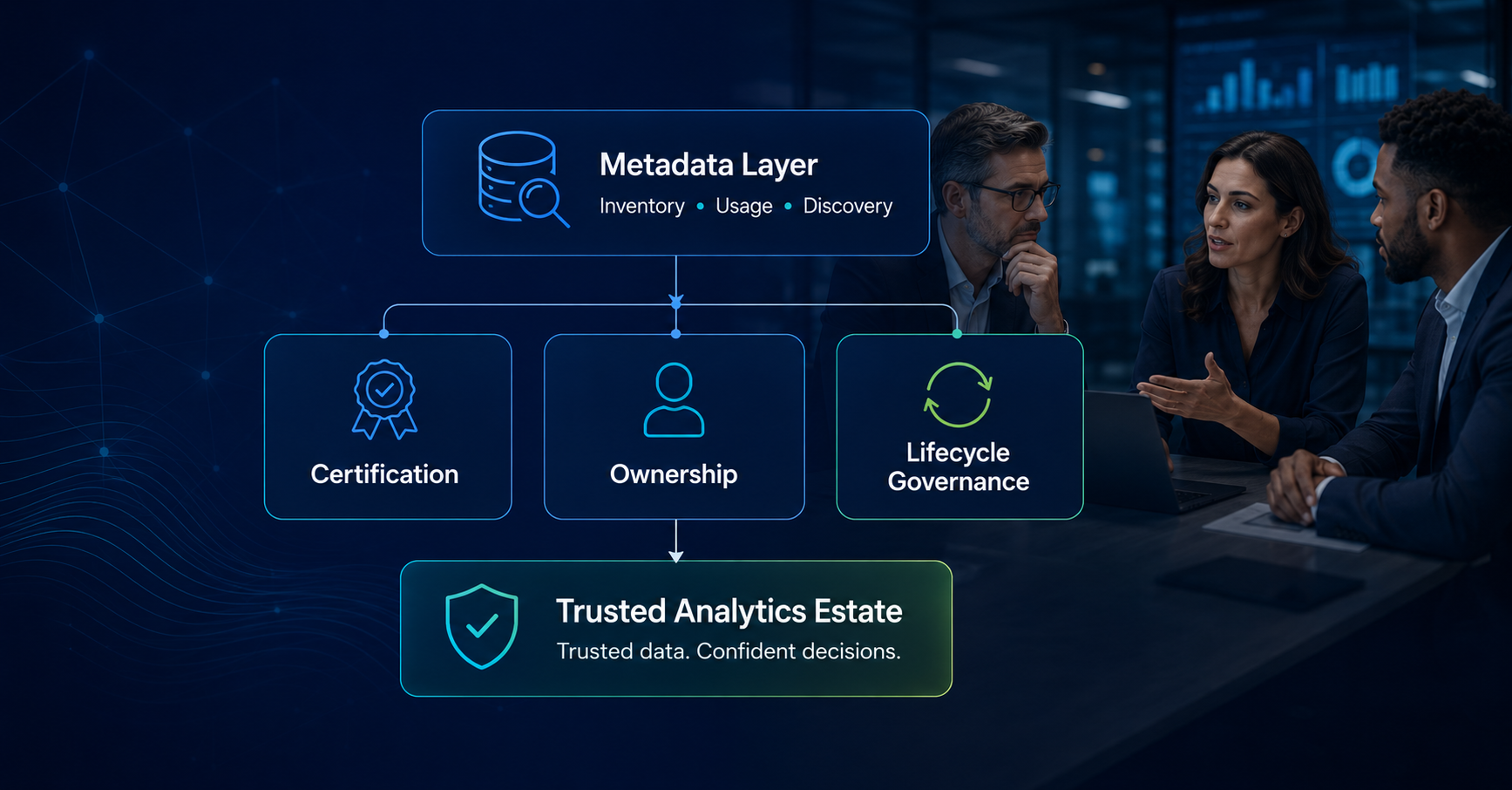
The recognition that governance processes matter is reflected in enterprise priorities. In the BARC Data, BI and Analytics Trend Monitor 2026, data and AI governance ranked fourth in importance among 1,579 analytics professionals worldwide, behind only data quality management, data security, and data-driven culture. The governance layer is no longer a future consideration. It is already among the industry’s highest enterprise priorities.
A governed analytics catalog adds three layers above the metadata foundation.
Certification governance means a defined workflow for validating reports as authoritative. It specifies who can initiate a certification review, who holds the authority to certify, what the review confirms, including metric definitions, data lineage, and ownership, and where the certification record is maintained. The outcome is a certification status that represents a governance decision, not a tag applied without process. When analysts search for a report and see a certification status, that status is meaningful because the process behind it is defined and recorded.
Ownership governance means maintaining a current owner for each analytics asset, not a historical creator. It requires defining governance accountability for each report, establishing how ownership transfers when roles change, and keeping that record in a system that persists as the organization changes. The difference matters when an analyst finds a report and needs to know whether someone is actively responsible for the underlying data and metric definitions.
Lifecycle governance means converting the catalog’s usage signals into governed decisions. It requires a retirement workflow that takes a low-usage flag from the catalog, routes it through a review process, records the decision outcome, and closes the loop on re-creation. Lifecycle governance ensures the analytics estate can shrink as well as grow: reports leave the catalog through a recorded decision, not by being quietly forgotten while remaining technically present.
As analytics increasingly becomes an input to AI agents and automated decision-making, discovery alone is no longer enough. An AI system may be able to find a report, but finding it does not establish whether the report is authoritative, whether its metrics are approved, who is accountable for it, or whether it should still be used.
For AI to operate on enterprise analytics with confidence, those governance decisions need to be explicit and accessible as context. The catalog answers what exists. Governance provides the context for determining what should be trusted and acted upon.
Atlas, the ZenOptics Analytics System of Record, provides the Analytics Catalog layer, including cross-platform inventory, metadata, usage signals, and discovery, as well as the governance layer above it: certification workflows, ownership tracking, lifecycle management, and re-creation prevention.
The distinction becomes important when organizations need to move from simply knowing what analytics assets exist to determining which ones can be trusted and acted upon. Atlas brings reports, dashboards, KPIs, and metrics from connected BI platforms into a governed cross-platform inventory through 100+ Smart Connectors. Analysts searching for content see what exists alongside its governance status: whether it is certified, who currently owns it, what the usage pattern shows, and what its lifecycle status is. The catalog and governance record exist within the same system, creating a consistent layer of context that can support both human analytics consumption and emerging AI-driven use cases.
Atlas does not replace the organization’s governance decision-making. It provides the visibility and workflows needed to make governance decisions informed, accountable, and repeatable.
Duplicate reports accumulate when governance is absent from the catalog layer. Report discovery falls short when certified content cannot be distinguished from uncertified content in search results. Both problems share the same root: an inventory without a governance layer above it. Atlas connects to existing BI environments without requiring platform consolidation, and the governance layer sits above the platforms and above the catalog, providing the certification, ownership, and lifecycle management that turn a described analytics estate into a governed one.
What is the difference between an analytics catalog and a governed analytics catalog?
An analytics catalog inventories reports, dashboards, and KPIs and surfaces metadata and usage information about each asset. A governed analytics catalog adds the processes that make that metadata actionable: certification workflows that validate reports as authoritative, ownership records that track current accountability rather than creation history, and lifecycle governance that converts usage signals into documented retirement decisions. The catalog describes. The governance layer decides.
Why can’t certification be managed as a metadata field in an existing catalog?
A certification field in a catalog is only as reliable as the process behind it. Without a defined review workflow, a designated authority, and a record of what was validated and when, a certification tag is a label anyone can apply. Certification as a governance act means a specified person or team has reviewed the report, confirmed the metric definitions, validated the lineage, and recorded the outcome. The governance process is what makes the status meaningful rather than decorative.
What does ownership succession mean in practice?
Analytics catalogs typically record the creator of a report at the time of creation. Ownership succession means tracking who holds governance accountability for each report as the organization changes, including when the original creator moves to another team, changes roles, or leaves the organization. Without succession tracking, analysts who find a report may have no reliable way to determine who is currently responsible for maintaining the underlying data or answering questions about accuracy.
How does lifecycle governance differ from usage analytics in a catalog?
Usage analytics show which reports are accessed frequently and which are not. Lifecycle governance uses those signals to initiate a defined process: a retirement review, notification to users who relied on the asset, a recorded decision about whether and when to retire, and a mechanism for preventing re-creation of the same content. Usage analytics surface the information. Lifecycle governance determines what to do with it and records the outcome.
How does Atlas extend the analytics catalog layer?
Atlas provides the cross-platform analytics catalog: inventory, metadata, usage signals, and discovery across connected BI platforms, as well as the governance layer above it: certification workflows, current ownership tracking, lineage, and lifecycle management. Analysts searching in Atlas see governance context alongside catalog results. The inventory and the governance record are part of the same system, so catalog data can be acted on rather than only observed.
Many enterprises have improved report search within individual BI platforms and, in some cases, across multiple analytics environments. Discovery capabilities can help enterprises surface report inventories, index metadata and make analytics content easier to find. However, achieving consistent discovery across Power BI, Tableau, SAP BusinessObjects, Qlik and other environments remains difficult when metadata and governance are fragmented.
Finding a report tells an analyst that it exists. It does not tell them whether it is certified, who is responsible for its accuracy, whether the version they found is the authoritative one among three near-identical copies, whether the data lineage is current, or whether the report is a candidate for retirement that the governance team has not yet acted on. Discovery surfaces the inventory. Governance determines what to do with it.
Report discovery tools solve the inventory problem. They index reports, dashboards, and KPIs across platforms and return search results against natural language or keyword queries. When an analyst needs a sales report, a well-implemented discovery layer can surface relevant content from Power BI, Tableau, and SAP BusinessObjects without requiring the analyst to know which platform contains the answer.
Good discovery tools surface more than names and locations. They capture usage signals: how often a report is accessed, when it was last viewed, and how many users interact with it. This is meaningful context. A report that nobody has opened in two years tells a different story than one accessed by forty people every Monday morning.
But usage signals are not the same as governance context. Basic discovery capabilities may show that a report exists and how frequently it is used, but they do not always provide consistent evidence that the report has been validated, that its metric definitions align with authoritative business definitions, or that its ownership and lineage remain current.
The question discovery answers is whether a report exists for a given business question. The questions it does not always answer are: Is this the right version? Is it certified? Who is responsible if the numbers are wrong?
In practice, three governance gaps consistently appear in organizations that have implemented analytics discovery without a governance layer above it.
The first is the certification gap. Discovery surfaces reports; it cannot identify which have been validated as authoritative by a governance authority. Without certification status visible in search results, analysts face a decision every time they find a report: invest time verifying whether the content is accurate, or use it without verification and accept the risk that the numbers are wrong. Many organizations find that their analysts default to a third path, building a new report from a known, trusted data source rather than using what the catalog surfaced. The catalog reduced search time. It did not reduce the recreation rate, because the underlying trust problem was never addressed.
The second is the ownership gap. Every report in a discovery index has a creator. That creator may have left the organization six months ago. Discovery tools surface creation metadata, not current governance accountability. When an analyst finds a report and has a question about whether the underlying data source has changed, there may be no one to contact. The owner is gone and no succession was recorded anywhere the discovery tool can surface. Accountability requires a clearly designated current owner and a governance process that keeps ownership records updated as roles and teams change.
The third is the lifecycle gap. Discovery is a point-in-time search against the current inventory. Discovery alone may not provide the workflows and governance signals needed to identify retirement candidates, track active reviews or show when an asset has been superseded by a newer certified version. The inventory grows because reports are easy to create. The governance layer that manages the inventory’s lifecycle does not exist inside the discovery tool. Content accumulates, and analysts searching for a report encounter an expanding result set without any signal about which assets are current and which belong to the past.
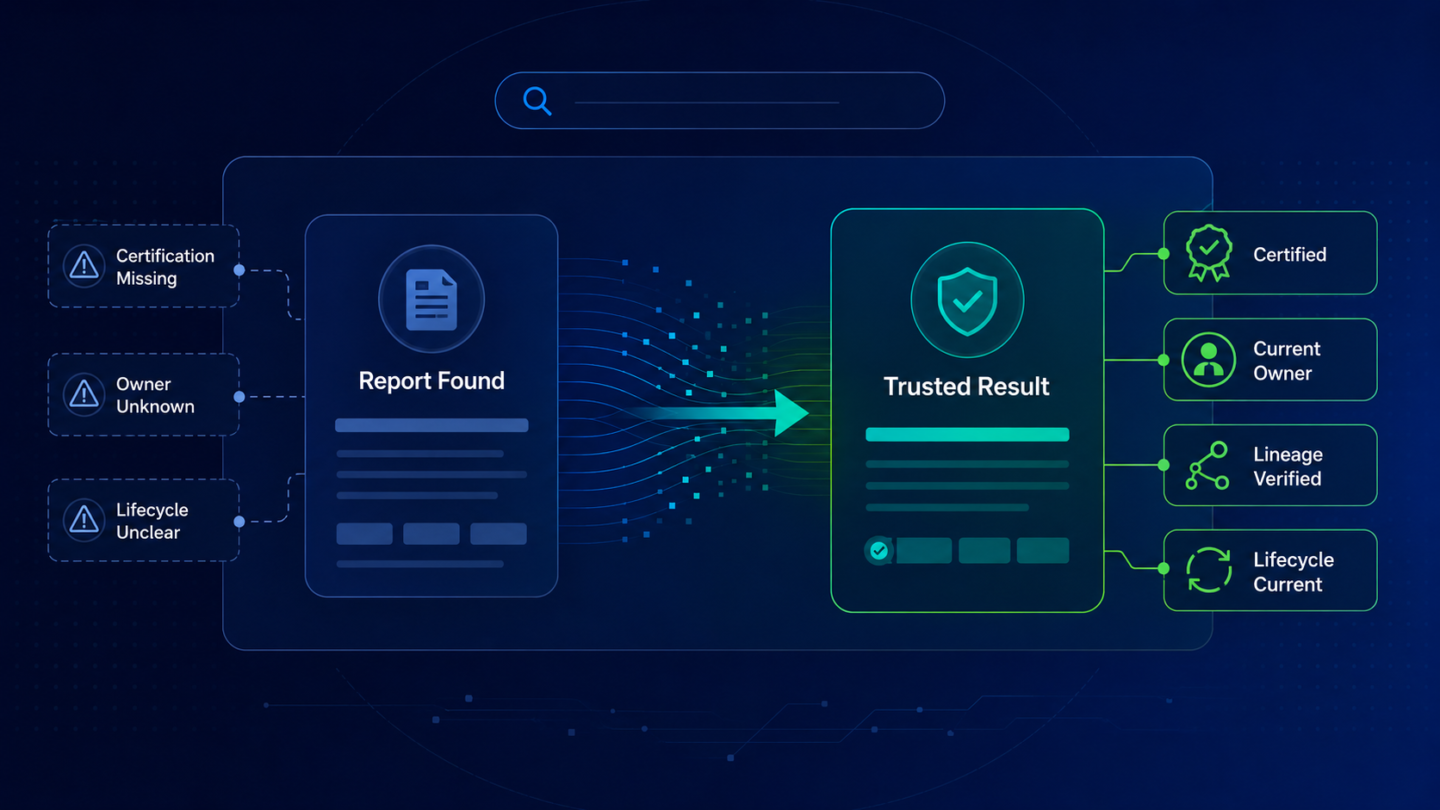
Governed discovery is discovery with governance context provided alongside the search result. When an analyst searches for a revenue dashboard, governed discovery surfaces the report’s inventory entry and its governance status together.
That means certification status: whether a governance authority has validated this report as authoritative, and when that validation last occurred. It means ownership: who is currently accountable for the report’s accuracy and when they last reviewed it. It means usage context: how many people in which teams are actively relying on this report, and what that usage pattern suggests about operational dependency. It means lineage: whether the report connects to certified data sources or whether there are breaks in the chain between the report and the underlying data it claims to represent. And it means lifecycle status: whether this report is current, under governance review, or a retirement candidate that the organization has not yet formalized a decision on.
These attributes cannot create trust merely by appearing as metadata fields. Their value depends on the governance processes behind them: certification workflows, ownership assignment, lineage management, periodic review and retirement decisions. Discovery tools show what exists. Governance processes are what make those results trustworthy.
Atlas, the ZenOptics Analytics System of Record, creates a governed, cross-tool inventory across connected BI and analytics environments. It brings together discovery, certification, ownership, usage intelligence, lineage context and lifecycle governance so users can understand not only what exists, but what can be trusted and acted upon.
Where basic discovery primarily indexes what exists, Atlas maintains a governed record of each analytics asset, including its certification, ownership, usage, lineage and lifecycle status. Analysts searching for a report in Atlas see which versions are certified, who currently owns each, what the usage pattern looks like, and whether the lifecycle status is current or under review.
Atlas does not replace the organization’s decision-making process. It provides the visibility and governance workflows needed to make that process informed, accountable, and repeatable.
The cross-tool BI inventory Atlas maintains addresses the recreation problem at the point it begins. When an analyst looks for an existing certified report before building something new, governed discovery surfaces authoritative content across all connected platforms, with certification and ownership information visible. Analysts build new reports when there is a genuine gap, not because they could not trust what the search returned.
The cost of ungoverned analytics sprawl accumulates across Power BI, Tableau, SAP BusinessObjects, Qlik, and any other platform in the estate. The cost of BI tool sprawl runs in parallel when duplicate and stale content crosses platform boundaries without a governance layer above them. Atlas connects to existing BI and analytics environments through 100+ Smart Connectors, maintaining the cross-platform inventory without requiring consolidation of tooling.
Governed discovery does not replace the organization’s analytics experience. It provides the governance context that makes search results actionable, so that finding a report is the point at which a trust decision can actually be made.
What is the difference between report discovery and analytics governance?
Report discovery answers whether a report exists and where to find it. Analytics governance determines whether that report is certified, who is accountable for it, whether it should continue to exist, and what lifecycle decisions have been recorded about it. Discovery and governance are complementary. Discovery without governance context returns a list of results. Governed discovery returns results with the information needed to act on them.
Why do analysts keep building new reports even when a discovery tool is in place?
The most common cause is the certification gap. When a discovery tool returns results without certification status, analysts have no reliable way to determine whether the reports they found are authoritative. Rather than verify each result manually, many default to building from a known trusted source. Governed discovery addresses this by surfacing certification status in search results, which gives analysts a basis for trusting what the catalog returns.
Can a data catalog provide the governance context that discovery tools lack?
Data catalogs are generally designed around data assets such as tables, schemas, pipelines and datasets. Some also index BI content, but organizations may still need analytics-specific governance capabilities that work consistently across reports and dashboards, including certification, accountable ownership, usage analysis and lifecycle workflows. An Analytics System of Record is designed for the analytics estate and the governance layer it requires.
What does governed discovery look like in practice?
In a governed discovery environment, an analyst searching for a revenue report sees results that include certification status, current owner, last governance review date, usage count and pattern, lineage status, and lifecycle disposition. The analyst can identify which result is the certified authoritative version, who to contact with questions, and whether any results are retirement candidates. The search result is actionable rather than a starting point for a separate verification process.
How does Atlas support governed discovery across BI platforms?
Atlas connects to Power BI, Tableau, SAP BusinessObjects, Qlik, and other platforms through 100+ Smart Connectors and maintains a governed cross-platform inventory with certification, ownership, lineage, and usage context for each asset. Analysts searching across the estate see governance context alongside inventory results. The governed record also helps prevent duplicate report recreation by making existing certified content visible and trustworthy at the point of search.