





You have built a world-class analytics stack. You have Tableau dashboards for strong visual exploration, perhaps Power BI is your standardized reporting platform, and legacy platforms are still floating around. Data access has been democratized, just as the industry promised.
Yet instead of truly data-driven decision-making, you face a paradox: the more analytical assets you deploy, the less value you extract.
The issue isn't the quality of your insights; it is the volume of your noise. Report sprawl has evolved from a minor inconvenience into a measurable financial liability. You are paying twice for your analytics: once for the licenses and cloud compute, and again through lost productivity and trust as your teams navigate through a fragmented, chaotic reporting landscape.
This is no longer a tooling problem; it's an operational crisis - eroding both your bottom line and your leadership's confidence. Industry analysis estimates that poor data management costs the U.S. economy roughly $3.1 trillion annually, while at the enterprise level, data inefficiencies can erode as much as 3% of EBITDA.
The Soft Cost: Why Sprawl Kills Trust
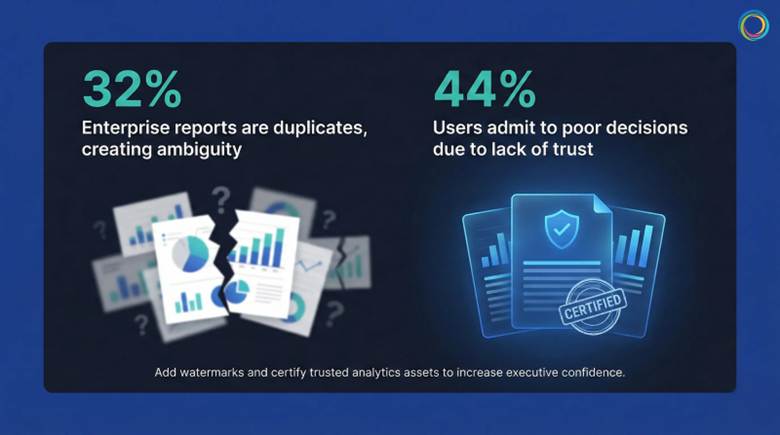
When you search “Gross Margin” and it returns fifteen nearly identical reports (v1, v2, Final, Real_Final, Q3_Update), trust disappears instantly. And it’s not an edge case: 32% of enterprise reports are duplicates. This ambiguity creates a "Trust Gap." If executives can’t tell what’s approved for use, or certified versus experimental, they default to spreadsheets. Even worse, the cost is real - 44% of users acknowledge making poor decisions because they didn’t trust the data in front of them.
The fix is not tighter control, but visible certification. You need an unmistakable signal of truth.
Bimbo Bakeries USA (the bakers of featured brands like Thomas', Sara Lee, Arnold, Entenmann's, Ball Park, and Oroweat) confronted this fragmentation head-on.
With ZenOptics’ governed analytics catalog powering discovery, lineage, and certification workflows, they certified and watermarked trusted assets, restoring executive confidence and preventing shadow IT from influencing strategic decisions.
→ Related: The Trust Gap: Why Executives Don't Believe Your Dashboards
The Hard Cost: The Price of "Zombie Reports"
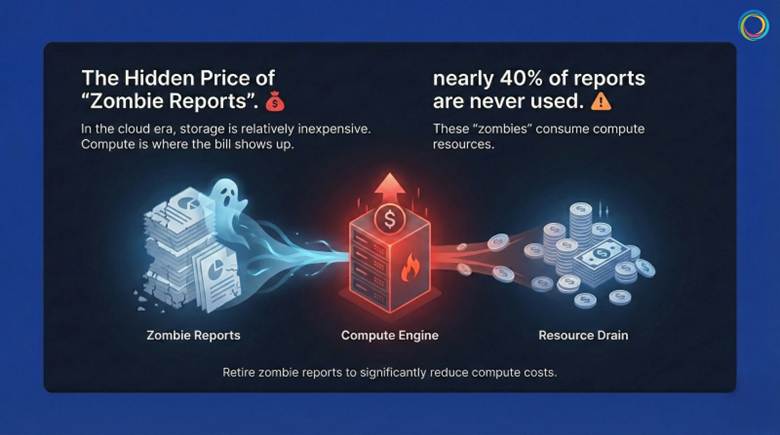
In the cloud era, storage has become inexpensive, but compute is where the bill shows up.
In many Tableau environments, nearly 40% of reports are never used. These “zombie reports” haven’t been viewed in over six months - yet they continue to consume cloud storage, burn refresh cycles, and incur high license costs.
This is not an analytics problem; it’s financial negligence. In an enterprise with 10,000 reports, roughly 4,000 generate zero value while quietly driving ongoing cloud spend. Every refresh, backup, and migration amplifies the leakage, turning unused analytics into a persistent tax on your cloud budget.
- Storage & Compute Waste: You are paying premium rates to host digital trash.
- Licensing Leakage: You are likely paying for "Creator" licenses for users who only view one PDF a month.
A biotech leader we worked with faced extreme sprawl with over 22,000 reports. By applying a rationalization strategy, they identified that 67% of their content was duplicate or stale. They successfully retired around 17,000 assets, bringing their optimized inventory down to just 4,600 business-relevant reports. This cleaned their server and radically reduced their technical debt.
The Pivot: From "Governance" to "BI Ops"
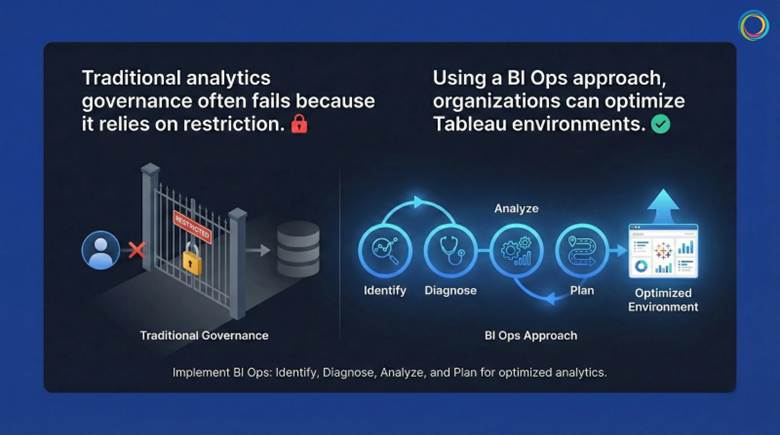
Traditional analytics governance fails because it relies on restriction. The modern alternative is BI Ops - operationalizing the lifecycle of your analytics to improve report discoverability, efficiency, and trust.
Using the BI Ops methodology (Identify, Diagnose, Analyze, Plan), you can optimize your Tableau environment in three simple steps:
1. Rationalization (The "Kill List")
You cannot manually audit 20,000 reports. You need automated diagnostics to crawl your metadata and identify "stale" content.
Strategy: Identify assets with zero views in 360 days.
Action: Create a "kill list" of zombie reports to safely decommission, instantly lowering your TCO.
2. Certification (The Trust Signal)
Improve report discoverability by elevating the signal over the noise.
Strategy: Apply a governance framework towards a "Certified" stamp to your top 100 business-critical reports. Link these reports to a Business Glossary so users understand the definitions of KPIs like "Net Sales " without constantly emailing IT.
Result: When your team sees the 'Certified' stamp on important reports, they can trust the data and make decisions with confidence.
3. Unification (The Adoption Driver)
Adoption fails when access is hard. Analysts currently spend 25% of their time just searching for data.
Strategy: Decouple consumption from the generation tool. Give users a "Netflix-style" portal where they can find Tableau dashboards, Power BI reports, and spreadsheets in one personalized view.
Result: Brown-Forman used this unified approach to increase analytics adoption by 27%, proving that when data is easy to find, business users will consume it.
Your Tableau environment is powerful, but it requires active curation to deliver ROI. The days of "build it and the team will use" are over. If they can't find it, or if they don't trust it, they won't use it. To stop the financial bleed of "Zombie Reports" and bridge the trust gap, you must move beyond passive storage to active analytics optimization. It is time to audit your estate, certify your winners, and retire the rest.
Published January 14, 2026