


While your team spends twenty minutes searching for the right sales report, a competitor may already have made their pricing decision and moved on.
That gap matters more than most leaders realize. McKinsey research shows that only 37% of executives believe their organizations make decisions that are both high-quality and fast. Most organizations end up trading speed for confidence, confidence for speed or losing both.
Organizations that consistently move quickly from question to confident action outperform peers. They respond faster to market shifts, identify risks earlier, and close opportunities more effectively. The difference is rarely about working harder or generating more dashboards. It is about removing friction between having analytics and acting on them.
This is where Decision Velocity becomes critical. For organizations investing in analytics trust and governance, decision velocity is where those investments translate into measurable business outcomes.
What Decision Velocity Actually Means
Decision velocity measures the time between asking a business question and taking confident action. It spans multiple steps:
- discovery (finding relevant analytics)
- interpretation (understanding what the data shows)
- validation (confirming trust and relevance)
- execution (acting on insights)
Each step introduces friction. Each delay compounds cost.
McKinsey estimates that managers at large enterprises collectively lose hundreds of thousands of days annually due to ineffective decision processes translating into hundreds of millions of dollars in lost productivity. Importantly, speed and quality are not opposites. McKinsey has found a strong positive correlation between decision speed and decision quality.
Organizations that decide quickly also tend to decide well because the same capabilities enable both:
- clear ownership of decisions
- accessible, trusted analytics
- reduced time spent validating information
The Hidden Costs of Slow Analytics
Business users spend a disproportionate amount of time simply finding analytics. Internal ZenOptics research indicates that employees can spend up to 25% of their time searching for reports across disconnected BI systems before analysis even begins.
Analytics sprawl magnifies the problem. As teams deploy new dashboards and tools independently, asset volume grows while discoverability declines. Under pressure, users often rebuild reports instead of locating existing ones, reinforcing duplication and inconsistency.
The impact is rarely isolated. A delayed analytics insight in one area cascades into operational delays elsewhere, pushing back decisions, compressing execution windows, and increasing risk.
Persistent access friction also erodes trust. When teams repeatedly struggle to find or validate analytics, they resort to workarounds: shadow spreadsheets, offline exports, and intuition-driven decisions. Industry research shows that a majority of organizations continue to struggle with trusting analytics for decision-making, a gap driven as much by visibility and access as by data quality itself.
Five Ways to Accelerate Decision Velocity
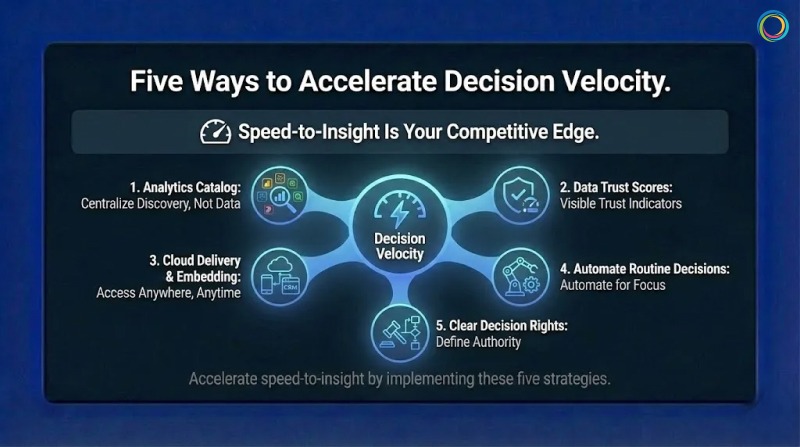
1. Centralize discovery without centralizing data
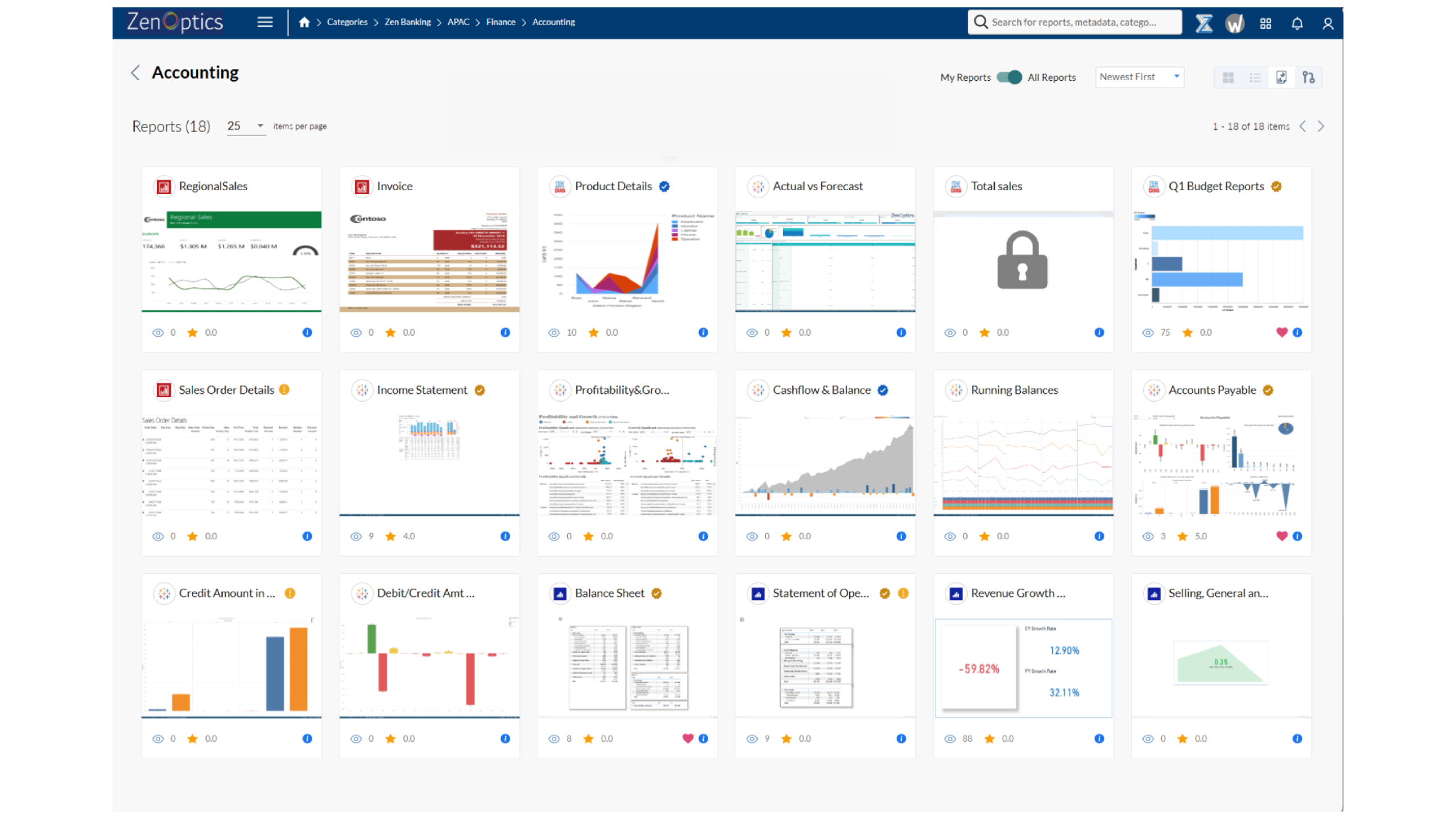
You don’t need to move all analytics into one system. You need one place where users can discover analytics across systems. An analytics catalog provides a unified search experience across platforms like Tableau, Power BI, and others, reducing time spent hunting for information without disrupting existing tools.
2. Make trust visible at the point of use
Finding a report is only half the battle. Users still need to know whether it is current, accurate, and appropriate for their decision. Visible trust indicators, such as certification status, freshness signals, and ownership, allow users to assess fitness quickly without manual validation.
3. Bring analytics into decision workflows
Decision velocity improves when analytics appear where work happens, not in separate tools. Cloud delivery and embedded analytics reduce context-switching by placing insights directly into operational systems such as CRM or ERP environments.
4. Automate routine decisions where appropriate
Not every decision requires human intervention. Routine activities such as threshold alerts, exception detection, or replenishment triggers can be partially automated. Automation reduces noise and frees teams to focus on higher-value decisions that require judgment.
5. Clarify decision ownership
Technical improvements alone cannot fix organizational ambiguity. When decision rights are unclear, analytics stall in approval loops. Clearly defining who can decide what enables faster action without sacrificing accountability.
How ZenOptics Accelerates Decision Velocity
ZenOptics directly addresses the discovery and validation bottlenecks that slow decisions.
Unified discovery provides a single interface to find analytics assets across BI platforms, eliminating the fragmentation that consumes productive hours. Trust indicators surface certification status, ownership, usage context, and freshness, helping users move from discovery to action with confidence.
By connecting analytics to governance context and operational workflows, ZenOptics reduces the friction that turns insights into delays. For enterprises managing analytics at scale, this transforms decision velocity from an aspiration into a repeatable capability.
Frequently Asked Questions
What does decision velocity mean?
Decision velocity measures how quickly an organization moves from identifying a question to taking action based on trusted analytics.
How much does slow decision-making cost?
Industry research estimates that ineffective decision processes cost large enterprises hundreds of millions of dollars annually in lost productivity.
Do faster decisions mean worse decisions?
No. Research consistently shows that organizations with high decision velocity also achieve higher decision quality, because clarity, trust, and access improve both.
Conclusion
Decision velocity separates organizations that lead from those that react.
Improving it requires reducing friction across the decision lifecycle: discovering analytics quickly, validating them confidently, and accessing them where decisions are made. Centralized discovery, visible trust signals, contextual access, selective automation, and clear decision rights work together to accelerate outcomes.
Your competitors are already optimizing for speed and confidence. The question is how much ground is lost while waiting.
Published February 9, 2026Decision Velocity: Why Speed-to-Insight Is Your Competitive Edge
Organizations that move quickly from insight to action outperform competitors. Discover how to accelerate decision velocity by reducing friction in analytics discovery, validation, and execution.
Schedule Your Assessment