


Your company runs Power BI on Azure, Tableau on AWS, and has a legacy SAP BusinessObjects instance that nobody wants to touch. Each platform has its own governance approach, its own certification process, and its own definition of what "revenue" means.
Welcome to multi-cloud reality. Gartner predicts that 90% of organizations will adopt a hybrid cloud approach through 2027. They are responding to real business needs: regional compliance, best-of-breed tools, M&A integration, and teams that prefer different platforms. Multi-cloud is not going away.
The challenge is governance. Traditional approaches assume centralization. But you cannot force distributed analytics into a single system without massive migration projects that rarely finish. Federated Analytics Governance offers an alternative: apply consistent policies across distributed environments while respecting local autonomy.
For organizations building data trust frameworks, federated governance is how trust scales across distributed environments.
Why Multi-Cloud Breaks Traditional Governance
Traditional data governance emerged when analytics lived in one warehouse accessed through one reporting tool. Governance meant controlling that single bottleneck. Simple. Effective. And increasingly irrelevant.
McKinsey research shows that more than 95% of enterprise organizations now have a cloud footprint, with workloads in the public cloud increasing from 32% in 2018 to 52% in 2025. When different business units deploy different BI tools on different clouds, each creates its own reporting ecosystem with parallel dashboards, reports, and KPIs. This BI Sprawl is not a bug. It is a feature of how modern enterprises actually operate.
Gartner predicts that 80% of data governance initiatives will fail by 2027 without proper change management. Much of that failure stems from governance approaches designed for centralized environments that no longer exist.
Most governance also stops at the data layer. But business users do not query databases. They open reports and dashboards. Gartner warns that organizations can no longer implicitly trust data, predicting 50% will adopt zero-trust data governance by 2028. Part of this Data Trust Gap exists because governance never reaches the consumption layer where trust needs to be visible.
What Federated Analytics Governance Actually Means
Federated Governance separates policy from execution. The enterprise defines standards for certification, quality, and access. Local teams implement those standards within their chosen platforms. Think of it like franchise operations. The parent company defines brand standards and quality requirements. Individual franchises execute within those standards using local resources. You get consistency without requiring every location to be identical.
The model operates across three layers. The policy layer defines enterprise-wide standards that apply regardless of platform: certification criteria, naming conventions, metric definitions, and lifecycle rules. Policy expresses requirements in terms of outcomes, not specific implementations. The orchestration layer coordinates governance across platforms through cross-platform discovery, unified monitoring, and centralized reporting that gives leadership visibility into governance health enterprise-wide. The execution layer implements governance within each platform. Teams use native tools to apply enterprise policies. They certify reports using Tableau's capabilities or Power BI's workflows. Execution stays local, but the standards are enterprise-wide.
Central ownership includes metric definitions, certification standards, compliance requirements, and cross-platform visibility. Distributed ownership includes report development, platform administration, certification execution, and local user support. Drawing this boundary deliberately prevents political negotiation or technical constraints from determining what should be strategic decisions.
Building Federated Governance in Practice
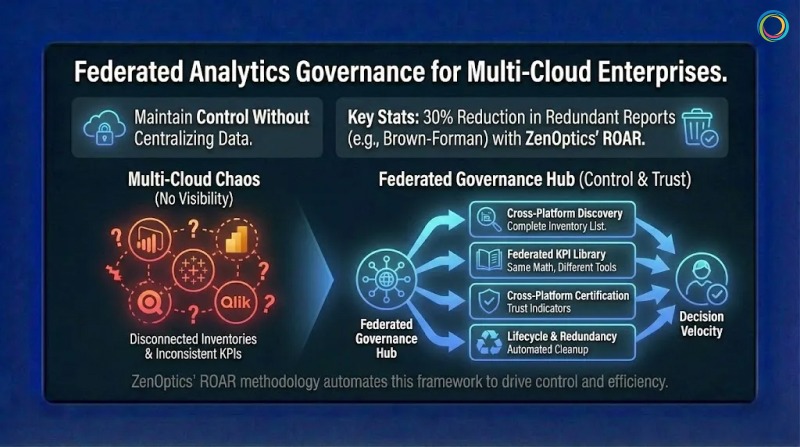
You cannot govern what you cannot see. Most enterprises lack a complete inventory of reports across platforms. Assets accumulate over years with inconsistent naming and documentation gaps. Cross-platform discovery requires connecting to each BI tool and extracting metadata about what exists, who owns it, and how frequently people use it. This inventory becomes the foundation for everything else.
When "customer count" means different things in Power BI and Tableau, every cross-platform comparison becomes an argument. A federated KPI Library defines enterprise-wide metric standards that all platforms reference, ensuring calculation consistency while allowing documented local variations. Same terms. Same math. Different tools.
Enterprise standards define what certified reports require: documented owners, accuracy validation, scheduled refreshes, approved data sources. Platform teams implement certification using native capabilities. Cross-platform visibility then aggregates certification status so users see trust indicators regardless of which platform contains each report. This connects directly to decision velocity. When users can quickly identify trustworthy reports across all platforms, they spend less time validating and more time deciding.
Reports accumulate without active management. Federated lifecycle governance applies consistent policies across platforms: review schedules, recertification triggers, and archival rules. Cross-platform redundancy detection identifies duplicates across tools. ZenOptics' ROAR methodology automates this analysis, with customers like Brown-Forman achieving 30% reduction in redundant reports.
Technology Requirements
Federated governance requires technology that connects across platforms without creating new vendor lock-in. Unified discovery connects to multiple BI tools and aggregates metadata into consolidated inventories that update automatically. Cross-platform search lets users find assets without knowing which platform contains them, then access reports with one click in their native environment. Governance dashboards aggregate compliance metrics across all connected platforms, surfacing trends and exceptions that require attention.
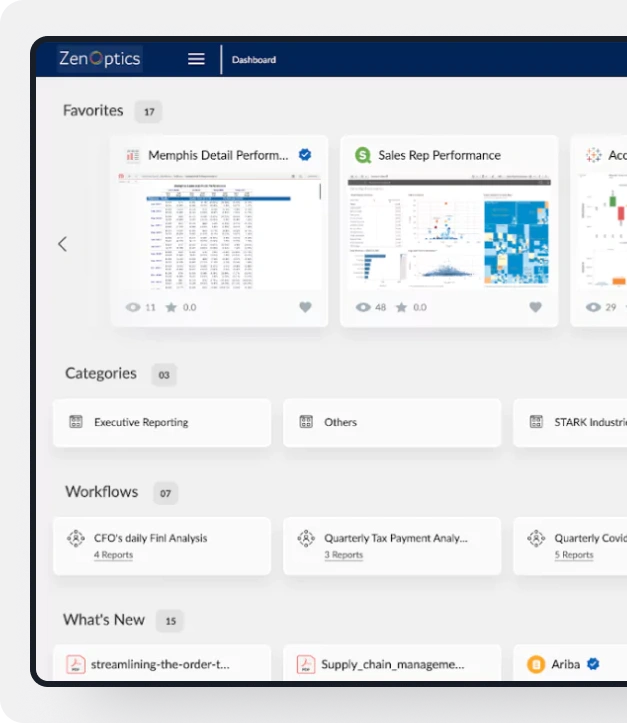
The ZenOptics Analytics Hub provides this foundation through 100+ smart connectors integrating Power BI, Tableau, Qlik, SAP BusinessObjects, and other platforms. The unified BI Portal architecture creates a single interface layer while preserving native report formatting and user experience.
Frequently Asked Questions
What is federated analytics governance?
Federated governance applies consistent enterprise policies across distributed analytics without requiring centralization. The enterprise defines standards. Local teams implement them within their platforms. This provides consistency across multi-cloud environments while respecting legitimate reasons for different tool choices.
How does it differ from centralized governance?
Centralized governance assumes a single access path you can control. Federated governance separates policy from execution: central teams own standards and visibility, distributed teams own development and administration.
What technology is required?
You need cross-platform connectors that create unified inventories, search interfaces that work across tools, and governance dashboards that aggregate metrics enterprise-wide. The technology must be platform-neutral to avoid creating lock-in.
Conclusion
Multi-Cloud is not going away. The majority of enterprises operating across multiple clouds are responding to real requirements that centralization cannot address.
Governance must adapt. Define enterprise standards for what trusted analytics look like. Let platform teams implement those standards within their chosen tools. Create cross-platform visibility so governance operates across the full ecosystem.
For enterprises managing analytics across multiple clouds and platforms, federated governance is the only model that matches how their analytics actually work.
Published February 20, 2026Federated Analytics Governance for Multi-Cloud Enterprises
Multi-cloud enterprises can't govern analytics the same way they did when everything lived in one warehouse. Discover how Federated Analytics Governance applies consistent policies across Power BI, Tableau, and SAP environments without forcing centralization.