

The AI copilots and agents enterprises are deploying today share a common failure mode. They land on top of analytics environments that were never designed for machine consumption. The AI doesn’t know what “Net Revenue” means in your finance team’s context versus your regional operations team’s. It doesn’t know which dashboard is authoritative, which KPIs are certified, or which reports are outdated.
So it generates answers. But not always the right ones.
The reason is structural. The analytics layer was never built to be machine-readable.
Enterprises spend considerable time debating which AI model to use, which vendor to trust, and which copilot to deploy. These are not the wrong questions; they are, for most organizations, the premature ones. The more foundational question is whether the analytics estate is ready to be consumed by AI at all.
Building an analytics system of record answers that question. It creates the foundation that allows AI to move from generating answers to driving decisions.
Why AI Agents Fail on Enterprise Analytics (And It’s Not the Model’s Fault)
The model problem is real, but secondary. AI agents deployed on enterprise analytics environments encounter three structural failures regardless of model capability.
The first is context overload. Enterprise BI environments accumulate years of dashboards, duplicated reports, and inconsistent governance. A large portion of reports often go unused, KPI definitions contradict across tools, and ownership is unclear. AI doesn’t start from a clean foundation—it starts from noise.
The second is context gaps. When KPI definitions are not machine-readable, AI fills the gap using probability. If “Net Revenue” is not defined with clear calculation logic, certified sources, and relationships to other metrics, the AI produces a statistically plausible but often incorrect answer.
The third is context misalignment. The same KPI means different things across Finance, Sales, and Operations. When AI retrieves context that is structurally present but semantically incorrect, it produces answers that sound right but aren’t.
The solution is not a better model. It is better analytics context structured, certified, and machine-readable. This is what an analytics system of record provides.
What Is an Analytics System of Record And Why It's Different From a Data Catalog
An analytics system of record is a single, authoritative, governed inventory of dashboards, reports, KPIs, and metrics across BI tools. It defines what metrics mean, who owns them, and which are trusted.
It operates at the decision layer, not the data layer.
A data catalog governs tables, pipelines, and schemas. It answers where data lives. An analytics system of record governs how that data is used in business decisions—through dashboards, KPIs, and reports.
An enterprise can have a well-governed data catalog and still have a fragmented analytics layer that is invisible to AI. This is where most AI initiatives fail.
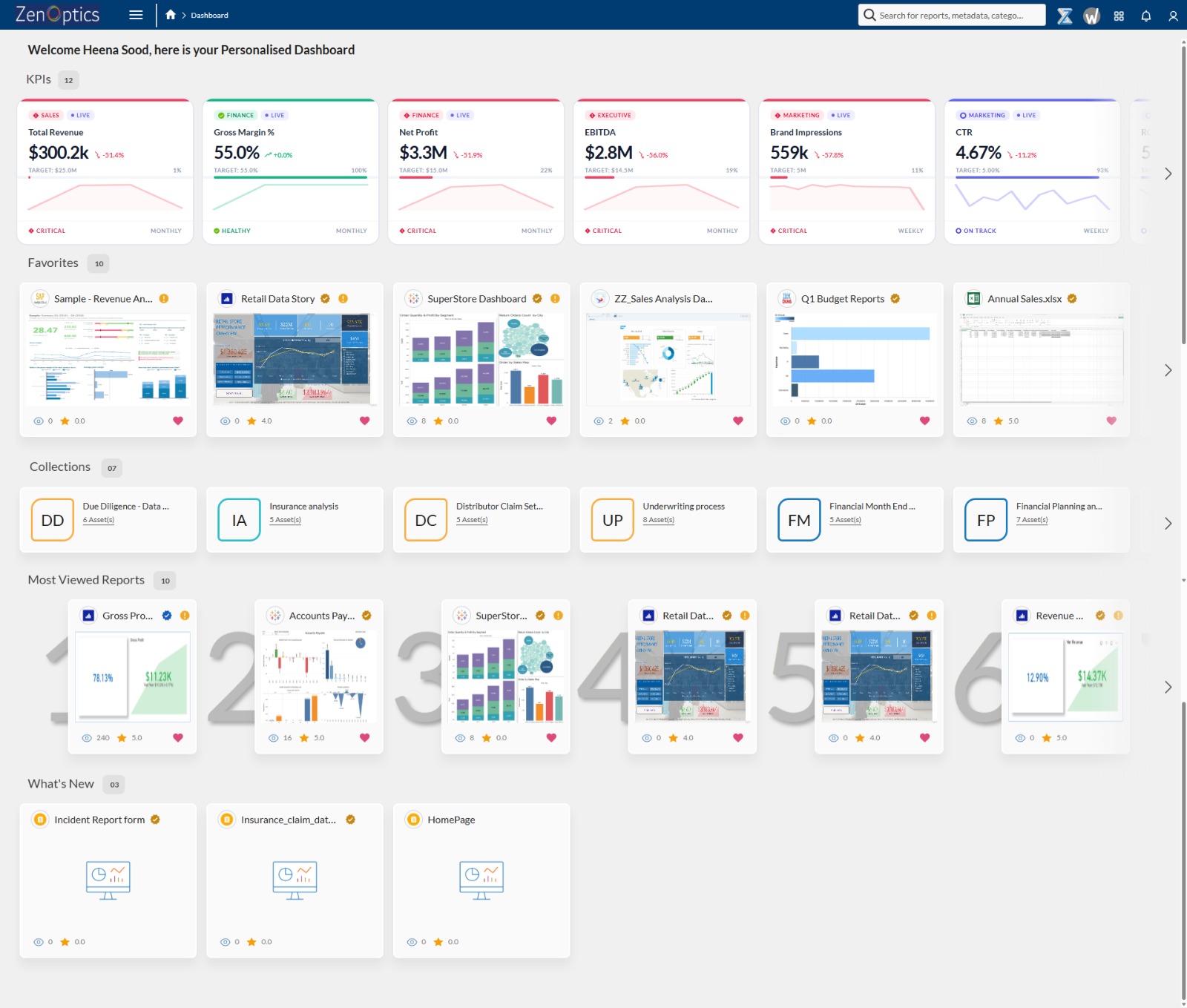
ZenOptics solves this through Atlas, which creates a single, trusted source of analytics across the enterprise cataloging, certifying, and governing metrics and dashboards.
For a deeper breakdown, see: Analytics Catalog vs Data Catalog: Why AI Projects Need Both
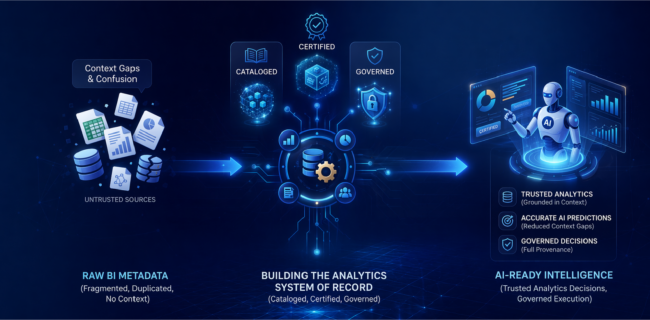
The Three-Layer Framework: From Raw BI Metadata to Governed AI Execution
Establishing an analytics system of record is only the first step. The complete journey to AI-ready analytics runs through three layers: Atlas, Nexus, and Maestro.
Layer 1 - Know: Atlas (Analytics System of Record)
Atlas connects to existing BI tools such as Tableau, Power BI, Qlik, Snowflake, and SAP. It ingests metadata across dashboards and reports without replacing existing systems. Atlas identifies duplicates, assigns ownership, and enables KPI certification creating a trusted analytics foundation.
Layer 2 - Understand: Nexus (AI Context Layer)
Atlas provides structure. Nexus makes it usable for AI.
Nexus transforms governed BI metadata into a machine-readable context layer. It maps KPI definitions, aligns business terminology, and connects relationships between metrics. This enables AI agents to understand business meaning not just data eliminating guesswork and inconsistency.
Layer 3 - Act: Maestro (Decision Governance Layer)
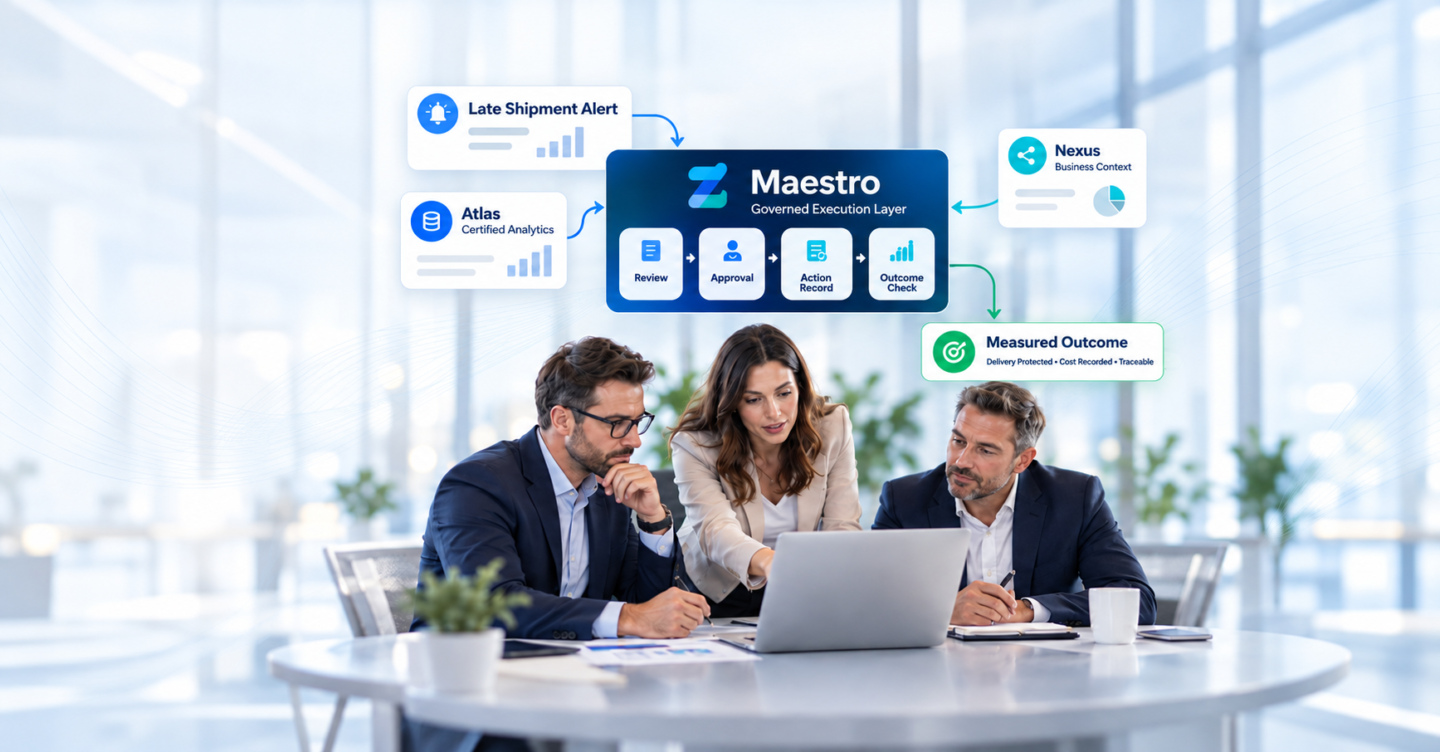
Nexus grounds AI in context. Maestro governs how AI acts on it.
Maestro ensures every AI-driven action is traceable to certified metrics and approved workflows. It introduces decision provenance making outputs auditable, explainable, and aligned with enterprise governance requirements.
Together, Atlas, Nexus, and Maestro create a complete decision intelligence platform.
What "AI-Ready Analytics" Actually Looks Like in Practice
Consider a common enterprise scenario. A business user asks: “What drove the decline in Net Sales last quarter?”
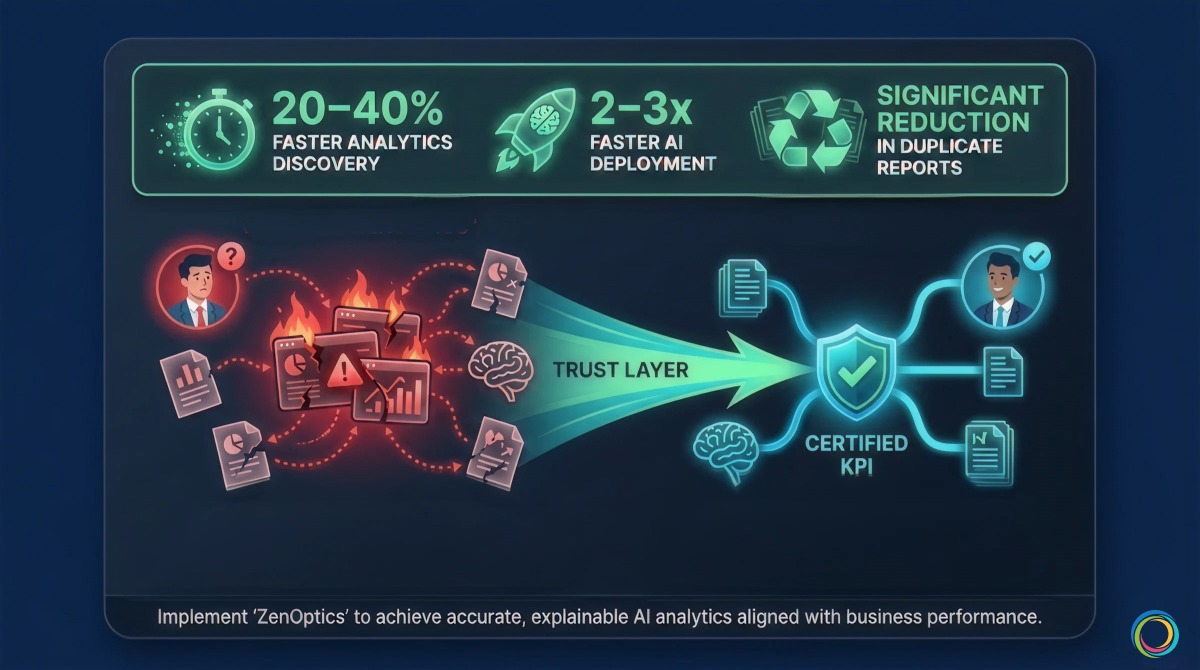
Without an analytics system of record, the AI scans multiple dashboards with conflicting definitions and selects the most statistically available interpretation. The result may sound correct but lacks business alignment.
With ZenOptics, the AI identifies the certified KPI, understands its definition and relationships, and links back to a trusted source. The answer is accurate, explainable, and aligned with how the business measures performance.
Organizations implementing ZenOptics typically see:
- 20–40% faster analytics discovery
- 2–3x faster AI deployment
- Significant reduction in duplicate reports
This is because the context layer is automatically generated from existing BI metadata rather than built manually.
The goal is not faster answers. It is trusted decisions.
The BI Ops Foundation: You Cannot Build an Analytics System of Record on Unrationalized Data
There is a sequencing problem that impacts most AI initiatives. Enterprises attempt to deploy AI before rationalizing their analytics environment.
Most BI ecosystems contain:
- Duplicate dashboards
- Conflicting KPI definitions
- Orphaned reports
Certifying this environment without cleanup creates a structured version of chaos.
ZenOptics addresses this through BI Ops a cross-platform inventory approach that identifies duplicates, analyzes usage, and rationalizes the analytics estate before governance begins.
Inventory first. Rationalize next. Certify what remains.
Learn more: BI Ops Methodology for Data Modernization
Who Needs to Own This Initiative And When
The analytics system of record initiative spans three key roles.
Data and Analytics Leaders (CDOs, VPs of Analytics) define the strategy. This is an AI readiness initiative not just a BI upgrade.
BI Teams operationalize it. They manage metadata ingestion, certification workflows, and context layer curation.
CIOs and CTOs sponsor the investment. Without a governed analytics layer, AI investments operate on unstructured and unreliable inputs limiting ROI.
This is infrastructure for AI not an optional enhancement.
5 Signs Your Enterprise Is Not AI-Ready (Analytics Checklist)
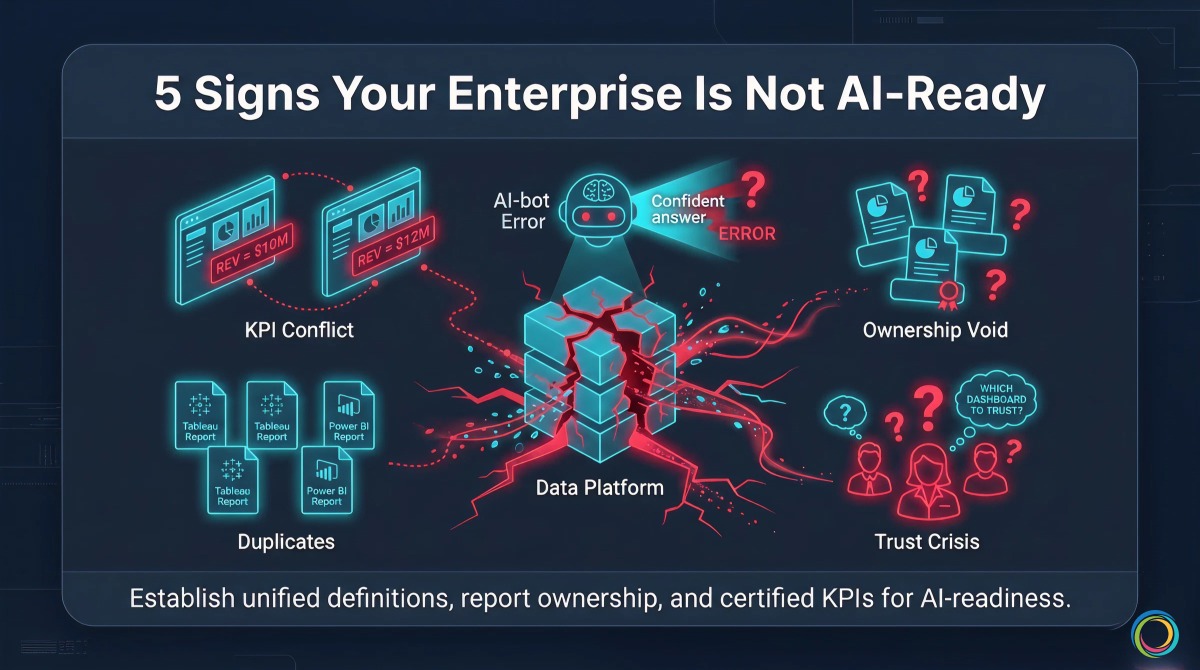
- The same KPI shows different values across dashboards
- AI returns confident but incorrect answers
- KPI ownership is unclear
- Duplicate reports exist across tools
- Teams frequently ask which dashboard to trust
These are structural issues not edge cases.
Frequently Asked Questions
What is an analytics system of record?
An analytics system of record is a governed, centralized layer of dashboards, KPIs, and metrics across BI tools. It defines what metrics mean, who owns them, and which are trusted making analytics usable by both humans and AI.
How is it different from a data catalog?
A data catalog governs raw data infrastructure. An analytics system of record governs business decision layers dashboards, reports, and KPIs. Both are required for AI readiness.
Why do AI copilots give wrong answers?
Not because of the model, but because of missing or misaligned context. Without structured KPI definitions and relationships, AI generates statistically plausible but incorrect answers.
What does AI-ready analytics mean?
It means analytics is structured, certified, and machine-readable before AI is deployed—ensuring accurate, explainable outputs.
How does ZenOptics enable this?
ZenOptics uses Atlas to build the system of record, Nexus to create the AI context layer, and Maestro to govern AI-driven decisions turning BI metadata into decision intelligence.
How long does it take to implement?
Timelines vary, but organizations typically start with BI Ops rationalization. Nexus then accelerates context generation, enabling 2–3x faster AI deployment compared to manual approaches.
The Foundation That Makes AI Investments Work
The enterprise AI problem, for most organizations, is not a model problem. The model class available today is fully sufficient to produce trusted, decision-ready answers from analytics: provided the analytics layer is structured, certified, and machine-readable enough to ground those answers accurately. Building that foundation runs through the Atlas, Nexus, and Maestro progression. Know the analytics estate. Generate the context layer from the BI metadata already in place. Govern what AI executes on top of it. Each step builds on the last; none of them works in isolation. ZenOptics connects fragmented BI tools, gives AI the business context it needs, and governs every decision — so analytics and AI finally work together.
Schedule a 15-minute demo