Most BI teams treat analytics sprawl as a deferred maintenance problem. The reports keep accumulating, the duplicates keep multiplying, and the response is usually the same: a cleanup project gets added to the backlog, pushed past each planning cycle, and never quite cleared. The assumption is that sprawl is cosmetic: untidy, low-priority, a problem for next quarter. That assumption is increasingly expensive. In environments where AI is being asked to operate on top of the BI estate, the cost of sprawl is not deferred. It arrives the moment an AI tool tries to ground its outputs in an uncharted, ungoverned analytics environment.
What Analytics Sprawl Looks Like Inside an Enterprise
Over the past two years, as enterprise AI investment has accelerated and new reporting demands have multiplied, the volume of BI content created in support of pilots, tool rollouts, and cross-functional requests has added to estates that were already managing years of accumulated technical debt. The pattern inside those estates is consistent.
A report gets built for a quarterly business review. Six months later, someone builds a nearly identical version for a different audience. A project ends; its dashboards stay live. A migration happens; the old tool retains content nobody remembered to retire. A team clones a report to make minor customizations and forgets to link it back to the original.
Each of those decisions made sense individually. None of them included a retirement plan. Over time, the result is an estate filled with analytics assets that nobody owns, nobody actively uses, and nobody can confidently retire without worrying about breaking something a downstream user depends on.
Analytics sprawl is the uncontrolled proliferation of duplicate, unused, or conflicting analytics assets across an organization's BI environment. It is not a sign of negligence. It is the predictable output of BI tools that make creation easy and lifecycle management nearly impossible at scale.
Where the Costs Actually Accumulate
The costs are distributed across three areas, and most of them do not appear on a single budget line.
BI tool licensing is the most visible. Many enterprise BI platforms price on consumption metrics that include content volume, user activity, and storage. An estate padded with orphaned reports and duplicate dashboards inflates those metrics without delivering proportional value. Organizations paying for capacity they are not using are subsidizing the growth of their own sprawl.
Labor cost is less visible and typically larger. When analysts need a report and cannot find it, they build one. Organizations implementing ZenOptics typically see 30 to 40 percent of their analytics estate comprised of duplicate or conflicting reports. That means a significant share of BI production effort goes into recreating work that already exists in another corner of the estate. Discovery time compounds the problem: when searching for an existing asset takes longer than building a new one, the sprawl grows faster.
Trust erosion is the hardest to quantify and the most consequential. When an analyst finds three versions of the pipeline report and cannot determine which is authoritative, the result is decision latency, escalations to BI teams, and a gradual retreat from self-service. The analytics investment produces outputs that stakeholders hedge rather than act on.
The Orphaned Report Problem
Orphaned analytics assets are reports and dashboards with no active owner, no verified usage, and no connection to current business processes. They are common in every multi-tool BI environment, and they accumulate for structural reasons.
BI assets are created on demand, often without an assigned owner or a documented purpose that survives the project they supported. When team structures change, when stakeholders move on, and when business priorities shift, the reports they required remain. Lifecycle management is rarely built into the BI governance process because it is treated as a separate concern from content creation.
The problem with orphaned reports is not just that they take up space. It is that they are indistinguishable from authoritative assets to anyone who does not already know the difference. When an analyst searches for a metric, the orphaned version surfaces alongside the current one. When governance teams try to certify the estate, orphaned assets create noise that slows the process and increases the risk of certifying the wrong version.
Why Sprawl Cannot Be Resolved Without Inventory
The reason sprawl persists is structural. Rationalization requires knowing what exists. Most BI leaders have a reasonable picture of which tools their organization runs. Far fewer have a complete, current picture of every report, dashboard, and KPI definition those tools contain across all platforms simultaneously, with visibility into ownership, usage, and duplication.
Without that inventory, cleanup efforts are limited to what individual teams happen to know about their own corners of the estate. Consolidation conversations stall because nobody can say with confidence what is safe to retire. Migration projects inherit sprawl from the platforms they replace. Each tool refresh moves content forward without clearing the backlog.
The inventory is not a one-time project. The estate changes continuously as teams create, modify, and abandon content. Maintaining a current, cross-tool picture of the analytics environment requires automation rather than periodic manual audits.

What Rationalization Requires at the Estate Level
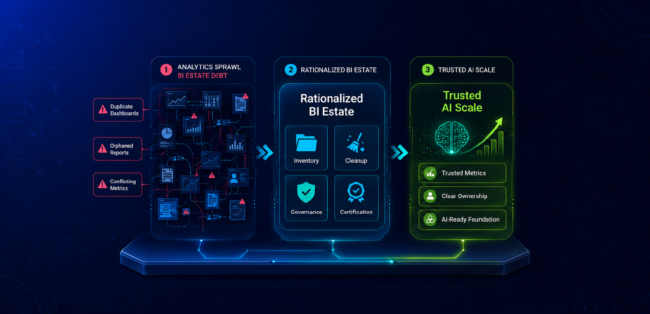
Rationalization is the process of moving from an uncharted analytics estate to one that is inventoried, governed, and certified. It requires four things: a complete picture of what exists, usage data to identify what is actively being used, ownership assignment for everything that remains, and a certification process that distinguishes authoritative assets from duplicates and orphans.
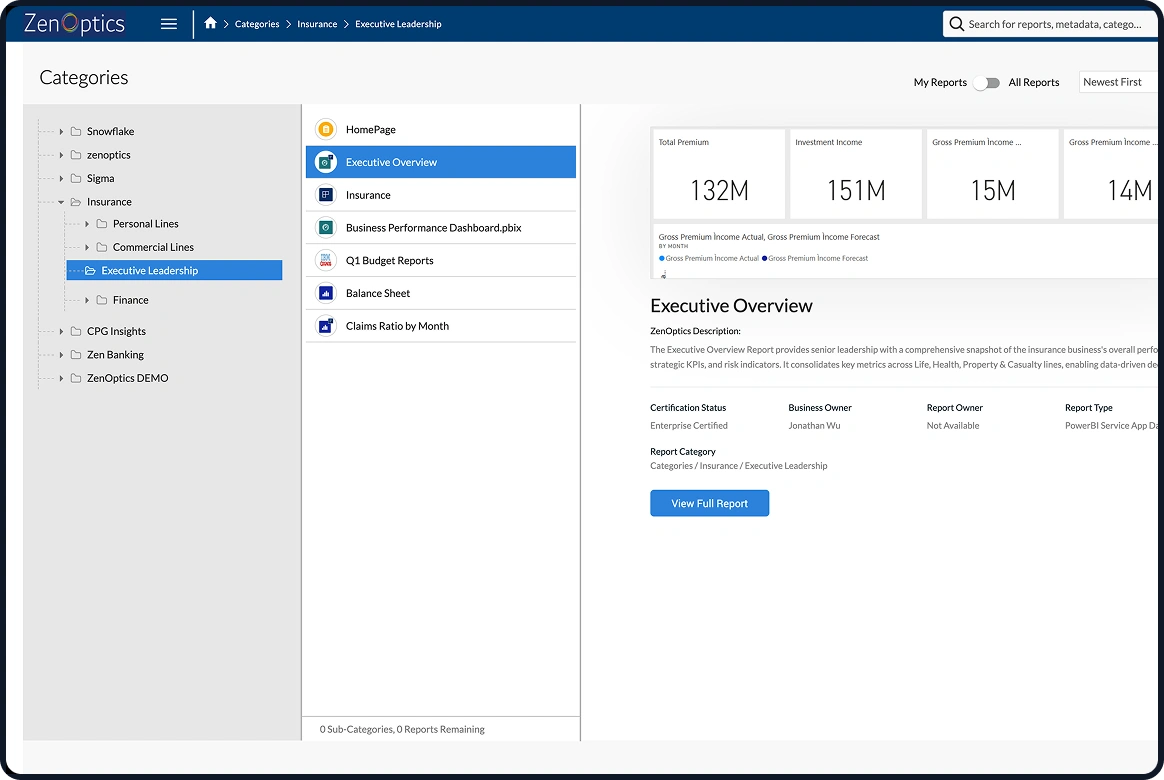
Atlas, ZenOptics's Analytics System of Record, provides this infrastructure across the existing BI environment. It surfaces every analytics asset across tools including Power BI, Tableau, and Looker without requiring those tools to be replaced. Usage data and ownership are tracked continuously, so the inventory stays current rather than decaying between review cycles. Certification is managed at the estate level, not tool by tool.
Organizations implementing ZenOptics typically see 20 to 40 percent faster analytics discovery once the estate is inventoried and governed, because assets become searchable and structured rather than scattered across tool-specific libraries with no cross-tool visibility.
Why Sprawl Is the Hidden Reason AI Grounding Fails
AI tools that operate on top of a BI estate ground their outputs in whatever analytics information is available to them. That grounding is only reliable if the underlying estate is governed. When the estate contains conflicting metric definitions, duplicate assets, and no certification layer, the AI model cannot distinguish an authoritative version from an orphaned one. That distinction lives in governance, not in the model.
Gartner is direct on the consequence: through 2026, organizations that do not support their AI use cases through an AI-ready data practice will see over 60 percent of those projects fail to deliver on business SLAs and be abandoned. Sprawl is a direct contributor to that failure rate. The AI project is not underperforming. The estate it is grounding in is ungoverned, and ungoverned estates produce unverifiable outputs.
Analytics sprawl feels like a BI housekeeping problem until the AI initiative arrives. At that point, it becomes a blocker. Rationalizing the estate before AI is introduced is not preliminary work. It is what determines whether the AI investment delivers anything the organization can act on. Atlas addresses the rationalization layer. Nexus converts the certified estate into machine-readable business context so AI workflows have the grounding they need to produce trusted, decision-ready outputs. For a broader view of what that readiness requires, analytics modernization in the AI era covers the full framework.
Frequently Asked Questions
What is analytics sprawl? Analytics sprawl is the uncontrolled proliferation of duplicate, unused, or conflicting analytics assets across an enterprise BI environment. It accumulates when reports and dashboards are created on demand without lifecycle management: assets are never retired, duplicates are never consolidated, and ownership is never formalized. The result is an estate where the volume of content grows faster than the organization's ability to govern it.
What causes analytics sprawl in enterprise organizations? Analytics sprawl has structural causes rather than individual ones. BI tools make content creation fast and low-friction. They rarely provide equivalent support for retirement, ownership tracking, or cross-tool visibility. As organizations add tools, migrate platforms, and support multiple business units, content accumulates in silos with no governing layer to identify duplication or enforce lifecycle management.
What is an orphaned report in BI? An orphaned report is an analytics asset that has no active owner, no recent verified usage, and no current connection to active business processes. Orphaned reports typically survive project endings, team reorganizations, and platform migrations. They are problematic because they consume capacity and because they are visually indistinguishable from authoritative assets to users who encounter them in search results.
How much does analytics sprawl cost an organization? The cost appears across three areas: BI tool licensing inflated by unused content, labor spent recreating reports that already exist, and decision latency caused by conflicting or unverifiable analytics outputs. Organizations implementing ZenOptics typically see 30 to 40 percent of their analytics estate comprised of duplicate or conflicting reports, which gives a concrete scale for the labor and licensing overhead that sprawl generates before any AI costs are factored in.
How does analytics sprawl affect AI initiatives? AI tools ground their outputs in whatever analytics information is available. When that information is ungoverned, sprawl means the AI model encounters conflicting metric definitions, duplicate assets, and no authoritative layer to distinguish trustworthy from orphaned content. The outputs it produces cannot be verified by teams that care about accountability. Gartner projects that over 60 percent of AI projects without an AI-ready data practice will fail to deliver on business SLAs through 2026. Sprawl is a direct contributor to that failure rate.
What is BI estate rationalization? BI estate rationalization is the process of inventorying, certifying, and governing an enterprise analytics environment to remove duplication, resolve conflicting definitions, and establish clear ownership of authoritative assets. It is distinct from a one-time cleanup project. Effective rationalization is a continuous practice: the estate changes constantly, so the inventory and governance layer must stay current to prevent sprawl from rebuilding.
Published May 13, 2026The Hidden Cost of Analytics Sprawl: How BI Estate Debt Limits AI Scale
Most organizations are sitting on years of unmanaged reports, dashboards, and data silos that quietly inflate cloud spend and destroy analytics trust. That “BI estate debt” becomes a hard limit when you try to industrialize AI slowing projects, amplifying bad decisions, and exposing governance gaps. Learn how to quantify this hidden cost and where ZenOptics fits in as the control center for taming sprawl and unlocking AI at scale.
Schedule a call