

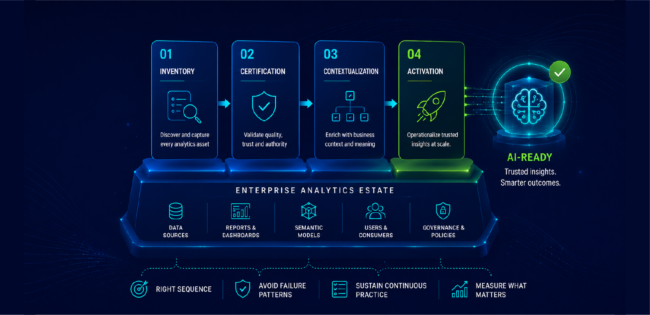
By the time an Analytics Director or VP Data is ready to run an enterprise analytics modernization initiative, the conceptual case has already been made. The budget is approved or in negotiation. The four-step framework of inventory, certify, contextualize, and activate has been presented to leadership. The question is no longer why analytics modernization matters. The question is how to execute it, in what order, without letting the initiative become another multi-year governance project that loses momentum before it delivers.
Why Analytics Modernization Initiatives Stall
Over the past two years, as AI pressure has accelerated timelines for getting the analytics estate AI-ready, a pattern has emerged in how enterprise modernization efforts play out. The initiative launches with strong intent, produces visible early progress, and then decelerates. Stakeholder attention moves elsewhere. The scope narrows. The completion criteria never quite arrive.
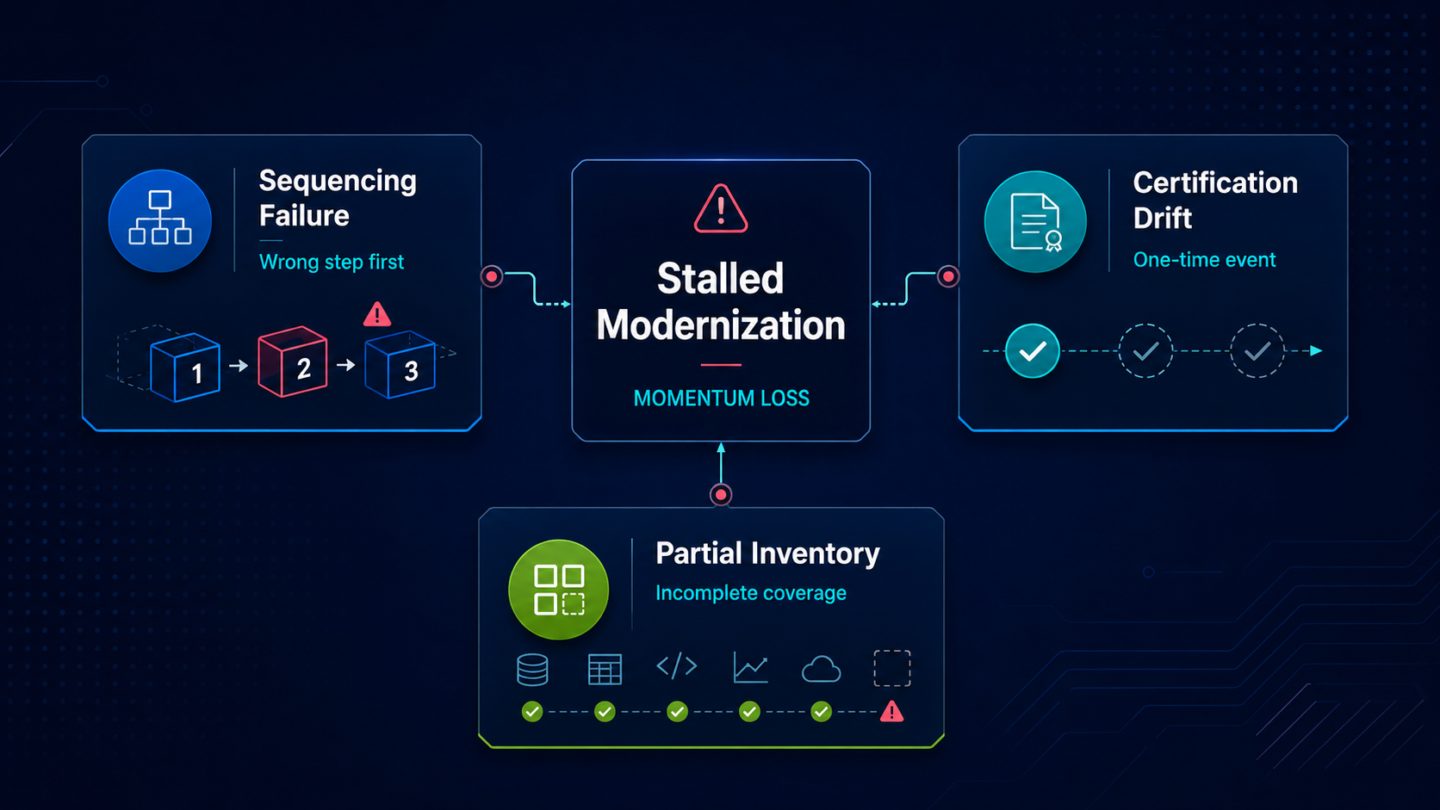
Three failure patterns account for most stalled modernization programs.
The first is sequencing failure: starting with the step that feels most urgent rather than the one that makes the next step possible. Certification launched before inventory is complete produces a certified subset while the rest of the estate continues to undermine trust. Contextualization attempted before certification produces machine-readable metadata attached to assets nobody has validated as authoritative.
The second is treating certification as an event rather than a practice. A team completes a certification pass, marks a set of assets as approved, and moves on. Six months later, those assets have drifted. New versions have been published without going through review. The certification label still exists but no longer means anything.
The third is underestimating the inventory scope. Most BI teams know their primary tools. Complete coverage means every tool: the secondary platforms running departmental reporting, the legacy systems that were never fully deprecated, the content that migrated into the new platform and never got cleaned up. Partial inventory produces partial governance.
The Sequencing Logic
The four-step sequence holds for a specific reason: each stage produces a dependency that the next stage requires, and shortcuts collapse the value of what follows.
Inventory is the precondition for certification. You cannot make principled decisions about which assets are authoritative if you do not have a complete picture of what exists. Certifying without full inventory means certifying a subset while the ungoverned portion of the estate continues to produce conflicting outputs.
Certification is the precondition for contextualization. AI tools need business context attached to assets that are known to be trustworthy. Context attached to uncertified assets is noise, not signal. Contextualization built on a partial or drift-prone certification layer will produce the same unreliable AI outputs that motivated the modernization initiative in the first place.
Contextualization is the precondition for activation. AI copilots and agents can only ground their outputs reliably if the business context they are grounding in is structured, current, and attached to certified assets. Activation without that foundation produces AI answers that cannot be traced, verified, or trusted.
The sequence is not a preference. It is the dependency chain that determines whether activation delivers anything the organization can act on.
Building the Inventory: What Complete Coverage Requires
An inventory that counts only the tools an organization actively manages is incomplete before it is finished. Enterprise BI environments accumulate content from multiple sources: migrations that moved some assets forward and left others behind, departmental reporting built in tools that IT does not centrally govern, dashboards created for projects that ended but never retired.
A complete inventory requires four attributes for every asset: ownership (who is responsible for this report), usage data (is anyone actually using it, and how often), certification status (has this asset been validated as authoritative), and relationships (what other assets depend on this one or share its definitions). Without those attributes, the inventory is a list. A list can support awareness but not governance decisions.
Manual inventory maintenance fails at enterprise scale. The estate changes continuously as teams build, modify, and abandon content across tools. An inventory built as a point-in-time exercise is outdated by the time it is presented to leadership. Sustained modernization requires an automated inventory layer that tracks changes as they happen.
Establishing Certification: The Difference Between Tagging and Governing
The most common certification failure is treating certification as a labeling exercise. A governance team reviews the inventory, marks a set of assets as certified, and considers the stage complete. The problem is that certification is not a state. It is a practice. A label applied once decays as the estate changes around it.
Durable certification requires three operational components. The first is a defined validation process: who reviews an asset before it is certified, what criteria they apply, and what documentation is required. The second is ownership that is institutional rather than individual: not a name attached to an asset, but a role with accountability for keeping that asset current and valid. The third is a refresh mechanism: a defined cadence or trigger that requires certified assets to be re-reviewed when the business definitions they represent change.
Organizations that treat these three components as ongoing governance infrastructure rather than a one-time project are the ones whose certified estate remains meaningful twelve months after the initial certification pass. The ones that treat certification as a campaign find that the label has degraded by the time they try to build contextualization on top of it.
Contextualizing for AI: What Machine Readability Requires in Practice
A certified analytics estate is ready for human governance. It is not automatically ready for AI.
AI tools require business context that is explicit, structured, and attached to the certified assets: what this metric means in this organization, how it differs from superficially similar metrics in other business units, what KPIs it feeds into, and who is accountable for its definition. Most organizations have this context. It exists in documents, in tribal knowledge among senior analysts, and in governance guides that are rarely updated. The problem is that none of that is machine-readable.
Making business context machine-readable has typically required significant manual build work tied to each specific AI tool deployment. A team integrates an AI copilot, then spends weeks documenting the context that tool needs to ground its outputs in the organization's actual definitions. That work does not transfer when the tool changes or when a new use case is added.
Contextualization as a modernization practice means building and maintaining that business context systematically, attached to the certified estate rather than to any specific AI deployment. The context persists and grows as the estate evolves, rather than being rebuilt from scratch each time a new AI workflow is introduced.
Measuring Modernization Progress at Each Stage
Analytics modernization produces infrastructure rather than visible outputs. That makes progress hard to communicate to leadership and hard to defend when priorities shift. Instrumenting each stage is what keeps the initiative accountable and visible.
At the inventory stage: percentage of BI tools with full asset coverage, total asset count by tool and status, percentage of assets with named ownership, and staleness rate measured as assets not accessed or validated within a defined period.
At the certification stage: percentage of active assets carrying a current certification, percentage with assigned ownership, time-in-review for assets pending certification decisions, and the conflict resolution backlog: how many assets have conflicting definitions that certification has not yet resolved.
At the contextualization stage: percentage of certified assets with structured business definitions, percentage with documented KPI relationships and ownership metadata, and coverage of the certified estate by the context layer.
At the activation stage: AI output traceability rate (what percentage of AI-generated answers can be traced back to a certified, contextualized asset), user confidence in AI-generated outputs, and reduction in escalations from AI tools to the BI team for answer verification.
The Platform Layer That Makes Modernization Continuous
The work described above is sustainable only if the infrastructure supporting it is automated. Manual inventory maintenance becomes a full-time burden at enterprise scale. Manual certification tracking drifts. Manual context builds are rebuilt from scratch for each new AI deployment. The governance practice collapses under its own weight before it reaches activation.
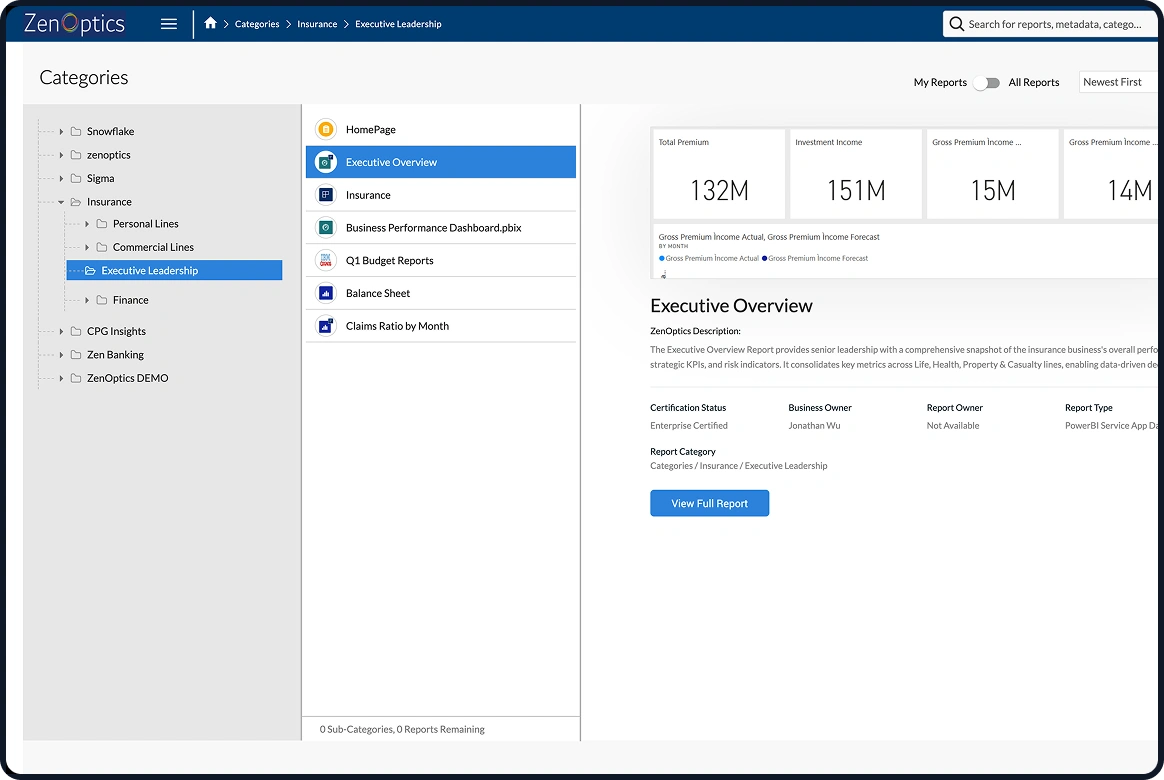
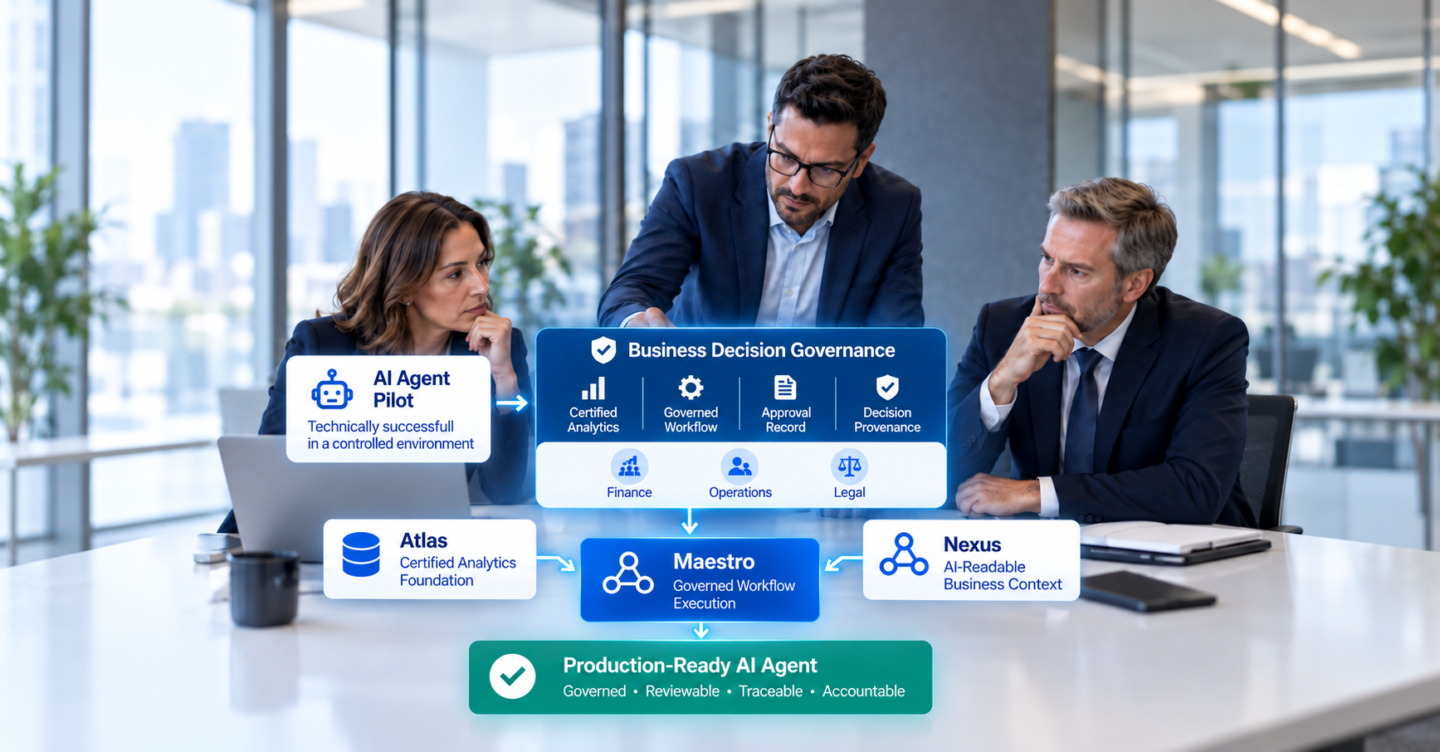
Atlas, ZenOptics's Analytics System of Record, handles inventory and certification continuously across Power BI, Tableau, Looker, and other BI tools in the existing environment without requiring those tools to be replaced. Usage data and ownership are tracked as the estate changes, so the inventory reflects current reality rather than a snapshot from six months ago. Certification is managed at the estate level: the governance practice is embedded in the platform rather than maintained through manual process.
Nexus automates contextualization. Rather than requiring a manual build of business context for each AI deployment, Nexus derives the definitions, KPI relationships, and semantic structure the certified estate contains and makes it machine-readable automatically. The context layer is maintained as the estate evolves rather than rebuilt from scratch each time it is needed.
Organizations implementing ZenOptics typically see 30 to 40 percent of their analytics estate comprised of duplicate or conflicting reports, and 20 to 40 percent faster analytics discovery once inventory and governance are in place. Those outcomes arrive before AI is introduced. The AI payoff comes after, because the estate is ready to support it.
For the full framework, including the four-step sequence and its rationale in the context of AI readiness, analytics modernization in the AI era covers the conceptual foundation.
Frequently Asked Questions
What is enterprise analytics modernization? Enterprise analytics modernization is the process of making an organization's entire BI estate trusted, governed, and machine-readable across all tools and business domains. It involves inventorying every analytics asset, certifying which assets are authoritative, structuring business context so AI can use those assets reliably, and activating AI workflows on that governed foundation. It is distinct from BI tool migration: modernization addresses the governance and structure of the estate, not the replacement of the tools it runs on.
What is a BI modernization playbook? A BI modernization playbook is a sequenced execution guide for taking an enterprise analytics estate from ungoverned to AI-ready. It defines what each modernization stage requires, the order in which stages must be completed, the failure modes to avoid at each step, and how to measure progress in terms leadership can evaluate. A playbook differs from a framework: a framework defines the stages; a playbook defines how to run them.
How long does enterprise analytics modernization take? Timeline depends on the size and complexity of the existing BI estate, the number of tools in scope, and how much automation is applied to inventory and governance. Organizations that approach modernization as a continuous practice rather than a bounded project make more durable progress: they establish the inventory and certification layers first, show measurable outcomes at each stage, and extend coverage over time rather than attempting full coverage before claiming completion.
What does an analytics governance framework include? An analytics governance framework defines the policies, processes, and ownership structures that keep an analytics estate trustworthy over time. At minimum it includes: an inventory practice that maintains current visibility into all analytics assets, a certification process that establishes and enforces which assets are authoritative, ownership assignment that makes individual teams accountable for specific assets, and a refresh cadence that keeps certification current as the business evolves. Governance frameworks that lack any of these components tend to produce certifications that decay and inventories that go stale.
What is trusted analytics? Trusted analytics describes an analytics estate in which the assets available to users and AI tools have been validated, certified, and assigned to named owners, so that anyone consuming an output knows it comes from a source the organization has designated as authoritative. Trusted analytics is the output of a working certification practice, not a technology feature. It requires ongoing governance to remain meaningful as the estate changes.
How do you measure analytics modernization progress? Meaningful measurement requires instrumentation at each stage. Inventory progress is measured by tool coverage, asset count, ownership rate, and staleness. Certification progress is measured by the percentage of assets certified, ownership coverage, and conflict resolution backlog. Contextualization progress is measured by the percentage of certified assets with structured business definitions and relationship metadata. Activation progress is measured by AI output traceability and reduction in AI-related escalations to the BI team. Without stage-specific metrics, modernization initiatives lose visibility and stakeholder confidence before the governance infrastructure is complete.
Published May 18, 2026Enterprise Analytics Modernization: Execution Over Strategy
Enterprise analytics modernization fails when sequencing is wrong. Discover why certification before complete inventory produces partial governance, how to measure progress at each stage, and the automation layer that makes modernization continuous instead of another stalled initiative.
Schedule 15min demo call