

Enterprise analytics is undergoing its most consequential shift in two decades. AI agents are moving from experimental features inside BI tools into the analytical workflows that organizations use to make real decisions: pricing, supply chain, financial close, risk assessment. Gartner estimates that 40% of enterprise applications will include task-specific AI agents by 2026, up from less than 5% in 2025. That deployment curve is steep, and the pressure on analytics and data leaders to participate in it is real.
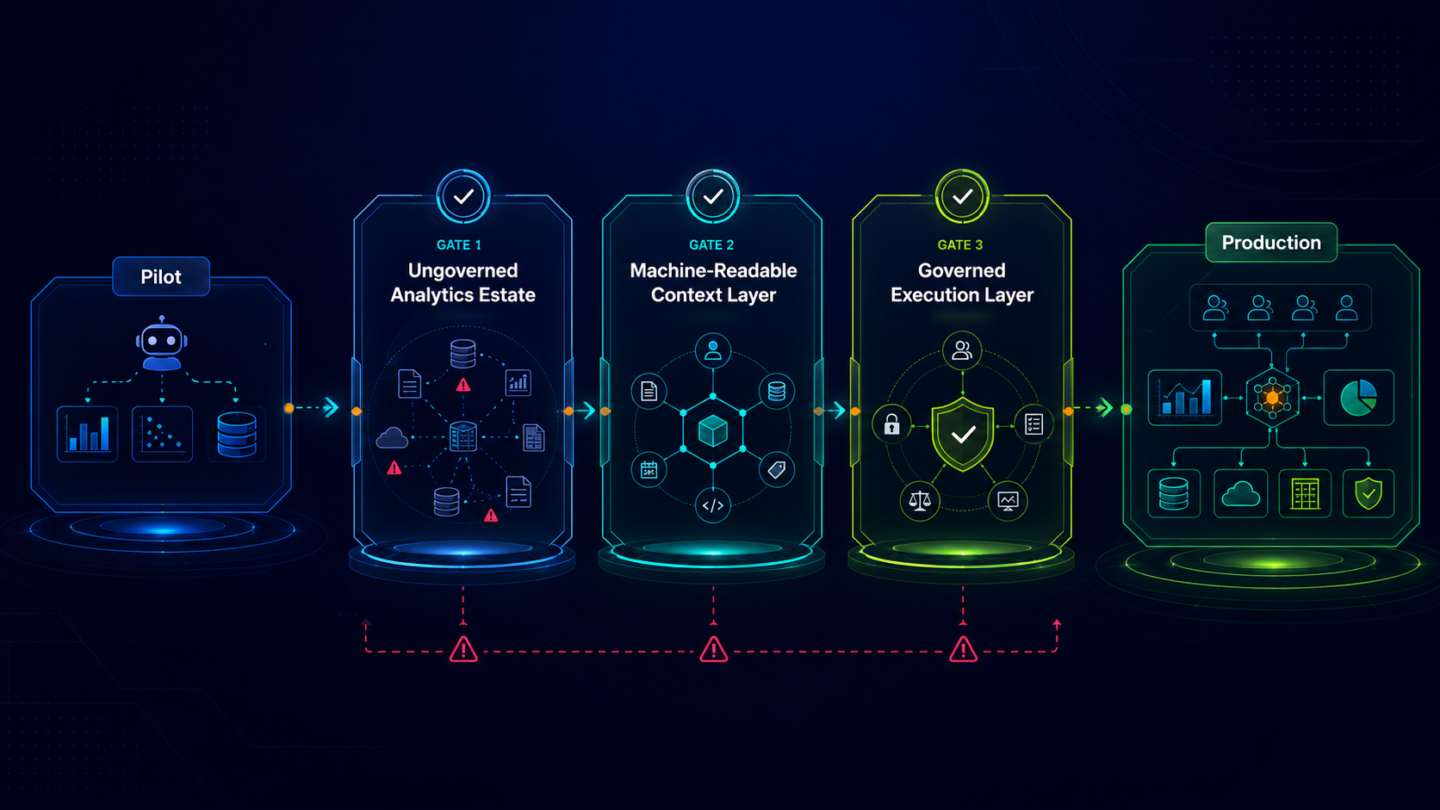
The challenge is not running a pilot. Almost any enterprise can stand up an agentic analytics proof of concept. The challenge is getting from a controlled demo to a production deployment that produces outputs the organization actually trusts and acts on. Most pilots don't make that crossing. Gartner predicts that more than 40% of agentic AI projects will be canceled by end of 2027, citing escalating costs, security concerns, and failure to demonstrate business value. The failure rate is not driven by technology immaturity. It is driven by three foundational gaps that most organizations enter the pilot stage without having closed.
Why Agentic Analytics Pilots Stall Before They Scale
When an agentic analytics pilot runs in a sandbox environment, it can look compelling. The agent queries data, returns structured outputs, and seems to understand the business question. The problems surface when the scope widens. Move from one business unit to three. Add a second AI tool alongside the first. Ask the agent to answer a question that involves data from multiple BI platforms. At that point, the three gaps that were invisible in a pilot become active blockers.
The first gap is an ungoverned analytics estate. The agent can only be as trustworthy as the analytics it queries. If the estate underneath contains duplicate reports, conflicting KPI definitions, uncertified dashboards, and orphaned content with no active owner, the agent will find all of it equally. It has no way to distinguish the certified version of revenue from the shadow version built by a regional analyst three years ago. Organizations implementing ZenOptics typically see 30 to 40 percent of their analytics estate comprised of duplicate or conflicting reports. An agent querying that estate will surface inconsistencies at scale, at exactly the moment when the organization is trying to demonstrate that AI can be trusted.
The second gap is the absence of a machine-readable analytics context layer. AI agents need more than access to data. They need to understand what the data means in this organization: what "revenue" means versus "net revenue," which KPI definition is authoritative for finance versus for the commercial team, how one metric relates to another in a governed hierarchy. Most organizations have this context: it lives in governance documents, in tribal knowledge among senior analysts, in spreadsheets that serve as unofficial business glossaries. None of that is machine-readable. An agent operating without a structured context layer fills the gaps using statistical inference. It produces answers that are probabilistically reasonable but contextually wrong, the enterprise equivalent of a confident hallucination.
The third gap is the lack of a governed execution layer. Even when an agent produces a correct answer, the question for enterprise deployment is whether the action the agent takes as a result is traceable, auditable, and aligned with approved business processes. In regulated industries, the requirement is explicit: every AI-driven decision must carry an auditable trail of what data it was based on, what recommendation it generated, and what action it drove. Without a governed execution layer, agents act without guardrails. Gartner projects that by 2030, 50 percent of AI agent deployment failures will be due to insufficient governance platform runtime enforcement. Organizations that wait to build governance until after agents are deployed will spend significantly more time and cost rebuilding than they would have spent building governance in first.
Gap One: The Analytics Estate Underneath the Agent
Agentic analytics runs on top of the existing analytics estate. The quality of what the agent returns is a direct function of the quality of what it has access to. An ungoverned estate, one where ownership is unclear, certifications are absent or decayed, and duplicate reports accumulate across tools, is not a foundation an agent can build trusted outputs on.
Making the estate agent-ready requires four things. Complete inventory across every BI tool in the environment, including secondary platforms that IT does not centrally manage. Certification of analytics assets that establishes which version of each metric is authoritative. Ownership assignment that gives every certified asset an accountable human. And continuous tracking of the estate as it changes, so the governance layer does not decay the moment the initial pass is complete.
The common failure mode is treating this as a one-time project. A team inventories the estate, certifies a set of assets, and marks the stage complete. Agents are then deployed against that certified subset while the ungoverned remainder of the estate continues to accumulate. The agent's outputs are accurate when they touch the governed portion and unpredictable when they do not. The resulting inconsistency is what drives stakeholders to distrust AI-generated analytics, not because AI doesn't work, but because the estate underneath it wasn't ready.
Gap Two: The Analytics Context Layer AI Actually Needs
A certified analytics estate is the starting point.
Certification confirms that an asset is authoritative. It does not tell an AI agent what the asset means. For an agent to produce answers that are contextually correct (not just statistically reasonable) it needs machine-readable business context: structured definitions of what each metric means in this organization, how it relates to other metrics, which KPIs it feeds into, who owns its definition, and how it differs across business units where similar terms are used with different meanings.
Many enterprise semantic initiatives struggle to scale and remain current over time. Manually constructing a knowledge base that captures the full semantic structure of an enterprise's analytics has historically required significant custom build work, often tied to a specific AI tool. When the tool changes, the build starts over. When the business definitions evolve, the knowledge base decays. Organizations end up with AI context that is either too narrow to be useful or too stale to be trusted.
The alternative is automated context generation: deriving the definitions, relationships, and semantic structure that already exist within the organization's BI metadata, and making that machine-readable without requiring a manual rebuild. The context layer built this way is tied to the estate rather than to any specific AI tool, so it persists as tools change and grows as the estate evolves. Organizations that have implemented this approach see AI deployment timelines compress significantly: the manual semantic build work that previously took months before an AI deployment could begin is replaced by automated derivation from existing metadata. Organizations implementing ZenOptics typically see AI deployment timelines move two to three times faster once the automated context layer is in place.
Gap Three: Governed Execution at the Decision Layer
The third gap is the one that separates organizations that can demo agentic analytics from organizations that can deploy it in regulated enterprise environments.
An agent that can answer questions correctly is useful. An agent whose every action is traceable back to a certified source, whose recommendations are aligned with approved business processes, and whose decisions carry a full audit trail from input to output is deployable in a regulated enterprise. That distinction (between an agent that works and an agent that can be governed) is what most agentic analytics architectures currently lack.
Decision traceability is the mechanism. Every AI-driven action needs to be traceable: which certified KPI triggered the analysis, what business context grounded the recommendation, what process boundaries the agent operated within, and what outcome it drove. Without that trace, the agent operates as a black box. Stakeholders will accept a black box in a demo. They will not accept it when the decision being made affects revenue recognition, regulatory reporting, or supply chain commitments.
Building governed execution requires an architecture that sits between the AI agent and the business process: a layer that enforces approved process boundaries, maps agent actions to trusted analytics sources, and captures the decision lineage needed for audit and compliance. This is not a feature that gets added after deployment. It is the infrastructure that makes deployment possible in the first place.
What the Production-Ready Architecture Looks Like
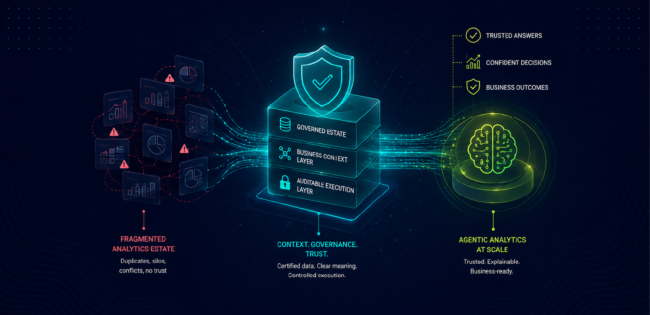
Production-ready agentic analytics is not a single technology. It is three layers working together.
The first layer is a continuously maintained analytics system of record. Every asset in the BI environment is inventoried, certified, and assigned to an owner. The governance layer is not a one-time exercise but an ongoing operational practice, automated so that as the estate changes the governance state changes with it.
The second layer is a machine-readable analytics context layer. The semantic structure, business definitions, KPI relationships, and ownership hierarchy are derived automatically from the existing BI metadata and structured so that AI agents can consume them reliably. The context layer is maintained as the estate evolves, not rebuilt from scratch each time a new AI use case is introduced.
The third layer is a governed execution environment. AI agents operate within defined process boundaries. Their actions are aligned to approved workflows. Every decision they drive carries a traceable lineage from the certified metric that informed it, through the recommendation it generated, to the outcome it produced. That lineage is the audit trail that makes the agent's outputs acceptable to compliance, risk, and executive stakeholders.
Organizations that have closed all three gaps report that the shift from pilot to production is less a technology problem than an infrastructure problem. The AI tools are largely ready. The analytics estate, the context layer, and the governed execution environment are where the work is.
The Platform Layer That Closes All Three Gaps
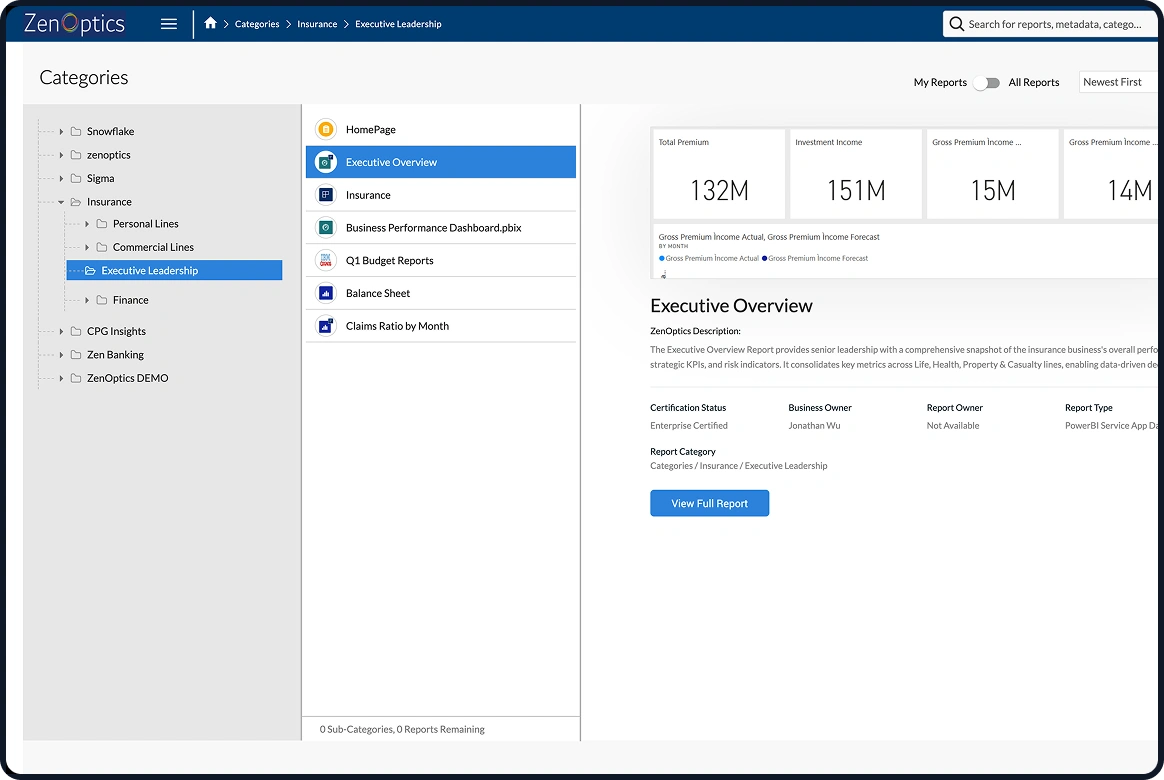
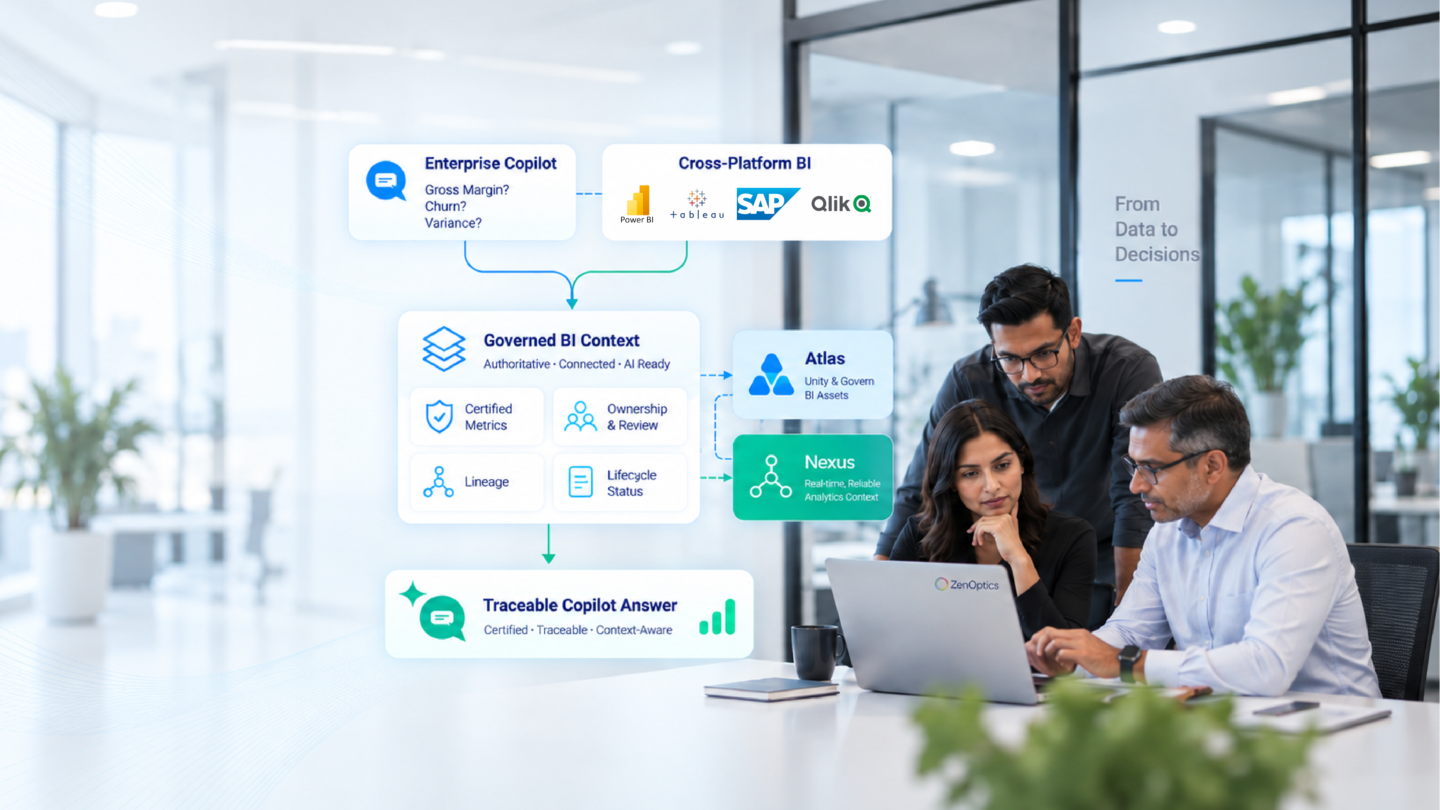
Atlas, ZenOptics's Analytics System of Record, addresses the first gap. Atlas continuously inventories analytics assets across Power BI, Tableau, Looker, and other BI tools, tracking ownership, certification status, and usage without requiring those tools to be replaced. The governance practice is embedded in the platform: the certified estate reflects current reality rather than a point-in-time snapshot, and it stays current as the estate changes.
Nexus, ZenOptics's AI Context Layer for Analytics, addresses the second gap. Rather than requiring a manual build of business context for each AI deployment, Nexus automatically derives the definitions, KPI relationships, and semantic structure the existing certified estate contains, and makes it machine-readable. The context layer is maintained as the estate evolves, available to any AI tool in the organization's stack without being rebuilt for each new use case.
Maestro, ZenOptics's Execution and Agent Control Layer, addresses the third gap. Maestro maps every AI-driven decision to the trusted analytics that informed it, enforces process boundaries, monitors agent behavior, and captures full decision provenance. Every action an agent takes under Maestro is traceable, auditable, and tied to an approved business process: the governance requirement for enterprise AI deployment in regulated industries.
Together, the three layers produce the production-ready foundation agentic analytics requires: a trusted estate (Know), an AI-ready context layer (Understand), and a governed execution environment (Act). For organizations whose analytics AI initiatives have stalled at the pilot stage, the question is typically not which AI agent to choose. It is which of these three layers is missing.
For organizations working through the analytics estate modernization that the first layer requires, analytics modernization in the AI era covers the foundational sequence. For the architecture that makes the full AI-readiness picture clear, the AI-ready analytics enterprise blueprint maps the decision intelligence stack end-to-end.
Frequently Asked Questions
What is agentic analytics? Agentic analytics is the use of autonomous AI agents to perform multi-step analytical tasks (querying data, synthesizing outputs, making recommendations, and in some cases triggering actions) without requiring a human to drive each step manually. Unlike single-turn AI queries, agentic analytics workflows operate continuously, adapt to new inputs, and can execute across multiple systems. The enterprise challenge is not deploying an agent that can run a task in a demo environment. It is deploying one that produces trusted, governed outputs at production scale.
Why do agentic analytics pilots fail to reach production? Most agentic analytics pilots fail to scale because they are run on top of an unprepared foundation. The three most common gaps: an ungoverned analytics estate where certified and uncertified assets are indistinguishable to an AI agent; the absence of a machine-readable context layer that tells the agent what metrics actually mean in the organization; and no governed execution layer that makes agent actions traceable and auditable. Each gap can be hidden in a controlled pilot and becomes a critical blocker at production scale.
What is the difference between agentic AI and agentic analytics? Agentic AI is the broader category of autonomous AI systems capable of multi-step task execution across domains. Agentic analytics refers specifically to AI agents operating within the enterprise analytics and business intelligence environment: querying BI platforms, interpreting KPIs, synthesizing reports, and driving analytical decisions. The distinction matters because the governance requirements for analytics decisions are distinct from those for general AI tasks: analytics outputs are tied to certified business metrics, regulated reporting, and executive decisions, which requires a specific layer of context and traceability that general-purpose agentic AI frameworks do not provide.
What does an enterprise need before deploying agentic analytics? Three things are required. First, a governed analytics estate: a complete inventory of all BI assets, with certification of authoritative sources and clear ownership assignment, maintained continuously rather than as a point-in-time exercise. Second, a machine-readable analytics context layer: structured business definitions, KPI relationships, and semantic metadata that AI agents can consume without requiring manual build work for each deployment. Third, a governed execution layer: an architecture that enforces approved process boundaries, maps agent actions to trusted analytics, and captures the full decision lineage required for audit and compliance. Enterprises that deploy agentic analytics without all three typically see inconsistent outputs, stakeholder distrust, and eventual project cancellation.
How does agentic analytics differ from traditional BI? Traditional BI is query-on-demand: a user navigates to a dashboard, runs a report, and interprets the output. Agentic analytics is autonomous and continuous: an AI agent monitors data, identifies signals, synthesizes outputs across sources, and can trigger next steps without waiting for a human to initiate the query. The shift from BI to agentic analytics is not just a technology change. It is an operational change. The governance, certification, and context requirements that were good practice in traditional BI become non-negotiable in agentic analytics, because the agent will act on whatever it finds, at scale, without a human reviewing each step.
How long does it take to make an analytics estate production-ready for agentic AI? Timeline depends on the size and complexity of the existing BI estate, the number of tools in scope, and how much automation is applied to inventory and governance. Organizations that approach readiness as a continuous practice rather than a bounded project make faster and more durable progress. Establishing the inventory and certification layers first, with automated tooling to maintain them, compresses the timeline significantly compared to manual governance approaches. Organizations implementing ZenOptics across these layers typically see AI deployment timelines move two to three times faster than manual semantic build approaches, because the context layer is derived automatically from what already exists rather than built from scratch.
Published May 22, 2026Why Agentic Analytics Pilots Fail to Scale
Learn why agentic analytics pilots stall before they scale and how Atlas, Nexus, and Maestro give enterprises the trusted estate, AI context, and governed execution needed for production AI.
Schedule a 15min demo call