

A March 2025 McKinsey Global Survey of 1,491 respondents across 101 countries found that more than 80% of organizations are not seeing a tangible impact on enterprise-level EBIT from their gen AI investments. Three-quarters of those organizations already use AI in at least one business function. Deployment is not the problem. Standard AI readiness assessments were not designed to explain that gap.
Standard AI readiness frameworks were designed for a specific era: when deploying AI meant building and governing machine learning models. That era has not ended, but the dominant deployment pattern has shifted. Most enterprise AI in 2026 is not about building models. It is about deploying AI copilots and agents that read from existing analytics to answer business questions on demand. No major AI readiness framework has been updated to assess whether the analytics layer those systems read from is in any condition to be trusted.
What Standard AI Readiness Frameworks Were Designed to Assess
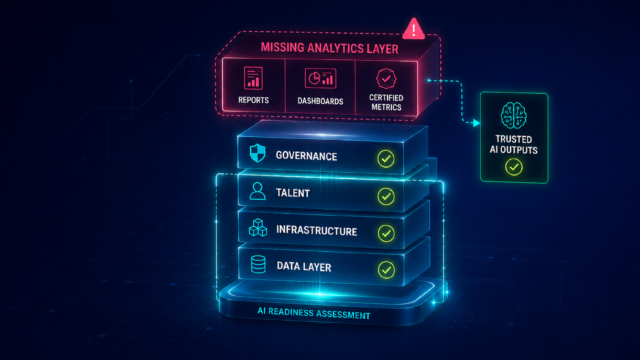
The major frameworks in circulation cover the same dimensions with different vocabulary. OvalEdge's framework organizes AI readiness across three dimensions: Why (purpose alignment and strategic intent), Who (workforce readiness and change management), and How (infrastructure, data quality, and governance capabilities). The Thinking Company's 8-dimension model evaluates Leadership Commitment, Data Readiness, Technology Infrastructure, Talent and Skills, Process Maturity, Culture and Change Readiness, Governance and Ethics, and Strategic Alignment. Broader assessments from technology providers and consultancies (including Microsoft's AI Readiness Assessment) address similar ground: data foundations, governance and security, infrastructure, and organizational alignment.
These are legitimate, well-structured frameworks. The dimensions they assess (data quality, governance at the pipeline level, infrastructure, talent, leadership alignment) are genuine prerequisites for enterprise AI. None of them are wrong to include.
The question is what era these frameworks were built for. They were designed when enterprise AI meant training models on data tables, and clean, governed, accessible data was the direct input to AI. That made data readiness the central question. When enterprise AI means deploying copilots and agents that query existing BI outputs, however, the direct input to AI is not the data warehouse. It is the analytics estate.
None of this is a criticism of those frameworks. They addressed the right problem for the right era. The issue is that the dominant enterprise AI use case shifted before any major assessment framework was updated to reflect it.
The Layer AI Agents Actually Read From
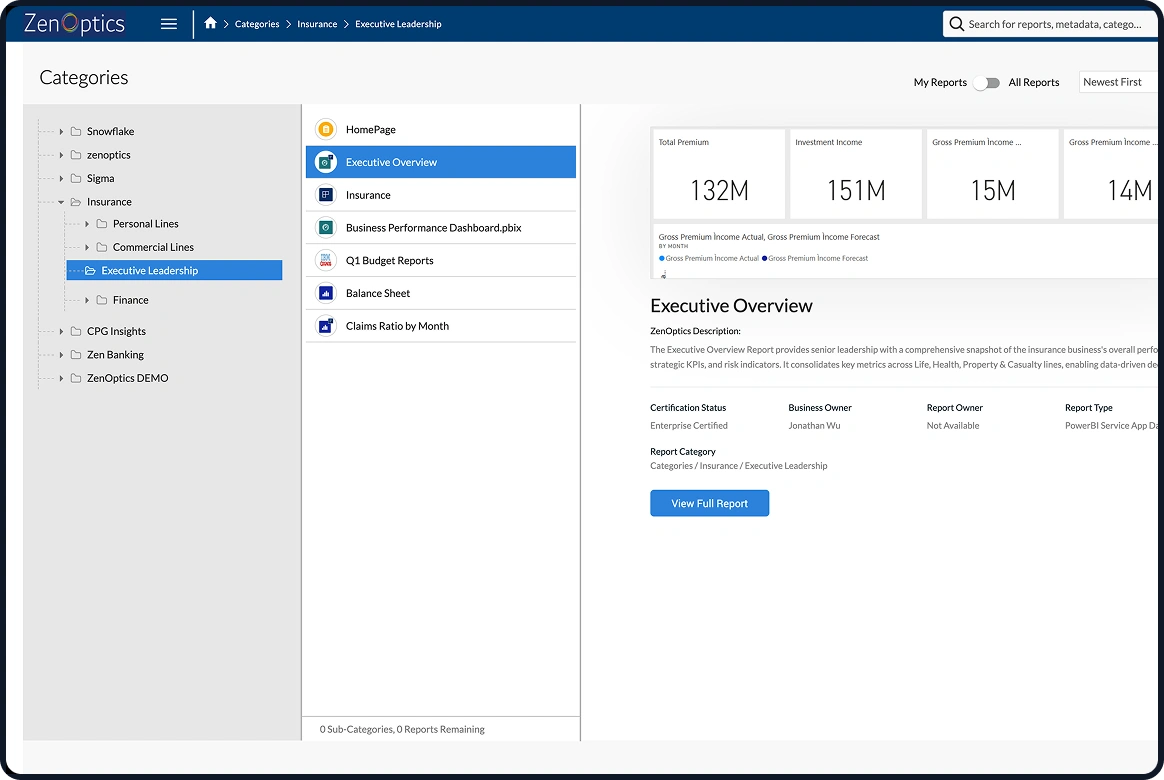
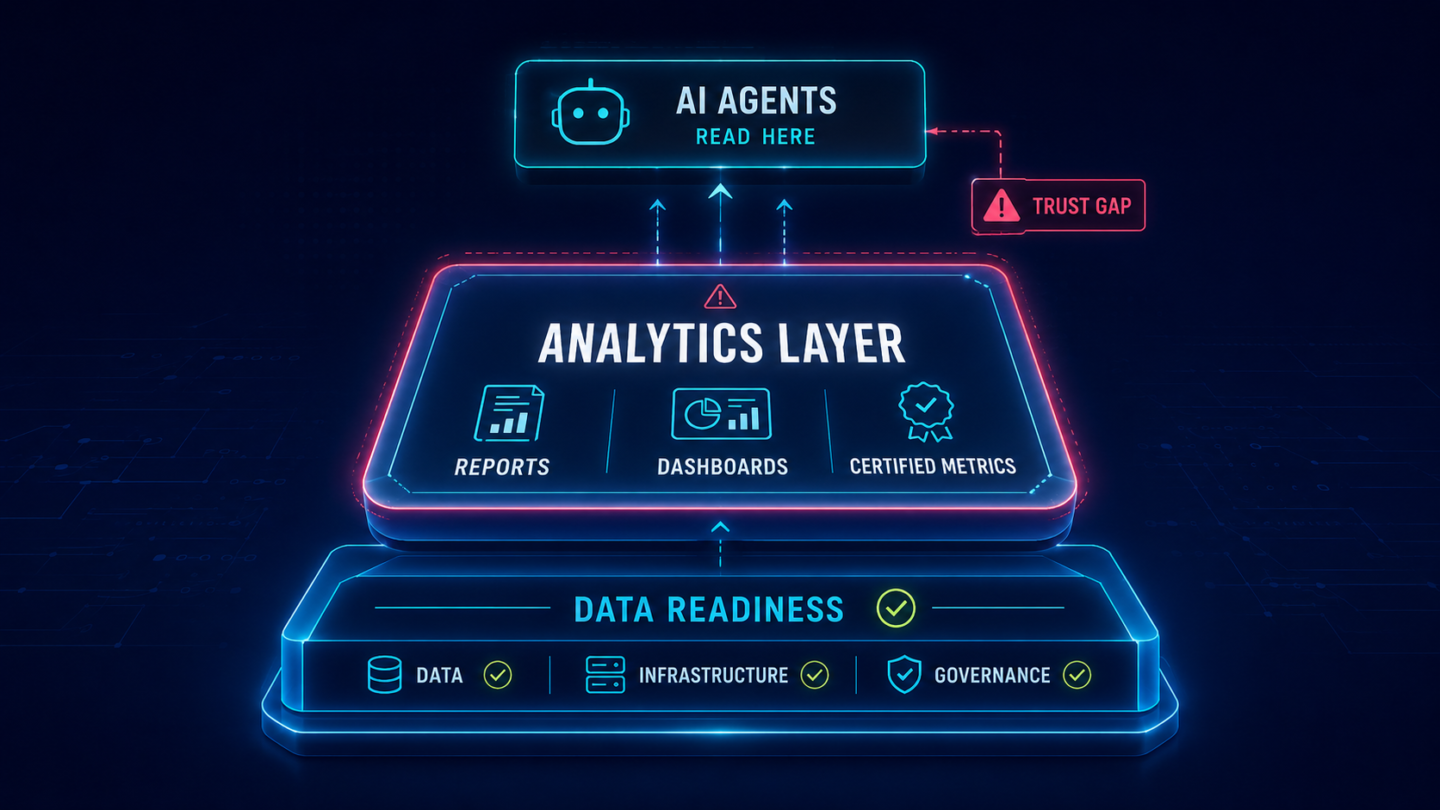
When an AI copilot or agent answers a business question in 2026, it does not query the data warehouse. It reads from the analytics estate: the reports, dashboards, certified metrics, and KPI definitions that sit above the data and represent how the business measures itself.
If a finance leader asks Microsoft Co-Pilot, "What is our Q2 gross margin by region?", Co-Pilot does not process raw transaction records. It reads whatever gross margin report or metric definition it can locate in the analytics estate. If that estate contains three conflicting gross margin reports across Power BI, Tableau, and SAP BO, Co-Pilot returns whichever it finds first. The underlying data may be clean and well-governed. The analytics layer is not.
Most analytics leaders discover this gap the same way: their first AI copilot deployment delivers inconsistent answers, the investigation traces back to duplicate reports and uncertified metrics, and they realize that nothing in their readiness work assessed whether those reports and metrics were fit for AI to read. This is the readiness gap behind most enterprise AI trust failures. Standard AI readiness frameworks assess whether the data layer is ready. They do not assess whether the analytics estate is certified, inventoried, and structured in a form AI can interpret correctly.
Four Dimensions Standard Frameworks Do Not Assess
The analytics estate has four dimensions of readiness that appear in no major AI readiness framework.
Inventory Completeness. Standard frameworks assess whether data is cataloged and governed. They do not assess whether every active report and dashboard across every BI tool in use (Power BI, Tableau, SAP BO, Qlik, and others) has been inventoried in a single, cross-tool view. Each BI tool maintains its own catalog. None see across tools. An organization running four BI tools has four partial, disconnected catalogs. AI agents reading from an incomplete inventory can only surface what they can see, which is typically a fraction of the full estate.
Certification Coverage. Standard frameworks assess data governance: who owns data tables, whether lineage is documented, whether quality thresholds are met. They do not assess whether analytics assets carry a machine-readable certification status that AI can distinguish from uncertified variants. When an AI agent finds multiple versions of the same metric or dashboard, it needs to know which one is certified. If that certification status lives in a SharePoint wiki or a Word file rather than a machine-readable governance layer, the AI cannot make the distinction.
Metric Governance. Standard frameworks assess data stewardship at the table and pipeline level. They do not assess whether each certified KPI has a designated owner accountable for its accuracy, whether calculation logic is documented, or whether there is a formal review cadence tied to policy changes. This is a different governance layer from data stewardship: different owners, different failure modes, different processes. Standard frameworks treat metric ownership as part of data stewardship. In most enterprises, it is not governed there at all.
Context Encoding. Standard frameworks assess data integration and lineage. They do not assess whether the relationships between certified metrics are encoded in a machine-readable format that AI agents can follow at query time. When an AI agent answers a question spanning multiple KPIs (revenue per account, net revenue retention, gross margin by channel), it needs the approved relationship between those metrics as the business defines it, not a reconstruction inferred from co-occurrence patterns in historical queries. An analytics context layer that encodes these relationships is what separates AI that follows business logic from AI that approximates it.
The self-assessment for all four dimensions is in The AI Readiness Checklist Every Analytics Leader Should Complete.
Why the Gap Persists
Standard frameworks were built for the right problem at the right time. Machine learning model deployment (the dominant enterprise AI pattern through roughly 2023) required assessing the data layer: pipelines, quality, lineage, access controls, and infrastructure. The analytics estate was not where AI systems read from in that era, so it was not where assessments looked.
The shift from model-building to agent-deployment happened faster than frameworks evolved. AI copilots and agents moved from experimental pilots to production enterprise deployments within roughly 18 months. Assessment frameworks take longer to update. The frameworks in broad use today reflect the 2021 to 2023 enterprise AI landscape. They have not been extended to assess the analytics estate those AI systems now read from.
In practice, an organization can score well on a standard AI readiness assessment (strong data quality, governed pipelines, trained workforce, aligned leadership) and then deploy AI copilots into an analytics estate that is entirely unprepared. The standard assessment did not assess the layer that is failing.
What a Complete Assessment Covers
A complete AI readiness assessment in 2026 addresses both layers. The data layer assessment most organizations have already completed is not replaced. The analytics estate assessment is additive.
For the data layer, standard frameworks handle this well. If your organization has not completed one, begin there.
For the analytics estate layer, the four dimensions above (Inventory Completeness, Certification Coverage, Metric Governance, and Context Encoding) require a separate, dedicated assessment. No standard framework reaches them.
Atlas addresses the first three dimensions by maintaining the certified analytics estate across BI tools continuously: cross-tool inventory, certification status, metric ownership, and review cycle tracking across Power BI, Tableau, SAP BO, Qlik, and 100+ connected systems. Nexus addresses Context Encoding by deriving the analytics context layer automatically from the governed estate Atlas produces. Together they address the four dimensions standard frameworks do not reach. Organizations that govern their analytics estate with Atlas and Nexus typically see a 20–40% improvement in analytics discovery speed and a 30–40% reduction in duplicate reports.
Frequently Asked Questions
What do standard AI readiness assessments typically cover?
Standard assessments evaluate data quality, data governance at the pipeline level, technology infrastructure, talent and skills, leadership alignment, organizational culture, and strategic readiness. The most comprehensive frameworks add responsible AI governance and regulatory compliance. None assess the analytics estate: the reports, dashboards, certified metrics, and business context AI systems read from when answering business questions. That layer requires a separate, dedicated assessment.
Why do organizations fail at AI deployment even after passing a standard readiness assessment?
Standard assessments evaluate the data and infrastructure layer: the foundation AI models are built on. AI copilots and agents read from the analytics estate, not the data warehouse directly. An ungoverned analytics estate produces inconsistent AI outputs regardless of how well the underlying data scores on quality and governance checks. Passing a data-layer assessment and then deploying AI into an uncertified analytics estate is the pattern behind most enterprise AI trust failures.
How is analytics estate readiness different from data readiness?
Data readiness assesses whether data is clean, accessible, and governed at the pipeline and warehouse level. Analytics estate readiness assesses whether the reports, dashboards, and certified metrics AI systems read are accurate, certified, and governed. These address different layers, with different owners, different processes, and different failure modes. Most enterprises have active data readiness programs. Very few have started analytics estate readiness programs. In most organizations, no single person currently owns both.
Which AI readiness framework is most complete for enterprise AI deployment in 2026?
No standard framework currently addresses the analytics estate layer. The Thinking Company's 8-dimension model and Microsoft's AI Readiness Assessment are among the more comprehensive general frameworks available, covering data readiness, governance, infrastructure, talent, and culture rigorously. Neither extends to analytics estate inventory, certification coverage, metric governance, or context encoding. A complete assessment in 2026 requires both: a standard framework for the data layer, plus the four-dimension analytics estate assessment. The self-assessment is in The AI Readiness Checklist Every Analytics Leader Should Complete.
What is the analytics estate in the context of AI readiness?
The analytics estate is the full collection of reports, dashboards, certified KPIs, and business context that AI agents read when answering business questions. It sits above the data layer and below the AI application layer. Standard AI readiness frameworks assess the data layer. The analytics estate requires its own assessment. The framework for understanding this layer is in Your Analytics Estate Isn't AI Ready. Here's How to Fix It.
Published July 6, 2026Why Most AI Readiness Assessments Miss the Analytics Layer
The analytics estate assessment identifies the gaps between where your estate is today and where AI systems need it to be. Schedule a 15-minute session to run it with ZenOptics.
Schedule a 15min demo call