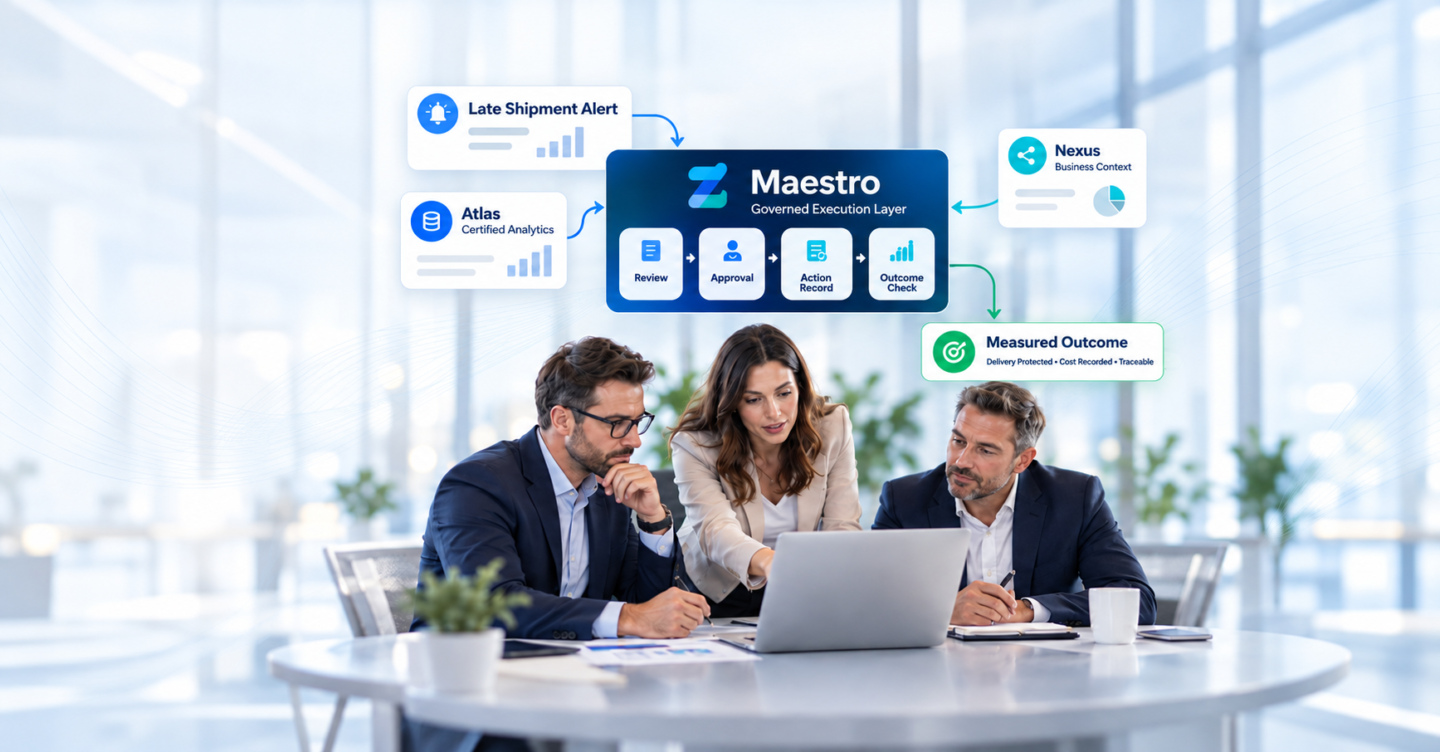


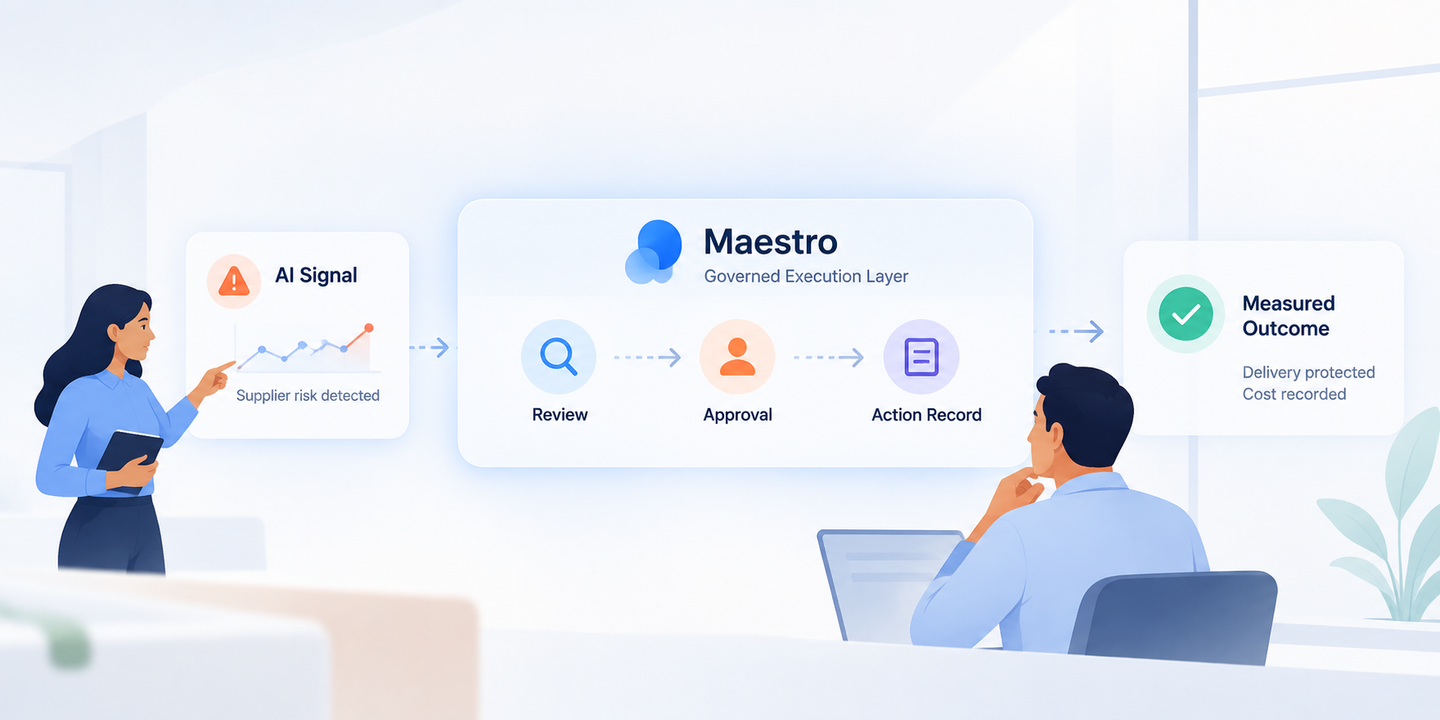
A supplier performance dashboard shows that late shipments have crossed an agreed threshold. An AI agent recommends a procurement review. A buyer checks the affected orders and asks a manager to approve a contingency plan. The company places a limited order with an alternate supplier to protect a production schedule.
Three months later, finance asks why the company paid more for that material.
“The AI flagged a supplier risk” is a starting point, but it is not a complete answer. Finance needs to know which metric triggered the alert, what the buyer learned during the review, who approved the additional cost, and whether the alternate order prevented a production delay.
This hypothetical scenario illustrates a challenge that grows as AI becomes involved in enterprise operations. An agent can help identify a risk and move work forward. The organization still needs to explain how the insight became a decision, who authorized the action, and what happened afterward.
That requires more than faster analytics. It requires governed execution.
The Gap Between Seeing a Signal and Taking Action
Enterprises have invested heavily in making analytics easier to find and use. Dashboards bring performance measures together. Embedded analytics puts information inside business applications. AI can summarize changes and recommend next steps.
Those capabilities help a team notice a supplier problem sooner. They do not, on their own, determine whether the proposed response is appropriate.
A late-delivery rate may have crossed a threshold, but several questions remain. Does the metric include the right shipments? Is the increase driven by one supplier facility or a broader pattern? Which customer commitments or production orders are exposed? Is the supplier already following a recovery plan? How much additional spending can the buyer authorize?
The answers may sit in different reports, applications, emails, and people’s experience. If the decision unfolds across those places without a defined process, it becomes difficult to reconstruct later.
This is why the analytics-to-action workflow matters. The objective is not simply to put an alert in front of someone. It is to connect that alert to a review, an authorized response, and a record of the result.
What Should Happen After an AI Agent Raises an Alert?
An AI recommendation should begin a decision process appropriate to the action being considered. In the supplier example, the process might work like this:
- Verify the signal. Confirm the late-delivery metric, its definition, the period measured, and the orders affected.
- Assess the business impact. Determine whether the delays threaten inventory, a production commitment, or customer delivery.
- Evaluate the options. Ask the supplier for a recovery plan and compare it with an alternate source, expedited freight, or a production schedule adjustment.
- Obtain approval. Route any additional cost or supplier change to the person authorized to approve it.
- Record the action. Capture the decision, its rationale, the approver, and the order or process change that followed.
- Check the outcome. Review whether the response protected delivery and what it cost.
An agent may help with several of these steps. It could identify affected orders, assemble relevant analytics, draft a recommendation, or route a review. But its ability to perform a task does not establish its authority to make every decision in that process.
The distinction matters most when an action has financial, operational, customer, or compliance consequences.
Four Requirements for Governed Execution
A governed process needs to preserve the connection between the original signal and the business outcome. Four requirements make that possible.
1. Trusted analytics at the point of decision
The team must be able to identify the metric that prompted the action. That includes its definition, owner, certification status, and the version available when the alert was raised.
Suppose “late delivery” means arrival after the requested date in one report but after the confirmed date in another. Both reports could show accurate numbers while prompting different decisions. A reviewer needs to know which definition the agent used.
Certification provides a way to identify the analytics assets approved for use in a business process. It also gives the organization a basis for checking the decision later, especially if the dashboard or metric definition has since changed.
2. Business context for interpreting the signal
A threshold breach does not tell the whole story. Ten late shipments of a readily available item may be less urgent than one delayed component that could stop a production line.
Business context connects the metric to affected orders, supplier commitments, inventory, costs, and operational priorities. It helps people and AI systems interpret the signal according to what it means for the company.
Without that context, an agent can produce a plausible recommendation that addresses the number on a dashboard but misses the consequence of acting on it.
3. Authority built into the workflow
Different steps require different levels of authority. A buyer may investigate a delay. A procurement manager may approve a limited alternate order. A larger contract change may require legal and finance review.
Those rules should be part of the workflow. The process should show when human review is required, what conditions trigger escalation, and who can approve each type of action. It should also record whether a recommendation was accepted, changed, or rejected.
This makes the decision reviewable. It also gives AI agents a clear role within the process instead of leaving them to infer what they are allowed to do.
4. An outcome the team can revisit
An action record establishes what the organization did. An outcome check helps determine whether it was the right response.
For the supplier decision, the team might review whether the alternate order arrived on time, whether production continued as planned, and how much the response added to cost. If the original supplier recovered sooner than expected, that finding should inform future decisions too.
The outcome may not be attributable to one action alone. The purpose is to give the organization enough evidence to assess the decision and improve its response to the next exception.
Why an Agent Log Is Not the Whole Decision Record
An agent log can show what an AI system recommended or which task it completed. That is useful, but the business decision often extends beyond the agent.
A manager may change the recommendation after speaking with a supplier. Finance may approve a smaller contingency order than the one initially proposed. Operations may decide to adjust the production sequence instead of changing suppliers. The final action may take place in a procurement or ERP system.
To understand the decision, the organization needs the relevant analytics, the agent’s contribution, the human review, the authorization, and the resulting action connected in a way people can follow. A transcript of the agent’s activity alone cannot explain every part of that sequence.
This is the practical meaning of decision provenance: being able to trace the evidence and process behind a consequential action.
How ZenOptics Connects Analytics to Governed Action
ZenOptics addresses different parts of this challenge through Atlas, Nexus, and Maestro.
Atlas provides the governed analytics foundation. It catalogs reports, dashboards, KPIs, and metrics across the enterprise, giving teams visibility into definitions, ownership, and certification. In the supplier example, Atlas helps establish which performance metric the team should rely on.
Nexus provides an analytics context layer for AI. It helps AI systems understand business definitions and relationships among analytics assets. That context matters when an agent must interpret what a change in supplier performance means rather than merely repeat a number from a report.
Maestro structures the process that follows the insight. It supports defined workflow steps, ownership, reviews, approvals, rejections, and escalations, while recording the actions taken during execution. In the supplier example, Maestro provides a way to guide the alert through investigation, approval, and action.
Together, these layers support a clearer path from trusted analytics to a governed business process. They help teams address the questions a leader will ask later: What did we know? What did the AI recommend? Who made the decision? What did we do?
Frequently Asked Questions
What is governed execution in enterprise AI?
Governed execution is a defined process for turning an AI-supported insight into an authorized business action. It establishes the analytics used, the business context, the required review and approval steps, and a record of what was done.
Why isn’t a certified metric enough?
A certified metric gives the decision a trusted analytical basis. The organization must still interpret the metric in context, choose a response, confirm who has authority to approve it, and record the action. Trust in the number does not automatically govern the decision made from it.
Can an AI agent take action in a governed workflow?
An AI agent can participate in workflow steps according to the permissions and controls defined for that process. The level of autonomy should reflect the consequence of the action. Gathering evidence and routing a review call for different authority than approving additional spending or changing a supplier.
How do Atlas, Nexus, and Maestro work together?
Atlas governs the analytics assets and metrics. Nexus helps AI interpret those assets in business context. Maestro structures the workflow through which teams review, approve, and act on the insight.
Published September 28, 2026The Question to Ask After Every AI-Supported Decision
An AI agent may identify a supplier risk in seconds. The harder test comes months later, when someone asks why the organization acted and whether that action worked. A defensible answer connects the trusted signal, the business circumstances, the recommendation, the approval, the action, and the result. That connection gives leaders a way to review decisions, identify where a process broke down, and improve the next response. Could your team reconstruct an AI-supported decision three months after it was made? See how ZenOptics supports governed execution
Schedule a 15min demo call