

The AI copilot is live. It can answer questions across the analytics estate in seconds—but only if it understands which reports, metrics, and KPIs it can trust. In the first weeks, it impresses. Then the failures start. The copilot surfaces a revenue report deprecated eight months ago. It returns two different figures for the same quarterly metric, because it found two versions in two different BI tools and had no way to determine which was authoritative. It returns a result that includes data a user's role should not be able to see, because the portal does not hold a unified access model: each connected BI tool enforces its own permissions independently.
These are not AI hallucinations. They are governance failures exposed by AI. The AI found real content in the analytics estate. The problem is that the estate it searched has no certified layer: no record of which report version is authoritative, no lineage tracing which data feeds which metric, no consolidated access policy the AI can check before surfacing a result. The portal was designed to present what is there. AI needs to know what is trustworthy, traceable, and permissioned, and no traditional analytics portal, homegrown or commercial, was built to provide that.
What the Portal Was Designed to Do
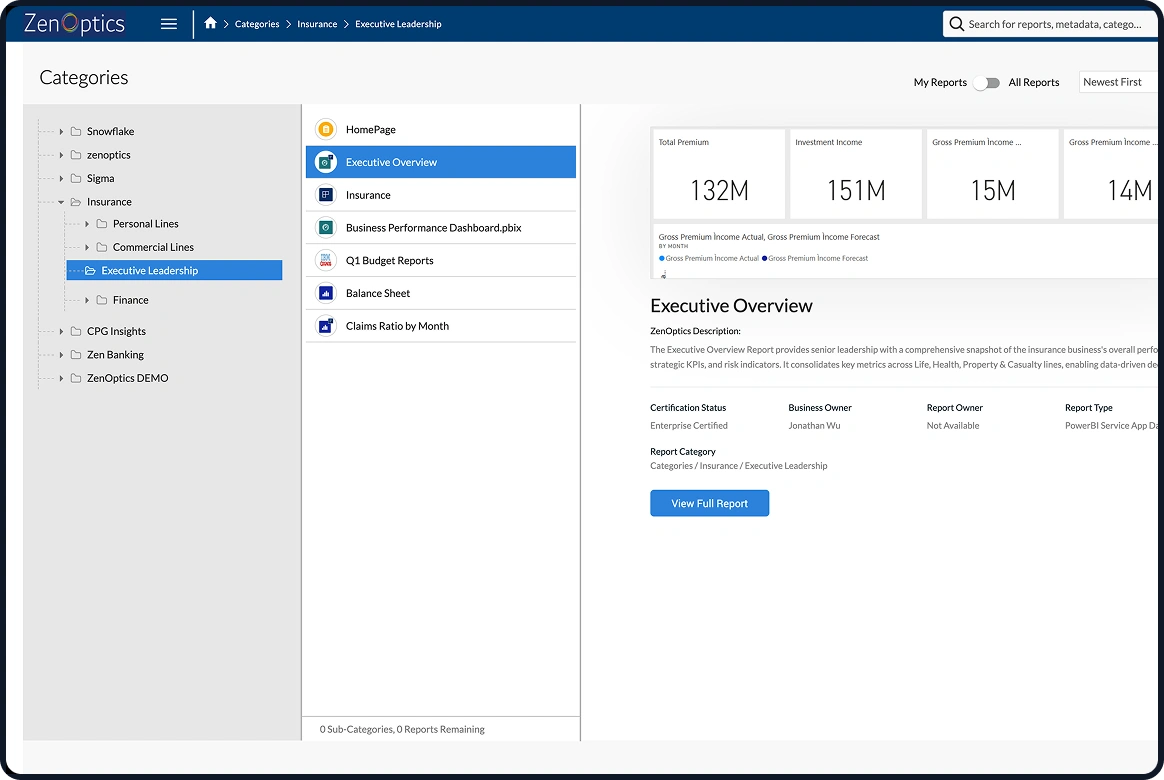
Traditional analytics portals were designed to help people discover reports—not to provide AI with trusted business context. It connects to BI tools, applies access rules through those integrations, and presents a searchable interface. For human-guided navigation, this architecture works. A user who opens a revenue dashboard exercises judgment. If they find two versions of the same metric, they know to ask the owning team which one to trust. If a report looks outdated, they can escalate.
AI does not have that judgment, and it cannot escalate. It requires certified versus deprecated status, report ownership, lineage, and unified access policy to be present as structured data in the systems it queries. The portal was not designed to hold or serve this context. It was designed to display what exists, not to distinguish what is authoritative.
As organizations embed copilots and AI agents into analytics workflows, this architectural boundary becomes impossible to ignore. As covered in Why Modern Analytics Portals Fail Without a Governance Layer, the display layer and the governance layer are architecturally separate functions. When the only users were humans, the absence of a governance layer created friction and inconsistency. When the user is AI, that absence creates answers that are actively wrong and delivered with confidence.
The Three Governance Gaps AI Exposes
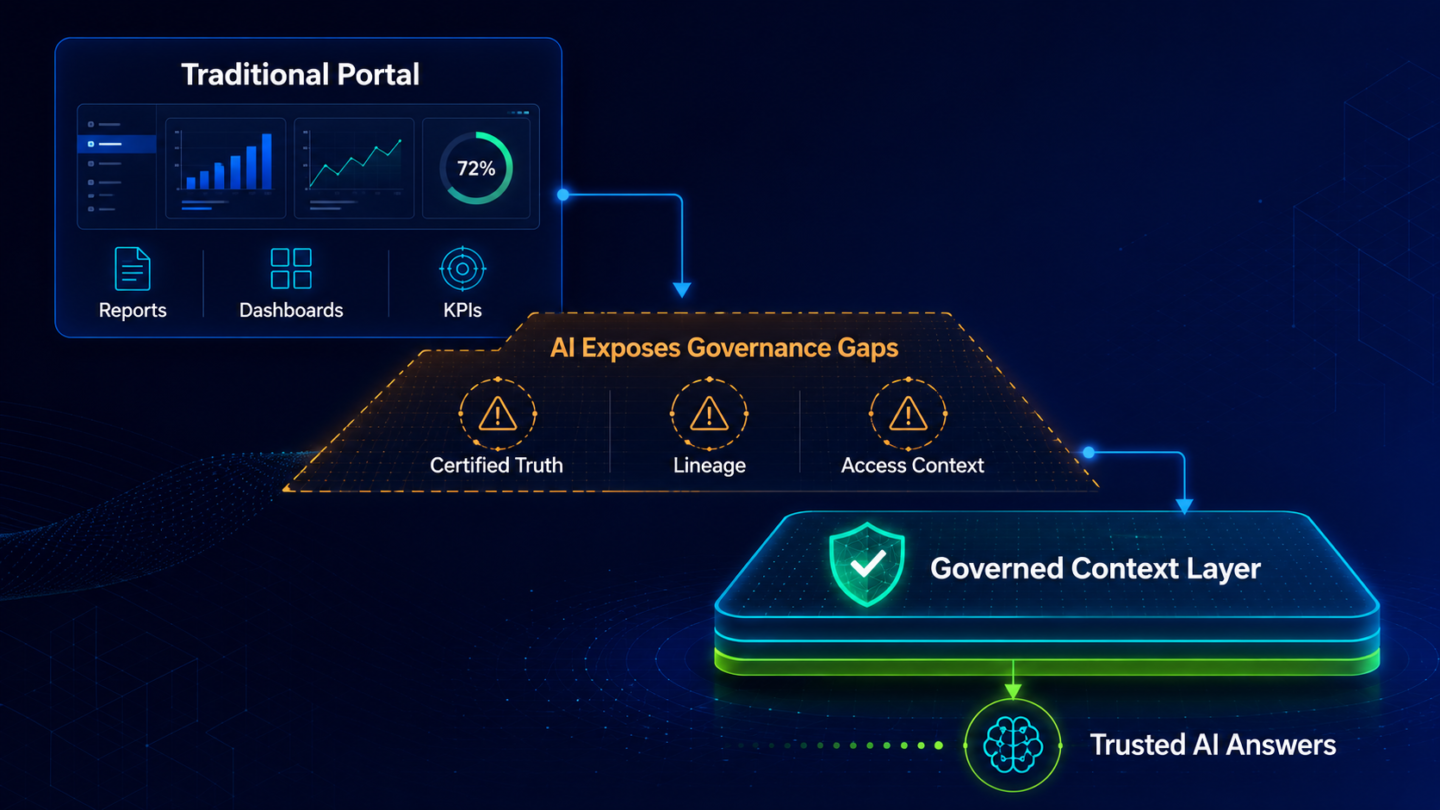
Governance gaps have always existed. AI simply exposes them at enterprise scale.
The first is the absence of certified truth. The analytics estate typically holds multiple versions of the same metric across connected BI tools. A quarterly revenue figure may exist in Tableau, Power BI, and a homegrown report, each fed by a different query, each last updated at a different time. A human user can ask which one to trust. AI cannot. Without a certification layer that marks the authoritative version, AI surfaces whatever it finds first or ranks highest. That may be a deprecated report, a duplicate, or a version that the owning team has already flagged for retirement.
The second gap is lineage. When AI returns an answer, the value of that answer depends on its provenance. "Revenue is $4.2M" is an answer. "Revenue is $4.2M, sourced from the March close report in Tableau, last refreshed 2026-07-15, owned by the Finance Analytics team" is a trustworthy answer. Lineage is not stored in the portal. It requires a governed inventory that tracks which data source feeds which report, who owns it, and when it was last validated.
The third gap is unified access context. Each BI tool connected to the portal enforces its own access model. The portal presents a unified surface, but it does not hold a consolidated record of what each user is permitted to see across all connected platforms. When AI searches across the estate and returns a result, it may be surfacing content from a platform where the requesting user's access was never established, was revoked in one tool but not reflected across the others, or was granted with access scope that the user's role was never meant to provide.
These are not AI problems, and they are not data governance problems. Data governance addresses quality, lineage, and schema at the data layer. What AI exposes on an analytics portal are failures at the report and KPI layer: which version of a metric is authoritative, who owns it, and what access rules apply across connected BI tools. That is analytics governance, and it is a function that the portal was never designed to provide. As Your Intranet Isn't Your Analytics Portal establishes, each layer of the analytics architecture has a defined function. AI deployment makes the absence of a governance layer visible in a way that is hard to defer.
What AI Actually Needs from the Analytics Layer
The framing that AI needs a smarter search interface or a better query layer misses the structural problem. AI needs a governed context layer.
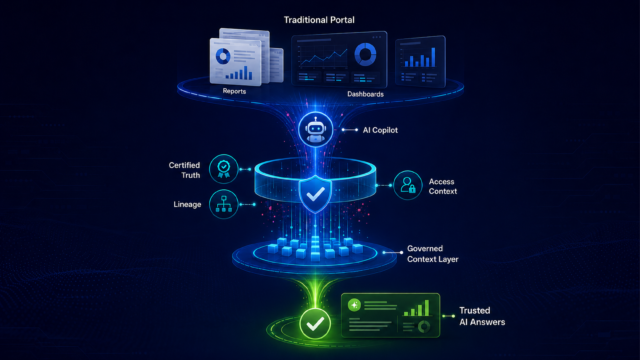
A governed context layer provides capabilities the portal does not. A certified report registry tells AI, before returning any result, whether a report is certified, who owns it, and whether it is still active. Lineage context lets AI trace and disclose the provenance of any answer: where the data comes from, when it was last refreshed, and who is accountable for it. Access policy is maintained in the governance layer rather than distributed across individual BI tools, so AI checks permissions from a single source before surfacing any result, regardless of which connected platform holds the underlying report.
AI is only as reliable as the business context surrounding the analytics it consumes. Without that context, faster answers simply mean faster mistakes.
This is where an Analytics System of Record becomes essential. Atlas maintains the governed inventory across connected BI platforms, tracking certification status, ownership, lineage, and lifecycle state through direct integrations with each platform. Nexus is the AI context layer built on top of Atlas. It makes the governed inventory consumable for AI agents, copilots, and natural-language query interfaces, so that responses are grounded in certified, traceable, access-aware context rather than raw search results across an ungoverned estate.
The Sequence That Determines Whether AI Works
Whether AI on the analytics estate delivers reliable results or accelerates the trust problem depends almost entirely on what it has access to when it searches.
AI deployed on an ungoverned estate produces unreliable answers at speed. The pilot phase often masks this, because pilot evaluations use clean, well-known reports chosen by the team running the pilot. Production exposes the real analytics estate—duplicate reports, conflicting KPIs, inconsistent ownership, and fragmented governance. By the time the trust problem surfaces in production, the AI initiative has already delivered wrong answers to stakeholders who acted on them.
AI doesn't become trustworthy because the model improves. It becomes trustworthy because the context improves. When AI operates on a governed analytics system of record, it knows which version of a metric is authoritative, where the data comes from, and what each user is permitted to access before returning an answer.
The governance layer does not need to be complete before AI is introduced. What matters is that the AI initiative and the governance initiative are treated as a sequenced pair, not as independent workstreams. Organizations that treat them separately consistently find that governance becomes urgent only after the AI initiative has already eroded trust in the analytics estate. Modernizing Homegrown Analytics Portals covers the transition architecture for organizations running governance and AI initiatives in parallel.
Analytics portals help users find reports. Analytics governance helps AI trust them. As enterprises adopt AI at scale, separating these responsibilities is no longer optional.
Frequently Asked Questions
Why does AI fail on an analytics portal if the portal already has access controls?
Portal access controls determine which reports a user can see in the portal interface. They do not tell AI which version of a metric is authoritative, who owns each report, or where the data comes from. AI needs all three to return reliable answers. Access control is one dimension of governance, not the whole of it.
What is the difference between data governance and analytics governance?
Data governance addresses the data layer: data quality, pipelines, schema management, and master data. Analytics governance addresses the report and KPI layer: which version of a metric is certified, who owns each report, what data feeds it, and who has access to it across BI tools. AI deployed on an analytics estate needs analytics governance specifically, because the failures it surfaces are at the report layer, not the data layer.
What is an analytics system of record?
An analytics system of record is a governed inventory of the full analytics estate: all reports, metrics, and KPIs across connected BI tools, with certification status, ownership, lineage, and access policy maintained for each. It is the layer that makes AI on the analytics estate reliable by providing the context AI needs before surfacing any result.
Published August 3, 2026See What AI-Ready Analytics Governance Looks Like
ZenOptics Atlas builds a governed inventory across your existing BI tools, without replacing them. Nexus makes that inventory available to AI agents and copilots so that every answer is grounded in certified, traceable context.
Schedule a 15min demo call