




The analytics AI value gap has become the defining story of enterprise analytics in 2026. CIOs and Chief Data Officers have approved the budgets, staffed the pilots, and watched the demos succeed, and they still cannot point to analytics AI that earns a CFO's sign-off, scales beyond a single business unit, or survives a real quarter-close intact.
The gap exists, and the data confirms it. Gartner CIO Agenda 2026 survey of 506 CIO and technology leaders found that 72% of CIOs say their organizations are breaking even or losing money on AI.
Those numbers cover enterprise AI broadly. Analytics AI sits squarely inside that universe and inherits the same failure pattern, amplified by a harder truth: the enterprise analytics estate has its own context problem long before any AI is layered on top of it. This piece names the pattern, locates the actual bottleneck, and offers a blueprint for analytics AI at enterprise scale that closes the gap.
The pattern is predictable. Gartner found that 57% of I&O leaders who reported at least one AI failure said initiatives failed because they expected too much, too fast. That phrase is doing a lot of work. "Too fast" is not a timeline problem. It is a sequencing problem. Enterprise analytics AI is being deployed on top of an analytics estate that was never prepared to support it, and the disappointment that follows gets logged as unrealistic expectations. The honest reading is different: the estate was not ready. The AI simply made the gap visible.
The Actual Bottleneck: Analytics Context
The common thread across stalled enterprise analytics AI is the absence of a trusted, governed, business-contextualized analytics substrate. Analytics AI cannot produce trustworthy answers from an analytics estate that the business itself does not trust.
Consider a representative scenario. An analytics AI agent answers the question "what was Q2 revenue" correctly in a demo. A finance leader then asks a real working question: "what was Q2 revenue for the mid-market segment, excluding one-time adjustments." The AI returns a confident answer. The CFO looks at it, asks which revenue definition the AI used, which segment mapping, and which adjustment list. The analytics team cannot answer cleanly. The underlying analytics estate carries three different revenue definitions across Finance, Sales, and BI dashboards, no certified mid-market segment, and an ad-hoc adjustment practice that lives in three analysts' heads. The AI answered the question as it understood it, but the organization cannot stand behind the answer.
That is the analytics AI context gap in a single example. The model was not the problem. The prompt was not the problem. The substrate was the problem.
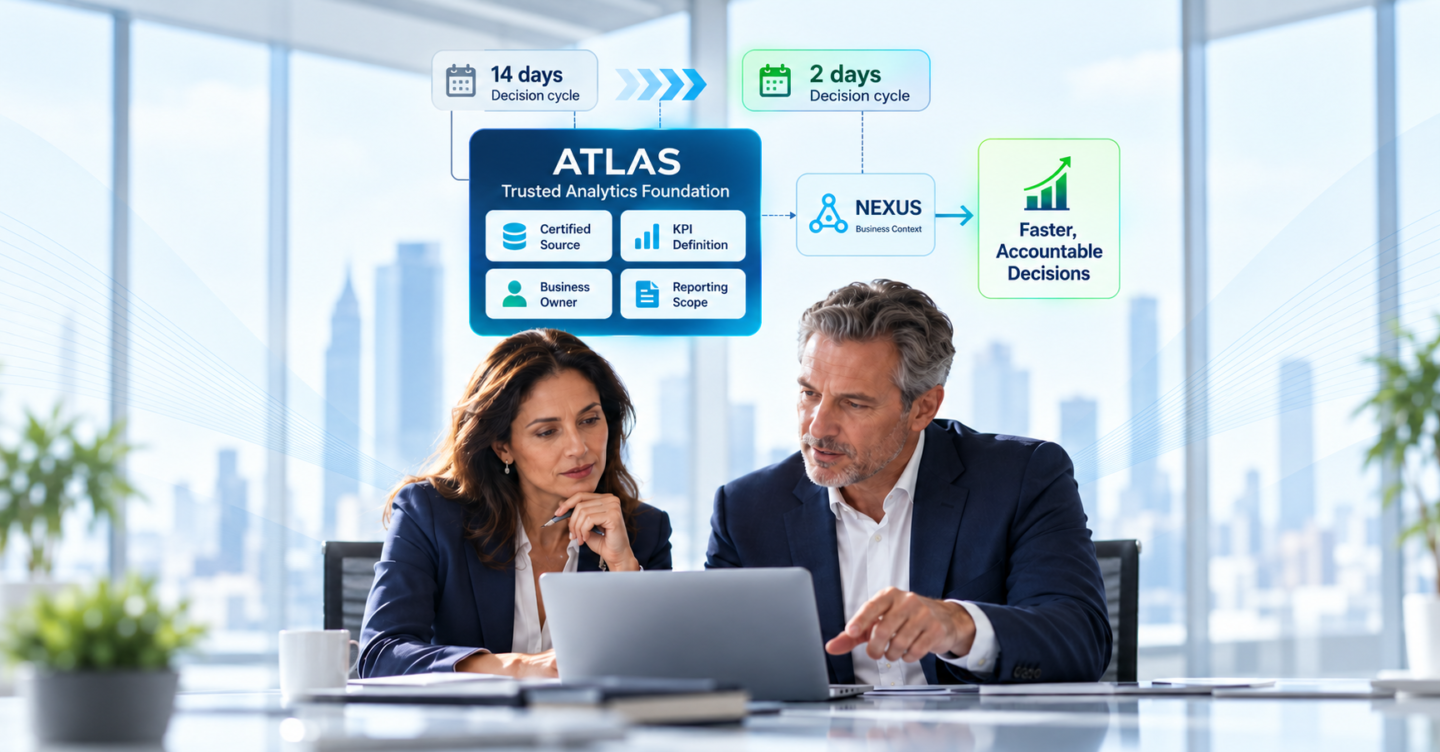
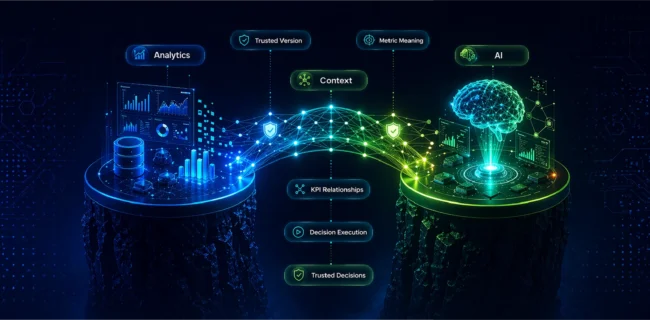
The substrate that resolves this sits between the raw analytics estate and the AI that operates on top of it. ZenOptics calls this substrate the Analytics Context Layer, delivered by Nexus. Nexus establishes certified business definitions, semantic relationships, and trusted metrics, and it grounds every analytics AI answer in those definitions. When the AI is asked about mid-market Q2 revenue, it operates against a certified definition, a certified segment, and a certified adjustment model, and it traces its answer back to those certifications so the CFO can see the lineage.
Organizations implementing ZenOptics typically see analytics AI deployments stand up two to three times faster, because the context substrate is in place before the AI is layered on top.
The Three-Tier Framework for Enterprise Analytics AI
Analytics AI value realization at enterprise scale requires three layers working together across the enterprise analytics estate. ZenOptics calls this The Decision Intelligence Platform, and it organizes those three layers as Know, Understand, and Act.
Know: A Certified Analytics System of Record
Atlas is the analytics system of record for the enterprise. It inventories, governs, and certifies the BI estate, whether the organization runs Tableau, Power BI, Looker, ThoughtSpot, or some combination of them. Atlas establishes which reports exist, which ones are trusted, which ones are duplicates, and which ones the business should retire. Without this layer, every analytics AI question lands on a fragmented analytics estate and inherits its inconsistencies.
Understand: The Analytics Context Layer
Nexus is the Analytics Context Layer. It is the substrate the AI grounds on. Nexus captures business definitions, semantic relationships, and certified metrics, and it exposes them to AI as a trusted source of meaning. When an analytics AI agent needs to know what "revenue" or "mid-market" or "active customer" means inside the organization, Nexus answers definitively. This is the layer most enterprise analytics AI programs skip, and it is the primary reason they stall.
Act: Governed Analytics AI Execution and Decision Traceability
Maestro is the execution and governance layer for analytics AI. It operationalizes analytics AI agents, enforces policy at runtime, and captures decision provenance so every AI-generated answer can be traced back through the context layer to the underlying certified metric. Maestro is what allows the CFO to sign off on an AI-generated answer: the lineage is there, the governance is enforced, and the execution is controlled.
Sitting across all three layers is ZenOptics AI, or ZIVA. ZIVA operationalizes the three layers for end users through governed, conversational analytics AI experiences. A business leader asks a question in plain language. ZIVA surfaces the certified answer, grounded in Nexus, drawn from the Atlas-certified estate, executed and traced through Maestro.
The blueprint is not a stack of disconnected tools. It is a single architecture in which every layer certifies the one above it. Know makes Understand trustworthy. Understand makes Act trustworthy. Act makes analytics AI a decision system the business will stand behind.
Closing the Analytics AI Value Gap: What Good Looks Like
With all three layers in place, analytics AI stops being a pilot economy and becomes a decision economy. The measurable pattern is consistent across enterprises that establish the context substrate first and operationalize analytics AI on top of it.
Organizations implementing ZenOptics typically see a 30 to 40 percent reduction in duplicate reports as Atlas surfaces redundancy and the BI estate consolidates around certified sources. They typically see analytics discovery accelerate by 20 to 40 percent, because business users no longer search across a dozen dashboards to find the one the CFO trusts. And they see analytics AI deployments stand up two to three times faster, because Nexus already answers the context questions the AI would otherwise fail on.
The counter-statistic is the one that should focus the CIO's attention. Gartner projects that through 2026, organizations without an AI-ready data practice will see over 60% of AI projects fail to deliver on business SLAs and be abandoned. The three-layer blueprint is the AI-ready analytics practice that flips that number. Know certifies the estate. Understand certifies the meaning. Act certifies the decision. Every analytics AI answer the business receives is traceable, governed, and grounded in business definitions the organization has already stood behind.
That is what closes the analytics AI value gap: not a better model, but a better substrate, governed and certified layer by layer.
Where to Go Next
Where your organization is stuck determines which layer to read about next.
If analytics AI deployments are moving but not fast enough, start with Analytics AI Time-to-Value at Enterprise Scale: Why Context Is the Bottleneck. It takes the velocity question head-on.
If autonomous analytics AI agents are on the roadmap and governance feels unsolved, read Governing Autonomous Analytics AI at Enterprise Scale: Beyond Cybersecurity. Governance for analytics AI is not the same problem as cybersecurity, and treating it as one is how programs stall.
If you are ready for the full architectural view, read Architecting the AI-Ready Analytics Enterprise: The Decision Intelligence Blueprint. It builds the three-layer architecture out end to end.
For readers earlier in the journey who are still shaping the analytics modernization case, start with Analytics Modernization for the AI Era. And for the category view, see the Decision Intelligence pillar.
FAQ: Analytics AI at Enterprise Scale
What is the analytics AI value gap?
The analytics AI value gap is the growing distance between enterprise analytics AI investment and enterprise analytics AI outcomes. Organizations are funding analytics AI pilots that demo well but fail to scale, fail to earn finance sign-off, or fail to survive a real quarter-close. Gartner research shows that only one in five AI initiatives achieves ROI and that 72% of CIOs report breaking even or losing money on AI. Analytics AI sits squarely inside that pattern, and the gap is the visible result.
Why do enterprise analytics AI projects stall?
Most enterprise analytics AI projects stall because the analytics estate underneath the AI lacks a context substrate. The AI is asked real business questions it cannot ground in certified definitions, because those definitions are not centrally established. The most common misdiagnoses are model quality, prompt engineering, or talent. The actual bottleneck is the Analytics Context Layer.
What is the Analytics Context Layer?
The Analytics Context Layer is the substrate that sits between the enterprise analytics estate and the AI that operates on top of it. It captures certified business definitions, semantic relationships, and trusted metrics, and it grounds every analytics AI answer in those definitions so the answer is traceable and defensible. ZenOptics delivers the Analytics Context Layer through Nexus.
How does ZenOptics close the analytics AI value gap?
ZenOptics closes the gap with a three-layer architecture called The Decision Intelligence Platform: Atlas as the certified analytics system of record, Nexus as the Analytics Context Layer, and Maestro as the governed execution and traceability layer. Organizations implementing ZenOptics typically see analytics AI deployments stand up two to three times faster, because the context substrate is in place before the AI is layered on top.
What is the three-layer blueprint for enterprise analytics AI?
The three-layer blueprint is Know, Understand, Act. Know is the certified analytics system of record. Understand is the Analytics Context Layer. Act is the governed execution and decision traceability layer. Each layer certifies the one above it, so every analytics AI answer is grounded, traceable, and defensible.
Close Your Own Analytics AI Value Gap
Every enterprise analytics estate has its own version of the gap. Yours is specific: specific definitions that conflict, specific reports the CFO trusts, specific AI answers that do not yet hold up. A 15-minute conversation is enough to locate it.
See how The Decision Intelligence Platform closes the analytics AI value gap in your analytics estate. Book a 15-minute demo call.
Published April 23, 2026