

Why CPG Analytics Governance Matters Now
Consumer packaged goods companies operate across fragmented networks: manufacturing plants, distribution centers, regional sales offices, and corporate headquarters. Each location generates analytics independently. Reports multiply. Dashboards duplicate. Ownership becomes unclear.
When someone needs a production metric or inventory visibility across distribution points, finding the right report becomes a maze.
The business impact is measurable. According to SR Analytics research, CPG brands using data analytics achieve 69% higher revenue and 72% cost reductions compared to peers. But that advantage only materializes when analytics are governed, discoverable, and trustworthy.
But governance alone is not enough.
The real challenge is context.
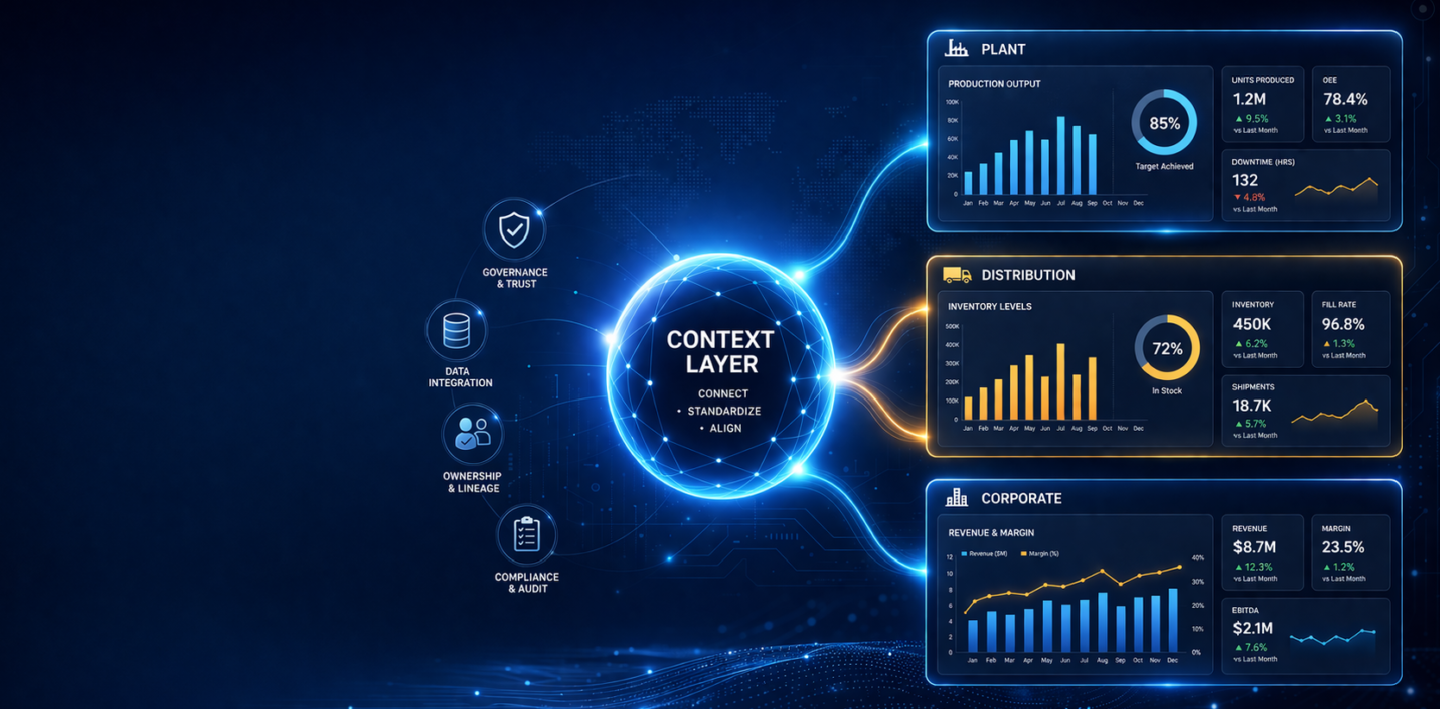
Most organizations already have the data and even the definitions. What is missing is a way to make that meaning consistent across plants, regions, and teams and usable by AI.
This is where analytics governance evolves into a context layer.
Analytics governance manages reports, dashboards, and KPIs.
A context layer connects them - linking metrics, definitions, and business domains into a single, governed understanding of performance.
The Four CPG Analytics Governance Challenges
1. Analytics Sprawl Across Distributed Operations
Your company uses Tableau in manufacturing, Power BI in supply chain, and SAP Analytics Cloud at corporate. Each plant operates independently. Reports multiply.
When teams cannot find the right report, they build their own.
Governance creates a single source of truth by cataloging assets and establishing ownership.
But a catalog alone is not enough.
It tells you what exists.
It does not tell you how metrics relate across plants, regions, and functions.
That requires a context layer.
2. Compliance and Food Safety Governance
FDA regulations (FSMA) and internal audits require traceability.
Auditors ask:
- Who approved this KPI?
- What data feeds it?
- When was it last validated?
Governance provides audit trails.
A context layer ensures those KPIs are consistently defined across the organization — not just documented, but aligned.
3. Supply Chain Visibility Across Plants and Distribution
A CPG company with multiple plants and distribution centers needs unified visibility into production, inventory, and fulfillment.
But each plant defines metrics differently.
Governance provides access.
Context ensures consistency.
Without context, the same KPI like “production output” cannot be reliably compared across plants.
4. Corporate and Plant Coordination
Corporate teams drive strategy. Plant teams drive execution.
Without governance:
- Reports are duplicated
- KPIs conflict
- Decisions slow down
Without context:
- Metrics are interpreted differently
- Teams operate on different definitions
Governance organizes analytics.
Context aligns the business.
The CPG Analytics Governance Framework
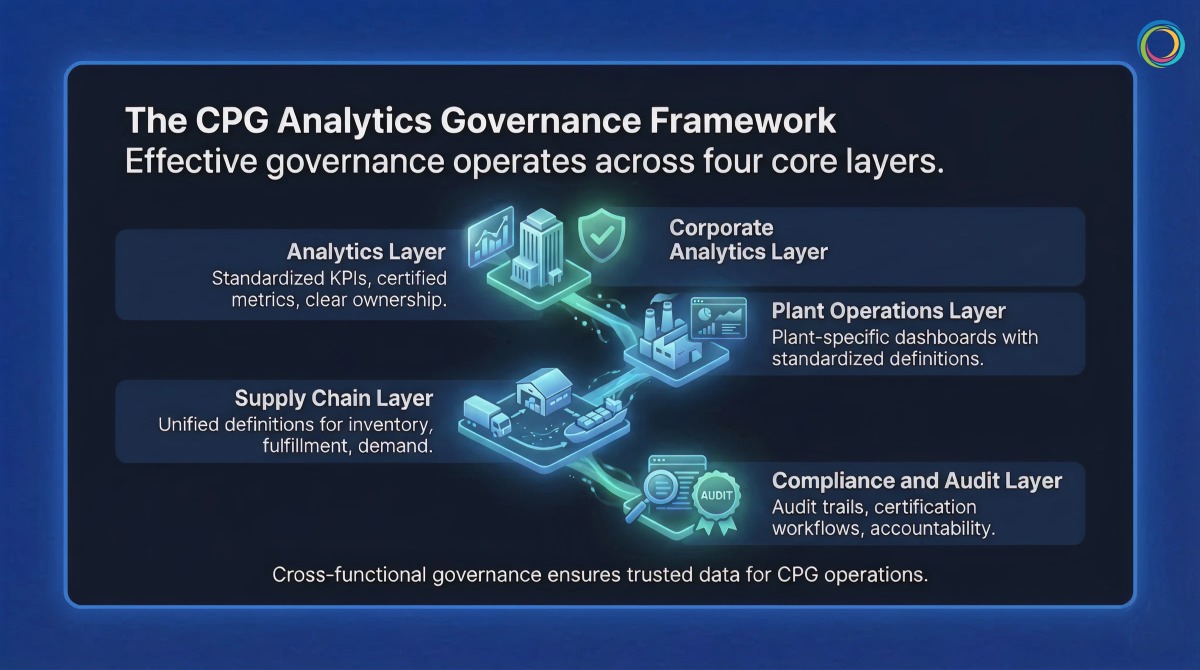
Effective governance operates across four layers:
Corporate Analytics Layer
A context layer ensures that “margin” or “revenue” means the same thing across all reports and tools.
Plant Operations Layer
Plant-specific dashboards with standardized definitions.
Context ensures comparability across plants.
Supply Chain Layer
Unified definitions for inventory, fulfillment, and demand.
Context ensures alignment across systems and regions.
Compliance and Audit Layer
Audit trails, certification workflows, and ownership accountability.
Context ensures traceability is meaningful, not just documented.
How Leading CPG Companies Govern Analytics
Brown-Forman unified 4,000+ users across BI tools:
- 30% report reduction
- 27% increase in adoption
Bimbo Bakeries USA:
- Consolidated reporting across 53 bakeries
- Eliminated 25 SharePoint sites
- Improved discovery and efficiency
Both proved the same thing:
- Governance is not about replacing tools
- It is about making existing tools work together
From Catalog to Context: The ZenOptics Approach
Traditional governance stops at cataloging.
ZenOptics Atlas builds the foundation:
- Cataloging
- Certification
- Ownership
- Lineage
But CPG enterprises need more than a catalog.
They need context.
“Revenue per case” may differ by plant.
“Production output” may vary by region.
A catalog shows reports.
A context layer explains meaning.
ZenOptics Nexus builds this context layer by:
- Mapping KPI definitions
- Linking reports to business domains
- Resolving naming conflicts
- Standardizing metrics across plants and regions
This creates a knowledge graph of your business.
As organizations deploy AI for demand forecasting, production planning, or compliance, this context layer ensures AI understands the business not just the data.
Atlas catalogs.
Nexus contextualizes.
Together, they make analytics:
- Trusted
- Discoverable
- AI-ready
Implementing Analytics Governance: A Four-Phase Roadmap
Phase 1: Inventory and Classify (Weeks 1–2)
Catalog all reports and KPIs across plants and corporate.
Phase 2: Establish Ownership and Certification (Weeks 3–4)
Assign owners and certify trusted assets.
Phase 3: Build Role-Based Access (Weeks 5–6)
Create role-based portals for plant, supply chain, and corporate teams.
Phase 4: Build Context and Optimize (Ongoing)
Track usage, eliminate duplication, and build the context layer that maps relationships across metrics and business domains.
Further Reading
FAQ
Q: Does analytics governance require us to migrate from Tableau or Power BI?
No. Governance works with your existing tools. It sits on top, creating a unified discovery and access layer.
Q: How long does it take to implement governance across multiple plants?
Most organizations see early results within 4–6 weeks, starting with inventory and ownership.
Q: How deoes the context layer help with AI adoption in CPG?
AI systems need to understand how your business defines metrics.
The context layer standardizes definitions and maps relationships between analytics assets - ensuring AI outputs align with how your organization actually measures performance.
Analytics governance for CPG is not a migration project.
It works with your existing tools: - Tableau - Power BI - SAP - Qlik - MicroStrategy When governance is combined with a context layer, analytics becomes: - Easier to find - Easier to trust - Ready for AI Schedule a demo to explore your CPG governance strategy
Schedule a 30-Minute Strategy Session