ZenOptics was recognized as a Sample Vendor in Gartner® Hype Cycle™ for Data and Analytics Governance, 2026 | Learn more
In the on-premise era, hoarding data was cheap. In the cloud era, it is a liability.
Every time you migrate a Tableau workbook or a Power BI report to the cloud, the meter starts running. You pay for storage, for compute power during refresh cycles, and for backup instances. Yet, a massive portion of this spend is wasted. According to ZenOptics enterprise analysis across Fortune 500 deployments, 38% of reports are never viewed, and 32% are duplicates.
These are “Zombie Reports” (officially classified as stale reports in your ecosystem). They haven’t been opened in over six months, yet they continue to consume licenses, engineer hours, and infrastructure budget. This bloat inflates your Total Cost of Ownership (TCO), and for a typical enterprise, it is costing nearly half a million dollars a year.
→ Related: Tableau Sprawl Is Costing You Twice: Why Dashboard Chaos Kills Both Trust and Cloud Budgets
You might think, ‘Storage is cheap, so why does it matter?’ But the Total Cost of Ownership (TCO) of a report is far more than just disk space.
Based on a typical enterprise model with 10,000 reports and 800 active licenses, the annual “maintenance bill” for the bi dashboards estate is approximately $1.07 million.
Here is where the waste hides:
Compute Costs (~$52k/month): Every zombie report that is scheduled to auto-refresh is burning CPU cycles you pay for.
Licensing Leakage (~$15k/month): You are often paying for expensive ‘Creator’ or ‘Explorer’ licenses for users who only consume static content or, worse, haven’t logged in for months.
Maintenance & Support (~$22.5k/month): Your data engineers spend hours troubleshooting failures on reports that nobody reads.
This aligns with Everest Group’s 2024 research, which found that 67% of organizations experienced higher-than-expected cloud costs, with 82% of global organizations reporting that at least 10% of their cloud spend is wasted.
When your users cannot find what they need, they create duplicates, compounding the trust gap and driving more wasted spend.
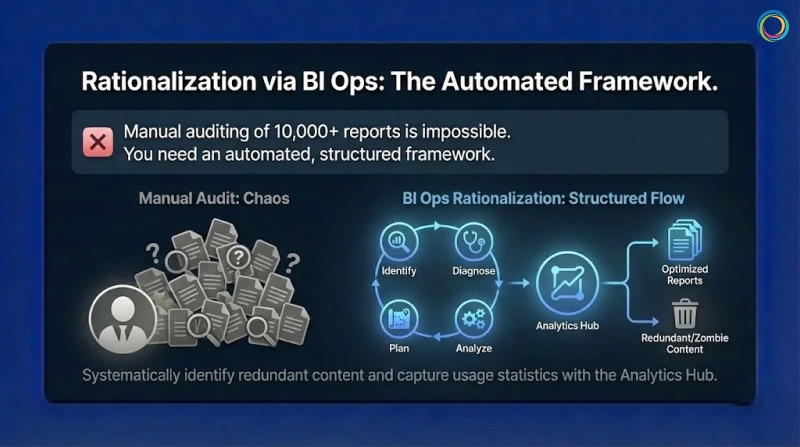
You cannot manually audit 10,000 reports to find the zombie reports. You need an automated, structured framework. This is the Analytics Ops (or BI Ops) methodology.
To reclaim your budget, follow the Identify > Diagnose > Analyze > Plan cycle:
Stop guessing. Deploy connectors to crawl your BI platforms (Tableau, Power BI, Qlik, etc.). This automatically builds an inventory and captures usage statistics.
What to look for: Reports with zero views in the last 180 days.
Use metadata analysis to detect redundancy.
The “Kill List”: Identify stale reports (zombie reports) and duplicate reports (e.g., ‘Sales_v1’ vs. ‘Sales_Final’).
Modern self service analytics environments often grow unchecked. Without automated detection, the same report gets recreated multiple times as users cannot find existing assets. This dashboard fatigue drives redundancy that inflates your BI spend.
Safely retire the unused assets. This immediately reduces your cloud footprint and frees up licenses.
The Result: A cleaner environment where search actually works, and a budget that is optimized for innovation rather than maintenance.
A global Fortune 500 manufacturer faced a challenge familiar to many large enterprises: an unmanageable reporting environment with no way to evaluate relevance, freshness, or reliability across thousands of assets.
The Challenge: The organization had accumulated over 10,000 reports across their ecosystem, with no systematic way to identify which reports were critical, which were duplicates, and which were no longer relevant.
The BI Ops Approach: They implemented the ZenOptics Analytics Hub to crawl their entire BI landscape, capture usage statistics, and systematically identify redundant content.
The Results:
Brown-Forman, the global spirits company behind Jack Daniel’s, achieved similar results with their analytics rationalization initiative:
“ZenOptics has helped us solve our distributed reporting challenges and improve collaboration throughout our organization.”
— Sam Sorsa, Senior Director of Finance, Brown-Forman
Every dollar you spend maintaining a zombie report is a dollar you cannot spend on AI or predictive analytics. With Gartner forecasting global public cloud spending to reach $723 billion by 2025, the stakes of cloud waste have never been higher.
Report Rationalization is not just a housekeeping task; it is a financial imperative. By identifying stale content and eliminating duplicates, you can slash your TCO by 40% and turn your analytics budget into an investment, not a tax.
You have successfully democratized data. Your teams have access to Tableau for visual analytics, Power BI for operational reporting, and perhaps a legacy layer of Qlik, Cognos, or SAP. But instead of empowering users, this abundance has created a new form of friction: Dashboard Fatigue.
Users are overwhelmed and to get a complete view of the business, a sales executive might have to log in to Salesforce for pipeline data, swivel to Tableau for regional visualizations, and then hunt through SharePoint for a Word doc or PDF strategy memo. This “swivel-chair” experience is a productivity killer that compounds with every additional BI tool you add to your stack.
According to Gartner, 47% of digital workers struggle to find the information or data needed to effectively perform their jobs. The same research found that knowledge workers now use an average of 11 applications daily – nearly double the six applications typical in 2019. This report sprawl is inconvenient, and measurable productivity loss.
When finding data is harder than using it, adoption plummets. Users stop logging in. They revert to emailing their favorite analyst for a static export, and your expensive BI investment becomes shelfware.
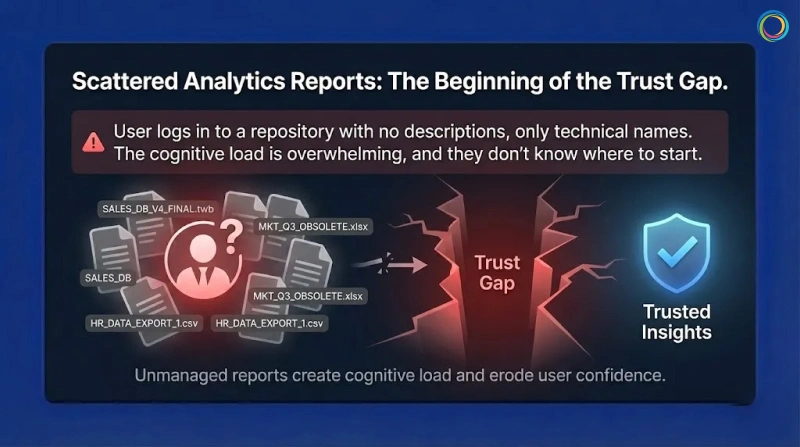
The root cause of low adoption is not usually the quality of the dashboard; it’s the analytics consumption experience of the delivery mechanism.
Contrary to the intent, most BI platforms get optimized for authors, not consumers. They organize content in technical hierarchies or massive lists. This logic makes sense to the data engineer who built it, but it is a maze for the business user who just wants “My Weekly Numbers.”
When a user logs in and encounters a large repository of reports with no descriptions or context, just the technical name of the dashboard, they experience cognitive load. They don’t know where to even start.
This is where the trust gap begins. When users cannot easily find certified, validated bi dashboards, they lose confidence in the entire analytics ecosystem. The problem isn’t data quality – it’s the delivery layer creating friction between users and insights.
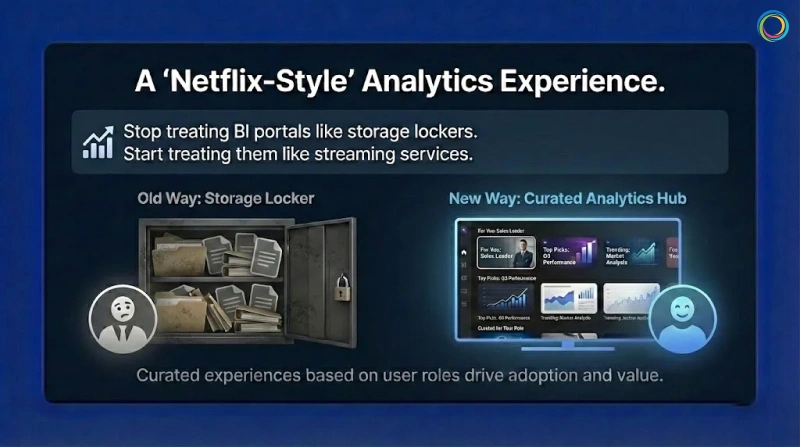
If we want analytics adoption to grow, we have to stop treating BI portals like storage lockers and start treating them like streaming services.
Netflix doesn’t dump every movie in front of you when you log in – and analytics shouldn’t either. The experience should be curated based on the user’s role.
That’s how self-service analytics moves from “hunt and search” to “discover and consume.”
First, eliminate the swivel chair. A Unified Analytics Hub aggregates metadata from all your systems – Tableau, Power BI, Qlik, Excel—into a single interface.
A user searches for ‘Gross Margin’ and sees the certified and approved Tableau dashboard and the related PDF commentary side-by-side. No more hopping between tabs.
By bringing all analytics assets into one searchable interface, you reduce thecost of zombie reports by making existing content discoverable before users request duplicates.
Move away from complex navigation. Use Portal Pages to create role-based landing zones.
The Strategy: An executive logging in should see a curated page featuring their ‘Top 5 KPIs,’ a ‘Quarterly Forecast’ widget, and a news feed of recent analyst commentary.
The Benefit: The user sees only what matters to them immediately. This reduces noise and guides attention to the highest-value assets.
Leverage usage data to drive discovery.
The Strategy: Show users ‘Trending’ reports or ‘Recommended for You’ based on what their peers in the Finance department are viewing.
The Benefit: This passive discovery helps users find insights they didn’t even know they were looking for, keeping them engaged with the platform.
Brown-Forman, the global company behind brands like Jack Daniel’s and Woodford Reserve, faced a classic case of fragmentation, not just of reports and dashboards but also of multiple portals. Their landscape included multiple portals, each housing SAP, Tableau, Salesforce, and Google Sheets, leading to a disconnected experience that hindered decision-making.
They didn’t want just another tool; they needed a ‘One-Stop Shop’ to glue their ecosystem together. They deployed the ZenOptics Analytics Hub to unify access. Instead of forcing users to remember five different logins, they provided a Single Point of Access for all analytics assets.
Brown-Forman achieved a 27% increase in user adoption of their analytics tools year over year by simplifying the “last mile” of analytics delivery. With 4,000+ users now unified under a single platform, teams focus on analysis rather than retrieval.
ZenOptics has helped us solve our distributed reporting challenges and improve collaboration throughout our organization.
– Sam Sorsa, Senior Director of Finance, Brown-Forman
To make users love your data, you have to respect their time. No executive wants to wrestle with complex source systems or multiple logins.
Studies show knowledge workers lose at least 2 to 3 hours each week searching for information. Personalized analytics discovery goes straight after this waste.
When you unify tools and curate the experience around the user, your BI platform becomes a menu, not a maze – eliminating friction and unlocking the full ROI of your data investment.
You have delivered the dashboard. It is beautiful, real-time, and built on a modern data and analytics stack. Yet, your executive team still starts every meeting with the same question: “Where did this number come from?”
This is the Trust Gap. It is the distance between the data you provide and the confidence your stakeholders have in using it.
According to the 2025 Data Integrity Trends and Insights report by Precisely and Drexel University, 67% of organizations don’t completely trust their data for decision-making, up from 55% just one year prior. They didn’t lack data, but they lacked certainty.
When executives cannot instantly verify the provenance of a KPI, they do not “trust but verify.” They simply ignore it. They revert to static spreadsheets and offline modes, creating a cycle of shadow IT that further erodes the integrity of your analytics. Gartner research confirms this pattern: 69% of employees have intentionally bypassed cybersecurity controls, often using unauthorized tools when they don’t trust official systems.
→ Related: Tableau Sprawl Is Costing You Twice: Why Dashboard Chaos Kills Both Trust and Cloud Budgets
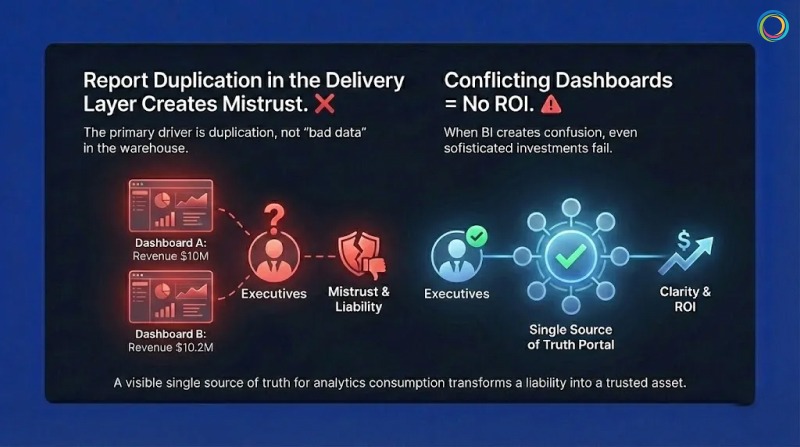
The primary driver of this mistrust is not usually “bad data” in the warehouse; it is report duplication in the delivery and consumption layer.
In a typical enterprise, it is common to find dozens of reports with nearly identical names like Sales_v1, Sales_Final, Q3_Sales_Update. When a VP searches for “Revenue” and finds 15 conflicting versions, they experience data dissonance.
If Dashboard A says revenue is $10M and Dashboard B says $10.2M (due to a different refresh cycle or filter logic), the executive assumes both are wrong. Without a visible single source of truth for analytics consumption, the platform is viewed as a liability, not an asset.
A 2025 Salesforce survey found that less than half of business leaders say their data strategies fully align with business priorities – a significant decline since 2023. When your BI dashboards create confusion rather than clarity, even the most sophisticated analytics investment fails to deliver ROI.
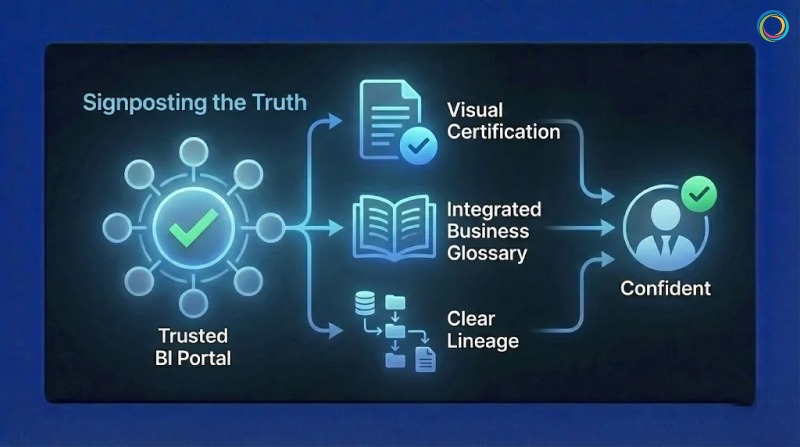
Traditional governance attempts to solve this by restricting who can build reports. This fails because it stifles agility. The modern approach (BI Ops) focuses on signposting the truth rather than hiding the noise.
To bridge the Trust Gap, you must implement three visible signals of authority within your BI portal:
1. Visual Certification (The “Blue Checkmark” for BI)
Your users are trained by consumer apps to look for verification symbols. Your self service analytics or BI portal should work the same way.
The Strategy: Implement a strict governance and certification workflow where only validated, business -approved assets receive a “Certified” watermark, not just data stewards.
The Outcome: When a user searches for a report, they can instantly filter out the noise and click the asset that is stamped as the corporate record. This eliminates the “which one is right?” guessing game.
2. Integrated Business Glossary
Numbers without context are dangerous. If a report lists “Churn Rate,” does that include involuntary cancellations?
The Strategy: Link your BI glossary directly to the report metadata.
The Outcome: A user can hover over a term and see the approved corporate definition, the owner of the metric, and the calculation logic. This transparency builds confidence that the metric is standardized, not ad-hoc.
3. Clear Lineage
Trust requires traceability.
The Strategy: Show the user the journey of the data.
The Outcome: When an executive sees that a dashboard is fed directly from the “Gold” layer of the data warehouse and was refreshed 5 minutes ago, they stop asking, “Where did this come from?”
One of the world’s leading bakery product companies faced a challenge familiar to many large enterprises: a complex reporting environment characterized by scattered assets and a lack of trust in data insights.
Leadership identified that users were overwhelmed by information and skeptical of the metrics presented. They didn’t need more reports; they needed clarity.
The “One Stop” Strategy: This company deployed the ZenOptics Analytics Hub to create a branded “One Stop” shop for enterprise data. Instead of fighting report sprawl with restrictions, they used the platform to:
The Result: By funneling users through a governed, certified layer, they established a culture where “One Stop” became the definitive source of truth. They effectively mitigated the risk of shadow IT and ensured that strategic decisions were based on governed, reliable data.
Trust is not a soft skill; it is an engineered outcome. You build it by removing friction and adding clear signals of validity.
If you want executives to believe your dashboards, you must stop asking them to hunt for the truth. Certify your best assets, define your terms, and make the “source of truth” obvious. When you do that, you don’t just get more dashboard views – you get a data-driven culture.
You have built a world-class analytics stack. You have Tableau dashboards for strong visual exploration, perhaps Power BI is your standardized reporting platform, and legacy platforms are still floating around. Data access has been democratized, just as the industry promised.
Yet instead of truly data-driven decision-making, you face a paradox: the more analytical assets you deploy, the less value you extract.
The issue isn’t the quality of your insights; it is the volume of your noise. Report sprawl has evolved from a minor inconvenience into a measurable financial liability. You are paying twice for your analytics: once for the licenses and cloud compute, and again through lost productivity and trust as your teams navigate through a fragmented, chaotic reporting landscape.
This is no longer a tooling problem; it’s an operational crisis – eroding both your bottom line and your leadership’s confidence. Industry analysis estimates that poor data management costs the U.S. economy roughly $3.1 trillion annually, while at the enterprise level, data inefficiencies can erode as much as 3% of EBITDA.
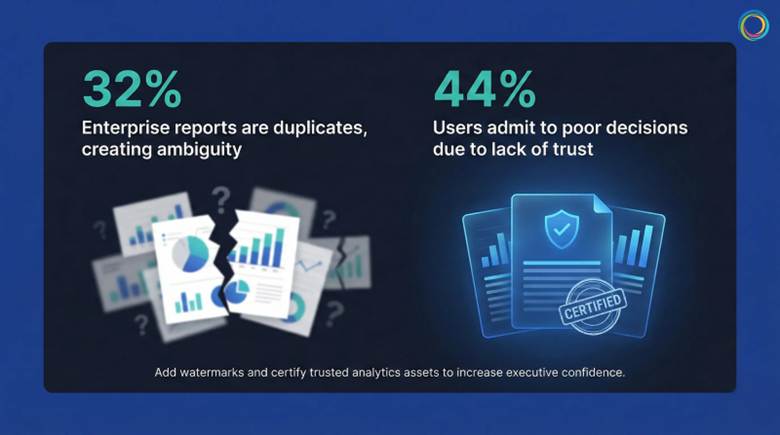
When you search “Gross Margin” and it returns fifteen nearly identical reports (v1, v2, Final, Real_Final, Q3_Update), trust disappears instantly. And it’s not an edge case: 32% of enterprise reports are duplicates. This ambiguity creates a “Trust Gap.” If executives can’t tell what’s approved for use, or certified versus experimental, they default to spreadsheets. Even worse, the cost is real – 44% of users acknowledge making poor decisions because they didn’t trust the data in front of them.
The fix is not tighter control, but visible certification. You need an unmistakable signal of truth.
Bimbo Bakeries USA (the bakers of featured brands like Thomas’, Sara Lee, Arnold, Entenmann’s, Ball Park, and Oroweat) confronted this fragmentation head-on.
With ZenOptics’ governed analytics catalog powering discovery, lineage, and certification workflows, they certified and watermarked trusted assets, restoring executive confidence and preventing shadow IT from influencing strategic decisions.
→ Related: The Trust Gap: Why Executives Don’t Believe Your Dashboards
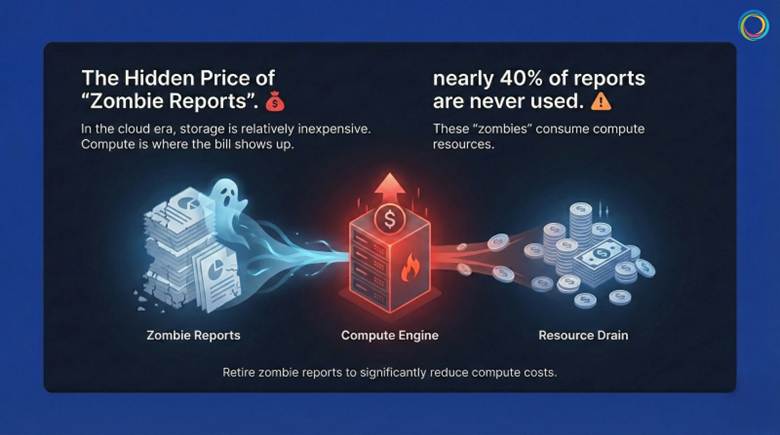
In the cloud era, storage has become inexpensive, but compute is where the bill shows up.
In many Tableau environments, nearly 40% of reports are never used. These “zombie reports” haven’t been viewed in over six months – yet they continue to consume cloud storage, burn refresh cycles, and incur high license costs.
This is not an analytics problem; it’s financial negligence. In an enterprise with 10,000 reports, roughly 4,000 generate zero value while quietly driving ongoing cloud spend. Every refresh, backup, and migration amplifies the leakage, turning unused analytics into a persistent tax on your cloud budget.
A biotech leader we worked with faced extreme sprawl with over 22,000 reports. By applying a rationalization strategy, they identified that 67% of their content was duplicate or stale. They successfully retired around 17,000 assets, bringing their optimized inventory down to just 4,600 business-relevant reports. This cleaned their server and radically reduced their technical debt.
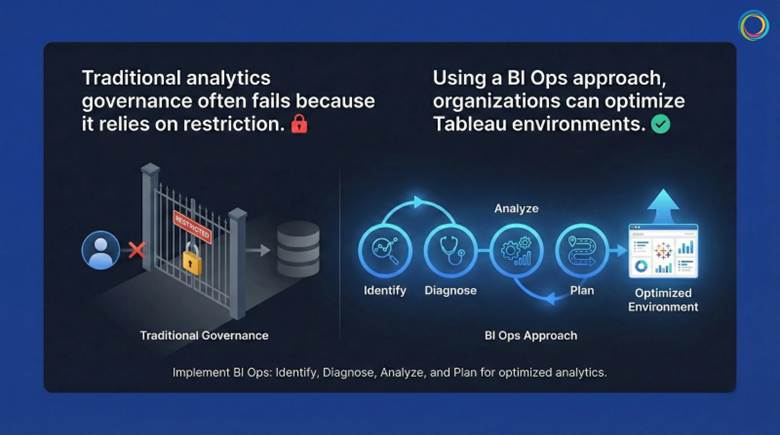
Traditional analytics governance fails because it relies on restriction. The modern alternative is BI Ops – operationalizing the lifecycle of your analytics to improve report discoverability, efficiency, and trust.
Using the BI Ops methodology (Identify, Diagnose, Analyze, Plan), you can optimize your Tableau environment in three simple steps:
1. Rationalization (The “Kill List”)
You cannot manually audit 20,000 reports. You need automated diagnostics to crawl your metadata and identify “stale” content.
Strategy: Identify assets with zero views in 360 days.
Action: Create a “kill list” of zombie reports to safely decommission, instantly lowering your TCO.
2. Certification (The Trust Signal)
Improve report discoverability by elevating the signal over the noise.
Strategy: Apply a governance framework towards a “Certified” stamp to your top 100 business-critical reports. Link these reports to a Business Glossary so users understand the definitions of KPIs like “Net Sales ” without constantly emailing IT.
Result: When your team sees the ‘Certified’ stamp on important reports, they can trust the data and make decisions with confidence.
3. Unification (The Adoption Driver)
Adoption fails when access is hard. Analysts currently spend 25% of their time just searching for data.
Strategy: Decouple consumption from the generation tool. Give users a “Netflix-style” portal where they can find Tableau dashboards, Power BI reports, and spreadsheets in one personalized view.
Result: Brown-Forman used this unified approach to increase analytics adoption by 27%, proving that when data is easy to find, business users will consume it.
Your Tableau environment is powerful, but it requires active curation to deliver ROI. The days of “build it and the team will use” are over. If they can’t find it, or if they don’t trust it, they won’t use it. To stop the financial bleed of “Zombie Reports” and bridge the trust gap, you must move beyond passive storage to active analytics optimization. It is time to audit your estate, certify your winners, and retire the rest.
Healthcare analytics governance brings together the people, processes, and controls required to ensure that reports, dashboards, KPIs, and analytic workflows containing protected health information (PHI) are accurate, secure, appropriately accessible, and fully auditable.
As healthcare organizations expand self-service BI and analytics across clinical, operational, and financial teams, governance challenges are no longer confined to raw data. Risk increasingly lives at the analytics consumption layer, where dashboards are shared, metrics are duplicated, exports are downloaded, and decisions are made.
When analytics governance is weak, organizations face more than fines. They experience higher PHI exposure, slower decision-making, inconsistent KPIs across teams, and prolonged audit cycles. Regulators continue to enforce HIPAA aggressively. The U.S. Department of Health and Human Services’ Office for Civil Rights (OCR) has issued over $144 million in settlements and civil penalties, making the risk far from theoretical.
The financial impact is equally stark. Healthcare continues to lead all industries in average data-breach costs, according to IBM’s Cost of a Data Breach Report. Strong analytics governance—supported by compliance analytics that capture lineage, approvals, certifications, and usage—helps organizations demonstrate due diligence, reduce exposure, and respond confidently to audits and investigations.
Modern healthcare compliance requires more than policies. Analytics teams must continuously demonstrate:
These controls form the compliance analytics evidence layer regulators increasingly expect.
Key regulatory drivers include:
Healthcare organizations often meet regulatory requirements on paper but struggle operationally in day-to-day analytics use.
Common gaps include:
These gaps increase risk, slow audits, and undermine confidence in analytics, precisely when healthcare leaders need faster, defensible decisions.
Leading healthcare organizations treat governance as an always-on analytics control plane, not a periodic compliance exercise.
Best-practice standards include:
A sustainable analytics governance program focuses on inventory, ownership, access control, and continuous evidence capture—directly aligned with regulatory expectations.
KPIs to Track
Suggested Rollout
AI initiatives in healthcare depend on trusted, contextual analytics. Without governed dashboards, certified KPIs, and clear lineage, AI systems risk amplifying inconsistency, bias, and error.
Analytics governance provides:
In short: AI without analytics governance is risk multiplied.
ZenOptics is purpose-built for governing analytics—not just data. It operates at the analytics consumption layer, where decisions are made, and risk materializes.
Core ZenOptics capabilities include:
Together, these capabilities transform governance from a reactive burden into a continuous, business-enabling discipline.
Assess your current analytics governance maturity, identify gaps, and initiate a 90-day governed rollout. With disciplined healthcare analytics governance and continuous compliance analytics, organizations can meet regulatory obligations, reduce exposure, and accelerate confident decision-making.
Contact ZenOptics to learn how we help healthcare organizations operationalize analytics governance—at scale, across BI tools, and ready for the future of AI.
Analytics portals have evolved far beyond static dashboards. They are now dynamic, integrative platforms—a unified view where users explore, interpret, and act on analytics assets surfaced through curated and governed processes, with enhanced visibility and business context for users.
Industry analysts expect this transformation to accelerate. Gartner’s “Top 10 Strategic Technology Trends for 2025” is referenced across the industry by CIOs seeking guidance on analytics and digital transformation—not for product endorsement, but to highlight radical shifts in the analytics landscape.
In this context, the next generation of analytics portals is not just for visualization—it’s about enabling greater efficiency, enhanced productivity, and genuinely smarter decisions.
Analytics portals have transformed into decision command centers. The traditional batch analytics model, where reports are delivered weekly or monthly, is giving way to continuous, real-time intelligence. With the integration of streaming data, AI-powered alerts, and automated workflows, portals now surface insights and trigger actions when opportunities are detected.
In the coming years, expect more analytics portals—including those leveraging advanced BI technologies—to combine predictive models, scenario simulations, and timely alerts, helping organizations act faster than ever before.
Many analytics portals, including ZenOptics, are advancing toward augmented analytics—using AI, machine learning, and natural language capabilities to simplify analysis, generate insights, and guide users step-by-step. Maturity of these features varies by solution, but the direction is clear: portals will soon do more than answer “what happened”—they’ll explain why, recommend actions, and generate plain-English summaries for business adoption.
Modern analytics portals empower users to discover, personalize, and share analytics content with reduced IT involvement. ZenOptics specializes in cataloging, governance, and seamless access to distributed BI assets—not dashboard building (which remains within the underlying BI tools). This trend is accelerating data literacy and collaboration across the organization.
Next-gen portals, such as ZenOptics, provide a unifying layer by integrating with on-premises, cloud, and hybrid BI tools, streamlining governance and user experience across sources. This approach—sometimes called “composability”—enables organizations to assemble, adapt, and future-proof analytics ecosystems through smart integration, not just monolithic systems
Analytics portals are embedding governance features such as data lineage, certification tracking, access management, and business glossaries. ZenOptics offers asset certification workflows, usage telemetry, and role-based access control, with integration capabilities for broader policy enforcement. As privacy and compliance demands rise, this embedded governance is becoming a must-have rather than a bolt-on.
Looking ahead, analytics portals will deliver:
This evolution positions analytics portals as the decision operating layer—where insight, action, and trust converge.
At ZenOptics, we believe the analytics portal serves as the nerve center of modern decision-making by providing a unified view for certified, real-time, and contextual insights across all BI tools.
ZenOptics delivers:
By simplifying discovery, supporting scalable adoption, and embedding governance, ZenOptics helps organizations eliminate report chaos, improve operational efficiency, and move toward a governed, scalable analytics ecosystem.
Schedule a demo to see how ZenOptics turns fragmented dashboards into a governed, high-adoption analytics experience.
Automotive fleets today face rising fuel costs, labor and maintenance pressure, and increasingly strict compliance requirements. Telematics, sensors, diagnostics, and safety technology are generating massive data streams with every mile, but only organizations able to unify, govern, and analyze these data sources effectively are positioned to control costs and improve performance.
The question is no longer whether the data exists, but whether fleet organizations can access and use it fast enough to reduce downtime, control total cost of ownership (TCO), and make timely, informed decisions.
Most fleets struggle to integrate legacy and new data—including telematics, GPS, maintenance, warranty, inventory, driver data, fuel, and compliance reports—because these often reside in separate, sometimes incompatible, systems. Manual consolidation remains common, especially when operational or IT infrastructure is fragmented or specialized hardware is in use.
Processes are still reactive: Vehicles are often serviced after breakdowns, safety interventions follow incidents, and compliance documentation is scattered across emails and local folders—difficult to validate during audits. Fragmented analytics contribute to hard-to-manage costs and a limited ability to address regulatory requirements proactively.
Advanced fleet organizations are adopting new technologies and practices:
Unified fleet analytics are increasingly recognized as essential for actionable decision-making and proactivity—not just dashboard “patchwork.”
Analytics modernization is about adding structure, governance, and repeatable processes—often on top of existing operational systems:
Unifying, contextualizing, and governing fleet analytics delivers:
Modernization means moving from manual, reactive report consolidation and fragmented metrics to curated, governed, and trusted analytics orchestration.
Fleet operations leaders now face analytics challenges long familiar to enterprise data teams: too many systems, too many versions of “the right” report, and high manual effort for analysis and audit prep.
ZenOptics solves this by unifying analytic assets—dashboards, maintenance reports, scorecards, compliance records, and more—into a single catalog. This enables:
The result is not a guarantee of perfect data, but a more governed, trusted environment—built for confident decisions, easier audits, and better business outcomes.
If your team is still manually consolidating reports or routinely debating trusted metrics, modernization with ZenOptics enables central curation, trustworthy access, and improved governance—outcomes shaped by the quality of your data, integrations, and stewardship practices.
Ready to learn more?
Contact ZenOptics to start the conversation.
Insurance claims reporting is central to customer trust and operational effectiveness. While many insurers are modernizing, some still face delays, inefficiencies, and compliance issues due to legacy systems, siloed spreadsheets, and manual routines.
These issues can contribute to longer claim resolution times, overburdened adjusters, and audit challenges. Gain Compliance reports that 58.2% of insurance companies had errors in multiple sections of their statutory filings, and 30.9% filed inconsistently between printed and electronic submissions—highlighting risks in regulatory reporting processes, not just claims reporting.
Modernization is essential for reducing manual errors, streamlining workflows, and improving compliance management in today’s insurance landscape.
Data complexity, growing regulatory oversight, and rising customer expectations are prompting insurers to invest in modernization. Many companies report compliance costs have increased by nearly 40% since 2019, with some firms seeing these costs reach up to 8% of total revenue—driving a stronger need for accuracy, transparency, and audit readiness.
Unified analytics platforms offer a crucial solution for consistent data, faster reporting, and more reliable compliance management.
These issues slow operations, decrease confidence in reported data, and raise regulatory scrutiny.
To address these challenges, leading insurers are implementing unified analytics platforms that consolidate dashboards, reports, and data metrics into a governed portal. The goal is to help teams work toward audit readiness and improved operational agility—not to guarantee it.
For example, ZenOptics’ unified analytics platform brings dashboards, reports, and KPIs from native BI applications into a central portal, helping insurers streamline regulatory processes and eliminate the “swivel-chair” reporting routine. With ZenOptics, users can search and access all analytics assets without having to separately open and switch between spreadsheets, legacy reports, and modern BI tools.
Unified access to analytics and reporting, as enabled by ZenOptics and similar platforms, empowers claims adjusters to access the analytics they need, streamlining reviews and supporting more confident decisions. Instant access to complete customer and policy data depends on integration with enterprise data sources.
A McKinsey study on AI in insurance found that advanced AI models can significantly reduce assessment times and complaints, saving major insurers millions. Unified analytics platforms support these advancements by helping surface certified or approved data for decision workflows, improving consistency and reducing errors.
Personalized dashboards further enhance efficiency—adjusters gain real-time visibility into caseloads, set alerts for complex claims, and collaborate across departments. In ZenOptics, dashboard access is managed through connected BI tools, while the platform provides governed discovery and usage analytics.
ZenOptics and unified analytics platforms support data governance critical for meeting operational and documentation needs for regulations like NAIC, SOX, and GDPR. Audit trails, report usage tracking, and role-based access controls are supported, leveraging native BI tool security for sensitive analytics assets.
Automated certification workflows and report tagging help ensure trusted, up-to-date content is surfaced for regulatory and operational reporting, but outcomes depend on correct integration and stewardship.
Unified insurance BI is transforming outcomes organization-wide:
ZenOptics case studies show a 25% increase in BI usage and a 30% reduction in redundant reports—freeing up resources and bolstering decision-making.
ZenOptics serves as a practical example of unified BI transformation. Its BI Portal provides a single, governed access point for analytics assets across Tableau, Power BI, Excel, and other enterprise BI platforms. The BI Portal enhances visibility, discovery, and workflow efficiency across the analytics ecosystem.
Users can create personalized workspaces, collaborate with teams, and automate analytics workflows. Role-based analytic asset access ensures stakeholders discover the most relevant insights for their jobs, while built-in governance features (audit trails, certification tracking, version control) help maintain data accuracy and compliance.
Unified analytics is a key enabler of modern claims reporting. By integrating analytic assets and compliance workflows into one governed environment, insurers can lower costs, improve accuracy, and strengthen regulatory confidence.
Insurance leaders aiming to modernize claims operations and reporting can schedule a demo with ZenOptics to discover how unified BI simplifies reporting and delivers measurable results across the organization.
Manufacturing organizations manage massive amounts of data daily. From production metrics and supply chain performance to risk management, the complexity can easily overwhelm individuals relying on traditional analytics approaches.
To stay competitive, manufacturers require faster and more insightful decision-making, supported by connected, real-time insights. A Unified view of analytics serves as the bridge between scattered data sources and actionable intelligence. They bring all critical analytics into a single, integrated view that accelerates business decisions and ensures alignment across teams.
Many manufacturers struggle with analytics scattered across separate systems, spreadsheets, and legacy BI tools. This fragmentation creates confusion instead of clarity.
In manufacturing, silos cause production bottlenecks, inconsistent reporting, and compliance challenges. Teams often spend more time reconciling data than acting on it. According to McKinsey, manufacturers that apply advanced analytics can reduce machine downtime by 30 to 50 percent and extend machine life by 20 to 40 percent. These figures highlight the performance losses that occur when data remains isolated.
Without a unified view of performance, decision-makers lack the clarity and confidence to act quickly. The result? Slower decisions, increased manual effort, and missed opportunities to optimize operations or mitigate risk. To overcome these challenges, organizations need a unified analytics approach that turns scattered data into fast, informed decision-making.
A unified view of analytics is an integrated BI platform that virtually consolidates analytics assets, such as reports, dashboards, spreadsheets, documents and KPIs, into one accessible and well-governed environment.
Key features include:
By connecting multiple reporting systems and applications into a single view, a unified view of analytics ensures that every user operates from the same trusted information. This single source of truth enables leaders to make faster, more confident, and data-backed decisions across the organization.
A unified view of analytics makes monitoring and analysis for manufacturing practical and actionable by giving teams a centralized platform to monitor production, quality, and resource allocation in real time.
Key applications include:
Organizations using a unified view of analytics have achieved tangible outcomes, such as reduced inventory levels, shorter lead times, and increased responsiveness across their operations. These benefits are especially valuable in modern data-driven Industry 4.0 environments.
For example, Brown-Forman implemented a ZenOptics Analytics Hub to unify Tableau, SAP BusinessObjects, and other reporting tools into one searchable interface. This consolidation led to a manageable and easier to use reporting environment, fewer duplicate reports, and a better user experience. As a result, Brown-Forman saw:
Features like search, favorites, and automated workflows made it easier for users to find trusted reports and act on insights quickly.
Manufacturing organizations report measurable improvements after implementing a unified view of analytics. These benefits include:
With a unified view of analytics, data becomes a strategic asset that fuels teams to make faster, smarter, and more consistent decisions across the enterprise.
ZenOptics provides a unified analytics catalog platform that centralizes reports, dashboards, spreadsheets, documents, KPIs, and BI assets within a secure, governed environment.
For manufacturing leaders, ZenOptics delivers:
ZenOptics helps cross-functional teams, from operational leaders to CFOs, make rapid and informed decisions from a single analytics intelligence platform.
Customers have reported up to a 300 percent increase in user adoption, along with significant reductions in redundant report maintenance and manual data retrieval. The ZenOptics case study from Brown-Forman demonstrates how organizations build resilience, improve efficiency, and transform data into actionable insight.
Ready to see unified analytics in action? Schedule a demo today to learn how to turn scattered reports into a single source of truth.
Self-service BI has transformed how organizations engage with analytics. Business users today build their own dashboards and run their own analyses, accelerating data-driven decision-making. However, this scale introduces challenges: report sprawl, duplicate or conflicting KPIs, and difficulty establishing which numbers are trustworthy. Regulatory expectations are higher than ever, with audit teams expecting clear traceability for data sources and the analytics that inform business decisions.
Modern analytics governance is the enterprise-wide discipline that helps organizations meet these challenges. It enables trust, ensures compliance, and supports accountable decision-making across the self-service BI landscape.
Modern analytics governance refers to the policies, practices, and controls targeted at the business layer of analytics—covering reports, dashboards, KPIs, and related content so they are accurate, consistent, secure, and ready for confident use in decision-making.
The goal is always to make self-service analytics reliable and trustworthy, not to slow innovation or access.
Common challenges include:
Most organizations recognize the importance of analytics governance and have taken steps to implement policies and controls. However, there is still a significant need for more operationalized governance and continuous validation to ensure standards are consistently enforced throughout the analytics ecosystem. This operational maturity is vital to building trust and maintaining compliance at scale.
To address these risks without undermining self-service BI, leading organizations adopt practices such as:
With robust governance:
ZenOptics delivers modern analytics governance through its unified Analytics Intelligence Platform, purpose-built to centralize catalogs, governance, and operational insights across all BI and analytics tools—without replacing them.
ZenOptics integrates with the broader analytics stack, aggregating analytic assets from third-party BI environments. The value depends partly on comprehensive integration and regular catalog updates, managed by both business and IT stewards.
Self-service BI’s power can only be fully realized when paired with comprehensive governance. ZenOptics’ platform helps enterprises centralize, standardize, and optimize the analytics ecosystem—improving decisions, audit readiness, and return on analytics investments.
See ZenOptics in action—Schedule a demo to discover how trusted analytics governance can empower your organization.