Maestro transforms analytics into structured workflows that guide teams from insight to action — while capturing the full context behind every decision. Dashboards show you what's happening. Maestro helps your organization decide what to do next.
Request Demo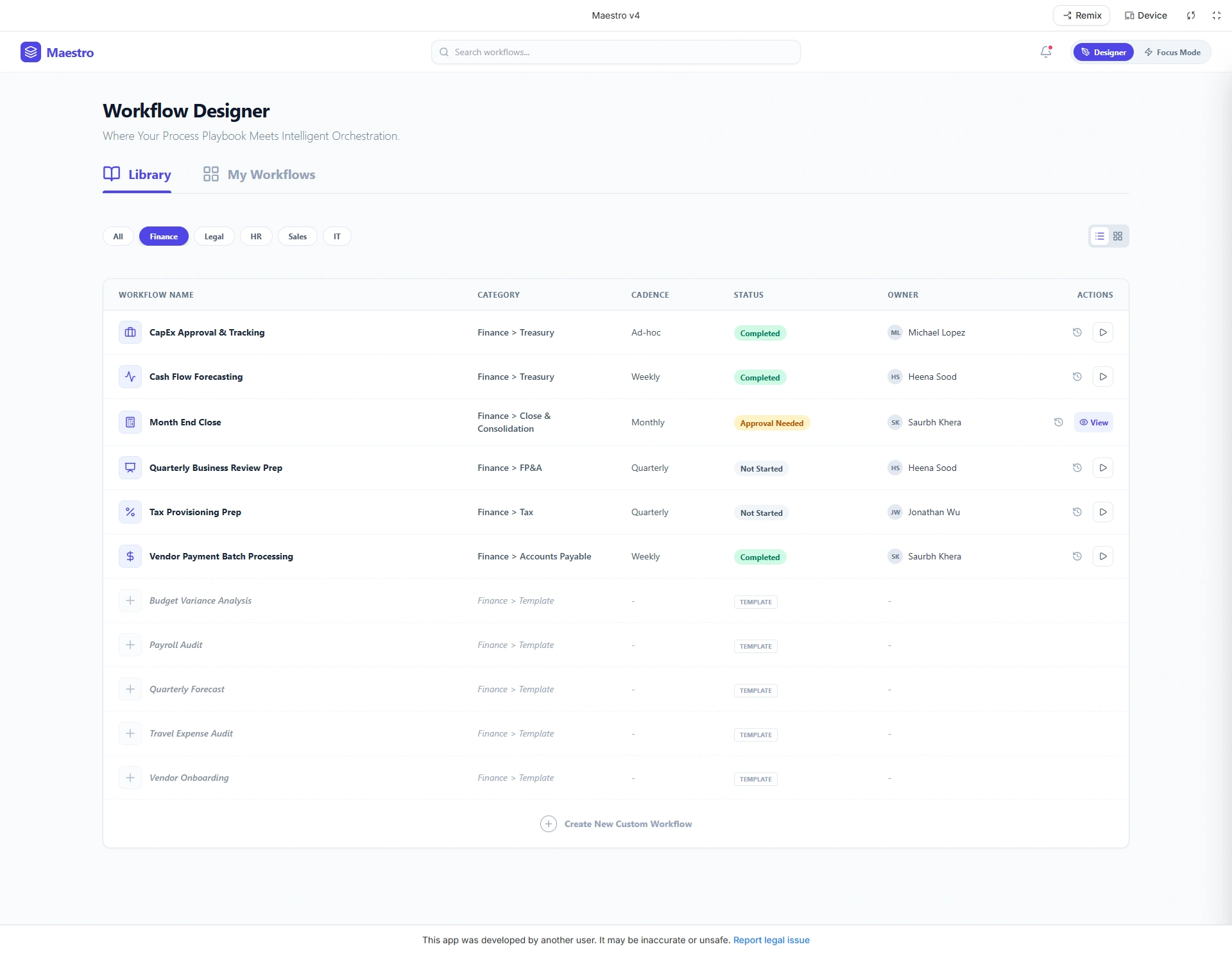
Most organizations run on recurring processes — month-end close, pipeline reviews, forecasting cycles, risk monitoring, compliance checks. These processes are repeatable, but the way they are executed often isn't.
The actual work usually lives across dashboards, spreadsheets, emails, and people's personal playbooks.
Maestro brings structure to that reality. It turns analytical work into structured workflows that guide teams from insight to action, while ensuring the right governance, accountability, and context are preserved along the way.
Just as importantly, Maestro captures decision provenance — the story of how a decision was made and what happened after.
By turning analytical processes into guided workflows, Maestro ensures that work is executed consistently, reviewed responsibly, and recorded transparently. Every step — from analysis to action — is structured, governed, and traceable.
Maestro provides a searchable library of business workflows organized by department—Finance, Legal, HR, Sales, IT, and more.
Each workflow includes a defined category, execution cadence (ad hoc, weekly, monthly, quarterly), current status, and assigned owner.
Prebuilt workflows cover common enterprise processes such as CapEx Approval and Tracking, Cash Flow Forecasting, Month-End Close, Quarterly Business Review Preparation, Tax Provisioning, and Vendor Payment Batch Processing.
Templates for processes like Budget Variance Analysis, Payroll Audit, and Vendor Onboarding are ready to customize and deploy.
Every workflow in the library maps its decision steps to certified analytics from Atlas. When underlying metrics change, the workflow automatically reflects the updated data.
This eliminates the drift that often occurs between business processes and the analytics meant to guide them.
Maestro embeds governance directly into the workflow itself. Reviews, rejections, approvals, and escalations can all be defined as part of the process.
Every action is recorded, and every step is visible.
Instead of relying on side conversations or scattered documentation, teams get a clear record of what was done, who did it, and when.
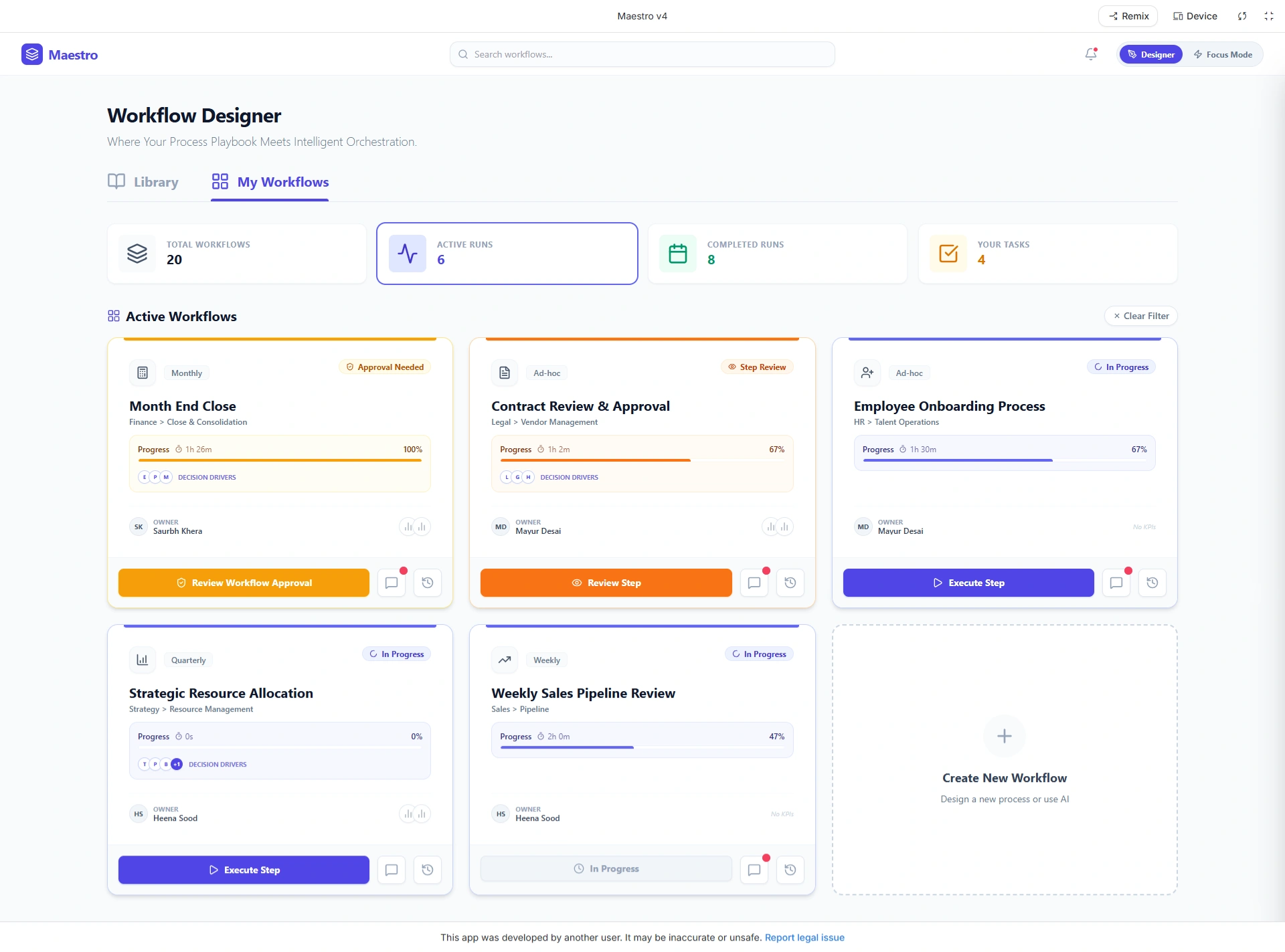
The My Workflows view gives every user a clear picture of their active processes—showing the current step, progress, assigned ownership, and available actions.
Teams can quickly see which processes are in progress, which require approval, and which are ready for the next step.
This helps organizations maintain accountability while keeping work moving efficiently. Maestro delivers a living execution environment where every step is backed by trusted analytics and governed context.
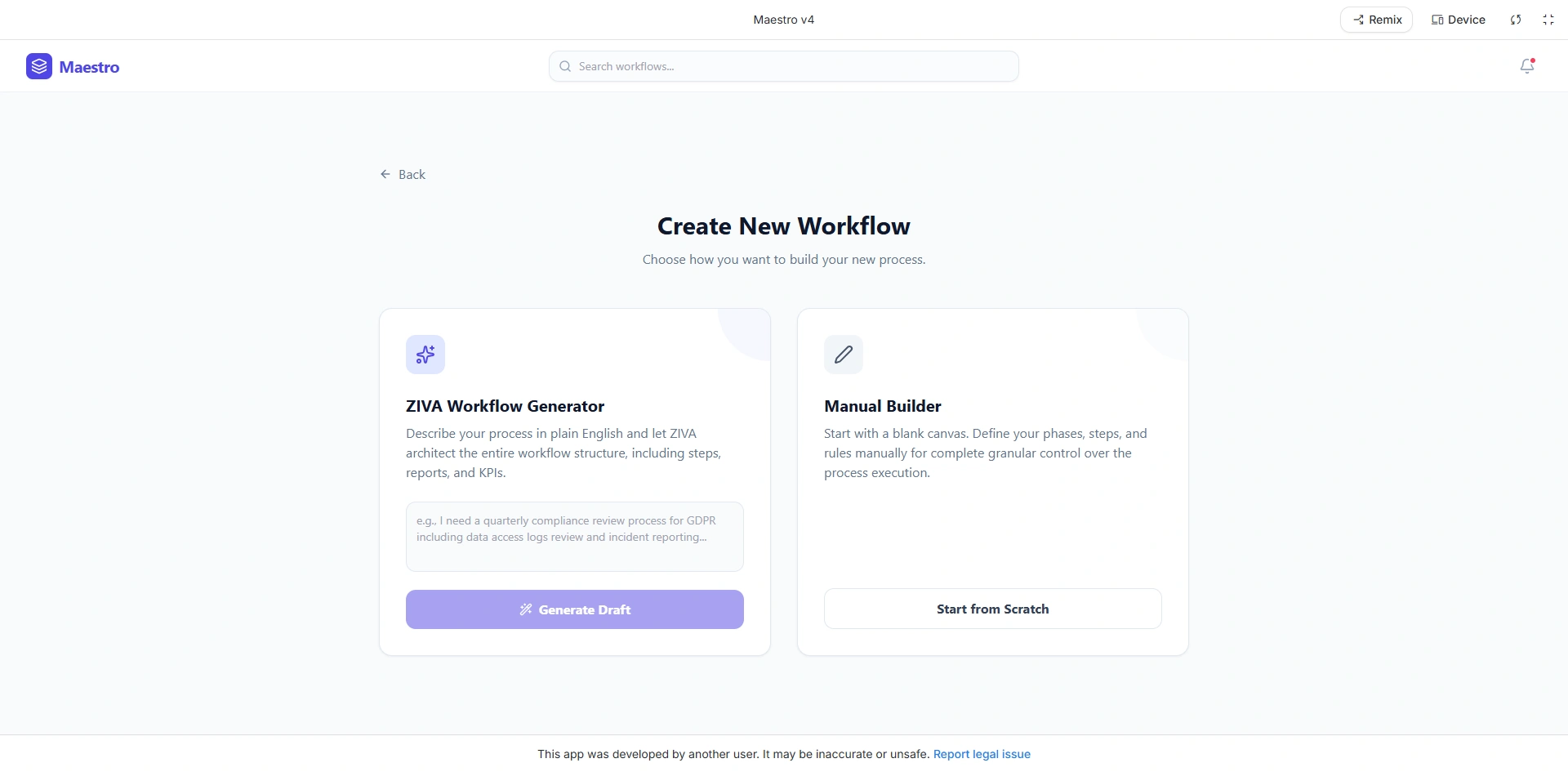
Creating new workflows in Maestro can be done in two ways.
The ZIVA Workflow Generator allows users to describe a business process in plain English. ZIVA then automatically architects the workflow structure—including phases, steps, decision points, relevant reports, and KPIs.
A compliance review process, a quarterly forecasting workflow, or an employee onboarding sequence—simply describe the process, and ZIVA generates a complete draft.
For teams that require more granular control, the Manual Builder provides a blank canvas. Define phases, steps, and rules from scratch with full control over execution logic.
Both approaches create workflows that are natively connected to your Atlas catalog and Nexus context layer.
Every step references governed analytics. Every decision point is traceable.
This is what separates Maestro from generic workflow tools: the process itself understands your data.

Higher % of business processes mapped to analytics

More AI agent actions traceable to approved processes

Reduced decision cycle time

Fewer agent exceptions and policy violations

Faster time to operationalize new AI use cases
Maestro answers the question that defines enterprise AI readiness: How do we ensure AI uses the right analytics, in the right way, at the right point in our business processes — at scale?