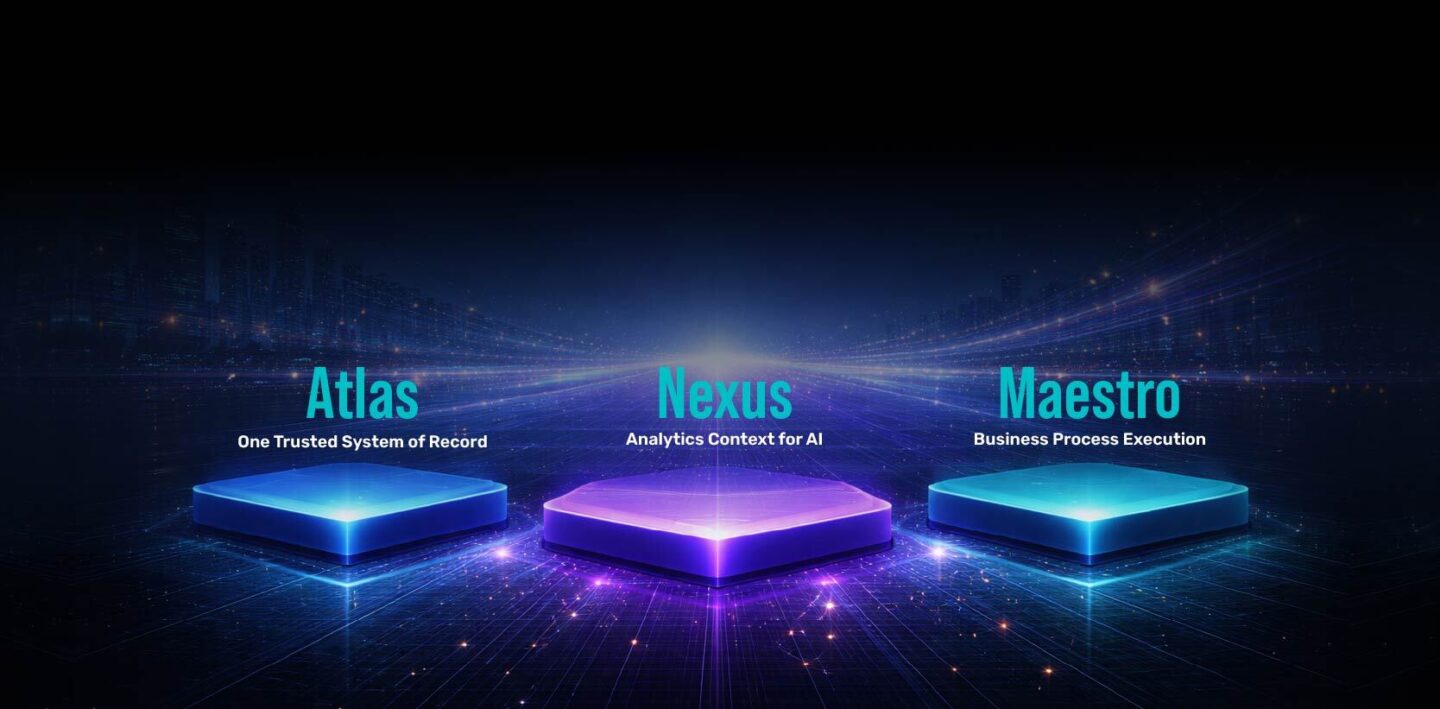
Nexus transforms BI metadata into a living, governed source of business understanding. AI copilots, conversational interfaces, and intelligent agents get the semantic context they need to interpret metrics correctly, understand relationships between KPIs, and generate insights your teams actually trust.
Request Demo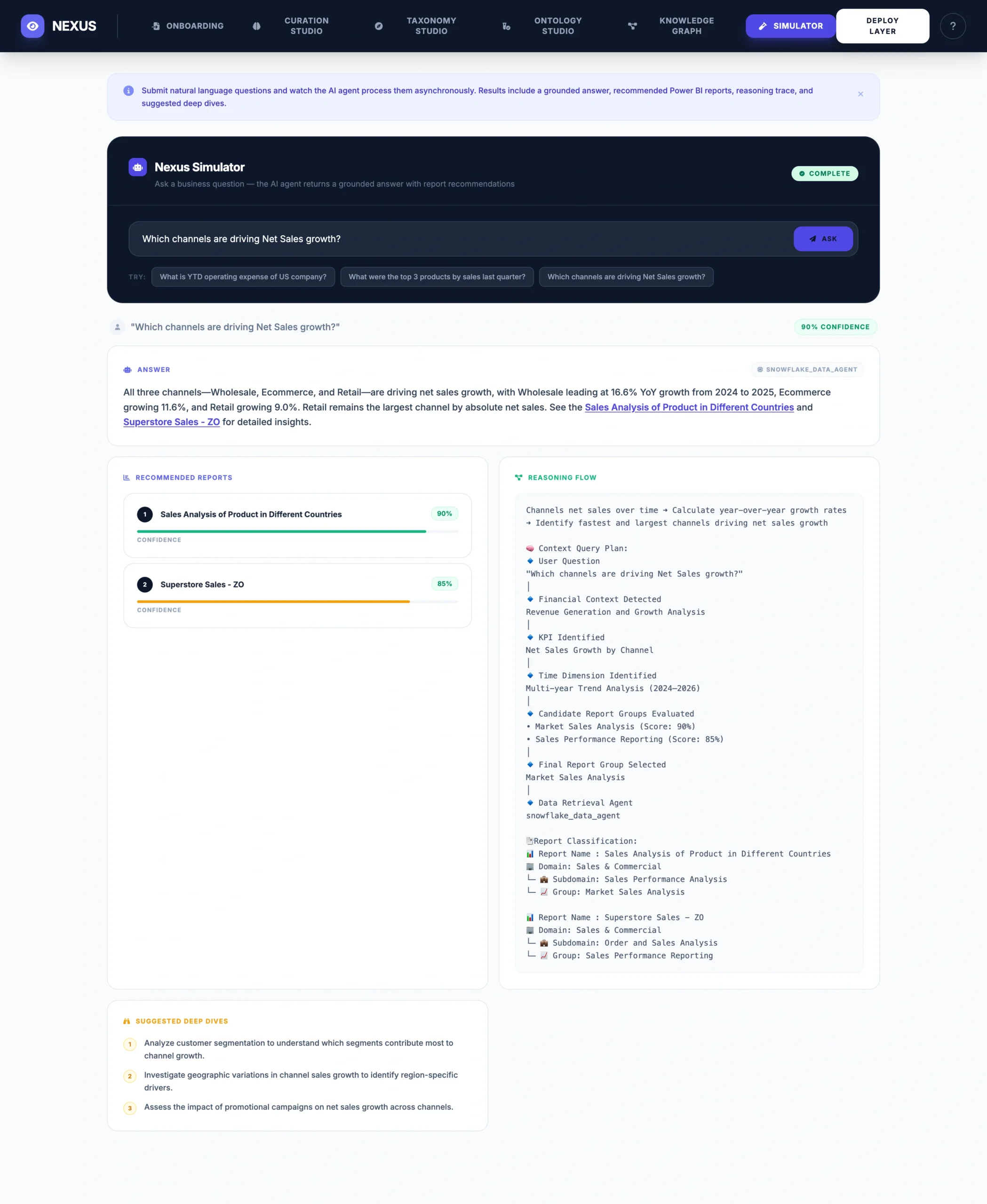
Organizations deploying AI copilots and conversational analytics on platforms like ChatGPT and Gemini encounter a fundamental limitation almost immediately. These models do not understand how your business defines and measures performance.
Even powerful models produce inconsistent or outright unreliable results when they cannot reference your actual metric definitions, dimensional relationships, and business logic.
Nexus solves this by unlocking the intelligence already embedded in your analytics.
Dashboards, metrics, filters, and dimensions encode how your organization thinks about success, how performance is segmented, and how decisions get made. Nexus captures this BI metadata from Atlas and models the relationships between analytics assets, metrics, and business domains.
The result is a continuously evolving analytics context layer that gives AI systems semantic clarity.
AI can reference governed metric definitions, understand relationships between KPIs, and align responses with how your organization actually measures outcomes. Ambiguity decreases. Hallucinations drop. The insights AI generates begin to reflect the answers your teams actually need.
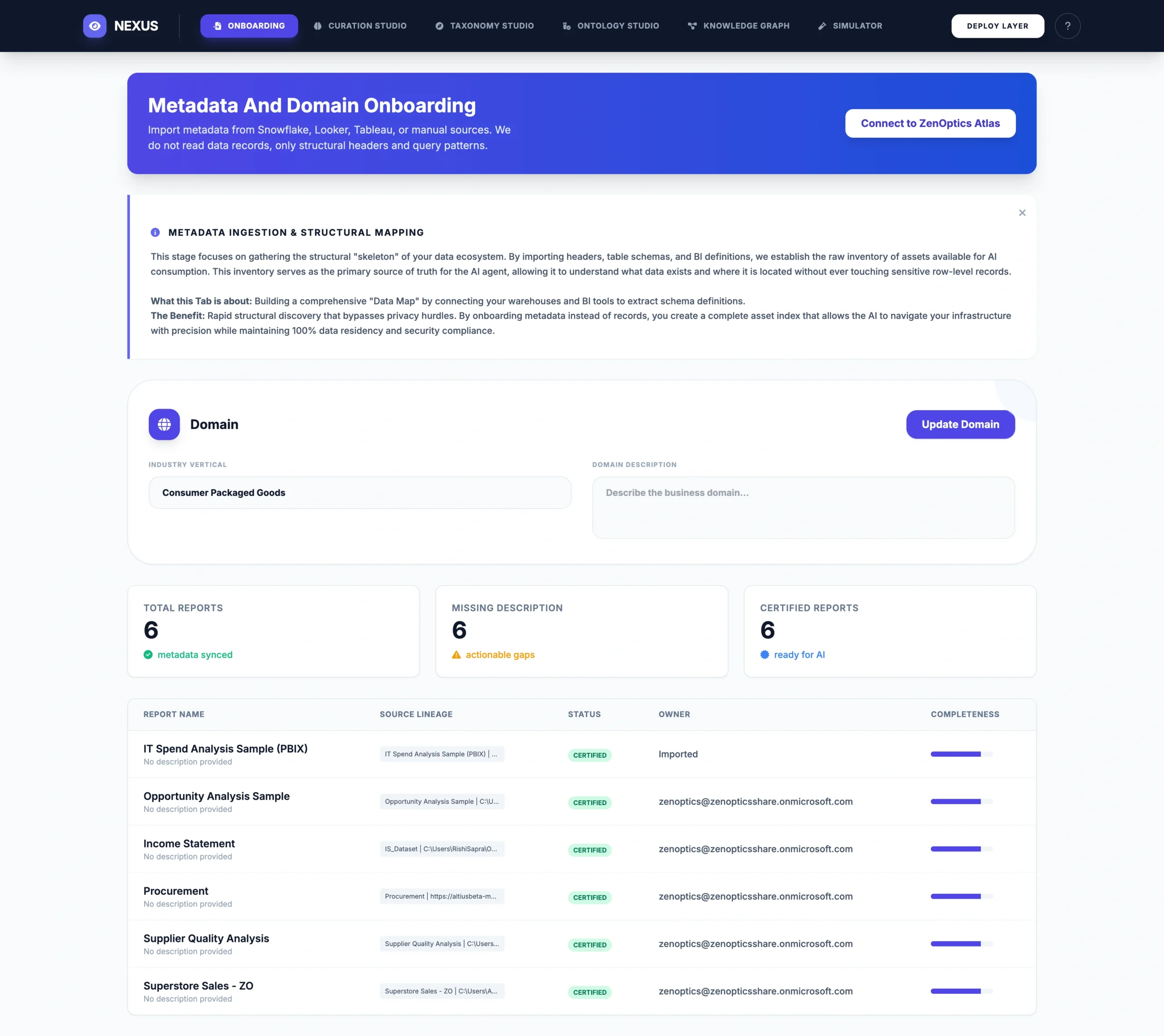
Nexus begins by consuming governed metadata from Atlas — your organization's analytics system of record.
Atlas connects to Snowflake, Looker, Tableau, and other BI platforms; Nexus then ingests the structural metadata these sources provide, or teams can upload metadata from manual sources.
Nexus does not read raw data records. Instead, it captures structural headers, schema definitions, and query patterns to build a comprehensive inventory of your analytics assets.
Each asset is mapped to a business domain, and Nexus immediately identifies gaps — missing descriptions, uncertified reports, and incomplete ownership records. This gives data stewards a clear view of what needs attention before any AI system interacts with the metadata.
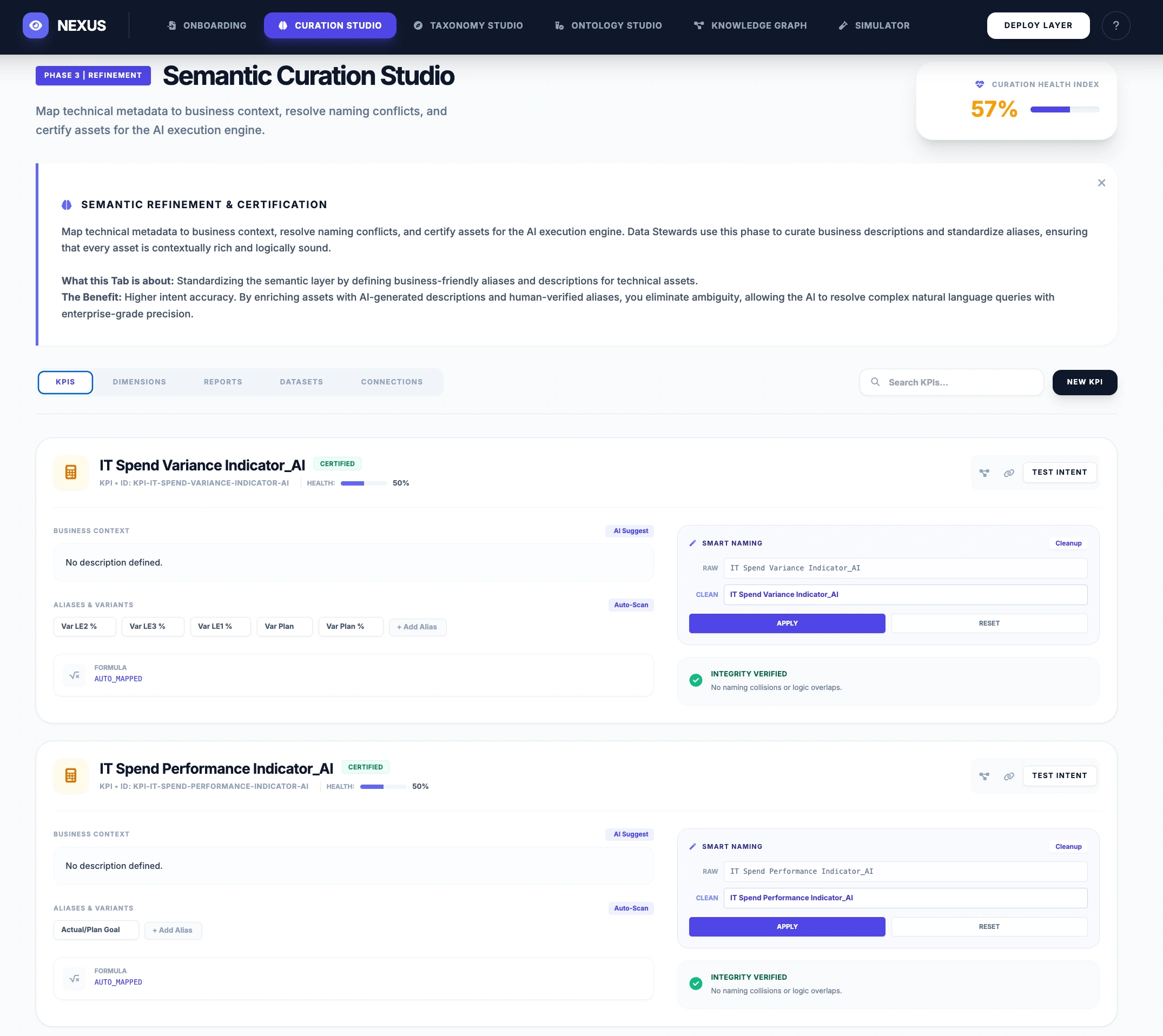
The Curation Studio is where technical metadata becomes business-meaningful context.
Data stewards use this phase to resolve naming conflicts, curate business descriptions, and standardize aliases so every asset is contextually rich and logically sound for AI consumption.
Nexus uses AI-generated suggestions to define business-friendly aliases and descriptions for technical assets. The smart naming engine recommends standardized names, and the integrity verification system checks for conflicts or overlapping definitions across your catalog.
A Curation Health Index tracks progress across KPIs, dimensions, reports, datasets, and connections, so teams know exactly where they stand.
By enriching assets with AI-generated descriptions and human-verified aliases, you eliminate the ambiguity that causes AI to misinterpret complex natural language queries.
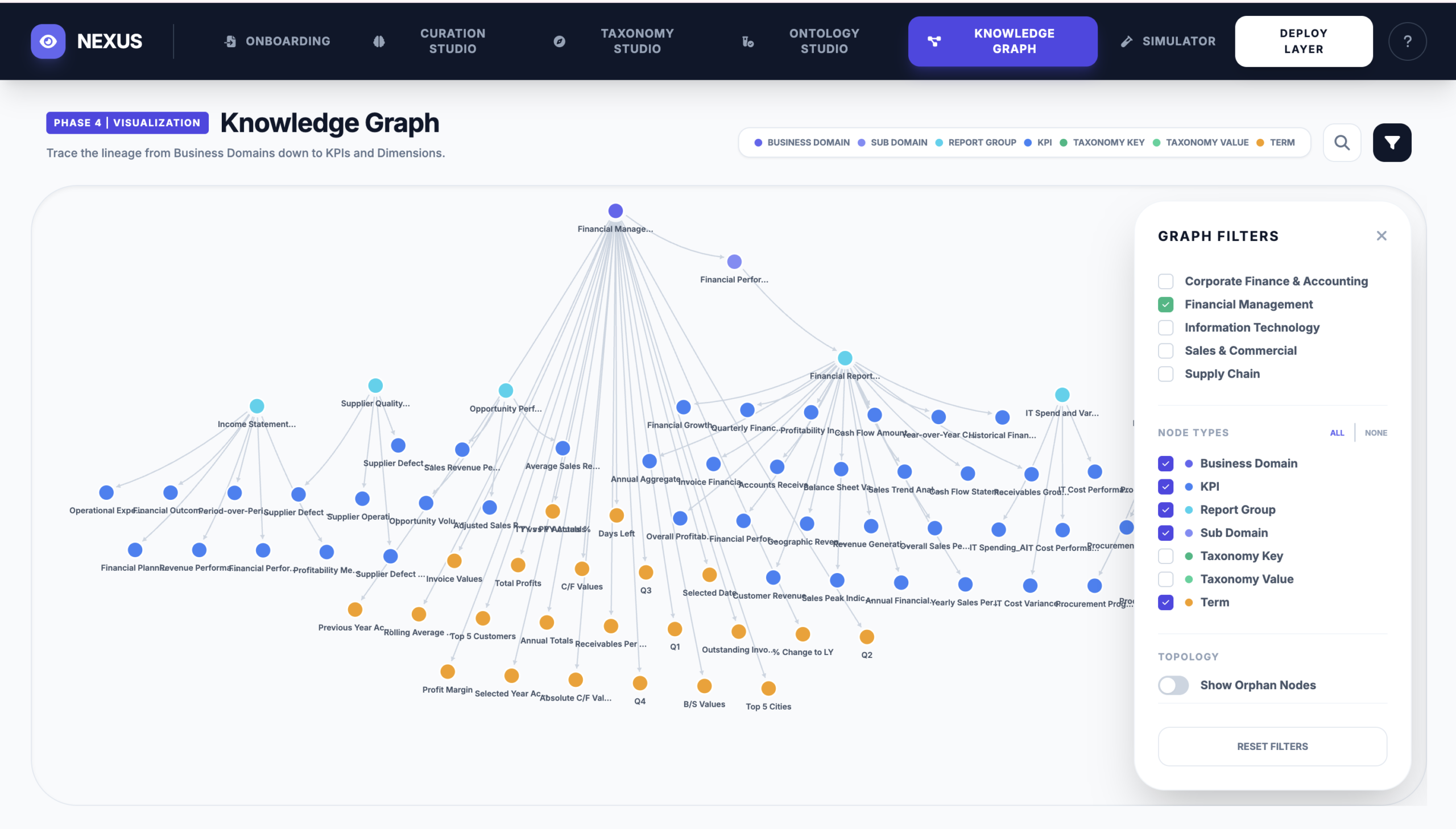
The Knowledge graph bridges the gap between technical fields and business concepts.
By defining logical clusters (such as "Financial Performance" or "IT Expense Management") and mapping analytics assets to them, you create a structured hierarchy that allows AI to reason about your business the way your teams do.
Each business domain contains core assets and related assets, organized into a visual knowledge graph. The ontology groups KPIs and metrics into high-level business concepts and defines their interrelationships.
When an AI agent encounters a question about "Sales Performance," it can navigate the ontology to understand which metrics are relevant, how they connect, and what the upstream dependencies look like.
Ontology completeness is tracked at the domain level, and teams can iterate on the structure as the business evolves. New metrics, new domains, new relationships all flow into the graph without requiring AI systems to be retrained.

Reduction in AI hallucinations and misalignment

Higher % of AI queries grounded in governed metrics

Faster time to deploy analytics-aware copilots

Increased AI adoption by business users

Consistent AI responses across teams and departments
Nexus answers a question every AI-driven enterprise faces: How does AI understand our metrics, our analytics, and how we make decisions?