


Enterprise analytics teams are no longer debating whether to adopt AI agents. Gartner estimates that 40% of enterprise applications will include task-specific AI agents by 2026. The adoption curve is steep, the pressure from leadership is real, and the vendors are ready. What most enterprise architectures are not ready for is the question that follows deployment: when an AI agent influences a material business decision, what is the auditable record of how that decision was made?
In regulated industries, that question is not rhetorical. It is a compliance requirement. And for most agentic analytics architectures currently in production or moving toward it, the honest answer is: there is no auditable record. The agent acted, the decision was made, and the reasoning path cannot be reconstructed.
Why "We Will Handle Governance Later" Creates Compounding Risk
The governance deferral pattern is familiar. A team deploys an agentic analytics workflow, governance is scoped as a future phase, and the deployment moves forward on the strength of the demo results. For a period, this works. The pilot performs well, the outputs look credible, and the governance gap is invisible.
The gap surfaces in one of two ways. The first is operational: an AI-influenced decision produces an outcome that needs to be reviewed, and the team discovers that the agent's reasoning cannot be traced. Which metric informed the recommendation? What business context shaped the analysis? What process boundary, if any, did the agent operate within? If those records were not captured at the time of execution, they cannot be retrieved.
The second is regulatory: an auditor, a regulator, or a board risk committee asks for documentation of how an AI-assisted decision was made. The absence of decision traceability is not a documentation gap that can be closed after the fact. It is evidence that the decision process itself was not governed. In financial services, insurance, and healthcare, that exposure is not recoverable through retroactive documentation.
Gartner projects that by 2030, 50% of AI agent deployment failures will be due to insufficient governance platform runtime enforcement. The organizations behind those failures are not making a considered trade-off. They are deferring governance until the cost of deferral is higher than the cost of rebuilding from scratch.
What Decision Traceability Actually Requires
Decision traceability is a specific technical and governance capability. It is not an audit log that records what queries were run, and it is not a general AI safety framework that monitors model outputs. In the enterprise analytics context, it is the complete, end-to-end capture of the reasoning chain behind an AI-influenced decision.
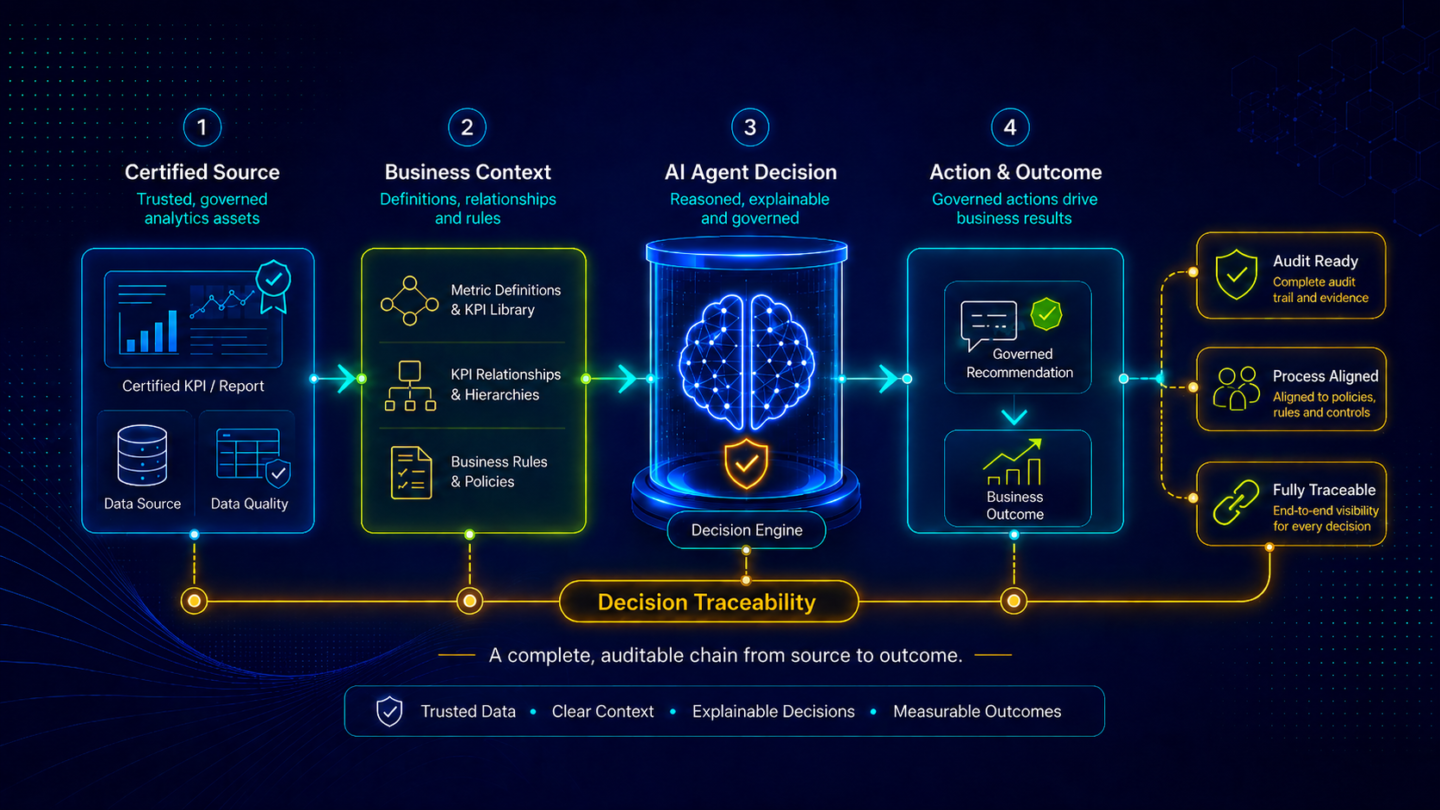
That chain has four components. First, the certified source: which analytics asset, with which certification status and ownership record, provided the data that grounded the agent's analysis. Second, the business context: which metric definitions, KPI relationships, and process rules the agent was operating within when it generated its recommendation. Third, the recommendation itself: what the agent surfaced, in what form, and under what parameters. Fourth, the action and outcome: what the agent triggered or recommended as a next step, what process that action was aligned to, and what business outcome it produced.
A trace that captures only some of these components is not decision traceability. In regulated environments, partial traces are not treated as partial compliance. They are treated as no compliance. The audit standard is completeness. An AI agent operating in enterprise analytics must carry a full chain of custody from the certified metric that triggered its analysis to the outcome its action produced.
This is a more demanding standard than most organizations applying general AI governance frameworks are currently meeting. General AI governance addresses questions like: is the model performing within acceptable parameters, is the output biased, and is the system secure? Those are required conditions. The analytics governance requirement goes further: is every action traceable to a certified business metric, is the recommendation grounded in the organization's own approved context, and is the decision lineage complete enough to satisfy an audit?
The Regulatory Pressure Already in Motion
The governance requirement is not a future state. The regulatory frameworks driving it are already in effect or in active enforcement planning.
The EU AI Act, which entered into force in stages from 2024 through 2027, establishes a risk-based classification for AI systems. Analytics-driven decisions in regulated industries (credit risk, insurance underwriting, and certain operational decision workflows) may fall within the high-risk classification under the Act's Annex III. High-risk AI systems require documented governance, human oversight mechanisms, and full traceability of how the system reached its outputs. Organizations deploying AI agents in these contexts without a governed execution layer face compliance exposure under the Act's requirements.
In financial services, the SEC and OCC have both issued guidance on AI governance for regulated entities. The common thread across regulatory frameworks: accountability for AI-influenced decisions cannot be waived by pointing to the model as a black box. The organization is accountable for the decision, which means the organization must be able to trace how that decision was made.
Enterprise risk frameworks are converging on the same requirement independently of specific regulations. Chief Risk Officers and enterprise audit functions are asking analytics and data leaders to demonstrate that AI agents operate within defined boundaries, that their actions are aligned to approved business processes, and that decision outputs are attributable. In organizations where those records do not exist, AI agent deployments are being paused or restricted pending governance architecture remediation.
Why Analytics Agent Governance Is Different from General AI Governance
General AI governance frameworks address the behavior of AI models across domains: safety, bias, output reliability, and access controls. These are necessary capabilities and most mature enterprises have some version of them in place.
Analytics agent governance addresses a more specific requirement: the governance of AI agents that operate within the enterprise analytics and business intelligence environment, where every output is tied to certified business metrics, regulated reporting cycles, and decisions made by senior leaders who are accountable for them.
The distinction matters because general AI governance does not provide what analytics agent governance requires. A model monitoring framework that confirms the agent is operating within statistical norms does not confirm that the agent's recommendation was grounded in the certified version of a financial metric rather than a shadow version built by a regional team. A bias monitoring framework that confirms output fairness does not confirm that the agent's action was aligned with the approved business process that governs that decision type. An access control framework that confirms only authorized users triggered the agent does not capture whether the agent's KPI references were authoritative.
For a detailed treatment of the distinction between general AI governance and analytics governance, Governing Autonomous Analytics AI at Enterprise Scale maps the gap that most enterprise governance programs have not yet closed.
What Implementation Requires at Each Layer
Building the governed AI execution environment for enterprise analytics is a three-layer project, and the layers must be built in sequence.
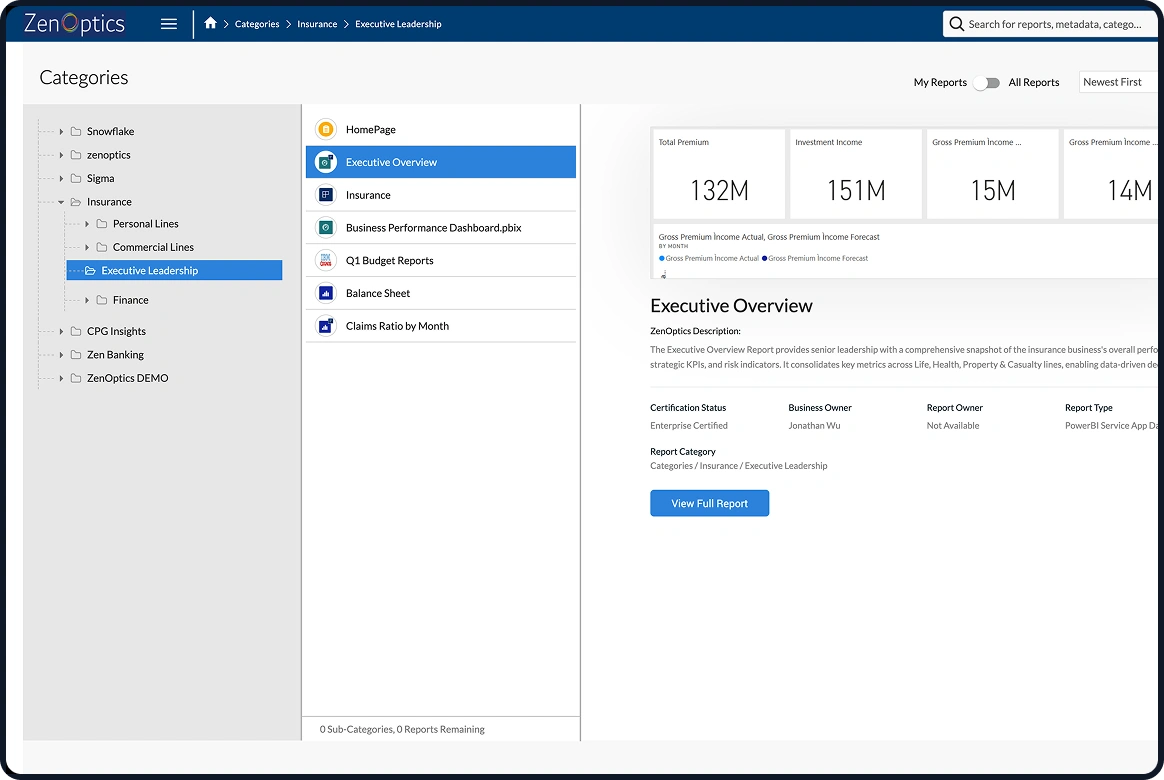
The foundation is a certified analytics estate. Every analytics asset that an AI agent might query must have a known certification status, an active owner, and a clear designation of whether it is an authoritative source for the relevant metric. An agent operating on an ungoverned estate will ground its analysis in whatever it finds, certified and uncertified assets alike. The decision lineage that follows is not auditable because the data foundation is not itself certified. This layer must be complete before governance of agent actions can be meaningful.
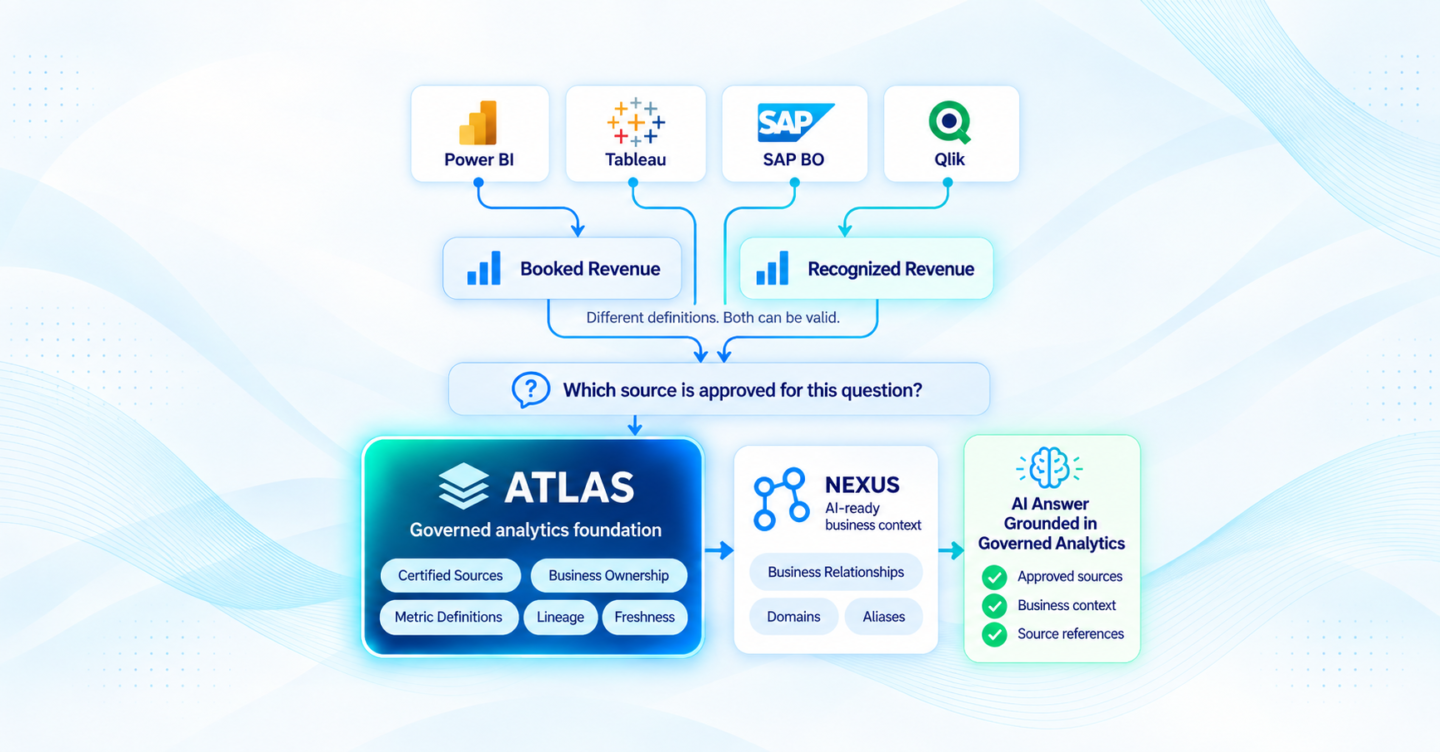
The second layer is the analytics context layer. Governed execution requires that every agent action be grounded in the organization's approved business definitions, not in the agent's statistical inferences. The context layer makes those definitions machine-readable: what each metric means, how it relates to other metrics, which definitions are authoritative for which reporting contexts, and what the approved process boundaries are for decisions in each domain. Without this layer, the agent's actions cannot be traced to business-approved logic. They can only be traced to what the model computed.
The third layer is the governed execution environment itself. This is where decision traceability is operationalized: every AI-driven action is mapped to the certified metric that informed it, aligned to the approved business process that governs it, and recorded with the full decision lineage from input to recommendation to outcome. The governed execution layer also monitors agent behavior in real time, enforcing process boundaries and flagging actions that fall outside defined parameters before they produce outcomes that require remediation.
For organizations working through the broader AI readiness architecture, the AI-ready analytics enterprise blueprint covers how the three layers connect at enterprise scale.
The Platform Layer That Makes Governed Execution Operational
Maestro, ZenOptics's Execution and Agent Control Layer, is built for this requirement. Maestro maps every AI-driven decision to the trusted analytics that informed it, enforces the process boundaries that govern agent actions, monitors agent behavior continuously, and captures full decision provenance at every step.
The decision provenance Maestro produces is not a general audit log. It is analytics-specific: every action is tied to the certified KPI that triggered the analysis, through the business context that grounded the recommendation, to the approved process that governed the action, to the outcome it produced. That chain is the auditable record that compliance, risk, and executive stakeholders require, and that regulators increasingly expect.
Maestro does not operate in isolation. It draws on Atlas for the certified analytics estate and on Nexus for the machine-readable context layer. The three layers together produce the governed execution environment that makes AI agent deployment viable in regulated enterprise environments.
For organizations that have closed the foundational gaps and are ready to understand what the full production-ready architecture looks like, Agentic Analytics in the Enterprise: From Pilot to Production maps the complete sequence.
Frequently Asked Questions
What is AI agent governance for enterprise analytics? AI agent governance for enterprise analytics is the set of controls, processes, and technical infrastructure that ensures AI agents operating in analytics environments act within approved boundaries, grounded in certified business data, with every action fully auditable. It is distinct from general AI governance because it addresses the specific requirements of analytics-driven decisions: certified metric sources, approved business process alignment, and complete decision lineage from KPI to recommendation to outcome.
What is decision traceability and why does it matter for enterprise AI? Decision traceability is the complete, end-to-end capture of the reasoning chain behind an AI-influenced decision. For enterprise analytics, that chain runs from the certified metric that triggered the analysis, through the business context that grounded the recommendation, through the process boundaries the agent operated within, to the action it triggered and the outcome it produced. Decision traceability matters because it is the auditable record that compliance and risk stakeholders require, and because partial traces are treated as no trace in most regulated environments.
How does the EU AI Act affect enterprise analytics deployments? The EU AI Act establishes a risk-based classification for AI systems. Analytics-driven decisions in regulated industries, particularly financial services and healthcare, may qualify as high-risk AI applications under the Act's framework. High-risk AI systems require documented governance mechanisms, human oversight, and full traceability of how the system reached its outputs. Organizations deploying AI agents in these contexts without a governed execution layer face compliance exposure under the Act's requirements as they come into full force.
What distinguishes analytics agent governance from general AI governance? General AI governance addresses model behavior across domains: output reliability, bias monitoring, safety controls, and access management. Analytics agent governance addresses the additional requirements specific to the business intelligence context: every AI action must be grounded in certified business metrics, aligned to approved business processes, and recorded with the complete decision lineage that analytics-specific compliance requires. General AI governance is a required condition for analytics agent governance, but it does not satisfy the analytics-specific traceability standard on its own.
Can AI agent governance be added after an agent is already deployed? Governance can be retrofitted, but at significant cost and risk. The core challenge is decision lineage: if the trace from input to recommendation to action was not captured from the start, it cannot be reconstructed for decisions that have already been made. Organizations that add governance after deployment can protect future decisions, but the period of ungoverned operation remains unauditable. For organizations in regulated industries, that gap represents a period of compliance exposure that may require disclosure. Building governance in from the start is always less expensive than retrofitting it.
What does a governed AI agent execution environment look like in practice? A governed AI agent execution environment has three visible characteristics. First, every agent action is traceable to the certified analytics asset that informed it: the agent cannot operate on uncertified or unclaimed data. Second, every recommendation is grounded in machine-readable business definitions that reflect the organization's approved KPI logic, not statistical inference. Third, every action the agent takes is aligned to an approved business process, monitored against defined behavioral boundaries, and recorded with the full decision lineage from source metric to outcome. In ZenOptics, Maestro is the execution layer that operationalizes all three.
Published June 1, 2026AI Agent Governance for Enterprise Analytics: Why Decision Traceability Is Non-Negotiable
Not sure your AI agents would pass a regulator or risk committee review? Reserve a 15‑minute governance consultation and we’ll walk through your analytics stack for decision traceability blind spots.
Schedule a 15min demo call