Enterprise organizations are spending more on AI than at any point in history. The models are more capable, the integrations are faster, and the vendor ecosystem is more mature. And yet the pattern from the past three years is consistent: AI investments deployed against analytics produce outputs that teams find plausible, sometimes useful, and rarely trusted enough to act on without manual verification. The problem is not the AI model. The problem is the layer beneath it that most AI deployments are missing entirely.
The analytics context layer is the structured representation of what your business metrics mean: how they are defined, how they relate to each other, who owns their definitions, and what process governs their use. Without it, AI systems fill the gaps with statistical inference. With it, AI systems produce answers that are grounded in the organization's actual business logic. The gap between those two things is why the context gap is the most common reason analytics AI investments stall in enterprise environments.
Why AI Needs More Than Access to Data
The assumption behind most enterprise AI deployments is that access is the bottleneck. If AI tools can connect to the data, they can use the data. This assumption underlies most data integration projects, most BI modernization programs, and most AI readiness assessments. It is also the reason so many of those investments produce less than expected.
Access and understanding are different things. An AI system given access to an enterprise's BI environment can read every report, query every metric, and return answers to any question it is asked. What it cannot do, without a context layer, is understand what those metrics mean in this organization. It cannot know that "revenue" in the commercial team's reporting excludes the adjustments the finance team applies. It cannot know that two reports with different names are measuring the same thing, or that two metrics with the same name are measuring different things depending on which business unit produced them. It cannot know which version of a KPI is authoritative for which reporting purpose, or that a metric's definition was revised six months ago and only applies to the current period.
These are not edge cases. They are the structural realities of enterprise analytics environments that have accumulated over years of BI investment across multiple tools, teams, and reporting cycles. AI systems operating without a context layer encounter all of it indiscriminately. They produce statistically reasonable answers and contextually wrong ones at unpredictable intervals. That unpredictability is what prevents the outputs from being trusted.
What an Analytics Context Layer Actually Is
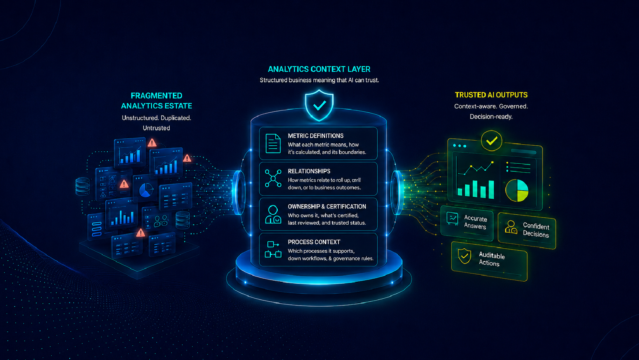
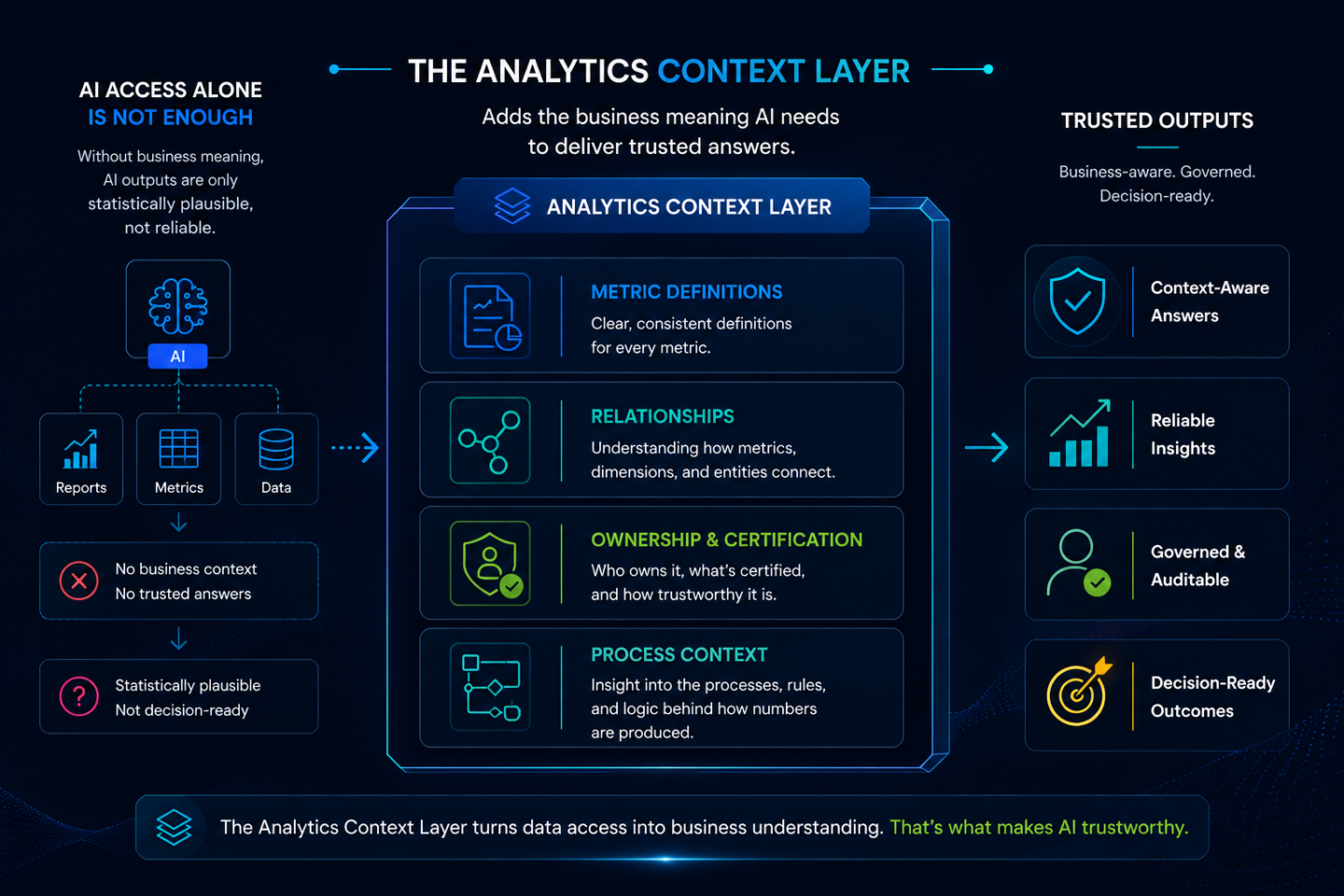
An analytics context layer is the machine-readable, structured representation of the business meaning embedded in an enterprise's analytics estate. It captures four categories of information that AI systems need to produce reliable, trusted outputs.
The first is metric definitions: what each KPI, metric, and measure means in precise business terms, including how it is calculated, what its boundaries are, and how it differs across business units or reporting contexts where the same term carries different meanings.
The second is relationships: how metrics relate to each other, which KPIs roll up into which business outcomes, which reports draw on which underlying metrics, and what the lineage is between raw data and the numbers that appear in executive dashboards.
The third is ownership and certification: which analytics assets have been designated as authoritative, who is accountable for their definitions, when they were last reviewed, and whether they are in current use or carry historical-only status.
The fourth is process context: which business processes each metric informs, what the decision workflow looks like around that metric, and what governance rules apply to AI systems that operate within that workflow.
Together, these four components give AI systems the business intelligence they need to move from statistically probable answers to contextually correct ones. They are the difference between an AI that knows your organization has a "net revenue" metric and an AI that knows what "net revenue" means in the context of your commercial team's Q3 reporting cycle.
Why This Is Not a Semantic Layer
Semantic layers, as developed in the BI context, address the translation between raw data schema and business-readable metric names. They sit between the data warehouse and the BI tool, mapping technical field names to business-language labels. They are valuable infrastructure.
They are not the same as an analytics context layer. A semantic layer handles the naming and basic calculation logic for metrics. An analytics context layer handles the organizational meaning behind those metrics: ownership, process context, certification status, cross-metric relationships, and the governance rules that determine how AI systems should use them. A semantic layer tells an AI system what "net revenue" is. An analytics context layer tells an AI system what "net revenue" means in this organization, for this reporting purpose, under this governance policy, and with this certification status.
The distinction matters for AI deployment because AI systems operating at the analytics layer need the organizational meaning, not just the technical definition. A semantic layer is a prerequisite for structured AI access. An analytics context layer is what makes that access produce trusted outputs.
Why This Is Not a Data Catalog
Data catalogs address the raw data and infrastructure layer: what datasets exist, where they live, what their technical schema is, and what the data quality is at the record level. Data catalogs are data engineering infrastructure.
An analytics context layer addresses the business intelligence layer: what metrics and dashboards mean, who owns them, how they relate to business decisions, and whether AI systems can trust them as authoritative sources for the decision they are supporting. These are different layers, different audiences, and different functions.
ZenOptics is explicit on this point: it is purpose-built for dashboards, metrics, and reports (the layer where business decisions actually happen) and is not a data catalog. A data catalog governs raw data so analysts can find and understand datasets. An analytics context layer governs certified analytics so AI systems can use them correctly and so the decisions AI influences can be traced, audited, and explained.
Organizations that have invested in data catalog programs sometimes assume the catalog addresses their AI context needs. It does not. The catalog tells data engineers what data exists. The analytics context layer tells AI systems what certified analytics mean and how they can be acted on.
What the Analytics Context Layer Enables
With a properly built analytics context layer in place, three capabilities become available that are not feasible without it.
The first is AI accuracy at business scale. AI tools connected to a context layer produce answers grounded in the organization's approved metric definitions, not statistical inferences. When an executive asks the AI system about revenue performance, the system draws on the certified version of the metric (the one the CFO has approved for quarterly reporting) rather than whichever report happens to be most statistically similar to the query. The difference between those two answers is the difference between AI that confirms what the team already knows and AI that produces numbers no one can reconcile.
The second is faster deployment of new AI use cases. The largest hidden cost in enterprise AI deployment is the manual semantic build work that precedes each new use case: defining what metrics mean for the AI, mapping relationships, and constructing the business context the AI needs to operate. Organizations implementing ZenOptics typically see AI deployment timelines compress two to three times once the automated context layer is in place, because the context layer is derived from existing BI metadata rather than built from scratch for each new AI application.
The third is the ability to govern AI execution. A governed analytics context layer is the foundation for decision traceability: every AI-driven action can be traced back to the certified metric that informed it, through the business context that grounded the recommendation, to the outcome it produced. Without the context layer, that trace does not exist. Every AI action is a black box. For the architecture that connects the context layer to governed agent execution, Agentic Analytics in the Enterprise: From Pilot to Production covers the full three-layer model.
How Automated Context Generation Changes the Build Equation
The traditional approach to building an analytics context layer is manual. A team of analysts or data engineers inventories the existing BI estate, maps metric definitions, documents relationships, and constructs the semantic and business context from scratch. This work takes months before the first AI use case can be deployed against it. When the business evolves, when definitions change, metrics are added, or BI tools are replaced, the manual build work begins again.
Automated context generation is a different approach. Rather than constructing the context layer from scratch, it derives the semantic structure, metric definitions, relationships, and business logic that already exist within the organization's BI metadata. The context layer is built from what is already there: the headers, schemas, query patterns, ownership records, and certifications that the BI estate already contains. The result is a context layer that is ready to serve AI systems without months of manual construction, and that updates automatically as the estate evolves rather than decaying between rebuild cycles.
Nexus, ZenOptics's AI Context Layer for Analytics, is built on this principle. Nexus onboards the metadata from the organization's BI tools through Atlas, automatically derives the context layer from what exists, and makes it machine-readable for any AI tool in the organization's stack. The context layer is maintained continuously as the estate changes, so new AI use cases can be deployed against the same trusted foundation rather than requiring a new manual build each time.
Organizations implementing ZenOptics typically see analytics discovery improve 20 to 40 percent once the context layer is in place, because every metric is surfaced with its certified definition, ownership, and relationship context rather than requiring analysts to reconstruct that information from institutional knowledge each time.
Frequently Asked Questions
What is an analytics context layer? An analytics context layer is the machine-readable, structured representation of what an enterprise's business metrics mean. It captures metric definitions, KPI relationships, ownership and certification status, and the process context that governs how analytics assets are used in business decisions. It is the layer between AI systems and BI data that enables AI to produce outputs grounded in the organization's actual business logic rather than statistical inference.
How is an analytics context layer different from a semantic layer? A semantic layer maps raw data fields to business-readable metric names and handles basic calculation logic. An analytics context layer addresses a broader set of information: who owns each metric's definition, what its certification status is, how it relates to other metrics in a governed hierarchy, and what business process context applies when AI systems use it. A semantic layer is necessary infrastructure for structured AI access; an analytics context layer is what makes that access produce contextually correct, trusted outputs. The two layers are complementary but address different problems.
Why do AI tools fail without an analytics context layer? Without a context layer, AI systems fill the gaps in their understanding with statistical inference. They can observe that two metrics are related based on how they appear together in queries and reports, but they cannot know which version of a metric is authoritative, what the governance rules around it are, or how its definition differs across business units. The result is answers that are statistically plausible but contextually wrong in ways that are difficult to predict and hard to diagnose, a pattern that erodes stakeholder trust over time.
Can you build an analytics context layer manually? You can, and many organizations have attempted it. Manual construction of an analytics context layer involves inventorying BI assets, documenting metric definitions, mapping relationships, and building the semantic structure by hand. The challenges are timeline (months of work before the first AI use case can deploy against it), maintenance (the context layer decays as the business evolves unless it is continuously updated), and coverage (manual builds typically cover a fraction of the full BI estate). Automated context generation (deriving the context layer from existing BI metadata rather than constructing it from scratch) addresses all three challenges.
How does the analytics context layer connect to AI agent governance? The analytics context layer is the foundation for governed AI execution. When AI agents operate within a context layer, every action they take can be traced back to the certified metric that informed it, through the approved business definitions that grounded the recommendation. Without that context layer, the trace does not exist, and agent actions are black boxes. The context layer is what makes decision traceability possible, which is the mechanism by which governed AI execution satisfies compliance, risk, and audit requirements.
How long does it take to build an analytics context layer with ZenOptics? With automated context generation through Nexus, the initial context layer is derived from existing BI metadata rather than built from scratch, significantly compressing the timeline compared to manual approaches. Organizations implementing ZenOptics typically see AI deployment timelines move two to three times faster than manual semantic build approaches, because the context layer is available for AI use as soon as the metadata onboarding is complete rather than after months of manual construction. The context layer also updates continuously as the BI estate evolves, rather than requiring periodic rebuild cycles.
Published June 5, 2026The Analytics Context Layer: The Missing Infrastructure for Enterprise AI
If you’re exploring how to make AI outputs actually trusted in your organization, schedule a 15‑minute working session with ZenOptics to review your current analytics stack.
Schedule a 15min demo call