

Most enterprise analytics teams that are building AI on top of their BI estate have a semantic layer. Many assume that the semantic layer addresses the context requirement for AI. The assumption is understandable: both layers deal with business terms, metric definitions, and the translation of technical data into something AI systems can use. It is also the assumption that causes the most predictable category of AI deployment failure: AI that queries the right metrics but interprets them incorrectly, producing outputs that are plausible but wrong in ways that take time to diagnose.
The difference between what a semantic layer provides and what an analytics context layer provides is specific and consequential. Understanding it before deployment saves significantly more time than diagnosing it after.
What a Semantic Layer Was Built to Do
The semantic layer emerged as a solution to a well-defined problem in business intelligence: the gap between how data lives in a warehouse and how business users need to access it. Raw data warehouses store information in technical schemas with field names, table structures, and calculation logic that are meaningful to data engineers and opaque to business users. The semantic layer sits between the warehouse and the BI tool, translating technical field names into business-readable labels, pre-computing common calculations, and presenting a consistent, user-friendly view of the underlying data.
This is genuinely valuable infrastructure. A well-built semantic layer means a business analyst can query "net revenue by region" without knowing which tables and fields the warehouse uses to calculate it. It means consistent metric naming across BI tools. It means business users and BI tools share the same vocabulary for referring to the data.
The semantic layer was built to solve a BI tool accessibility problem: making data usable by people without database expertise. It does this well. What it was not built to solve is the AI understanding problem: making business meaning accessible to autonomous AI systems.
What AI Agents Need That a Semantic Layer Doesn't Provide
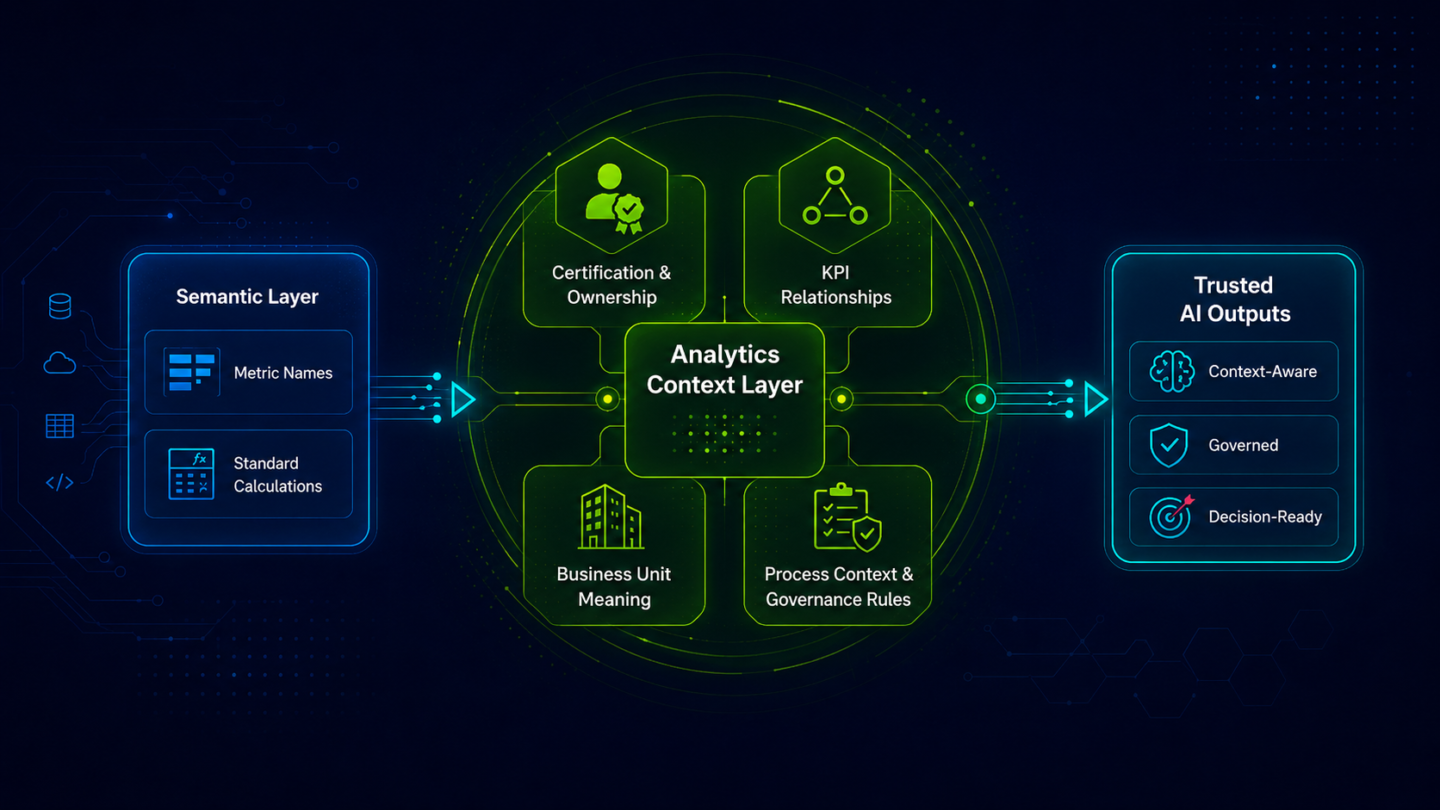
When an AI agent queries an enterprise analytics environment, it needs more than access to consistently labeled metrics. It needs to understand what those metrics mean in the context of this organization. Four categories of information that AI agents require are not typically captured in a semantic layer.
The first is certification and ownership. A semantic layer maps what a metric is called and how it is calculated. It does not record whether that metric has been certified as authoritative, who is accountable for its definition, or when it was last reviewed. An AI agent has no way to distinguish a certified version of a metric from a shadow version built by a regional team, both of which may exist in the BI environment with similar or identical names. When the agent retrieves both and synthesizes an answer, the output reflects neither accurately.
The second is cross-metric relationships in a governed hierarchy. A semantic layer provides individual metric definitions. An analytics context layer captures how those metrics relate to each other within the organization's specific governance structure: which KPIs roll up into which business outcomes, which metrics feed which forecasting models, and what the approved sequence of metrics is for a particular reporting or decision workflow. AI agents operating on multi-step analytical tasks need that relational structure. Without it, they construct the relationships themselves using statistical inference.
The third is how the same term means different things across business units. Enterprise BI environments regularly carry multiple versions of the same metric with the same name, each carrying different calculation logic depending on which team built them. A semantic layer typically picks one definition to surface. An analytics context layer records the variation: that "net revenue" in the commercial team's context excludes adjustments that the finance team's version includes, and that an AI system should apply the appropriate version depending on who is asking and for what purpose.
The fourth is process context and governance rules. An analytics context layer captures what business processes each metric informs, what the decision workflow is around that metric, and what governance rules apply to AI systems operating within that workflow. This is the information that makes AI actions traceable and auditable. A semantic layer has no mechanism for recording which process a metric belongs to, or what constraints apply when an AI agent acts on it.
Where the Confusion Comes From
The confusion between the two layers is not unreasonable. Both deal with business terminology. Both create a more accessible interface between technical data and business users or AI systems. Both involve documentation of what metrics mean. And both are sometimes marketed as the "context" layer for AI.
The distinction becomes clear when you consider what each layer does with that business terminology. A semantic layer is a query-time translation mechanism: when a user or AI system queries a metric, the semantic layer ensures they get it by its business name and with its standard calculation applied. The work happens at the moment of the query.
An analytics context layer is a meaning-time governance mechanism: it captures, organizes, and maintains the organizational knowledge about what every metric means, who owns it, how trustworthy it is, how it relates to other metrics, and what process governs its use. That knowledge exists independently of any query. It is available to any AI system, any BI tool, and any agentic workflow that needs to act on certified business intelligence rather than just retrieve labeled data.
The difference shows up in what happens when an AI agent encounters ambiguity. With a semantic layer, the agent has consistent metric names but fills gaps in meaning with statistical inference. With an analytics context layer, the agent has the organizational meaning behind those names and can resolve ambiguity using the organization's actual business logic.
What Each Layer Does and Does Not Replace
The analytics context layer does not replace the semantic layer. The two layers address different problems and operate at different points in the analytics and AI stack.
The semantic layer handles the translation from technical data to business-readable queries. It makes BI tools work for business users. It creates consistent naming across tools. It pre-computes common calculations. These are foundational capabilities that an analytics context layer does not duplicate.
The analytics context layer handles the organizational meaning behind the metrics the semantic layer surfaces. It records what those metrics mean to the business, how they relate to each other in a governed hierarchy, who owns their definitions, how trustworthy they are as authoritative sources, and what governance rules apply when AI systems use them.
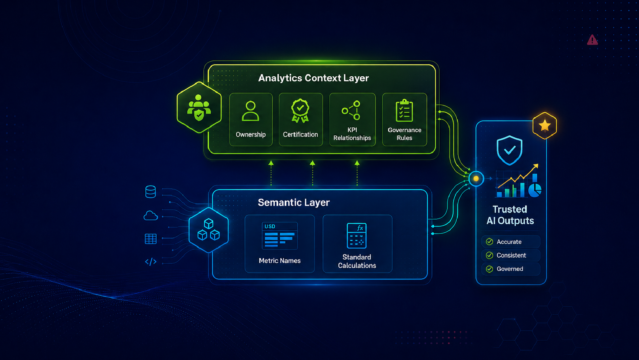
For AI deployment, both are required. The semantic layer gives AI consistent access to business-named metrics. The analytics context layer gives AI the organizational intelligence to interpret those metrics correctly and act on them in ways that are grounded in the organization's approved business logic rather than statistical inference about what those metrics probably mean.
What the Difference Means in Practice
The practical difference between deploying AI against a semantic layer only versus deploying AI against an analytics context layer shows up in the consistency and trustworthiness of the outputs.
With a semantic layer and no context layer, an AI agent retrieving revenue figures will get a business-named metric. When the answer conflicts with what the finance team expects (because the agent retrieved a version of the metric that excluded an adjustment the finance team applies) the agent has no mechanism to know that a conflict exists. The output is internally consistent from the agent's perspective. It is wrong from the business perspective. That type of error is difficult to diagnose because the metric name is correct; the error is in the organizational meaning behind it.
With an analytics context layer, the agent understands which version of the metric is certified for which purpose, who owns its definition, and what adjustments apply in which reporting context. The output is grounded in the organization's actual business logic rather than the agent's statistical inference about it. Outputs that used to require manual verification become outputs that can be acted on directly.
This is why the context gap is the most consistently cited reason analytics AI investments stall in enterprise environments: the semantic layer is in place, the AI tool is connected, and the outputs are still not trusted. The gap is not in the technical connectivity. It is in the organizational meaning that the technical layer does not carry.
This is where enterprises increasingly require a dedicated analytics context layer that complements the semantic layer rather than replacing it. Nexus, ZenOptics's AI Context Layer for Analytics, builds the analytics context layer automatically from the organization's existing BI metadata, without requiring the semantic layer to be rebuilt or replaced. It captures the certification status, ownership, cross-metric relationships, and process context that the semantic layer does not carry, and makes all of it available to AI systems as machine-readable business intelligence.
Frequently Asked Questions
What is the main difference between a semantic layer and an analytics context layer? A semantic layer translates technical data field names into business-readable metric names and handles standard calculations. An analytics context layer captures the organizational meaning behind those metrics: certification status, ownership, cross-metric relationships in a governed hierarchy, how the same metric differs across business units, and what governance rules apply when AI systems use it. The semantic layer handles query-time translation; the analytics context layer handles meaning-time governance.
Can a semantic layer replace an analytics context layer for AI deployments? No. A semantic layer gives AI consistent access to business-named metrics, which is necessary for structured AI access. An analytics context layer gives AI the organizational intelligence to interpret those metrics correctly, understanding which version is authoritative, who owns its definition, how it relates to other metrics, and what process context governs its use. Both are required for AI deployments that produce trusted, business-grounded outputs.
Do I need to replace my existing semantic layer to build an analytics context layer? No. The analytics context layer and the semantic layer are complementary and operate at different levels. The semantic layer continues to handle metric naming and query translation. The analytics context layer is built on top of the existing BI metadata to capture the organizational meaning that the semantic layer does not record. ZenOptics builds the analytics context layer from existing BI metadata without requiring the semantic layer to be rebuilt or replaced.
Why do AI agents struggle when operating with only a semantic layer? AI agents operating with only a semantic layer have consistent metric names but must fill gaps in organizational meaning with statistical inference. When an agent encounters multiple versions of a metric (certified and uncertified), it has no mechanism to distinguish between them. When a metric has different meanings across business units, the agent applies statistical inference to determine which meaning to use. The result is outputs that are internally consistent from the agent's perspective but contextually wrong from the business perspective, a pattern that erodes stakeholder trust progressively.
How does the analytics context layer handle metric definitions that differ across business units? The analytics context layer explicitly captures metric variation across business units: that "net revenue" in the commercial team's context excludes adjustments that the finance team's version includes, for example. When an AI agent queries a metric, the context layer provides not just the metric value but the governance metadata that determines which version is authoritative for which reporting purpose. This resolves the ambiguity that statistical inference cannot, and ensures AI outputs align with the organization's actual business logic rather than a generalized approximation of it.
How is building an analytics context layer different from extending a semantic layer? Extending a semantic layer typically means adding more metric definitions, more calculation logic, or more business-readable names. These additions stay within the semantic layer's scope: query-time translation. Building an analytics context layer means capturing a different category of information entirely: certification and ownership records, cross-metric governance hierarchies, process context, and the organizational rules that govern how AI systems should act on analytics. These capabilities require a different architecture, not an extension of the existing semantic layer.
Published June 8, 2026Analytics Context Layer vs. Semantic Layer
Understand why a semantic layer alone is not enough for AI deployments and how an analytics context layer helps AI interpret enterprise data with the right business meaning.
Schedule a 15min demo call