

Semantic layers have made a compelling case for themselves as the foundation for enterprise AI analytics. Define your business metrics once: the right SQL, the correct business rules, the appropriate grain. AI agents then reason from those definitions rather than reconstructing calculation logic from raw schema on every query. The case is accurate. Metric definition solves a real problem.
The limitation is that "defined" is not the same as "certified." A metric that has been accurately defined can still carry the wrong calculation if the definition was never validated against the organization's authoritative business standard. It can reflect outdated logic if the analyst who wrote it has since left and no one has reviewed it. It can drift from current standards if the underlying business rule changed and the definition was not updated. AI grounding on an uncertified definition does not hallucinate in the generative sense. It returns precisely what the definition says, consistently and without deviation. If the definition is wrong, the AI can reproduce that error consistently and confidently. Unless governance signals such as certification status, ownership and review history are supplied as context, the agent has little basis for determining whether the definition is still authoritative.
For enterprise organizations building AI analytics on top of semantic infrastructure, certified metrics for AI grounding are not an optimization. They are the condition under which AI analytics answers can be trusted.
How Semantic Layers Approach AI Grounding and Where They Stop
A semantic layer addresses one specific failure mode in AI analytics: inconsistency from re-derivation. Without a layer that encodes what "revenue" means, an AI agent constructing queries against a raw data warehouse will derive its own interpretation each time, drawing on schema structure, column names, and whatever context the query carries. Different agents, different sessions, different phrasings of the same question produce different revenue numbers. The semantic layer eliminates that class of failure by specifying the calculation once, making every query use the same definition.
This is a meaningful improvement for enterprise AI analytics. Consistent metric definitions prevent the most common source of AI analytics inconsistency. By centralizing calculation logic, governed semantic layers can make AI-generated analytical outputs more consistent than approaches that require agents to reconstruct metrics directly from raw schemas.
But repeatability is not accuracy. A metric definition that consistently encodes the wrong logic produces consistent wrong answers. A definition written to match last year's revenue recognition policy produces repeatable outputs that diverge from this year's audited P&L. A definition written by an analyst who has since moved to a different team may reflect that analyst's interpretation of the metric rather than the finance function's authoritative standard. Semantic layers store and enforce metric definitions, and some platforms also support approval or certification features. The enterprise gap appears when certification must remain accountable, current and discoverable across multiple BI tools, semantic environments and business domains, not only within the platform where the metric was defined.
Gartner's broader warning about ungoverned AI decision-making reinforces the need for accountable grounding inputs. Gartner's 2026 Data and Analytics Trends identified AI agent decision governance as a top priority, noting that as AI agents execute more strategic and operational decisions, "ungoverned decision-making increases exposure to legal, operational and reputational risk." For analytics leaders, ZenOptics believes that principle extends to the metrics agents use when generating answers and supporting decisions. Most enterprise AI analytics failures traced to governance gaps begin at exactly this point. The semantic layer did its job. The definition it stored was the problem.
Three Reasons a Defined Metric Is Not a Certified Metric
Three distinct gaps separate a defined metric from a certified metric. Each produces a class of AI grounding failure that metric definition cannot prevent.
The first is the validation gap. A metric definition records what someone believed the metric should be when they wrote it. A certified metric has been reviewed by a designated authority who confirmed that the definition aligns with the organization's current business standard: that the revenue calculation matches the finance team's audited methodology, that the churn definition matches customer success's authoritative measure, that the calculation grain is appropriate for the reporting context in which the metric will be used. Validation is an organizational act. It requires authority, a review process, and a record of what was confirmed and when. A stored definition, or even a certification label, is not automatically evidence that the metric was validated by the appropriate business authority. Trust requires a recorded validation process showing who approved the metric, what was reviewed, where it applies and when it must be reviewed again.
The second is the ownership gap. A defined metric has an author: the person or team who wrote it. A certified metric has a current owner: a designated person accountable for its accuracy today, responsible for flagging when the underlying business logic changes, and reachable when an AI output based on that metric needs to be investigated. When an AI analytics answer is questioned, "who wrote this definition" is the wrong question. "Who is accountable for this metric right now" is the governance question. Ownership is a responsibility that must be tracked, transferred, and maintained as the organization changes. The metric definition does not update when the original author changes roles or leaves. Analytics catalogs face the same gap when they record creation history rather than current accountability.
The third is the lifecycle gap. Business logic changes. Revenue recognition policies are revised. Customer definitions are reorganized. Product lines are reclassified. A metric definition that was accurate when written drifts from organizational standards as the business evolves. Without a review cycle, that drift goes undetected until AI answers based on a stale definition reach decision-makers, which is the worst possible moment to discover the grounding input was outdated. A certified metric has a review cadence: a scheduled process that confirms the definition remains aligned with the current standard, or triggers an update when it does not. A defined metric persists as written until someone notices something is wrong.
These three gaps compound each other. An unvalidated definition with no accountable owner and no review cycle is not a reliable AI grounding input. It is an assertion that AI will treat as authoritative because the semantic layer presented it as such.
| Defined metric | Certified metric |
| Contains calculation logic | Validated against an authoritative business standard |
| Has an author | Has a currently accountable owner |
| May remain unchanged indefinitely | Has a review or recertification cycle |
| Creates calculation consistency | Creates governance evidence and accountability |
| May be platform-specific | Can be governed across the analytics estate |
What Metric Certification Requires
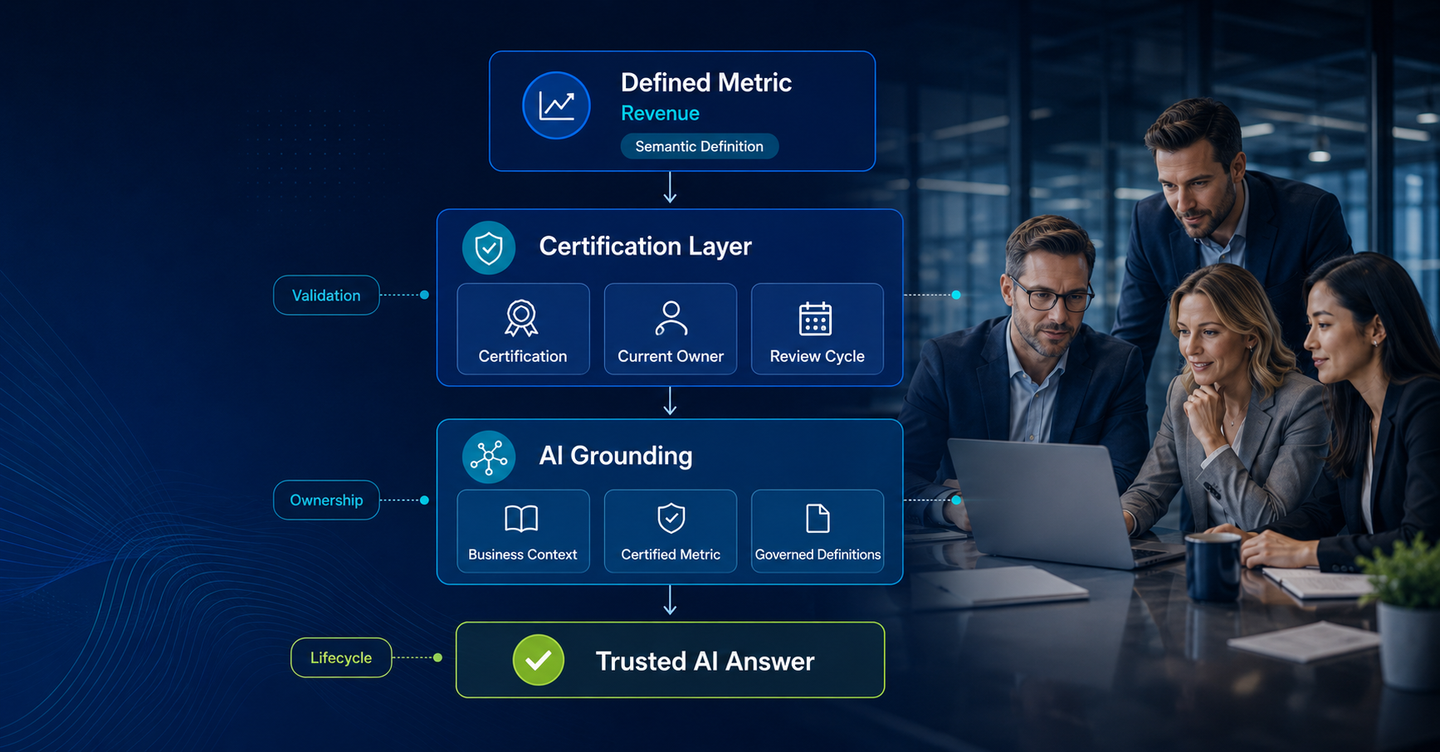
Certification is a governance process, not a quality label applied to a definition. Gartner's Zero-Trust Data Governance prediction forecasts that 50% of organizations will implement a zero-trust posture for data governance by 2028, driven by the proliferation of unverified AI-generated data. ZenOptics believes the same principle applies to the metrics AI systems consume: trust in a definition should be established through an explicit governance process, not assumed from its presence in a semantic layer. Three elements distinguish a certified metric from one that has only been defined.
A designated certification authority is the first requirement. Someone with organizational standing must be able to declare that a metric definition is authoritative for a specific reporting context. This is not the analyst who wrote the definition. It is the finance lead who confirms the revenue calculation aligns with the audited P&L methodology, or the analytics governance function that validates KPI definitions before they enter the governed analytics layer. Authority is what makes certification meaningful. Without it, a certification status is self-certification, which provides no governance guarantee.
A recorded validation act is the second requirement. The certification record must capture more than the metric definition itself: it must document who validated it, what was confirmed, including definition correctness, data lineage alignment, and the reporting contexts the metric governs, and when the validation occurred. This record is what makes an AI grounding input traceable. When an AI analytics answer is questioned, the certification record is the governance trail that shows the answer was derived from a validated, accountable source. Context engineering builds the organizational processes that generate and maintain those records: who certifies, what the review confirms, and how certification status flows to the AI systems that consume certified metrics as grounding inputs.
An ownership and review cycle is the third requirement. A current owner holds ongoing accountability for the certified metric. A defined review cadence confirms the definition remains accurate as business logic evolves. When a review reveals that the underlying standard has changed, the certification is updated or suspended until the definition is corrected. Without these two elements, even a metric that was correctly certified at initial review can carry stale logic within months.
How Atlas Certification and Nexus Grounding Work Together
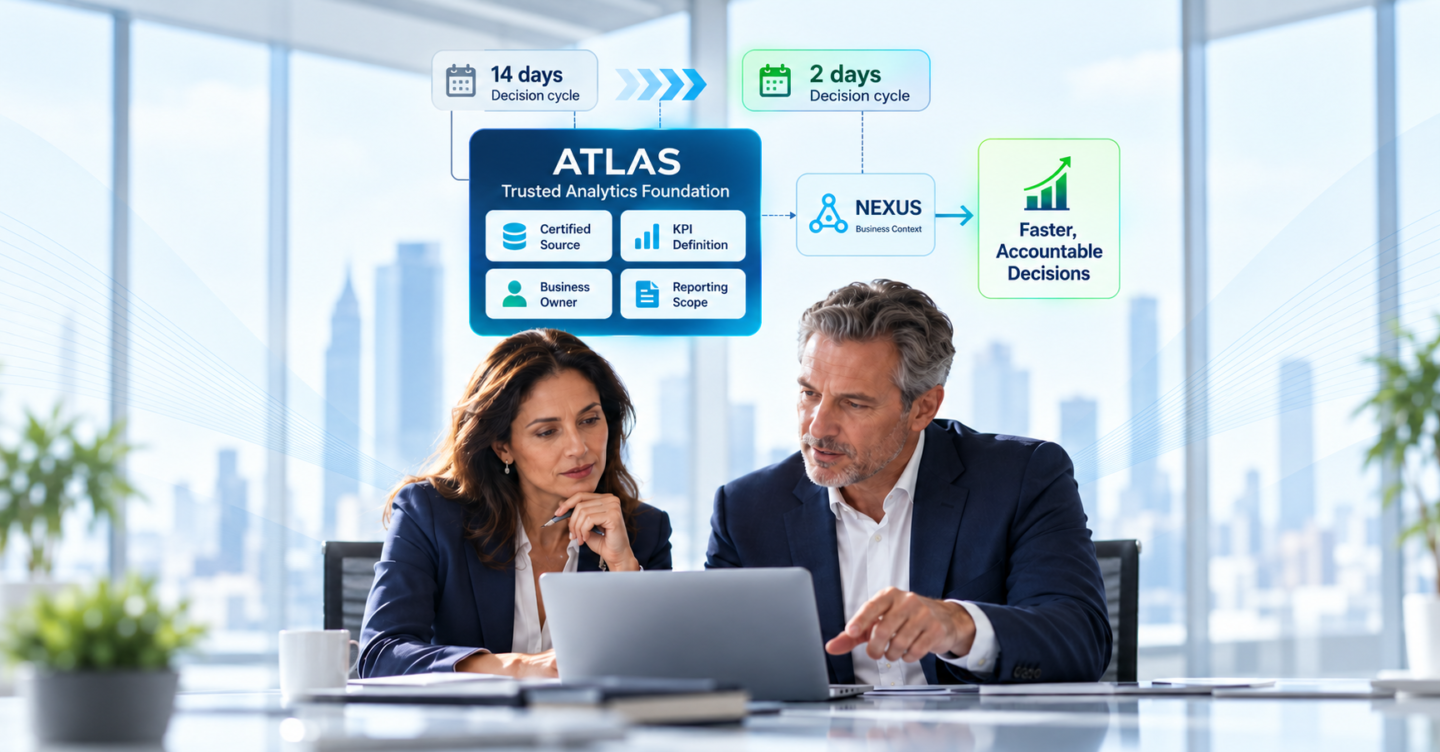
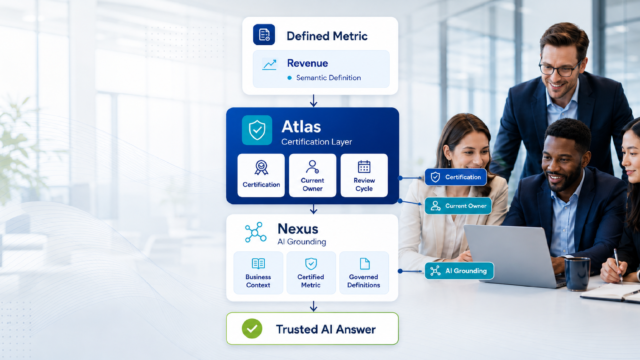
Atlas, the ZenOptics Analytics System of Record, provides the governance layer that operates above the semantic layer: supporting metric review workflows, organizational accountability structures, validation records, and ownership tracking. Atlas does not replace the semantic layer. It provides the governance process that helps make semantic layer definitions more trustworthy as AI grounding inputs.
Nexus, the ZenOptics AI context layer, grounds AI reasoning in governed metrics rather than in raw semantic layer definitions. Nexus makes governed business context, including certified metrics, definitions, ownership, relationships and lineage, available in a machine-readable form that AI systems can use for more trustworthy analytical reasoning.
This is where ZenOptics extends beyond platform-specific metric governance. Atlas creates a governed inventory across the enterprise's distributed BI environment, connecting Power BI, Tableau, SAP BusinessObjects, Qlik, and other platforms. Nexus converts that governed analytics estate into context AI systems can understand. The analytics context layer is the infrastructure that makes this connection between governed metrics and AI reasoning practical at enterprise scale.
The distinction this post opened with becomes operational here. Semantic layers deliver calculation consistency. Certified metrics deliver governance accountability. Enterprise AI analytics requires both. Nexus is where those two requirements meet.
Frequently Asked Questions
What is the difference between a defined metric and a certified metric?
A defined metric specifies the calculation logic in a semantic or metric layer tool: the SQL, the business rules, the grain, the applicable filters. A certified metric has also been validated by a designated authority who confirmed the definition aligns with the organization's current authoritative business standard, with a current owner assigned and a validation record maintained. Defined metrics provide calculation consistency across queries. Certified metrics provide governance accountability for what those calculations represent.
Can a semantic layer provide certified metrics for AI grounding?
Some semantic-layer platforms support elements of metric governance. However, enterprises still need a governance system that can coordinate validation authority, ownership, review history and certification status across the broader analytics estate. Atlas provides that cross-platform governance layer while the semantic layer continues to manage calculation logic.
Why does metric lifecycle governance matter for AI grounding specifically?
AI agents use metric definitions as grounding inputs across every session, query, and workflow. If a metric definition was accurate when written but has since drifted from the organization's current business standard, the AI will continue grounding on the outdated definition until someone corrects it. Unlike a human analyst who might notice that something seems off, an AI agent operating without governance context has little basis for questioning whether a definition it was given is still current or authoritative. A review cycle catches definition drift before stale grounding inputs reach decision-makers.
What does Nexus do that a semantic layer does not?
Nexus provides AI agents with the governance context surrounding each metric: the Atlas certification record, ownership, lineage, and the relational structure connecting certified metrics across business domains. A semantic layer tells an AI agent what a metric means. Nexus tells it whether that meaning has been validated, who is accountable for it, and whether the certification is current. That governance context is what makes an AI analytics answer traceable to an accountable source.
Which metrics need to be certified first?
Certification matters most for the metrics AI agents use in high-stakes analytical reasoning: KPIs that appear in executive reporting, measures that drive financial or operational decisions, and metrics used in regulatory or compliance contexts. Organizations typically begin metric certification programs with tier-one KPIs and expand governance coverage over time. Nexus can surface certification status for every metric an AI agent accesses, so analysts understand the governance standing of every grounding input behind each AI answer.
Published August 24, 2026From Metric Definition to Governed AI Grounding
Your semantic layer can standardize how a metric is calculated. Atlas helps govern whether that metric is validated, current and accountable across the analytics estate. Nexus makes that governed context available to AI, helping enterprises produce analytical answers that are more traceable and trustworthy.
See How Atlas Governs AI Grounding