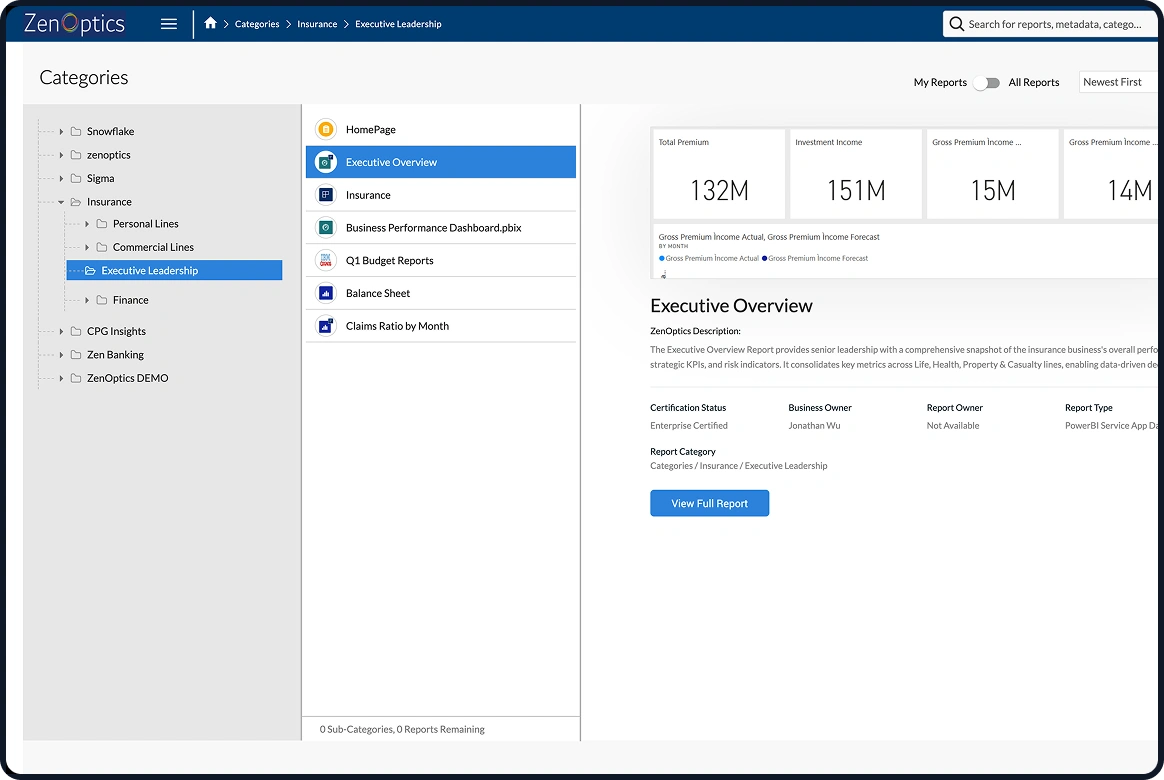



An AI agent flags an unexpected cost variance, recommends holding a vendor payment, and routes the exception for approval. Weeks later, finance asks a straightforward question: why was that action taken?
A confidence score or model card cannot provide the full answer. The organization also needs to know which metric triggered the action, whether that metric was certified, which workflow and controls applied, who approved the decision, and what happened next.
The field of explainable AI has developed sophisticated tools for making model behavior interpretable. SHAP values, LIME explanations, model cards, and feature attribution methods tell data scientists and ML engineers why a model produced a particular output. These tools are valuable. But they do not tell a finance controller, a legal reviewer, or an operations leader what they need to know when an AI agent has taken a consequential action in a business process.
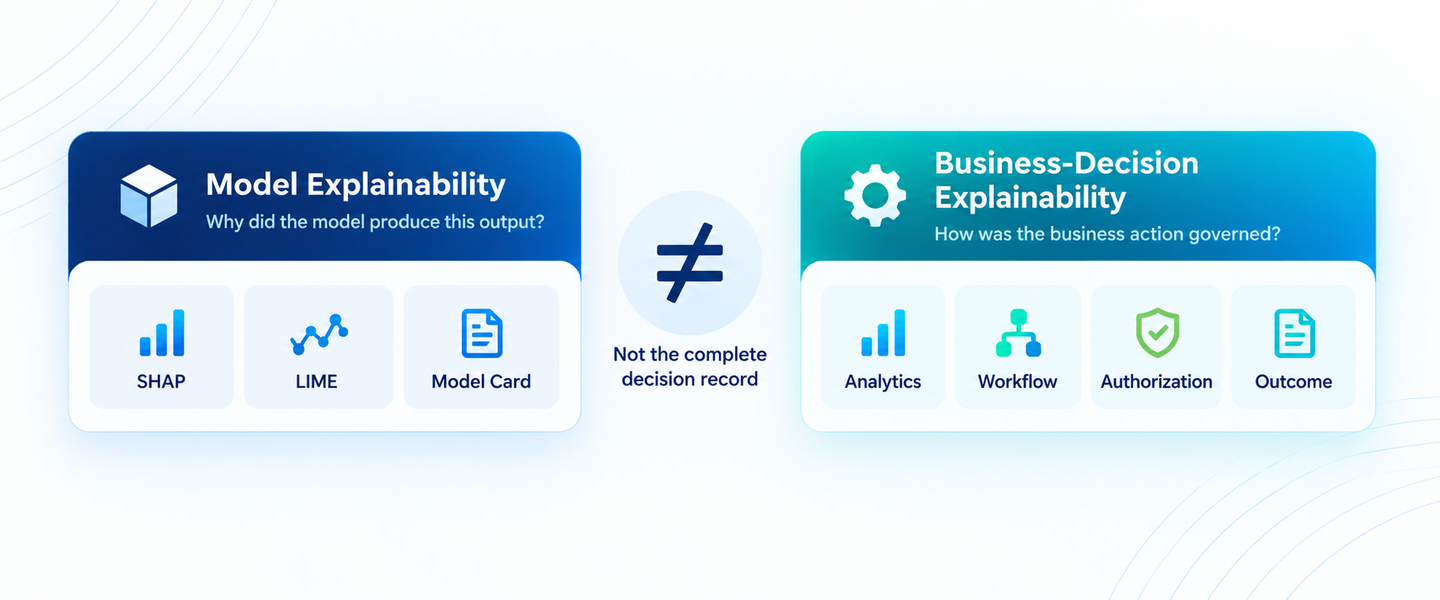
Model explainability answers the question: why did the AI system produce this output? Business-decision explainability answers a different question: what did the AI agent do, on what certified analytics, under what workflow authorization, and with what measurable outcome? For most enterprise AI deployments, only the first question has a structured answer.
Why the Two Questions Require Different Answers
The decision governance for AI agents literature draws a consistent distinction between governing the AI system and governing the business decision the AI system influences. That distinction matters when the question of explainability arises.
A model card is a document about how an AI system was built: its training data, its evaluation methodology, its known limitations, and its intended use cases. It is a technical artifact. When a compliance reviewer asks how an AI agent's CapEx routing was governed, the model card does not answer: it does not capture whether the analytics the agent referenced were certified, what workflow structured the routing decision, who held authorization authority, or what the outcome was.
The governance requirements that follow AI agents into enterprise workflows are governance-layer requirements, not model-layer requirements. The EU AI Act makes traceability, documentation, human oversight, and transparency increasingly important for organizations that develop or deploy AI. The precise obligations depend on the system's role, risk classification, and use case, and different provisions follow different implementation timelines. Although the Act does not prescribe the specific decision record described here, organizations will need reliable evidence showing how regulated AI systems were used, monitored, and governed. For relevant high-risk use cases, model documentation alone may not provide sufficient evidence of how an AI-supported action was governed within the business process. Organizations should assess the complete documentation, logging, oversight, and record-keeping requirements applicable to each system.
The gap is structural. Model explainability tools were built to answer engineering questions. Business-decision explainability requires a different architecture: one that governs the analytics basis, the workflow context, the authorization record, and the outcome connection at the point where AI agents act in business processes.
What Business-Decision Explainability Actually Requires
Although regulatory requirements vary by jurisdiction and use case, ZenOptics recommends four operational components for creating an explainable business-decision record. What a complete decision record requires is a set of four connected elements, each addressing a distinct dimension of the question "how was this decision made?"
A certified analytics basis. When an AI agent references a metric during a workflow step, a compliance reviewer's first question is whether that metric was current, certified, and owned. If the agent drew on an uncertified metric without a designated owner or current approval status, the decision cannot be fully explained because its analytical foundation is not governed. Explainability at this layer requires a record connecting the agent's action to the certified metric it referenced, including that metric's definition, ownership, lineage, and certification status at the time of decision.
A governed workflow context. An AI agent acting outside a structured workflow may produce a technically correct output that is disconnected from the authorization, controls, and accountability structure consequential business decisions require. A governed workflow defines the permitted actions, ownership, approval thresholds, and escalation paths for each step. When an agent operates within that structure, its action is explained not only by the model but by the process context: the workflow step, the controls that applied, and the governance conditions that were in place.
A control and authorization record for consequential steps. For steps involving a consequential decision, the record should capture whether the applicable control condition was satisfied: whether the relevant authorization was in place, whether a review was required and completed, whether a policy check was triggered. This is the record that allows an operations or legal reviewer to assess whether the AI agent's action was sanctioned, not merely technically executed.
A decision provenance record connecting action to outcome. Explainability is incomplete if the record ends at the action. The outcome connects the agent's action to the business consequence that followed. Without this connection, accountability rests on process compliance alone, not on whether the governed process produced a traceable, evaluable result.
Together, these four elements constitute the business-decision explainability record. None of them are produced by model documentation. All of them require a governance architecture that operates at the workflow layer, not the model layer.
Where Most Enterprise AI Programs Stop Short
Enterprise AI programs often invest heavily in model documentation while leaving the surrounding business-decision process less visible. The gap appears when an auditor, regulator, or business leader asks not only why the model generated an output, but how that output became an authorized business action.
Accurate models and useful insights are important. But organizations also need a traceable record of the analytics, workflow, controls, and outcomes surrounding consequential actions. What metric certification requires is a governance discipline, not an AI engineering discipline. The same is true of workflow authorization, decision provenance, and outcome traceability. An analytics-to-action workflow that lacks a decision governance layer can surface the right insight, but the resulting action may not be explainable in the sense that business stakeholders require.
How Maestro Supports Business-Decision Explainability
Meeting this requirement does not mean replacing model-explainability tools. It means complementing them with governance at the analytics and workflow layers. This is where ZenOptics' platform architecture becomes relevant.
The governance layer that makes AI agent deployment production-ready is a workflow governance layer that connects the certified analytics AI agents reference to the governed processes those agents execute within.
Maestro is ZenOptics' governed workflow execution layer. When AI agents participate in Maestro workflows, the workflow structure can connect the analytics basis, the execution context, the governance controls, and the action history in a single governed process record. This can support the kind of business-decision explainability that compliance reviewers and operations leaders require: not why the model scored the input, but what the agent did, on what analytics, under what authorization, and with what outcome.
By connecting Maestro workflows with Atlas-governed analytics assets, organizations can preserve important context around the metrics informing an AI-supported action, including definitions, ownership, and certification status. Nexus can further provide business context that helps AI systems interpret governed enterprise analytics more consistently.
Together, Atlas, Nexus, and Maestro can help organizations extend explainability beyond model behavior and into the surrounding business-decision process. The model documentation records how the AI system was built. The decision governance record can capture what the AI agent did, and whether that action was governed, authorized, and traceable.
Frequently Asked Questions
What is the difference between explainable AI and business-decision explainability?
Explainable AI (XAI) typically refers to techniques and tools that make model behavior interpretable: feature attribution, SHAP values, LIME explanations, and model cards. These address the model layer: why did the AI system produce this output? Business-decision explainability addresses the governance layer: what did the AI agent do in a business process, on what certified analytics, under what authorization, and with what outcome? Both are necessary, but they require different tools and different governance architectures.
Why doesn't model documentation satisfy explainability requirements for AI agent decisions?
A model card records how an AI system was developed and evaluated. It does not record whether the analytics the agent referenced were certified, what workflow governed the decision, who held authorization, or what the outcome was. When a compliance reviewer or regulator asks how an AI agent's consequential action was governed, model documentation does not answer that question. A business-decision governance record does.
What does the EU AI Act require for explainability?
The EU AI Act applies different obligations according to an AI system's role, risk classification, and use case. Requirements may include technical documentation, record-keeping, transparency, human oversight, risk management, and post-market monitoring. Certain transparency rules became enforceable in August 2026, while some obligations for high-risk systems follow later application dates. Penalties also vary by type of infringement; the maximum €35 million penalty is associated with prohibited AI practices rather than every failure involving a high-risk system. Organizations should obtain qualified legal advice for their particular systems and deployment contexts.
How does a governed workflow contribute to AI decision explainability?
A governed workflow defines the process structure within which an AI agent acts: permitted actions, ownership, approval thresholds, escalation paths, and control conditions. When an agent operates within that structure, the workflow record captures what happened, what governance conditions applied, and whether those conditions were satisfied. This is the process context that model documentation cannot provide.
What role does ZenOptics play in AI decision explainability?
ZenOptics connects certified analytics, governed workflow execution, and decision provenance in enterprise AI deployments. Atlas governs the certified analytics basis agents reference. Nexus gives agents the business context to interpret those analytics correctly. Maestro structures the workflow, controls, ownership, and action history that constitute the business-decision record.
Published September 25, 2026From Model Transparency to Decision Accountability
Explainability requirements for enterprise AI are not going to contract. Operations, finance, and legal teams need to understand and evaluate the AI-influenced decisions that affect their domains. Regulatory frameworks like the EU AI Act bring the compliance dimension into focus, but the business case for traceable, accountable AI decisions precedes the regulation. Model transparency is necessary. It is not sufficient. The certified analytics basis, the governed workflow, the authorization record, and the outcome connection are what transform a model output into an explainable, accountable business decision. ZenOptics connects these layers across the decision lifecycle. Atlas governs the analytics foundation. Nexus provides the business context AI needs to interpret it correctly. Maestro structures execution, controls, and the decision record. Can you reconstruct an AI-supported decision from metric to outcome? See how ZenOptics connects governed analytics, business context, and workflow execution to help create a more traceable decision process. Explore AI Decision Governance with ZenOptics
Schedule a 15min demo call