


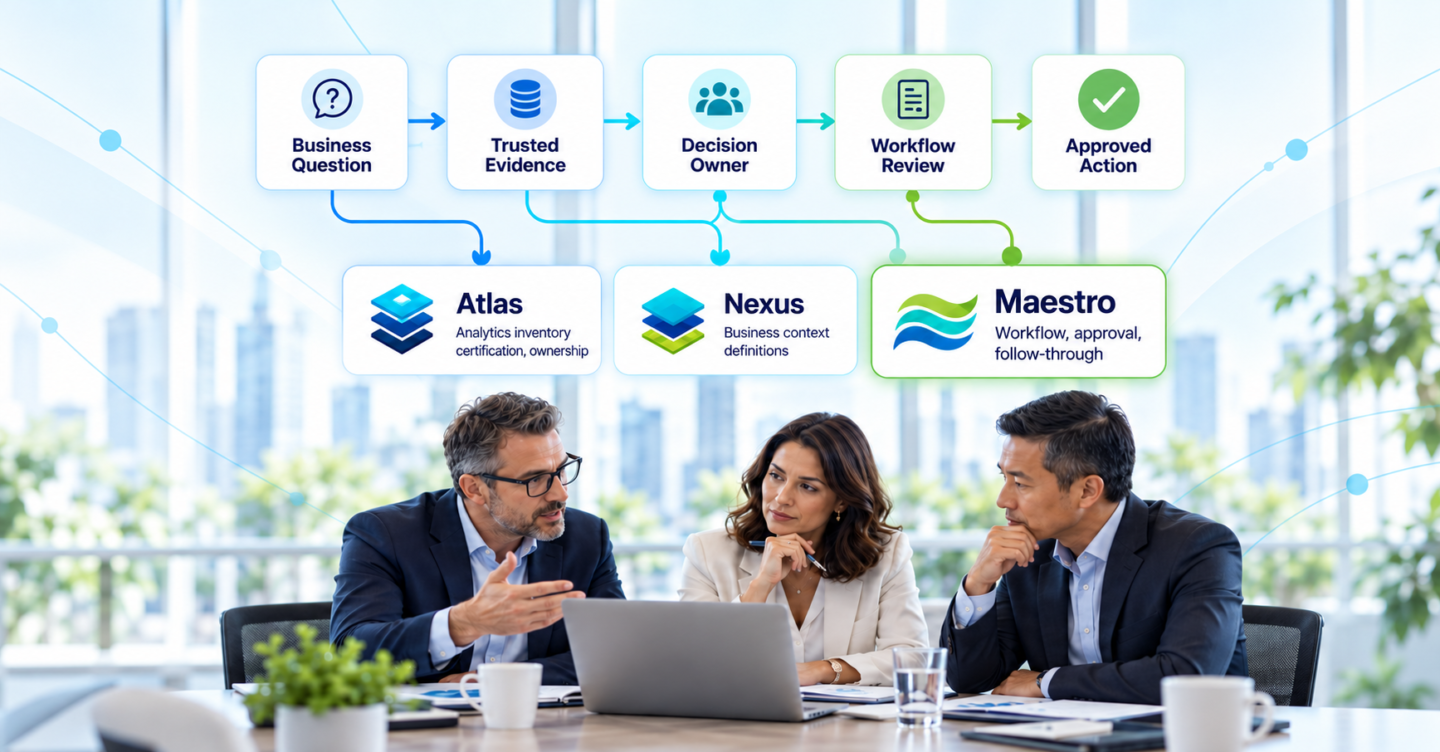



Most enterprises are good at producing insights. The harder part is turning those insights into governed, accountable actions. A certified KPI identifies a threshold breach, a BI tool flags a variance, or an AI copilot surfaces a critical metric. But what happens next is often informal: a meeting, an email, or a decision with no clear record of who approved it, what evidence supported it, or what outcome followed.
This is the analytics-to-action gap. The phrase is widely used, but the underlying problem is often misunderstood. Insights may be accessible, but most enterprise operations teams still lack the workflow governance layer needed to convert them into authorized, traceable business actions.
What "Analytics to Action" Actually Means in Enterprise Operations
The insight-to-action gap is real, but the standard explanation does not tell the whole story. A common approach is to surface insights inside the business applications where decisions are made. Embed the metric in the CRM. Put the KPI widget in the collaboration tool. Make the dashboard appear inside the ERP. Bringing insights closer to where work happens can accelerate action, but it does not automatically govern that action.
Visibility reduces friction. It does not make the action that follows governed, authorized, or traceable. An analyst who sees a certified variance in a project management tool still decides what to do about it in a meeting, via email, or through an informal directive. The insight may be visible, but the organization can still lack a reliable record of what was decided, who authorized it, which evidence supported it, and what outcome followed.
Decision intelligence connects trusted analytics with structured, accountable business decisions. It requires a workflow layer that defines what should happen after an insight appears—who reviews it, who approves the response, what action is taken, and how the outcome is recorded. This infrastructure is what many enterprise analytics programs are missing.
Why Embedded Analytics Does Not Close the Governance Gap
Embedding analytics in business apps is a real improvement for the visibility layer. It is not a solution to the governance gap, because visibility and governance address different parts of the analytics-to-action chain.
An embedded metric can reduce context-switching, but visibility alone does not establish whether the metric was certified, what decision it triggered, who authorized the response, or what outcome followed. Six months later, when a budget variance requires explanation, when a compliance review asks how a particular action was authorized, when an audit trail is needed for an AI-executed step, there is no governed record.
As AI becomes more involved in enterprise decisions, organizations increasingly need to understand what analytics informed an action, who authorized it, and what happened next. Embedded analytics makes insights more visible, but it does not create the governance record connecting a certified metric with an authorized action and its outcome. Creating that record establishes decision provenance: a traceable connection between the trusted analytics used, the process followed, the authorization provided, and the resulting outcome. A metric surfaced inside a collaboration tool does not produce that artifact regardless of how well the underlying BI is governed.
The gap persists at the workflow execution layer. That is where the solution belongs.
Four Elements of a Governed Analytics-to-Action Workflow
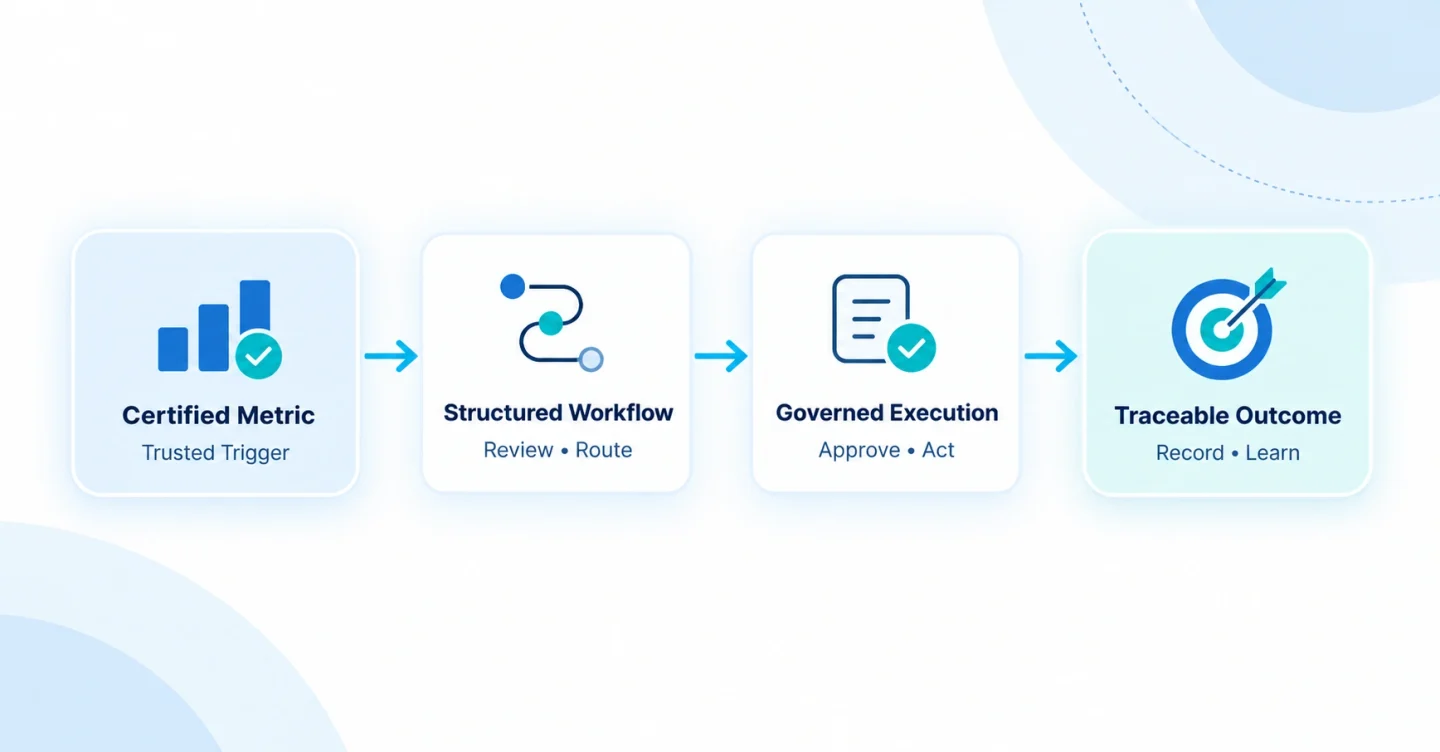
Closing the analytics-to-action gap at the governance layer requires four components working together.
A certified analytics trigger. The metric triggering the workflow should be trusted and certified, with a clear definition, designated owner, current certification status, and established review cadence. What metric certification requires is a formal governance record, not a label. When a certified metric triggers a decision workflow, its certification status can become part of the workflow record. If an uncertified metric drives the workflow instead, that too is a governance signal.
A structured workflow. The process that governs what happens when a certified metric triggers a decision must be defined: who is involved at each step, in what sequence, with what authority. In enterprise operations, this means structured workflows for the repeating analytics-driven processes that run the business: month-end close, budget variance review, CapEx approval, QBR preparation. A structured workflow converts an informal decision into a governed process with defined steps and owners. For example, a budget variance could automatically initiate a review by the finance manager, require approval from the finance director, and record the final adjustment and rationale.
Governance built into execution. Reviews, approvals, and authorizations must be captured as part of the execution record at each step, not added as separate documentation after the workflow runs. Approvals, escalations, supporting evidence, and completed actions become part of the workflow record as the process runs—not documentation assembled afterward.
A decision provenance record that closes the loop. The connection between the certified metric, the authorized action, and the outcome must be captured and retrievable. Without this connection, it becomes difficult to evaluate which decisions worked, understand why they worked, and improve future responses. The analytics context layer provides a governed, machine-readable representation of the certified analytics estate that AI systems can access during the workflow. When AI participates in a governed workflow, its access to certified context is what makes that participation traceable.
How Maestro Connects Analytics with Governed Business Action
Maestro helps organizations turn trusted analytics into structured business action. Its Business Process Workflow Library provides prebuilt workflows across functions such as Finance, Legal, HR, Sales, and IT. Each workflow is structured for the consequential analytics-driven decisions those functions execute: CapEx approval, cash flow forecasting, month-end close, QBR preparation, headcount planning, vendor evaluation.
Maestro workflows can connect relevant process steps with certified analytics governed in Atlas: the analytics system of record that certifies KPIs, governs BI inventory, maintains ownership records, and tracks lifecycle status across the analytics estate. The metric that surfaces in a Maestro workflow step is the same certified metric from the governed BI catalog, with the same certification status and the same ownership record attached. This helps maintain continuity between the analytics governed in Atlas and the business processes managed through Maestro.
Governance is built into each execution step. Reviews, approvals, and escalations are structured into the workflow itself, captured as the step completes, and retrievable as part of the decision provenance record. Governance is the native output of the process, not an afterthought added for audit purposes.
With ZIVA, teams can describe an analytics-driven process in plain language and use AI to generate an initial workflow structure, reducing the manual effort required to design the process from scratch.
When AI agents participate in Maestro workflows, they can operate within a governed structure, using certified analytics from Atlas and governed business context supplied through Nexus: the analytics context layer that makes the certified estate interpretable to AI in machine-readable form. The workflow can capture the analytics referenced, the step completed, the applicable governance condition, and the action taken—creating a traceable record of AI participation. This governed structure helps make AI participation accountable, traceable, and easier to review.
Frequently Asked Questions
What is the analytics-to-action gap?
The analytics-to-action gap is the absence of a governed connection between a certified analytics insight and the authorized business action it justifies. Most enterprise organizations surface insights well; few have the workflow governance layer that converts those insights into structured, authorized, traceable business decisions. The gap is a workflow architecture problem, not a data quality problem.
Why is embedded analytics not enough to close the analytics-to-action gap?
Embedded analytics reduces the friction of accessing insights by surfacing them inside the business apps where work happens. It does not make the decisions those insights trigger governed, authorized, or traceable. Closing the analytics-to-action gap requires more than insight visibility. It requires a workflow execution layer that captures the decision process, authorization, and outcome as a governed record.
What does a governed analytics-to-action workflow require?
A governed analytics-to-action workflow requires four components: a certified analytics trigger, a structured workflow that governs the decision process, governance built into execution at each step with reviews and approvals captured as the workflow runs, and a decision provenance record connecting the certified metric to the authorized action to the outcome.
What is Maestro's role in analytics-to-action workflows?
Maestro provides the governed workflow execution layer. Its Business Process Workflow Library contains prebuilt analytics-driven workflows by business function, with governance built into each execution step. Maestro workflows can connect relevant process steps with certified analytics governed in Atlas, helping preserve the analytical basis for each decision. When AI agents participate, the workflow can capture the analytics referenced, the governance conditions applied, and the actions taken.
How does AI participation in analytics-to-action workflows stay accountable?
When AI agents execute steps within a Maestro workflow, they can use governed business context from Nexus and certified analytics from Atlas. The workflow can capture the analytics referenced, the step completed, the applicable governance condition, and the action taken, creating a traceable record of AI participation. This governed structure helps make AI actions accountable, traceable, and easier to review.
From Insight to Governed Outcome
Enterprises do not lack insights. They often lack a consistent way to turn those insights into authorized actions and measurable outcomes. Closing that gap requires more than another dashboard—it requires governed workflow execution.
Atlas establishes trusted analytics, Nexus makes that context accessible to AI, and Maestro connects insights with governed business workflows. Together, they help close the analytics-to-action gap by connecting trusted insights with governed, traceable execution—not visibility alone.
See How ZenOptics Turns Trusted Analytics into Governed Action
Published September 18, 2026