

A semantic layer helps establish what a metric means. Enterprises also need to establish which reports and dashboards are approved for specific decisions and give AI the context to interpret them. This becomes especially important when analytics span several BI platforms, business units, and reporting systems.
Defining revenue once reduces inconsistent calculations among consumers using that definition. But business users and AI agents may also encounter older reports, departmental dashboards, and operational views with different purposes or filters. A governed metric alone does not resolve every question about which analytics asset to use.
What a Governed Semantic Model Enforces
A well-implemented semantic layer provides shared metric definitions, calculation logic, relationships, and governance controls. Depending on the architecture, it can carry ownership, certification, lineage, and access policies into the interfaces that query it.
Databricks describes semantic layer governance in which row-level security, column masking, and certification policies travel with metric definitions. Its architecture discussion also includes ownership, descriptions, and downstream lineage. These capabilities deserve recognition when assessing where additional governance is needed.
Cube’s discussion of semantic layers for AI agents similarly emphasizes applying governance before SQL is generated. Constraining an agent to governed definitions can reduce ambiguity and improve consistency. Reliable answers still depend on how the agent interprets the question, retrieves information, and validates its response.
In its March 2026 data and analytics predictions, Gartner predicts that universal semantic layers will become critical infrastructure by 2030. That supports investment in shared semantics. Enterprises must also examine how governance applies across the analytics assets people and AI actually consume.
Where Additional Analytics Governance Is Needed
A semantic model governs the definitions and queries within its implementation scope. The wider reporting estate can include assets that do not use that model, as well as assets that use it but still require decisions about approval, ownership, freshness, and intended use.
Legacy reports
Reports created before a central semantic model may continue to serve business processes. Some have established owners and controls; others have unclear approval status. Their age alone does not determine whether they are trustworthy.
Departmental and operational reporting
Business units may build dashboards from their own extracts, while finance, HR, and operational systems provide embedded reports. These assets can be governed locally without appearing in the central semantic model. The challenge is making their status and business meaning understandable across the enterprise.
Different views of the same governed metric
Even when two dashboards use the same governed metric, their reporting periods, filters, audience, and approval status can differ. Teams still need to identify which view is appropriate for a particular decision and whether it remains current.
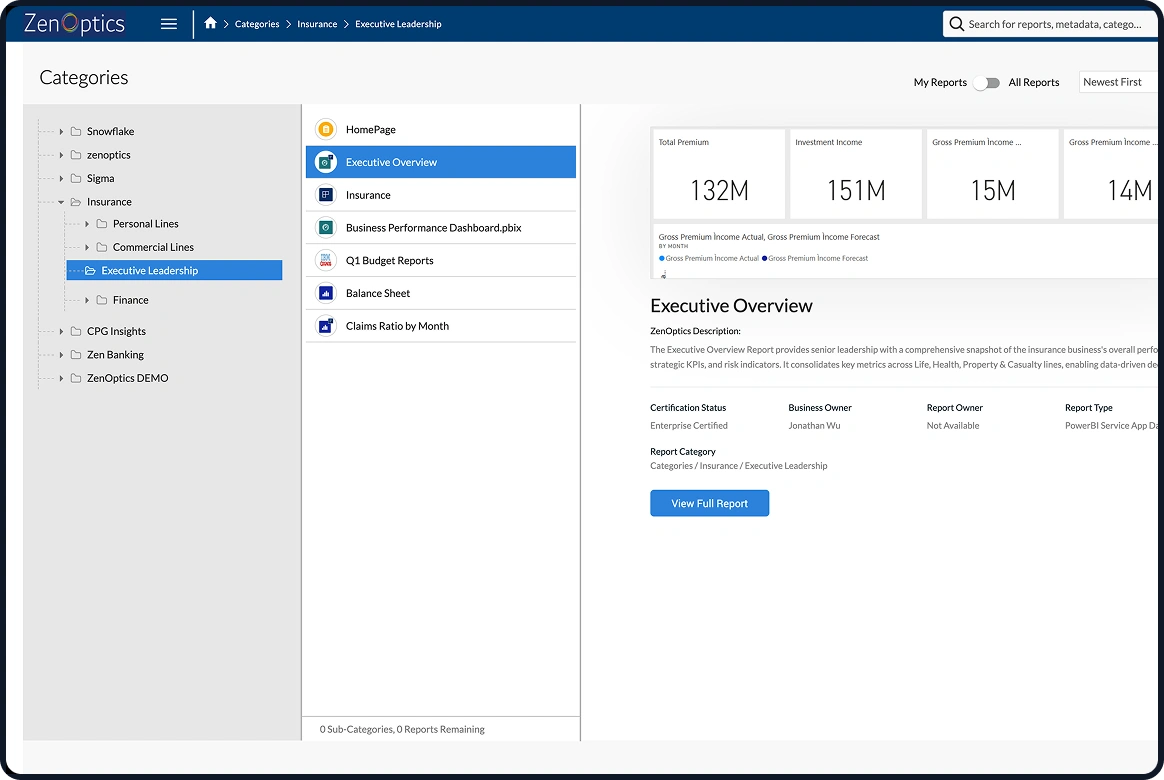
For analytics leaders, this is a question of visibility and accountability across platforms. A cross-tool BI inventory provides a starting point for identifying assets, reviewing ownership, and assessing governance coverage.
A Practical Example of the Trust Gap
Consider a hypothetical finance team using an approved quarterly revenue dashboard while Sales uses an operational revenue dashboard for weekly pipeline discussions. Both may be valid, but they serve different purposes and apply different reporting periods or filters. An older copy may also remain accessible.
When someone asks an AI agent for quarterly revenue, finding a dashboard labeled “Revenue” is insufficient. The agent needs evidence about the reporting period, business definition, approval status, and intended use. If the available context does not resolve the difference, it should explain the uncertainty or route the question for review.
For the business, the consequence can be avoidable reconciliation, delays in executive reporting, or decisions based on an unsuitable view. The governance task is to make the distinctions explicit before the answer is consumed.
The Questions Your Analytics Estate Must Answer
Which asset is approved for this decision
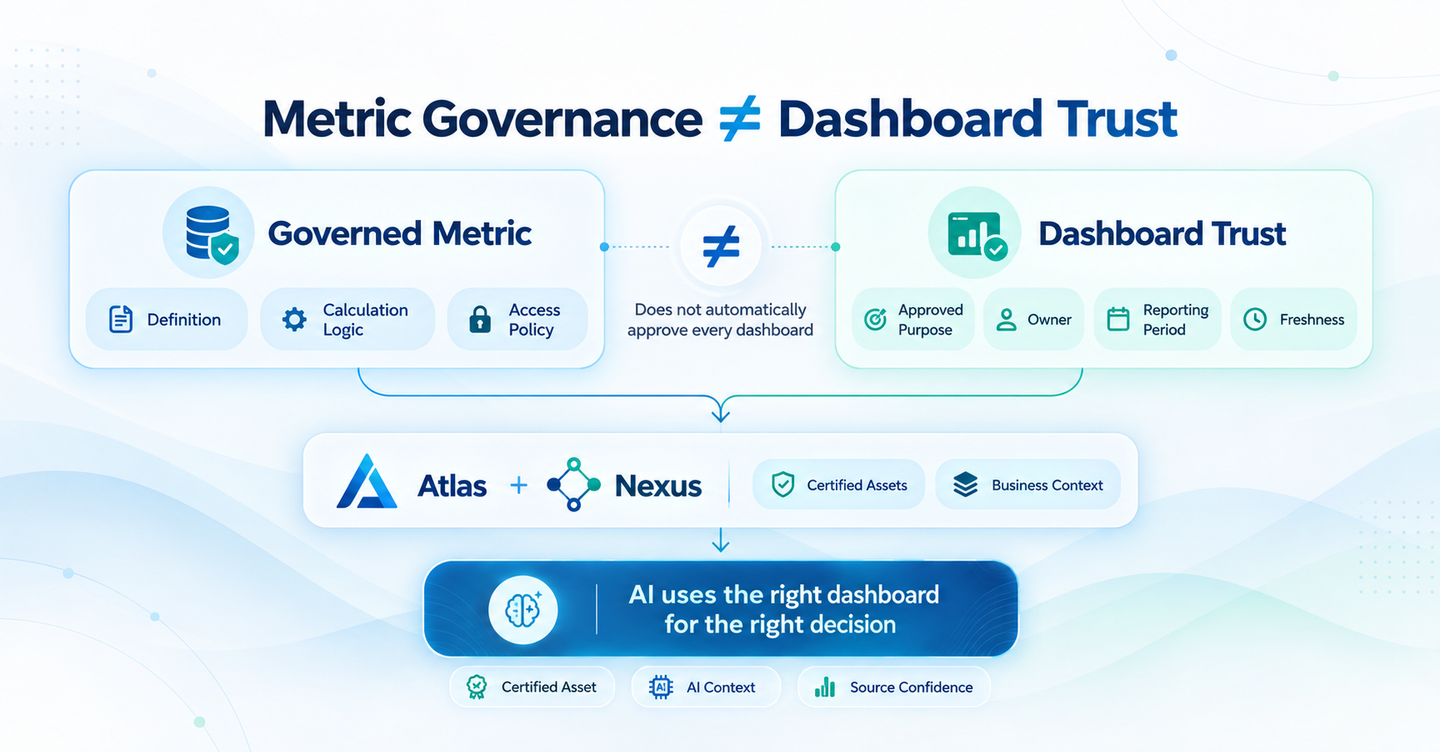
A governed revenue definition does not, by itself, establish which quarterly dashboard Finance has approved across every BI platform. Approval at the report level records the business purpose and accountability of the complete asset, including its presentation and filters.
Who resolves conflicting views
When reports disagree, the difference may reflect an error, a different definition, or a legitimate change in scope. Owners and domain stewards need to review the evidence and document which view applies to which purpose. Certification should reflect that review rather than act as a substitute for it.
What context is available to AI
AI needs meaningful descriptions, metric relationships, dimensions, filters, and domain mappings alongside trust signals. A certification label helps identify reviewed content; sufficient business context helps explain how to use it. Access permissions must also be enforced through the systems and integrations serving the agent.
How Atlas and Nexus Support This Work
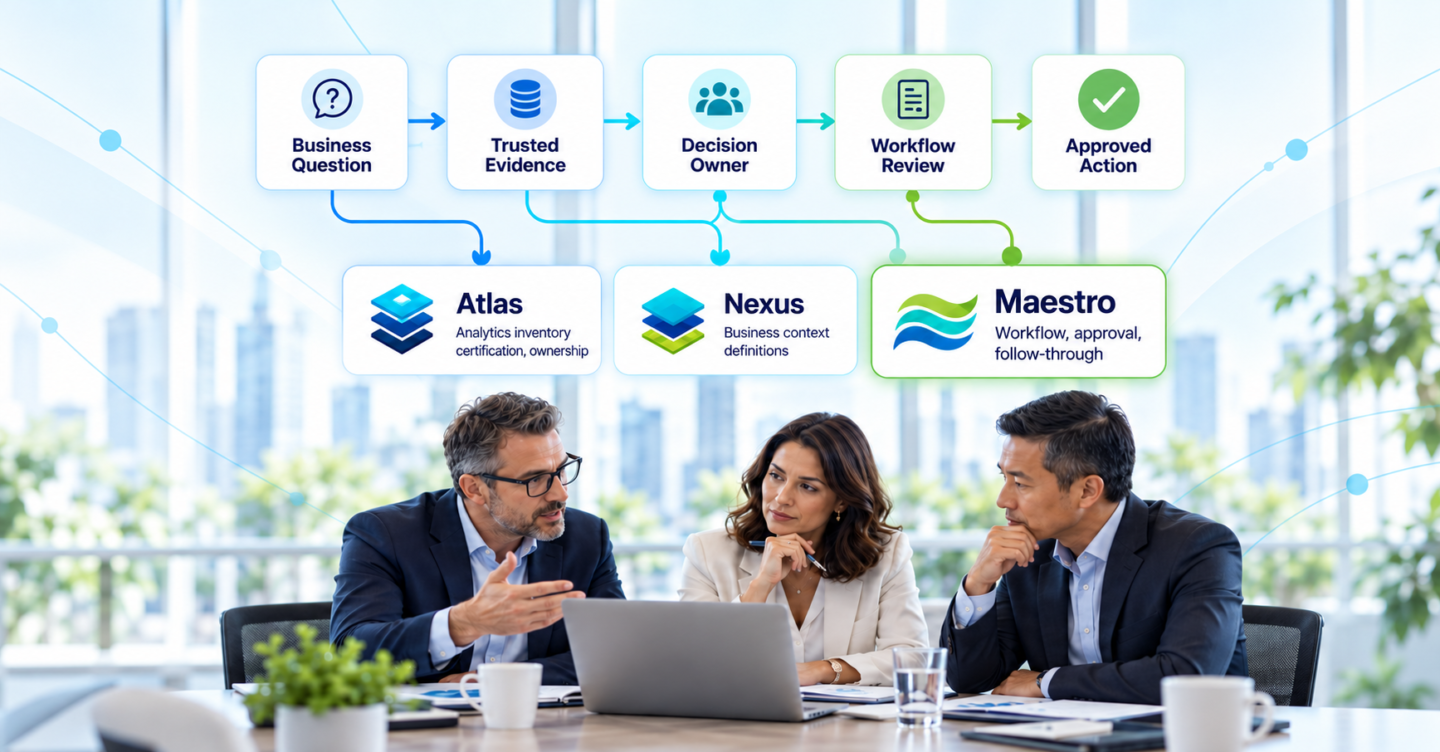
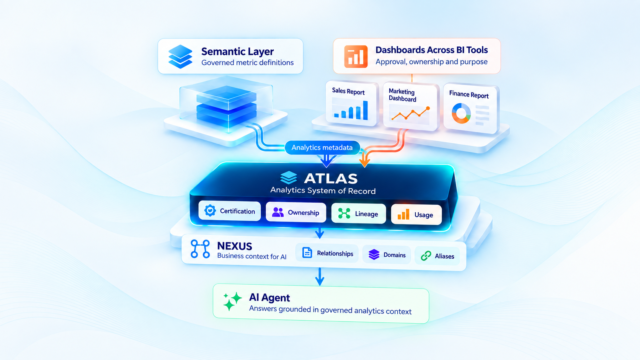
Atlas is ZenOptics’ analytics system of record. It catalogs analytics assets across connected platforms and captures definitions, ownership, lineage, and usage. Certification and governance workflows help teams establish which dashboards and metrics are authoritative and who is accountable for them.
This gives analytics leaders a central view of what exists and where governance requires attention. It also supports identifying duplicate reports across BI platforms and reviewing assets that may be redundant or no longer fit their intended purpose.
Nexus builds on governed metadata from Atlas to provide business context for AI. It supports curation of descriptions and aliases and models relationships between analytics assets, metrics, dimensions, and business domains in a knowledge graph. Nexus works with structural metadata rather than reading raw data records.
Together, Atlas and Nexus help make analytics assets discoverable, governed, and interpretable. Where a semantic layer already provides authoritative definitions, those definitions should inform the surrounding asset governance and context rather than be recreated inconsistently.
The relationship between a semantic layer and an analytics context layer matters because enterprises need both consistent metric logic and a clear understanding of the analytics assets used to make decisions.
What to Check Before Expanding AI Access
- Inventory the assets an agent can reach across connected platforms. Identify which use your semantic model and which rely on other reporting systems or definitions. Assets outside the model need a governance assessment; they are not automatically ungoverned.
- Review ownership, certification, business purpose, and freshness. Check what certification means in each platform and document how conflicting signals will be resolved.
- Test the business context. Can the agent distinguish an approved quarterly view from a weekly operational dashboard? Can it explain the relevant period, filters, and metric definition?
- Check access controls and uncertainty handling. Verify permissions in the actual integration path and test whether the agent asks for clarification when available evidence is insufficient.
- Choose the appropriate lifecycle action. Extend model coverage where useful, review and certify assets in their existing platforms, or retire redundant content after owners confirm business, regulatory, and retention requirements.
These checks support a controlled expansion of AI access while giving teams a clearer view of the reporting estate. Governance needs to remain current as definitions, permissions, dashboards, and business requirements change.
Frequently Asked Questions
Does a semantic layer govern dashboards
A semantic layer can apply governed definitions and policies to dashboards consuming it. Broader questions about dashboard approval, intended use, ownership, and lifecycle may require additional controls across the reporting estate.
Are reports outside the semantic model ungoverned
No. They may have governance in their source platforms or business processes. The task is to assess that governance and make its status understandable to users and AI.
Why do we need report certification if metrics are already certified
Metric certification establishes trust in a definition. Report certification establishes approval of an analytics asset for its intended purpose. The report can introduce filters, reporting periods, and presentation choices that require review.
Can Atlas and Nexus replace our semantic layer
They address complementary needs. Atlas provides an analytics system of record and governance workflows. Nexus provides curated business context for AI. A semantic layer continues to serve governed metric logic within its scope.
How should we scope an AI agent’s analytics access
Start with assets reviewed for the agent’s domain and intended tasks. Provide meaningful context and enforce permissions through the connected systems. Test source selection and uncertainty handling before expanding access.
Published October 5, 2026Govern the Model and the Estate
A governed semantic model is an important foundation. Trustworthy analytics consumption also requires clarity about which reports are approved, what they mean, who owns them, and when they should be used. These questions apply both inside and beyond the model’s coverage. Explore Atlas and Nexus to see how ZenOptics helps teams and AI identify and interpret trusted analytics across the BI estate.
Schedule a 15min demo call