

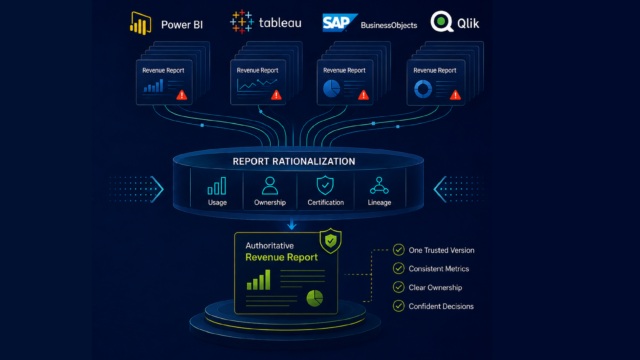
Most enterprises running multiple BI tools already know they have duplicate reports. The Power BI dashboard that finance built mirrors the Tableau workbook that marketing created six months earlier. The SAP BusinessObjects report that operations uses daily covers the same regional sales data as the Qlik analysis built after an acquisition. The same business question answered multiple times, across multiple platforms, with results that do not always match.
The instinct is to treat this as a detection problem: find the duplicates, eliminate them, move on. Similarity analysis can identify potentially overlapping reports. Rationalization requires additional business context: usage, ownership, certification, lineage and agreement on which asset should remain authoritative.
Why Duplicate Reports Accumulate Across BI Platforms
Duplicate reports are not created by carelessness. They are the structural outcome of running multiple BI platforms without a common inventory.
When Power BI reports and Tableau workbooks exist in separate governance silos, each team builds what it needs because it cannot see what already exists in the other platform. Finance creates a revenue dashboard in Power BI. Marketing creates a revenue dashboard in Tableau, unaware that the first one exists. Operations creates a third version in SAP BusinessObjects because neither of the first two surfaces in a search it can run.
Acquisitions compound the problem. The acquired company arrives with its own BI environment, its own reports, and its own definitions for shared business metrics. Those reports are embedded in operational workflows. They cannot be migrated or retired quickly, so they run alongside the acquiring company's existing content for months, then years, with no clear record of which version is authoritative.
Self-service analytics accelerates the accumulation. When the barrier to creating a new report is low, every team creates its own version of the metrics it needs. The result is not chaos within any individual platform. The gap is structural: the same measure exists in multiple forms across multiple tools, each with a different owner, a different refresh schedule, and potentially a different answer to the same business question.
Why Detection Alone Does Not Rationalize Duplicate Reports
Identifying overlapping reports is a necessary first step. It is not rationalization.
A similarity analysis across Power BI and Tableau can flag two reports that cover the same data, the same business question, and the same user base. That finding does not answer the harder questions: which version is authoritative, which has higher usage, which is certified, and which owner is responsible for the retirement decision.
Without cross-platform ownership data, there is no one accountable for the retirement. The finding sits in a spreadsheet or a review meeting, and neither report is retired because the decision belongs to no one specific enough to act on it.
Without cross-platform usage data, the organization cannot confirm which version users actually rely on. Retiring the wrong report creates an immediate operational problem and a governance failure.
Without a record of the retirement decision, the institutional memory of why a report was retired disappears. A new analyst arrives with the same business question and builds the same report again. The cleanup cycle repeats.
In most organizations, duplicate rationalization happens during significant events: a BI migration, an M&A integration, a governance audit. These are episodic moments, not ongoing processes. When the event ends, duplicates begin accumulating again, because the root cause, the absence of governed cross-platform visibility, was never resolved.
A Governed Report Rationalization Process
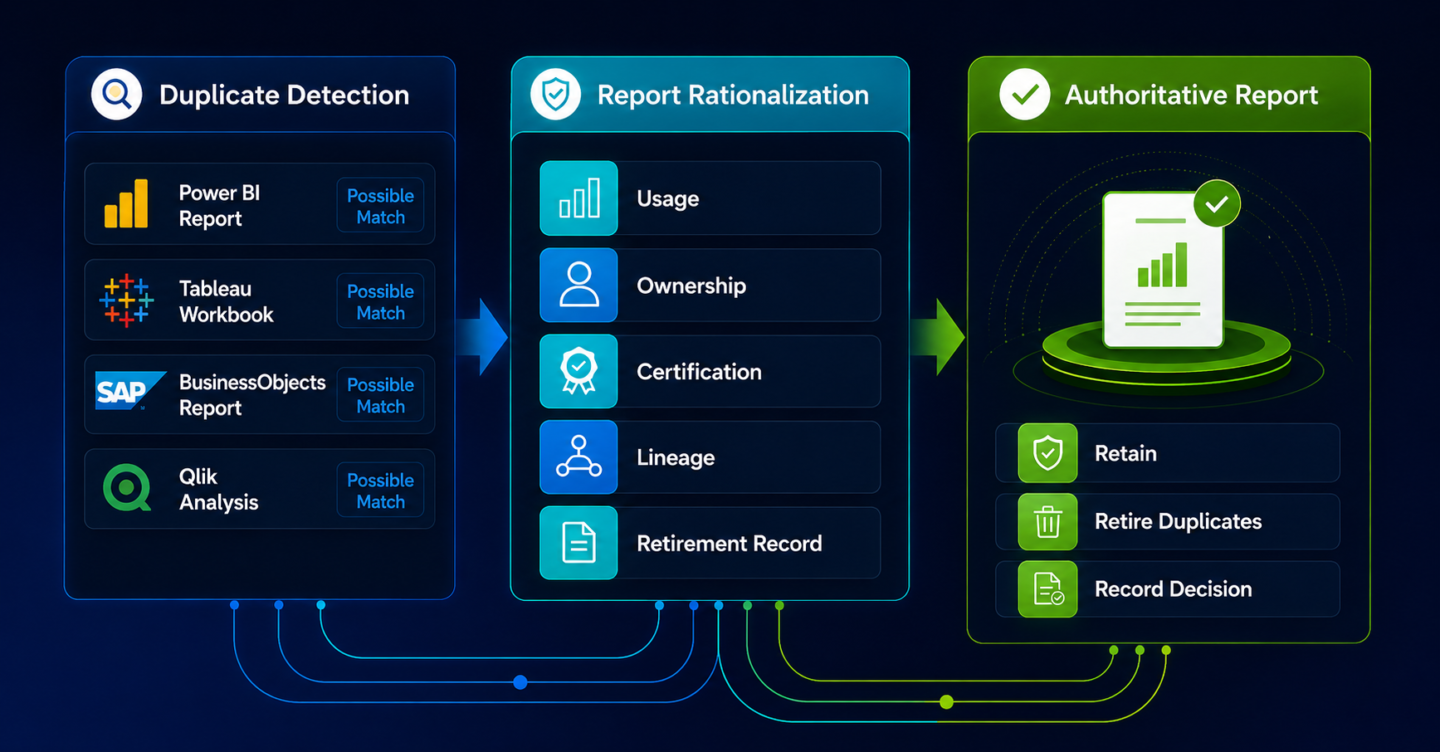
Effective duplicate report rationalization requires five things that detection alone does not provide.
The first is a cross-platform inventory. Before any report can be retired, the organization needs a complete view of what exists across Power BI, Tableau, SAP BusinessObjects, and Qlik, including who owns each report, how often it is used, what data it connects to, and whether it carries a certified status. Without this inventory, similarity analysis has no governance context to act on.
The second is cross-platform usage analysis. Usage data surfaces which reports are actually trusted and consumed by the business. A report with high usage, a certified owner, and confirmed data lineage has a different governance disposition than one built for a project three years ago that nobody has viewed since the analyst who created it left the organization.
The third is ownership resolution. For any pair of overlapping reports, a specific person or team must own the retirement decision. This requires knowing who owns each report, whether those owners are still active in the organization, and which team is the appropriate decision authority when owners span different business units. Cross-platform ownership tracking makes this possible. Without it, the default outcome is inertia.
The fourth is a retirement record. The retirement decision must be recorded in a governance system that persists beyond the cleanup project. A decision that exists only in a spreadsheet or a project ticket has a lifespan measured in months, not years.
The fifth is governed discovery at the point of creation. Re-creation is rarely intentional. It is the absence of a searchable, governed inventory that analysts can consult before building something new. When a new report is requested and the analyst cannot search across Power BI, Tableau, SAP BusinessObjects, and Qlik to find whether an authoritative version already exists, the outcome is a new duplicate. Closing this loop requires making the governed estate visible at the moment of creation, not only after duplicates have already accumulated.
How an Analytics System of Record Supports Cross-Platform Report Rationalization
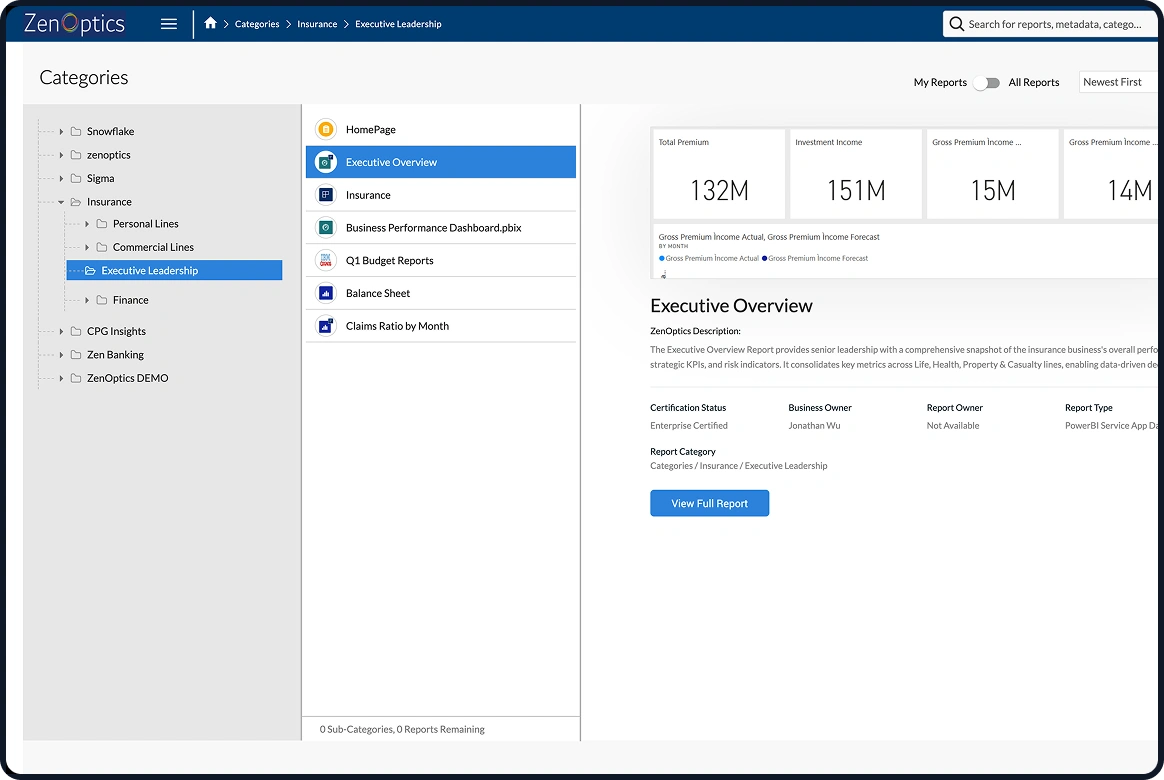
Atlas, the ZenOptics Analytics System of Record, creates a centralized, authoritative inventory of reports, dashboards, KPIs and metrics across the enterprise.
By bringing ownership, certification, lineage and usage information into one governed environment, Atlas gives analytics teams the context needed to identify overlapping content, evaluate which assets remain valuable and coordinate rationalization decisions across BI platforms.
Atlas does not replace the organization's decision-making process. It provides the visibility and governance workflows needed to make that process informed, accountable and repeatable.
The cross-tool inventory Atlas maintains also supports the discovery step. Analysts searching for an existing certified report can find it across all connected platforms before creating a new version. Governed discovery helps reduce unnecessary report recreation by making existing trusted content easier to find.
The Hidden Cost of BI Tool Sprawl covers the full financial case for why this matters at scale. The Hidden Cost of Analytics Sprawl covers the estate debt that accumulates when duplicate content goes ungoverned over time.
The existing BI platforms remain in place. Atlas operates above them as the governed record of what exists, who owns it, which assets are certified and how they are used. Report rationalization can become a continuous governance practice rather than a one-time cleanup exercise.
Frequently Asked Questions
Why do duplicate reports keep reappearing even after a cleanup?
Rationalization without governed cross-platform discovery does not address the root cause. When analysts cannot search a governed inventory of existing certified reports across all platforms before building something new, they recreate content that already exists elsewhere. A cleanup removes visible duplicates. Governed discovery helps reduce re-creation by making existing trusted content easier to find.
What is the difference between duplicate report detection and duplicate report rationalization?
Detection identifies which reports overlap, scores the degree of similarity, and surfaces the worst offenders. Rationalization requires governance decisions: which version is authoritative, who owns the retirement, how the decision is recorded, and who needs to be informed. Detection produces a list. Rationalization requires business context and governed decision-making.
Which version of a duplicate report should be retired?
Usage and certification are important signals, but they should not determine the decision alone. Teams should also consider business criticality, regulatory requirements, data lineage, calculation logic, audience needs and accountable ownership before deciding which report should remain authoritative.
Does an Analytics System of Record replace the need for BI platform consolidation?
Consolidation reduces tool count, but it does not govern the rationalization process. An organization that migrates from four platforms to two still needs to identify which reports are duplicated across the surviving platforms, decide which versions survive, and govern the retirement. An Analytics System of Record provides the inventory and lifecycle layer that makes this possible regardless of how many platforms remain.
How does Atlas support duplicate report rationalization across BI platforms?
Atlas connects to existing BI and analytics platforms through 100+ Smart Connectors and establishes a cross-platform inventory of reports, dashboards, KPIs, ownership, certification, lineage, and usage. This gives analytics teams the context needed to identify overlapping content, coordinate rationalization decisions, and support governed discovery so analysts find existing certified reports before creating new ones.
Published August 14, 2026Turn Duplicate-Report Cleanup into Continuous Analytics Governance
Atlas establishes a governed cross-platform inventory of reports, dashboards, KPIs and metrics, giving analytics teams the ownership, certification, lineage and usage context needed to rationalize duplicate content without replacing their existing BI tools. Request an Atlas Demo
Schedule a 15min demo call