

An AI assistant prepares a margin analysis in seconds. A finance manager reviews the recommendation, adjusts a pricing proposal, and sends it for approval. The analysis took less time. But did the business make a better decision?
That question deserves a place in every enterprise AI measurement program.
The Gartner July 2026 survey of 204 finance leaders, conducted in March, found that 45% of finance AI investments leaned toward productivity, while 20% leaned toward decision quality. Gartner urged CFOs to connect AI investment to enterprise outcomes, including better decision-making and growth.
For analytics leaders, this creates a practical challenge. How do you connect an AI-generated answer to the evidence behind it, the action someone took, and the outcome that followed?
A useful approach starts with a recurring business decision, a baseline, and a scorecard. ZenOptics supports the analytics and workflow foundation for this work through governed sources, business context, and documented review processes.
How do you measure AI’s impact on business decisions
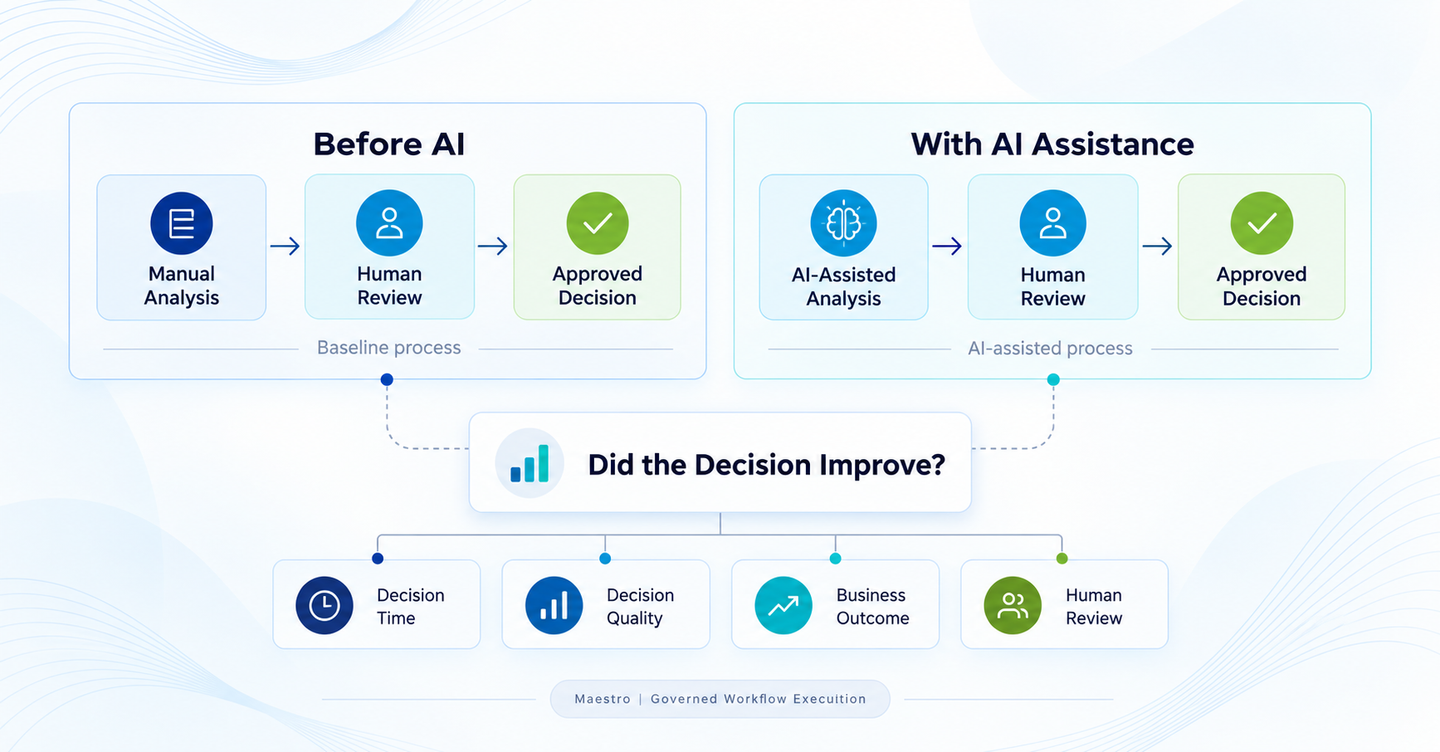
Measure AI’s impact by comparing a defined decision process before and after AI assistance. Track decision time, analytical errors, evidence quality, human intervention, business outcomes, and downstream risk. Use comparable cases and account for external factors before attributing an improvement to AI.
This framework separates operational efficiency from decision quality. Both matter, but a faster answer is valuable only when the full process and its results justify the investment.
Choose one recurring decision and define success
“Improve financial decision-making” is too broad for a useful pilot. A monthly pricing review for a specific product category gives the team a clearer starting point.
Choose a decision with an accountable business owner, enough repetition to evaluate results, and an outcome that can be observed. Inventory replenishment, discount approvals, cash flow forecasting, and budget variance investigations are suitable examples.
Define improvement before introducing AI. For replenishment, the objective might be fewer stockouts while inventory investment stays within an agreed range. For pricing, it might be higher contribution margin without an unacceptable reduction in sales volume.
Record the tradeoffs and decision boundaries. A recommendation that improves revenue while violating a margin threshold should not count as a successful result. Have the business owner approve the evaluation criteria so the pilot is judged against business priorities.
Establish a baseline for the complete process
Without a baseline, teams can report activity but struggle to demonstrate improvement. Record the current time from the initial question to an approved action, including report discovery, reconciliation, review, and any rework.
Also record how often calculations or assumptions require material corrections, how frequently decisions are reopened, and what business results follow. Define a material correction as one that could change the recommended action or its justification.
An assistant might reduce drafting time while increasing verification effort. Measuring the complete process makes that tradeoff visible.
Where practical, compare similar decisions over a defined period or retain a comparable group using the existing process. Document changes in demand, staffing, supplier costs, and other conditions that could affect the outcome. These details make the eventual comparison more credible.
Build an AI decision quality scorecard
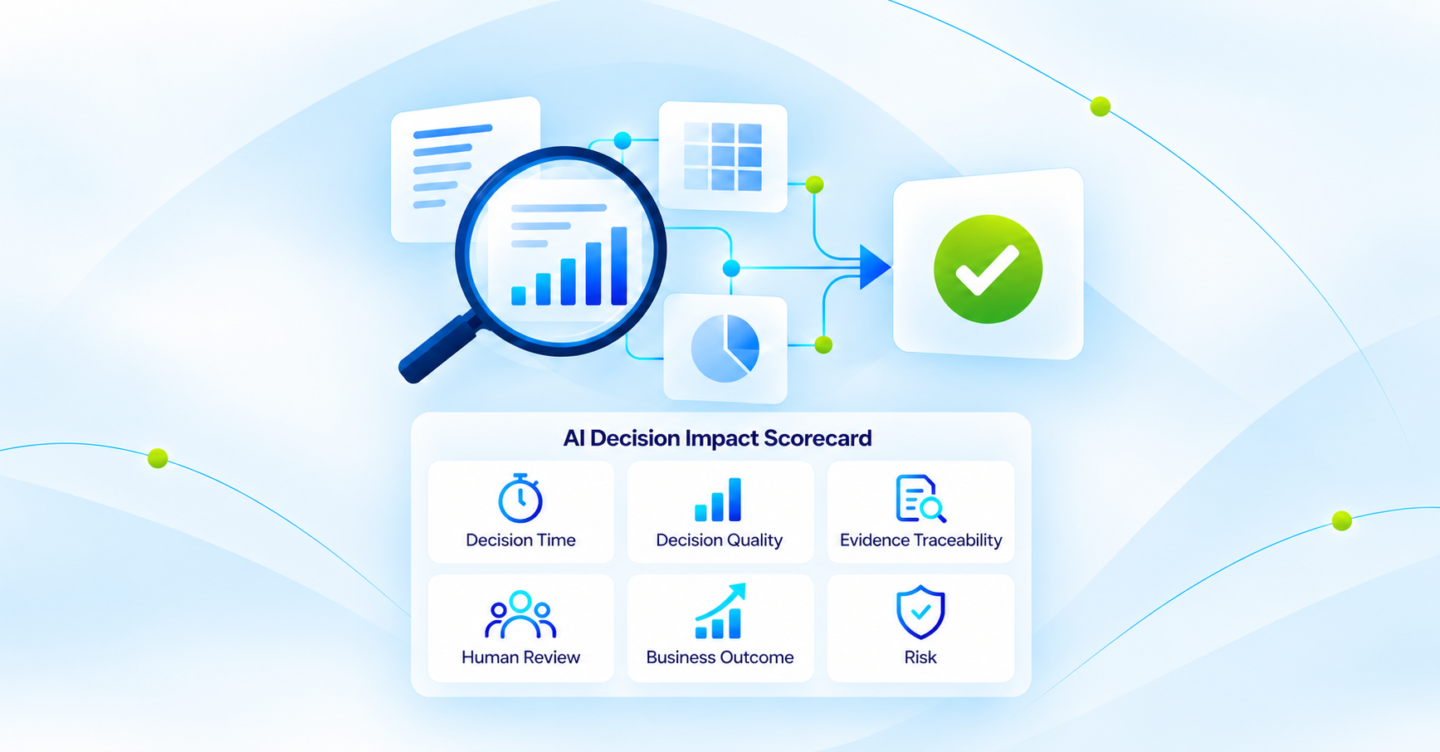
Use a small set of measures that the business owner can review consistently. The following scorecard is a proposed framework for adaptation, rather than an industry benchmark or a built-in ZenOptics scoring model.
| Area | Suggested metric | Evaluation question |
| Speed | Median time to approved action | Did the full process become faster? |
| Quality | Outputs needing material correction | Did reliability improve? |
| Evidence | Recommendations with approved sources | Can reviewers inspect the evidence? |
| Review | Reasons accepted or modified | Where does AI help or need intervention? |
| Outcome | Decision specific business KPI | Did business performance improve? |
| Risk | Reopened decisions and exceptions | Did downstream costs increase? |
Define the denominator and review method for every percentage. For evidence coverage, for example, divide sampled recommendations with a verifiable approved analytics source by all sampled recommendations reviewed, then multiply by 100.
Do not treat high acceptance as proof of quality. Reviewers may accept recommendations because they are useful, because they are under time pressure, or because they do not recognize an error. Examine the reasons for acceptance, modification, and rejection alongside the rate itself.
Identify the analytics behind each recommendation
A decision measurement program becomes difficult to defend when teams cannot establish which report, metric definition, or reporting period informed a recommendation.
A pricing analysis might use gross margin while the approval process evaluates contribution margin. Both calculations can be valid, yet the mismatch can undermine the recommendation and its evaluation.
ZenOptics Atlas catalogs analytics assets and captures definitions, ownership, lineage, and usage. It supports certification and change workflows. Teams can use that foundation to identify the sources approved for a selected decision and assign responsibility for maintaining them.
Before the pilot begins, agree on the authoritative reports and definitions for the evaluation. Record relevant source identifiers and preserve the evidence needed to interpret historical results. The evaluation design should confirm how historical versions or snapshots will be retained in the deployed environment.
Our article Can Your AI Agent Trust the Reports It Reads explains why successful retrieval alone does not establish whether a source is appropriate for a business question.
Evaluate whether AI understands the business context
An AI answer can be numerically correct and still be unsuitable for a decision. It may use the wrong fiscal period, overlook a segment, or interpret a business term differently from the reviewer.
ZenOptics Nexus consumes governed analytics metadata from Atlas and organizes business meaning through semantic curation and a knowledge graph. Its capabilities include curating descriptions, standardizing aliases, and mapping relationships among metrics and business domains.
Teams can use that context when configuring analytics-aware AI experiences, then test whether responses apply it correctly. Context availability should be evaluated separately from the model’s actual use of that context.
Create a test set with known answers, ambiguous terminology, conflicting definitions, and questions that require clarification. Have business reviewers assess the answers against agreed criteria. Repeat the evaluation when relevant definitions, model configurations, or integrations change.
Follow the recommendation through review and action
A useful recommendation may be modified, postponed, or only partly implemented. The final business result should therefore be evaluated against the action actually taken.
ZenOptics Maestro supports structured workflows connected to governed analytics. Reviews, approvals, rejections, escalations, and ownership can be defined within a process, providing a record of participation and execution.
For an AI-assisted pricing review, a team could configure a workflow covering analysis, business review, approval, and follow-up. The measurement design should specify which recommendation details, reviewer comments, and outcome measures must be captured, including information maintained in other business systems.
This helps distinguish the assistant’s initial recommendation from the final human-approved action. It also makes it easier to investigate whether a disappointing outcome arose from the analysis, the review, execution, or changing business conditions.
Compare outcomes and account for external influences
Suppose margins improve after a pricing pilot. AI may have contributed, but supplier costs, product mix, or customer demand may also have changed.
Use comparable cases, document external influences, and involve the business owner in interpreting the results. Controlled testing or a phased rollout can strengthen the evaluation when operationally feasible. If comparable groups are unavailable, report the limitations of a before-and-after comparison.
Include implementation, integration, review, and ongoing operating costs when calculating AI ROI. Hours saved should be translated into financial value only when the organization can explain how that capacity was used or how spending changed.
The Gartner September 2026 guidance calls for realistic return expectations. Its research found that report creation and transactional automation generally delivered returns sooner than more complex activities such as insight generation and forecasting.
Set the evaluation window around the decision. A weekly replenishment process produces evidence on a different schedule from an annual capital allocation decision.
Frequently asked questions
What is AI decision quality
AI decision quality describes how well an AI-assisted decision meets defined business objectives using appropriate evidence, accurate interpretation, and acceptable risk. It should be assessed against explicit criteria and observed outcomes for a specific use case.
What metrics should businesses use to measure AI decision quality
Useful metrics include decision cycle time, material correction rate, evidence coverage, reviewer intervention, decision reversals, and a business KPI such as forecast error or contribution margin. Choose metrics that reflect the actual decision and its tradeoffs.
How can ZenOptics support AI impact measurement
ZenOptics supports the evaluation foundation through Atlas for governed analytics, Nexus for business context, and Maestro for structured workflows and accountability. Teams must configure the evaluation process and connect the business outcome data required for their use case.
Does faster AI analysis prove positive ROI
No. Faster analysis is one input to an ROI assessment. Businesses also need to consider review effort, implementation and operating costs, downstream rework, and measurable financial or operational outcomes.
Published October 19, 2026Use the results to improve the next decision cycle
Start with one decision, one accountable owner, an agreed source set, and a manageable scorecard. Review both successful and unsuccessful cases. Update the workflow or context when the evidence reveals a recurring problem. Atlas helps teams identify governed analytics. Nexus supplies business context. Maestro structures workflow execution and accountability. Together, these capabilities can support a more inspectable evaluation process, while the organization defines success, collects business outcomes, and assesses attribution. The goal is to make each improvement explainable. When AI changes a decision, the team should be able to show what changed, what evidence supported it, and what happened afterward. Explore ZenOptics to discuss how governed analytics, business context, and structured workflows can support your AI decision evaluation strategy.
Schedule a 15min demo call