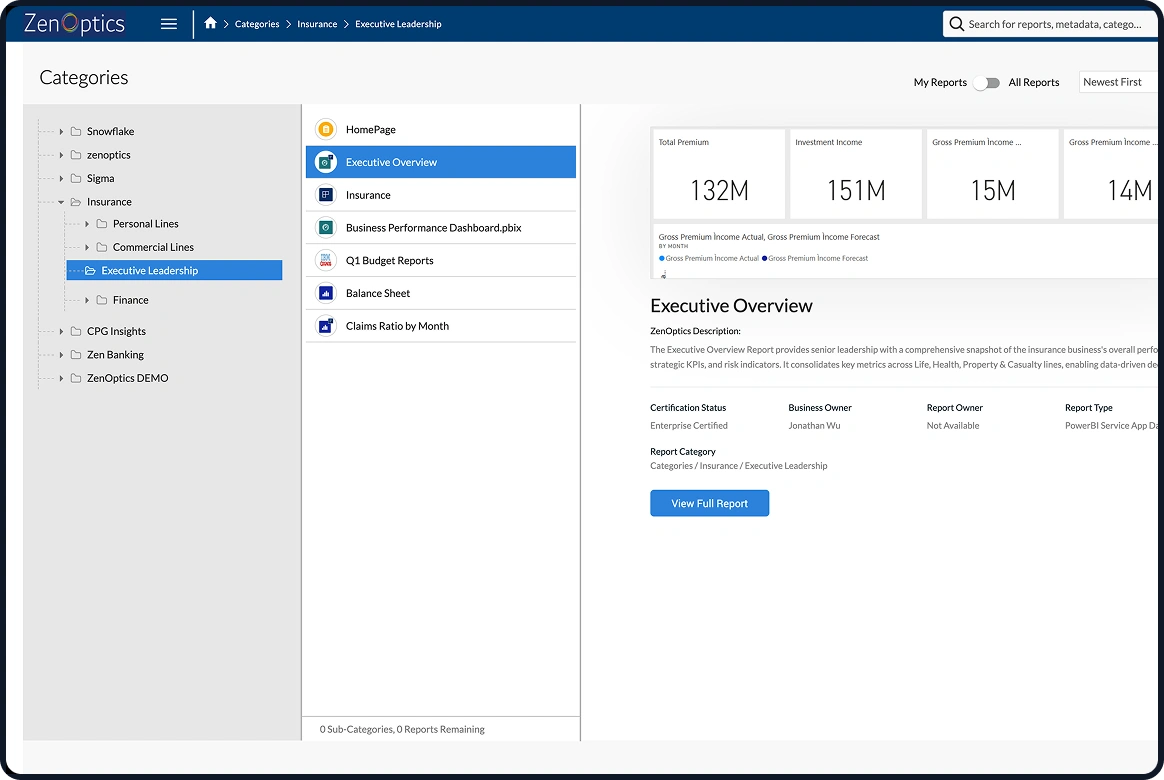



An AI agent can retrieve a number from a dashboard in seconds. Before that number supports a forecast, a board presentation, or an operational decision, the business needs to know whether the report is current, which definition it uses, and who has approved it for that purpose.
This is a practical BI readiness challenge. Connecting an agent to analytics tools gives it access to information. Providing authoritative sources and business context helps it interpret that information appropriately.
For enterprises preparing their BI estate for AI, the starting point is the analytics itself: what exists, which sources should be used, what the metrics mean, and who maintains those decisions.
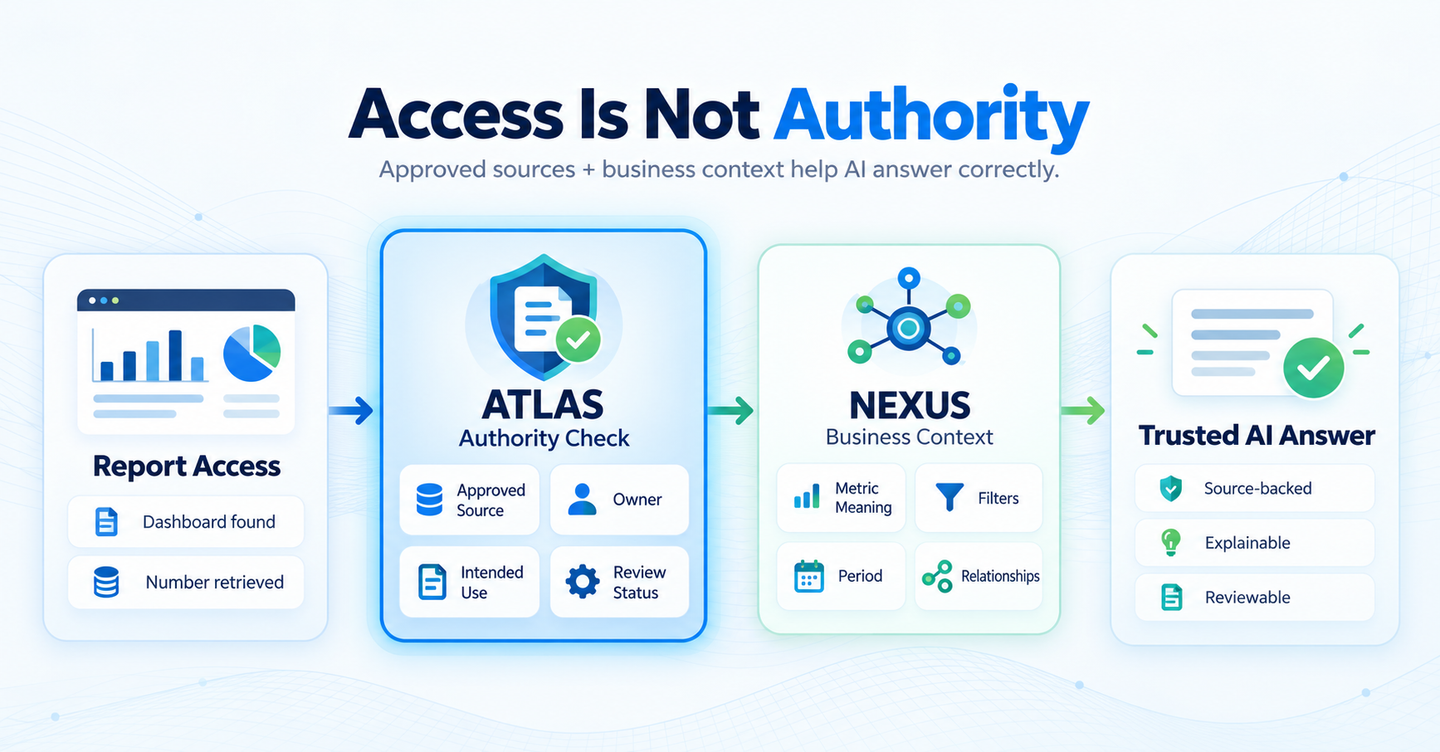
Access to a report does not establish its authority
Consider an agent asked to retrieve quarterly revenue. It finds a dashboard labeled Revenue Overview and returns a figure. The dashboard may be an archived version, a departmental view, or a report built around booked contracts rather than recognized revenue.
The retrieval worked. The source may still be wrong for the question.
Two read-only agents can encounter different evidence. One retrieves information from a reviewed finance collection. Another searches a broader portal containing duplicate reports and assets with unclear status. Their permissions to act may be similar, while their ability to identify appropriate analytics differs.
A small approved collection is not automatically reliable for every question. Its definitions, reporting period, filters, freshness, and intended use still matter. The goal is to help the agent select evidence the business can explain and defend.
What Gartner means for analytics teams
In its May 26 2026 press release, Gartner recommends proportional controls that account for agent autonomy and access scope. It predicts that 40% of enterprises will demote or decommission autonomous agents by 2027 after production incidents expose governance gaps.
Gartner distinguishes agents that observe, advise, act with human approval, and act autonomously. Observing and advising can both involve read-only access; recommendations can influence decisions even when a person executes the action.
For analytics teams, the practical implication is to define which sources an agent may use and provide enough context to interpret them. That work complements the organization’s broader security and agent controls.
Establish a clear view of the connected BI estate
Reports and dashboards can multiply across platforms, departments, acquisitions, and migrations. Similar titles may conceal different calculations. Copies may remain available after their replacements are introduced. Ownership can become unclear when teams change.
Start by identifying the assets connected to the intended AI use case. Record their platform, identifier, business domain, owner, lifecycle status, and approval purpose. Include relevant metric definitions and relationships to underlying datasets where available.
A bounded pilot does not require every report in the enterprise to be cataloged first. It does require a reliable view of the sources the pilot actually uses. Expand the inventory as the use case expands.
This view gives analytics teams a practical way to distinguish current authoritative assets from duplicates, retired content, and reports that still need review.
Make approval specific to a business purpose
Microsoft documents promotion and certification in Power BI, and Tableau documents certification for supported data assets. These endorsement mechanisms provide useful signals about reviewed content.
Enterprises still need to decide how those signals relate to their business questions. A certified sales dashboard and an approved finance report can use different revenue definitions because they serve different purposes.
Approval should identify the owner, intended use, definition, and review expectations. When two approved reports disagree, the responsible business owner should resolve which applies. An agent should surface an unresolved conflict rather than silently choose the more convenient number.
Certifying everything is not the objective. Making status and purpose visible helps teams decide what is suitable, what needs review, and what should be excluded.
Supply the business context behind the metric
Technical metadata can identify a field name or a report location. Business context explains what the field represents and how it should be used.
For a revenue question, useful context might include whether revenue is recognized or booked, which currency applies, whether cancellations are excluded, and how the fiscal quarter is defined. For a margin question, it might identify the cost components included in the calculation.
Context should connect business terms and synonyms to metric definitions, dimensions, filters, and relevant analytics assets. It should also describe limits: which comparisons are appropriate and which questions require another source.
This makes the analytics foundation useful to AI systems and to the people reviewing their answers. A plausible explanation becomes easier to assess when its definitions and evidence are visible.
How Atlas and Nexus support analytics readiness
Atlas provides a centralized analytics system of record across connected BI platforms. It catalogs reports, dashboards, and metrics and supports information about ownership, certification, definitions, lineage, and usage.
That foundation helps teams identify what analytics exist, which assets have been reviewed, and who is accountable for their meaning. It supports the source-selection decisions that an analytics-aware agent needs.
Nexus uses governed analytics metadata to build business context through metadata onboarding, semantic curation, and a knowledge graph. It helps AI systems interpret metrics and relationships between assets and business domains.
Together, Atlas and Nexus connect analytics discovery with business understanding. The deployment must still enforce access through the relevant source-system permissions and integration controls, and teams should evaluate whether the agent uses the context correctly.
When insights enter a recurring business process, Maestro can support structured workflows with reviews, approvals, and action records. The analytics foundation remains the focus: appropriate evidence, understood definitions, and accountable use.
A practical example for a finance team
Suppose an agent prepares an explanation of quarterly revenue performance. A finance analyst reviews the explanation and decides whether the forecast needs adjustment.
The team limits the agent to a current finance revenue dashboard and a relevant approved pipeline report. The source records identify the owners, reporting periods, definitions, currency treatment, and expected update schedule.
The agent should distinguish recognized revenue from pipeline value, identify the sources used, and explain which period and filters support its answer. If a required report is stale or two definitions conflict, it should flag the issue for review.
Test the scenario with a retired dashboard, a similarly named sales metric, a missing period, and an unauthorized request. The question is whether the agent selects appropriate evidence, respects access limits, and makes uncertainty visible.
This example is illustrative. Its value is a repeatable way to check analytics readiness before expanding the use case.
Where to start before the next deployment
Begin with one business question and a named owner. Agree on what a useful answer should contain and which decisions it is intended to support.
Identify the required reports and metrics, verify their status, and resolve material definition conflicts. Confirm that the intended users and integration have appropriate permissions.
Then curate the business context and test realistic questions with domain experts. Include cases where the evidence is missing, outdated, contradictory, or outside the approved scope.
Record the sources and context used, along with review outcomes where required. Revisit the setup when reports, definitions, owners, or connections change. A certification percentage alone cannot establish readiness; evaluate the evidence used for the actual business purpose.
Frequently asked questions
Do read only agents need authoritative analytics sources
Yes. Read-only access prevents some actions, but an incorrect answer can still influence a business decision. Appropriate sources and clear definitions remain necessary.
Does certification guarantee an accurate answer
No. The report must fit the question, and the agent must apply the correct period, filters, and definition. Certification supports source selection; it does not replace evaluation.
Is a complete enterprise inventory required before a pilot
A bounded pilot needs an inventory of the sources it uses. A wider inventory can develop as additional domains and platforms are connected.
Is this a broader AI governance framework
The focus is analytics readiness: knowing which reports and metrics to use and supplying their business meaning. This work supports enterprise AI controls alongside security, permissions, and operational safeguards.
Published October 12, 2026Build AI readiness into the analytics foundation
Before asking an agent to work across more dashboards, establish which sources are authoritative for its questions and what their metrics mean. Maintain ownership and review decisions as the BI estate evolves. For analytics teams, this is a concrete path from connected tools to useful AI-supported decisions. Atlas provides the analytics record; Nexus supplies the business context that helps AI interpret it. Talk to ZenOptics about preparing trusted analytics and business context for AI.
Schedule a 15min demo call