

Most large enterprises know they have BI tool sprawl. Power BI in finance. Tableau in marketing. SAP BusinessObjects in operations. Qlik in a business unit acquired three years ago. Each platform may have entered the organization for a legitimate business reason. The problem emerges over time, when the enterprise can no longer see or govern the complete analytics estate as one connected environment.
The instinct is to count unused licenses and duplicate dashboards and present the total to leadership. That captures only the visible cost. The deeper problem is structural: the enterprise lacks an Analytics System of Record, a governed, cross-platform inventory showing what analytics exist, which assets are authoritative, who owns them, how they are used, and what should be retired.
How BI Tool Sprawl Accumulates
Multi-tool analytics environments are not the result of poor planning. They are the result of normal business forces operating over time.
Acquisitions bring BI tools from the acquired company, embedded in operational workflows that cannot be migrated quickly or cheaply. Departmental preferences drive independent platform decisions: finance favors Power BI for its Microsoft ecosystem integration, creative and marketing teams run Tableau because the team already knows it, and operations inherits SAP BusinessObjects from a decade-old ERP implementation. Platform migrations that were scoped as full replacements frequently go incomplete, leaving the previous tool running alongside the new one for months, then years.
The result is not necessarily chaos within any individual platform. Each BI tool may provide its own controls for access, certification, ownership, and usage. The gap appears between the platforms. No individual BI tool provides an authoritative, governed view of the entire analytics estate, including the reports, dashboards, KPIs, definitions, owners, lineage, and usage patterns distributed across other tools.
Five Costs That Compound Without an Analytics System of Record
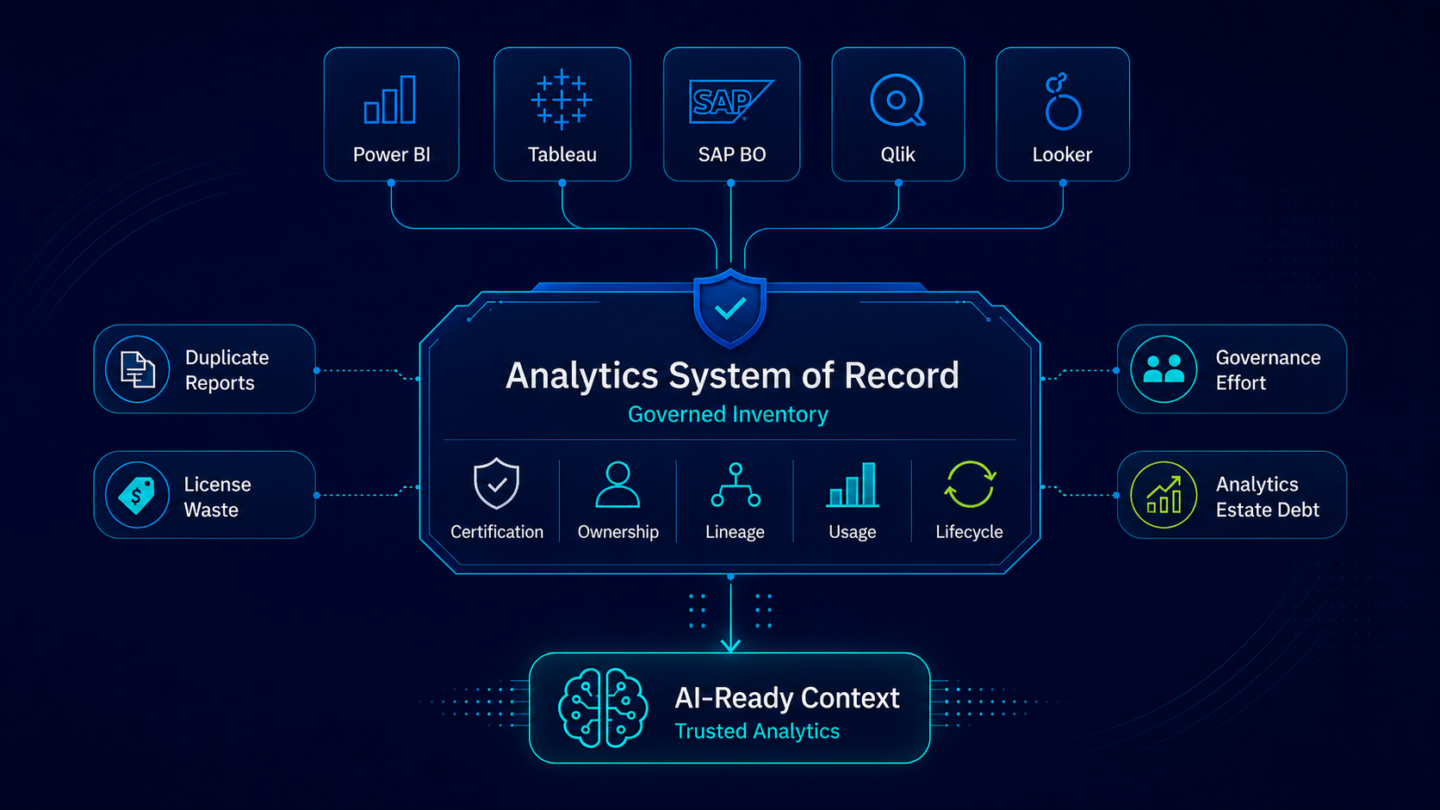
When no governance layer exists above the individual BI platforms, five categories of cost compound continuously.
The first cost is duplicate content and repeated development effort. Without cross-tool discovery, analysts may recreate a report or KPI that already exists in another platform. The immediate cost is wasted development time. The larger cost is the creation of competing versions of the same business measure, with different definitions, owners, calculation logic, certification status, or refresh schedules. Every decision based on those competing versions inherits the resulting ambiguity.
The second cost is license and platform waste at scale. Enterprises frequently maintain licenses, infrastructure, and support capacity for analytics content that is rarely used, duplicated elsewhere, or no longer connected to an active business requirement. An organization running multiple BI platforms typically receives platform-specific usage views, but leadership still lacks a unified picture of adoption across the entire analytics estate. Without cross-platform usage visibility, rationalization requires manual effort, and in most organizations, it rarely happens at all.
The third is governance effort multiplied. Certification, ownership assignment, access review, and deprecation are not performed once across the analytics estate. They are performed separately in each BI tool. A governance team operating across four platforms performs every governance action four times, with no cross-platform view of whether the same metric is certified and owned in one tool while orphaned with no owner in another. The effort and coordination required generally increase as more platforms, business domains, assets, and governance processes are added.
The fourth cost becomes more consequential when AI is introduced. If "quarterly revenue" appears across Power BI, Tableau, and SAP BusinessObjects with different definitions, owners, certification records, and calculation logic, an AI assistant lacks a reliable basis for determining which version represents the organization's authoritative business meaning.
A governed inventory is the necessary first step: it establishes what exists and which analytics are trusted. The next step is converting that governed metadata into machine-readable business context so AI systems can interpret definitions, relationships, and business logic consistently.
The Hidden Cost of an Ungoverned Analytics Estate covers this dynamic in detail.
The fifth cost is analytics estate debt, the cumulative operational burden created by outdated, duplicated, unowned, uncertified, or unused analytics assets. Content accumulates naturally in any multi-tool environment. Reports built for a project three years ago remain searchable and accessible. KPIs defined by employees who have since left the organization stay in the system without an owner. Analytics estates grow easily but rarely shrink naturally. Without governed lifecycle processes for review, certification, ownership, archiving, and retirement, the estate continues to expand while discovery becomes harder, maintenance effort increases, and trust declines.
Why Consolidation to a Single BI Tool Rarely Solves It
For most organizations running multiple BI tools, the instinct is the same: consolidate to one platform and migrate everything to it. This is the position taken by most vendor content in this category, and by platform vendors whose commercial interest aligns with becoming the single surviving tool in the estate.
For most large enterprises, full consolidation is not achievable within any realistic timeframe. BI tools become embedded in operational workflows over years. Users are trained on specific interfaces and resistant to mandatory platform changes. Licensing commitments span multiple contract cycles. Regulatory requirements in some jurisdictions restrict where certain data can be processed, which determines which platforms are available for specific use cases.
The deeper issue is that consolidation addresses the symptom rather than the root cause. Even after a major consolidation initiative, new tools can re-enter the environment through acquisitions, departmental requirements, embedded applications, and changing business needs. Without estate-level governance, the same fragmentation can gradually return.
Consolidation may be a valid component of a long-term platform strategy, but it should not be a prerequisite for analytics governance. Enterprises need visibility, ownership, certification, usage intelligence, and lifecycle control across the environment they operate today, not only across a future-state architecture that may take years to achieve.
How an Analytics System of Record Governs Sprawl Without Forcing Migration
The alternative to forced migration is a governance and inventory layer that operates above the existing BI platforms, without requiring any of them to be replaced.
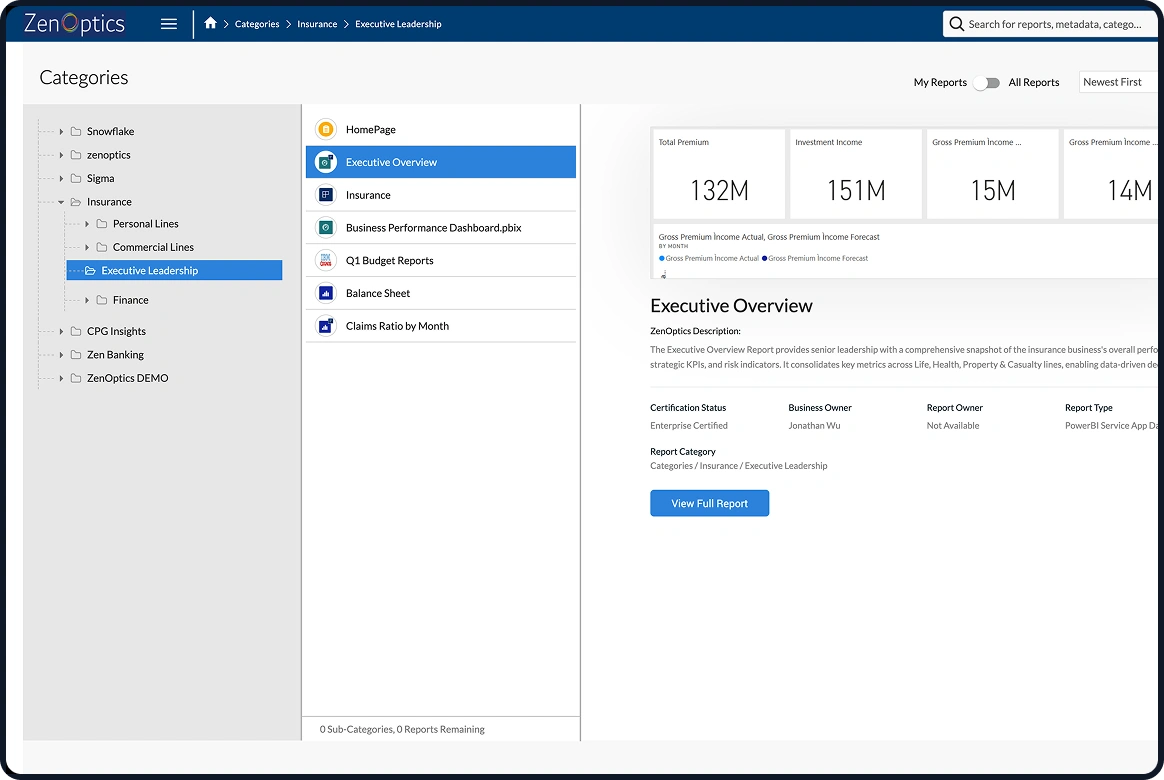
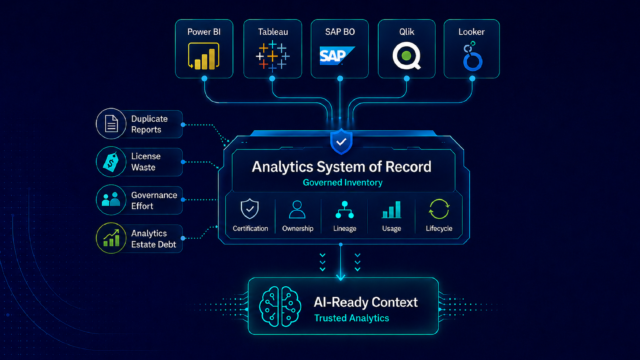
Atlas, ZenOptics' Analytics System of Record, creates an authoritative inventory of reports, dashboards, KPIs, metrics, definitions, ownership, lineage, certification status, and usage patterns across the enterprise analytics estate. Through 100+ Smart Connectors, Atlas indexes assets from Power BI, Tableau, SAP BusinessObjects, Qlik, Looker, and other analytics environments without requiring those platforms to be replaced.
With this layer in place, the enterprise can establish and manage consistent certification, ownership, and lifecycle records across the analytics estate rather than relying solely on disconnected, platform-specific processes. Ownership is tracked for every asset across all platforms. License rationalization becomes possible because usage data is visible across the full estate, not siloed per tool. Duplicate and orphaned content can be identified and retired through a governed lifecycle process rather than a periodic manual cleanup.
This governed estate also becomes the foundation for AI readiness. Atlas establishes which analytics assets and metrics are authoritative. Nexus then transforms that governed metadata into an Analytics Context Layer that helps AI systems understand metric definitions, business terminology, KPI relationships, and the logic connecting analytics to business decisions.
Existing BI platforms remain the systems in which analytics are authored and consumed. Atlas operates above them as the enterprise Analytics System of Record, providing an authoritative view of what exists, who owns it, which assets are certified, how they are used, and what should be reviewed or retired.
The cross-tool inventory that Atlas maintains is the governed record on which certification, ownership, lifecycle management, and AI readiness are built.
This addresses the root cause of BI tool sprawl: not simply the presence of multiple platforms, but the absence of a trusted governance layer across them. Tool diversity can be managed. An analytics estate that cannot be inventoried, understood, or governed as a whole cannot.
Frequently Asked Questions
What is BI tool sprawl?
BI tool sprawl occurs when an organization accumulates multiple business intelligence platforms, each operating with its own governance model, without a common inventory or governance layer above them. It is a natural result of acquisitions, departmental preferences, and incomplete platform migrations rather than a single poor decision.
What does BI tool sprawl actually cost?
The most visible costs are unused licenses and duplicated reports. The more significant costs are structural: governance actions performed separately in each platform multiply effort across the team, AI systems may encounter conflicting metrics, definitions, and certification records across a fragmented estate without an authoritative source of governed analytics and the business context required to interpret them, and analytics debt accumulates because there is no governed mechanism for retiring old content.
Is consolidating to a single BI tool the right answer?
Consolidation can reduce tool count, but it addresses the symptom rather than the root cause. Organizations that consolidate to a single platform frequently find additional tools added because the governance gap was never resolved. For enterprises with deeply embedded platforms and multi-year licensing commitments, full consolidation may also not be achievable in the near term.
How does Atlas address BI tool sprawl?
Atlas connects to existing BI and analytics platforms through 100+ Smart Connectors and establishes an authoritative, governed inventory of reports, dashboards, KPIs, metrics, ownership, certification, lineage, and usage. This enables cross-platform discovery, governance, rationalization, and lifecycle management without requiring a BI migration or tool replacement. Atlas also provides the governed foundation from which Nexus builds AI-ready analytics context.
Does an Analytics System of Record replace existing BI tools?
No. The existing BI platforms remain in place. Atlas operates above them as the Analytics System of Record, providing the governance and inventory layer that was missing across the estate.
Published August 10, 2026Do You Know What Your Analytics Estate Is Costing You?
Atlas connects to your existing BI and analytics platforms through 100+ Smart Connectors, creating an authoritative Analytics System of Record without replacing the tools your teams already use. Discover where duplication, unclear ownership, low usage, inconsistent certification, and lifecycle debt are increasing the cost of your analytics estate. Request an Atlas Demo
Schedule a 15min demo call