

PwC's 29th Global CEO Survey of 4,454 business leaders across 95 countries found that 56% of CEOs report no significant financial benefit from AI: no higher revenues and no lower costs. The diagnoses in circulation focus on technology selection, talent gaps, and integration complexity. Those are real factors. The one missing from most AI ROI analyses: the analytics estate those AI systems read from is ungoverned, and that governance deficit is generating costs that no one is currently measuring.
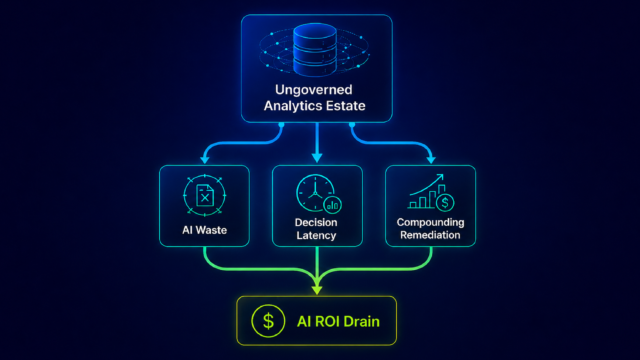
An ungoverned analytics estate does not produce a single large, visible failure. It produces three cost categories that accumulate across every AI deployment: AI waste, decision latency, and the compounding cost of a governance deficit allowed to grow. None of these appear on a governance program's cost center. All of them show up in AI ROI.
What Most AI ROI Diagnoses Are Missing
The standard diagnosis of AI ROI failure runs along predictable lines: the models are not trained on enough relevant data, the tools are not integrated deeply enough into workflows, the workforce does not have the skills to use AI outputs effectively, or leadership alignment is insufficient to drive adoption. These are legitimate explanations for some AI failures.
AI copilots deployed into an enterprise produce inconsistent, conflicting answers to the same business questions, even when the underlying data is clean, the integration is working, and the workforce is trained. That is the pattern those diagnoses leave unexplained. And analytics leaders recognize it immediately. The investigation in these cases consistently traces back to the same layer: the reports, dashboards, and certified metrics the AI reads from. That layer is ungoverned.
As established in AI Agents Don't Read Data Warehouses. They Read Analytics Estates., enterprise AI copilots and agents do not query raw data. They read from the analytics estate: the reports, dashboards, KPI definitions, and certified metrics that sit above the data. Standard AI readiness assessments do not assess this layer. The governance deficit accumulates there untracked, and so does its cost.
AI Waste: What Happens When AI Reads from Uncertified Analytics
Consider a revenue operations leader who asks an AI copilot: "What is our pipeline coverage ratio this quarter?" The copilot reads from whatever pipeline report or metric definition it can locate in the analytics estate. If the estate contains three pipeline coverage reports (one from the CRM team, one from finance reconciliation, one from the sales ops dashboard) with different definitions of "qualified pipeline," the copilot returns the one it finds first.
The number is plausible. It is also unverified. The revenue operations leader cannot act on it without first determining which report the AI used and whether that report's definition matches the one leadership has approved. That reconciliation takes time. It happens on every AI-generated output that touches an uncertified metric. At the scale of an enterprise with multiple AI copilots running across revenue, finance, and supply chain, this is not occasional overhead. It is structural waste embedded in the AI deployment itself.
This is the AI waste cost: the gap between what an AI investment should be delivering and what it actually delivers when the analytics estate it reads from lacks certification coverage. The PwC finding that 56% of CEOs see no financial benefit from AI is not entirely explained by this gap. A significant portion of enterprise AI ROI failure lives here, in the reconciliation loop that follows every uncertified AI output.
Decision Latency: The Meeting Cost of Conflicting Metrics
Every organization with metric governance gaps runs a version of the same meeting.
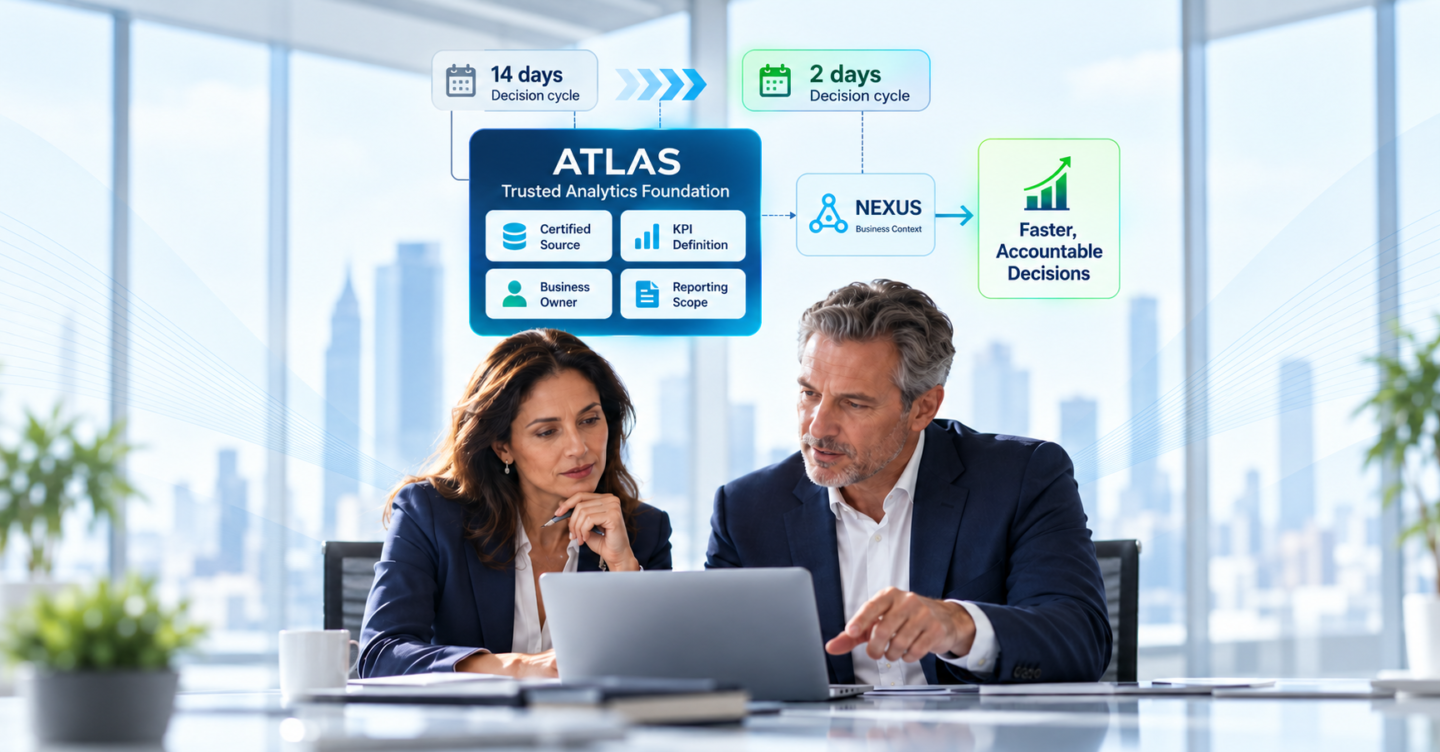
A finance leader enters a quarterly review with one gross margin figure. A regional VP enters with a different one. Both numbers come from the same underlying data. They differ because one report excludes a cost category the other includes, and neither report carries a certified definition that resolves the conflict. The meeting cannot close on any decision that depends on gross margin until someone goes back to source, finds the discrepancy, and confirms which calculation is the approved one. That investigation takes days. The decision waits.
This pattern does not announce itself as a governance cost. It surfaces as "the meeting ran long" or "we needed more time to align on the numbers." At enterprise scale, across a leadership calendar of quarterly reviews, board preparations, planning cycles, and operational check-ins, the time consumed reconciling conflicting metrics before decisions can be made is substantial. It does not appear on any cost center. It does not show up in AI ROI metrics. It is the invisible tax that metric governance gaps impose on every cross-functional decision that depends on shared numbers. Most analytics leaders, when pressed, can name the specific meeting they are thinking of right now.
The Compounding Cost of Governing Later
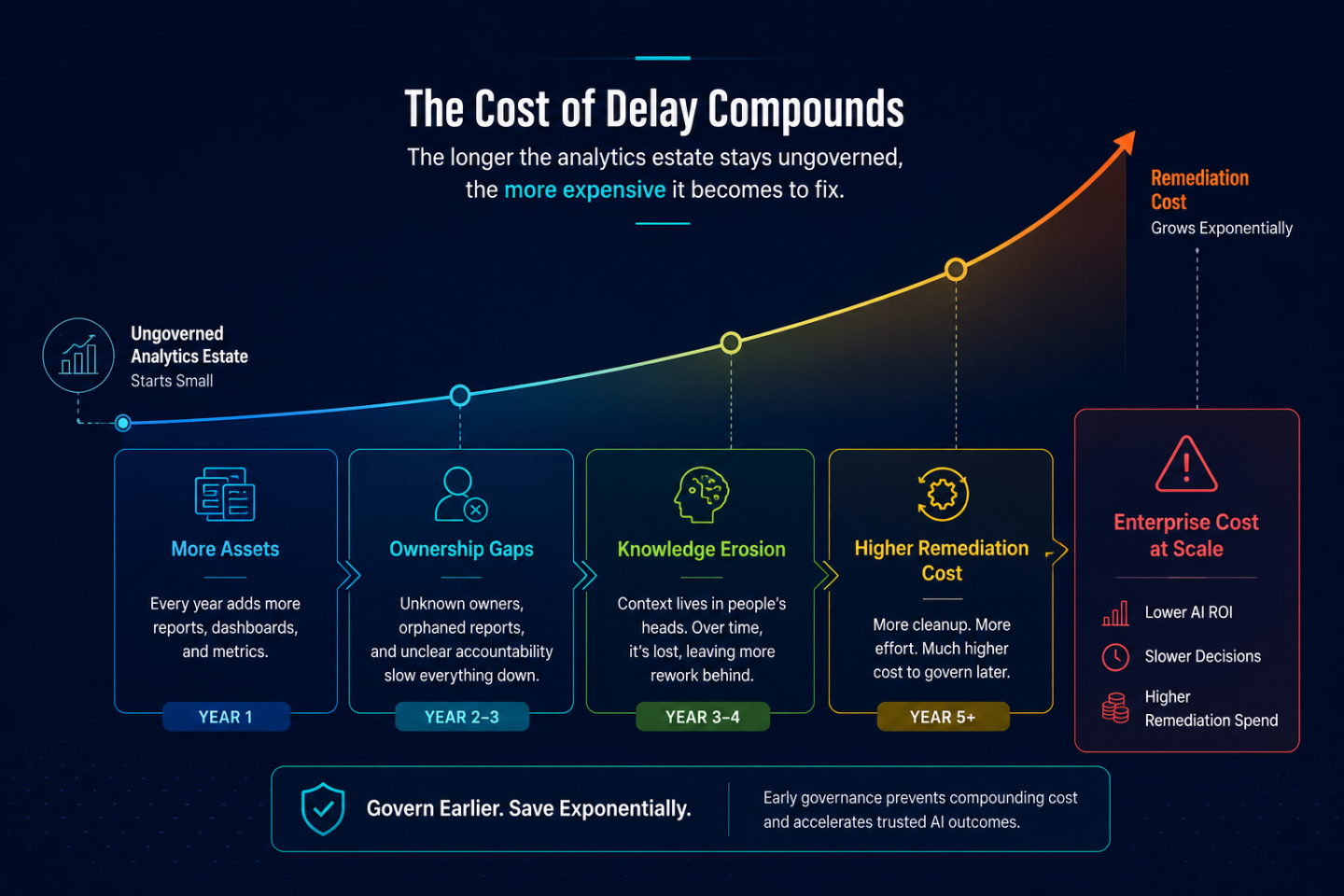
Governing an analytics estate that has grown ungoverned for three to five years costs significantly more than governing it progressively. Three factors drive this compounding.
Asset volume. Every year without governance adds more reports, more metric variants, and more BI tools to the inventory. An estate that accumulates 12,000 reports before governance begins is not simply four times harder to govern than an estate of 3,000. It is harder to triage, harder to selectively certify, and harder to deduplicate because the relationships between variants have become difficult to trace.
Ownership gaps. Metric definitions and report ownership are tied to the people who built them. When those people move on, the definitions remain but the owners do not. An estate governed years after initial deployment will have substantial portions where no current employee knows why a specific metric was calculated the way it was, what it was supposed to include, or which downstream reports depend on it. Reassigning ownership is possible. Reconstructing intent is often not.
Encoded knowledge erosion. Metric relationships (how gross margin connects to revenue mix, how pipeline coverage connects to forecast accuracy) are typically held informally by senior analysts who have been at the organization long enough to just know. Every year without encoding these relationships in machine-readable form increases the risk that the knowledge is lost before it can be captured. The analytics context layer that AI agents need to follow business logic rather than approximate it becomes harder and more expensive to reconstruct from partial information. This is the hardest governance gap to quantify before it becomes urgent. It is also the one organizations most consistently underestimate.
The remediation cost is not a one-time event. It is a curve that steepens with every year of delay. An analytics estate left ungoverned in 2024 is more expensive to govern in 2026 than it was in 2024, and the AI systems feeding from it are generating costs in the interim.
What Governing the Analytics Estate Actually Costs
The three cost categories above (AI waste, decision latency, and compounding remediation) each trace back to the same four governance gaps in the analytics estate: Inventory Completeness, Certification Coverage, Metric Governance, and Context Encoding. Each gap has a starting point that does not require rebuilding the estate from scratch.
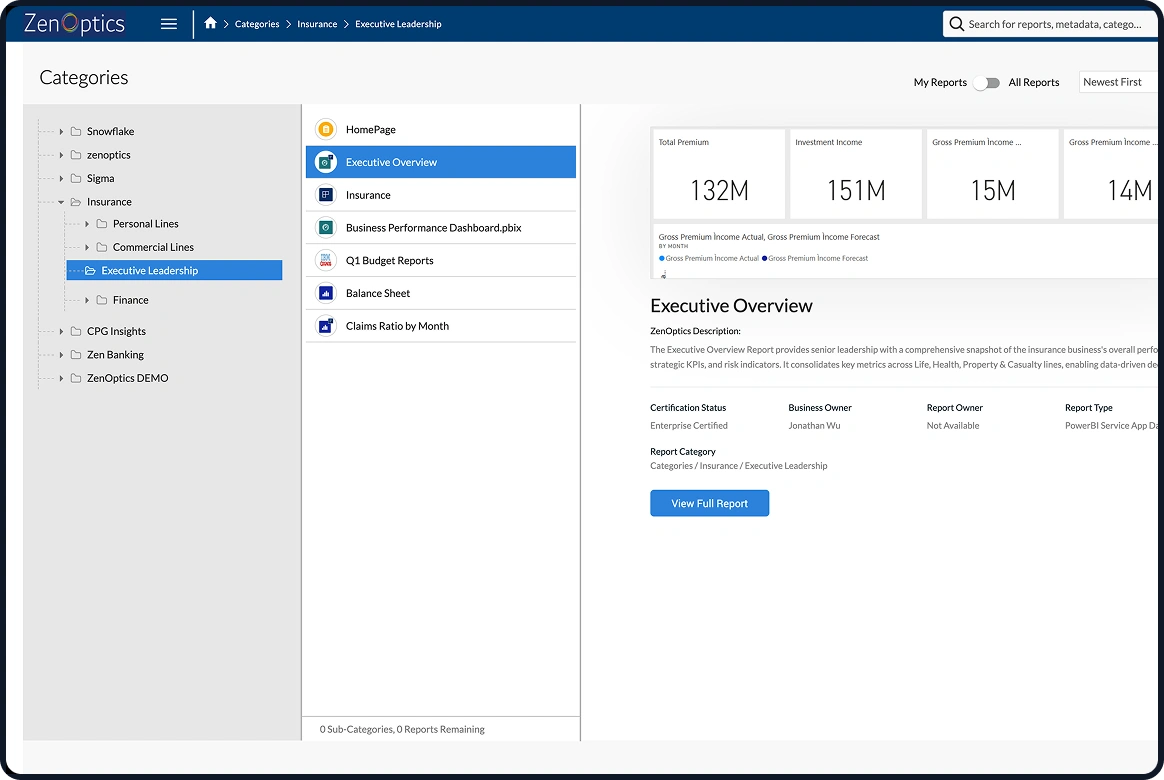
Inventory comes first. Certification coverage without a complete inventory is partial by definition: you can only certify assets you can see. Most enterprises running multiple BI tools have four partial, disconnected catalogs rather than one unified view. Atlas addresses this through 100+ Smart Connectors, building a continuous, cross-tool inventory of every active report and dashboard across Power BI, Tableau, SAP BO, Qlik, and others, with certification status, metric ownership, and review cadence tracked continuously. The estate becomes visible before governance begins.
Context encoding follows the estate. Building a machine-readable context layer before the underlying estate is certified and governed produces a context layer that reflects the estate's disorder rather than the business's logic. Nexus derives the analytics context layer automatically from the governed estate Atlas produces. Metric relationships, definitions, and business logic are encoded from existing BI metadata without requiring manual semantic mapping or a rebuild from scratch.
Organizations that bring their analytics estate under governance with this approach typically see a 20–40% improvement in analytics discovery speed and a 30–40% reduction in duplicate reports. The compounding costs described above (AI waste, decision latency, and the remediation curve) begin to close. Neither outcome happens overnight; metric governance in particular requires sustained organizational commitment that the technology supports but does not replace.
The self-assessment for all four dimensions is in The AI Readiness Checklist Every Analytics Leader Should Complete.
Frequently Asked Questions
Is the cost of an ungoverned analytics estate the same as the cost of analytics sprawl?
No. Analytics sprawl refers to volume-based costs: duplicate reports, licensing overhead from redundant BI tools, orphaned assets, and the labor cost of rebuilding reports that already exist. The cost of an ungoverned analytics estate is distinct: it is not about volume but about governance deficit. An estate can have a manageable number of reports and still carry high costs from low certification coverage, undefined metric ownership, missing context encoding, and incomplete cross-tool inventory. The two cost categories overlap only in that both are addressed by governing the analytics estate. The root causes and cost mechanisms are different.
How does an ungoverned analytics estate affect AI ROI specifically?
Enterprise AI copilots and agents read from the analytics estate: the reports, dashboards, and certified metrics that sit above the data. When that estate has low certification coverage, conflicting metric definitions, or incomplete inventory, AI produces outputs that require manual reconciliation before they can be acted on. That reconciliation loop is the AI waste cost: AI generating work rather than reducing it. For the 56% of CEOs in PwC's 2026 survey who report no significant financial benefit from AI, a meaningful portion of that ROI gap traces to the analytics layer AI is reading from. The full architectural explanation is in AI Agents Don't Read Data Warehouses. They Read Analytics Estates.
What is the most expensive governance gap to leave unaddressed?
For enterprises with active AI deployments, certification coverage carries the highest near-term cost. Without machine-readable certification status on analytics assets, AI agents have no signal to distinguish an authoritative metric from an outdated or incorrect one. They surface whichever they locate first. The reconciliation cost follows every decision that depends on those outputs. Over the medium term, metric governance becomes the highest-cost gap: calculation logic changes without certification updates, and teams operate on different definitions of the same KPI without knowing it. Metric drift compounds silently until a decision depends on a metric that two teams calculate differently.
How long does it take to govern an ungoverned analytics estate?
The starting point, a complete current cross-tool inventory, typically surfaces significantly more active analytics assets than single-tool catalogs show. The four dimensions build sequentially: inventory before certification, certification before context encoding. The timeline depends on the estate's current size and the number of BI tools in use. Atlas builds the cross-tool inventory automatically through Smart Connectors, reducing time-to-inventory substantially compared to manual audit approaches. The path to a governed, AI-ready analytics estate is measured in months, not years, when the starting point is automated inventory rather than manual catalog construction.
Where should an organization start when the estate is already ungoverned?
Start with Inventory Completeness. Certification, metric governance, and context encoding all require a complete, current view of the estate to be meaningful. Without cross-tool inventory, governance programs certify only what they can see, which is typically a fraction of the full estate. From a complete inventory, prioritize certification coverage for the metrics that AI copilots are currently querying most frequently. Those are the assets generating the highest AI waste cost today. The full sequencing guidance is in Your Analytics Estate Isn't AI Ready. Here's How to Fix It.
Published July 13, 2026The Hidden Cost of an Ungoverned Analytics Estate
The Analytics Estate Assessment identifies the governance gaps generating cost in your estate today. Schedule a 15-minute session to run it with ZenOptics.
Schedule a 15min demo call