

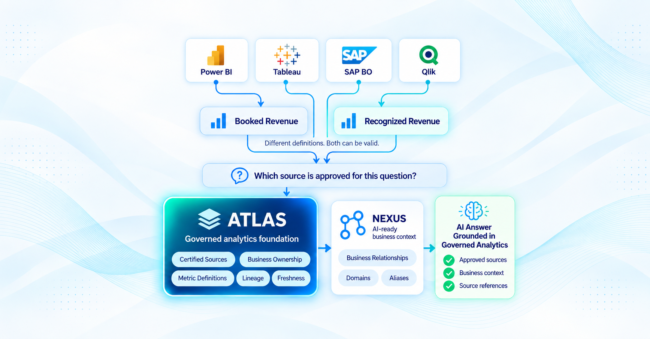
Two teams ask an AI agent about quarterly revenue and receive different numbers. One answer comes from a sales dashboard that measures booked revenue. The other comes from a finance dashboard that measures recognized revenue. Both reports may be valid, but they answer different business questions.
For quarterly financial reporting, the agent needs the finance-approved definition, the correct reporting period, and an authoritative source. Being allowed to open a dashboard does not establish that the dashboard is appropriate for that purpose.
As enterprises connect AI agents to Power BI, Tableau, SAP BusinessObjects, Qlik, and other analytics platforms, this distinction becomes urgent. Authoritative analytics for AI agents requires clear ownership, approved definitions, and business context that can be understood across tools.
Connection Is Getting Easier
Native integrations, vendor connectors, and the Model Context Protocol (MCP) are making it easier for AI systems to interact with enterprise tools. Organizations still need to address authentication, permissions, deployment, and operational reliability, but standardized interfaces reduce the need for custom integration work.
That progress creates room to focus on the harder question. Connectivity cannot say which analytics an agent should use for a particular business decision.
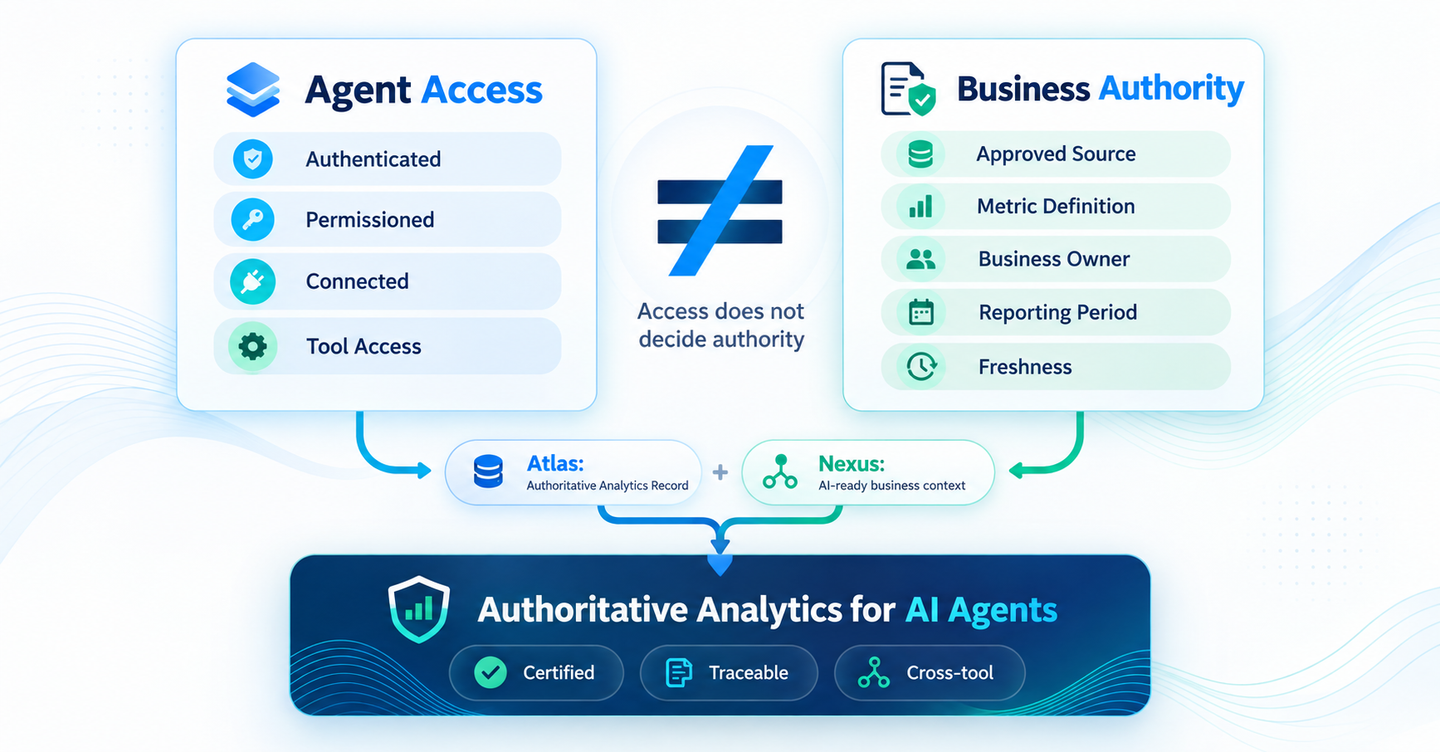
A successful connection establishes a route to information. It does not establish whether a report is current, whether its definition matches the question, or whether the business has approved it for the intended use.
Identity and Business Authority Need Different Controls
The MCP roadmap published on August 22, 2026 includes agent identity and enterprise-ready security among its five priorities. Its planned work addresses how servers recognize agent identities and support delegation through established security standards.
These capabilities matter. Organizations need to know which agent is making a request, on whose behalf it acts, and what access it should receive.
Business authority concerns the information available within that access. A properly authenticated agent can still select an outdated dashboard or confuse bookings with recognized revenue. MCP can carry tools and resources that expose governance information, but the protocol does not independently determine which business report is authoritative.
Enterprise teams therefore need both security controls and maintained analytics governance. Neither substitutes for the other.
Why This Matters Before Production
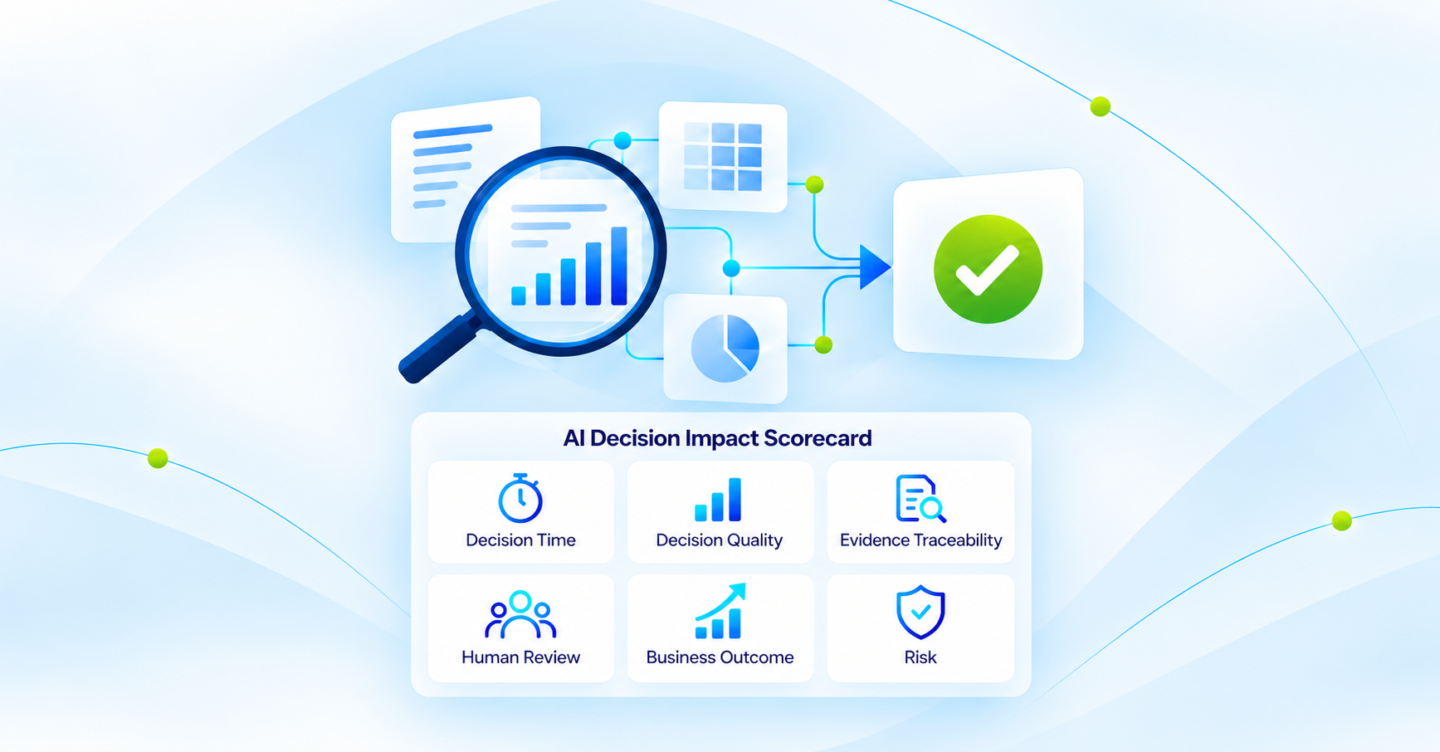
Gartner published a prediction on this in a press release dated May 26, 2026. "By 2027, 40% of enterprises will demote or decommission autonomous AI agents due to governance gaps identified only after production incidents occur."
The broader recommendation is to match governance to an agent's autonomy and access scope. This prediction is not specifically about conflicting BI reports. For analytics agents, however, a practical application is to establish approved sources, test interpretation, and make answers traceable before deployment.
Note where the gaps are found in that sentence. Not in review, not in procurement, and not during the pilot. They surface in production, in front of a business user, which is the most expensive place to discover them.
A read-only assistant does not change a business system, yet an incorrect recommendation can influence a forecast, investment, or operational decision. Governance should account for how people will use the answer as well as what the agent can execute.
What Makes an Analytics Asset Authoritative
Authority should be defined for a business purpose. A finance dashboard may be authoritative for recognized revenue, while a sales dashboard remains authoritative for bookings. Certification should explain this scope rather than imply that one asset answers every question.
This is harder with an agent than with a person. An analyst who has worked in finance for three years knows which dashboard the close runs on, and carries that knowledge without being told. An agent has only what the estate makes explicit. Which reports can AI agents trust is therefore a question about recorded governance state, not about the report content.
A useful review covers the following information:
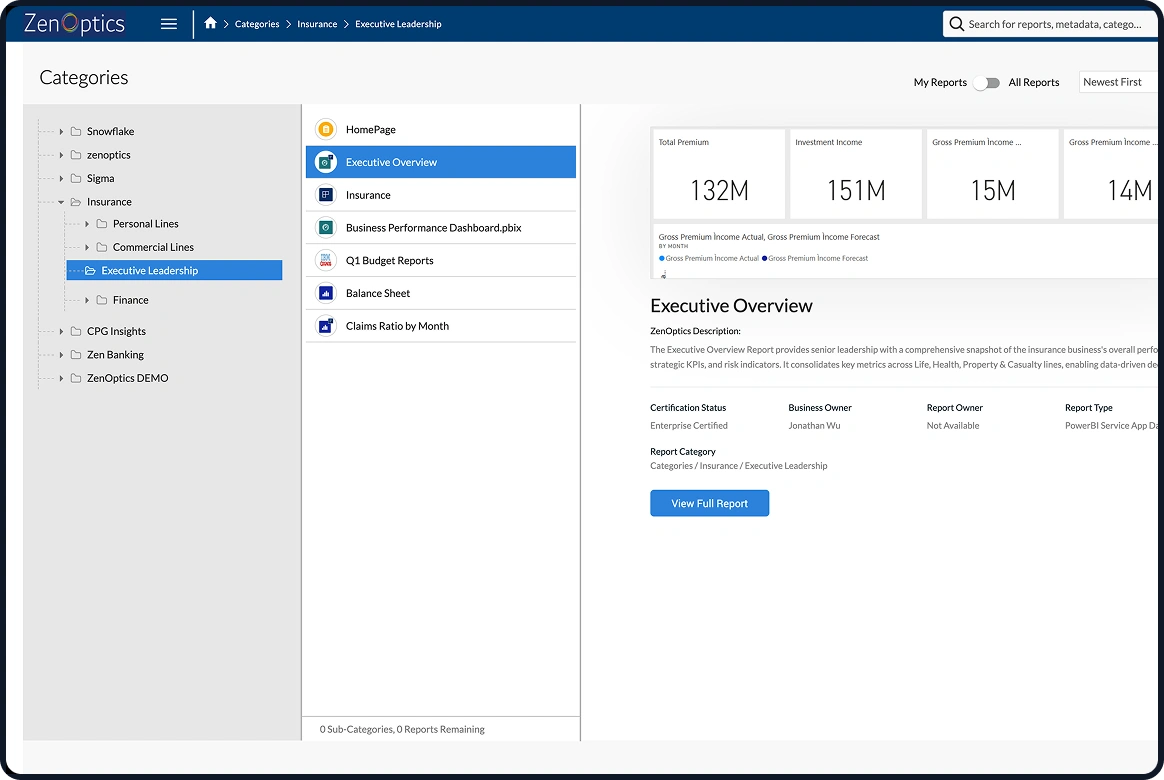
Certification and approved purpose. Identify who approved the asset, what questions it supports, and whether that approval remains current.
Business ownership. Name the person or team accountable for the metric definition and for resolving disagreements.
Metric definition. Record inclusions, exclusions, calculation logic, filters, and relevant dimensions. Revenue without its definition is incomplete context.
Freshness and reporting period. Establish when the source was refreshed and whether the question requires live, preliminary, or closed-period figures.
Lineage and dependencies. Understand where the numbers originate and which upstream changes could affect their interpretation.
Usage and lifecycle status. Use engagement patterns to identify assets that need review. Popularity is not proof of accuracy, and low usage does not make a regulatory report obsolete.
Some of this information already exists within BI platforms. The challenge is making it consistent and accessible across the estate. An analytics catalog can provide a shared record of those governance signals.
Certification Across Multiple BI Platforms
Large enterprises often maintain several analytics platforms because of acquisitions, departmental requirements, and ongoing migrations. Each platform may have its own certification process, object types, and ownership conventions.
Microsoft documents promotion and certification in Power BI. Tableau also provides certification for supported data assets. These capabilities are useful, but their labels do not automatically establish a shared enterprise interpretation.
The differences are practical rather than cosmetic. The schemes apply to different object types, so a certified item in one tool may have no equivalent in another. They differ on who holds the right to certify, which means an approval carries different weight depending on where it was granted. And none of them extend past the boundary of their own platform, so nothing reconciles a certified asset in one tool against a competing asset in the next.
An agent spanning several tools needs to understand what each trust signal means and how it applies to the business question. This is where AI agent BI report trust is won or lost. The enterprise must reconcile definitions and approval scope rather than assume that every certified object is interchangeable.
Cross-tool report certification therefore has to be maintained above the platforms rather than inside any one of them. A cross-tool BI inventory provides a starting point. It helps teams identify relevant assets, overlapping definitions, missing owners, and candidates for review without replacing the BI systems where those assets are maintained.
Start With One Business Domain
Preparing analytics for AI does not require certifying every report before the first deployment. Begin with a defined domain and a specific set of questions.
Consider an illustrative finance assistant that answers questions about quarterly recognized revenue. Its initial inventory contains ten related dashboards. A finance steward reviews their definitions, reporting periods, dependencies, and certification status. Three assets are approved for the assistant's intended scope, and the others may remain useful for different purposes. Certified reports for AI agents are the output of that review, not the starting point.
The approved sources then need meaningful context. The assistant should understand which metric measures recognized revenue, which dimensions support regional comparisons, and which asset represents the closed reporting period.
Configure the agent's retrieval and access controls to match the approved scope, while retaining source-system permissions. Domain grouping alone is not an access control, and approval for a use case does not grant a user additional data rights.
Test whether the assistant selects the right source, applies the right definition, and identifies uncertainty. If two approved sources still disagree, it should surface the conflict for review rather than silently choose one.
Scope also changes what happens when an answer turns out to be wrong. Across an open estate, the investigation covers everything the agent could have read. Across a reviewed domain, it covers three assets and the steward decision behind them. That is the practical value of governed analytics access for AI agents, provided the system records the sources and context used. Certification reduces ambiguity. It does not guarantee every generated answer will be correct.
How Atlas and Nexus Support the Foundation
Atlas is ZenOptics' analytics system of record. It catalogs analytics assets across platforms and supports governance through certification, ownership, metric definitions, lineage, and usage information.
This foundation helps teams establish what exists, which assets have been approved, and who is accountable for them. The analytics system of record gives stewardship a shared reference across the estate.
Nexus builds on governed metadata from Atlas to provide business context for AI. It supports business-friendly descriptions and aliases for technical assets, and it models the relationships among analytics assets, metrics, and business domains.
That context helps AI systems interpret what a metric means and how it relates to the question being asked. The approved source scope also needs to be reflected in the agent's integration and permission controls, alongside this business context.
Together, a governed asset record and curated business context address different parts of analytics readiness. Teams can begin with the relevant assets in one domain and expand as ownership and definitions mature.
Before the Next Analytics Agent Goes Live
- Define the questions. Specify the business domain, intended users, reporting periods, and decisions the agent will support.
- Inventory the relevant assets. Identify candidate reports, dashboards, metrics, and datasets across connected platforms. Finding a report is not the same as establishing trust.
- Resolve authority. Ask the accountable business owner to approve the assets and definitions for that purpose. Where definitions differ, record when each applies.
- Curate the context. Document business terms, aliases, dimensions, relationships, and freshness requirements so the agent can interpret approved sources.
- Configure and test the scope. Align retrieval with approved assets and existing permissions. Test conflicting definitions, stale sources, unauthorized requests, and questions outside the domain.
- Maintain the approval. Assign review responsibility and revisit certification when definitions, ownership, or upstream dependencies change.
Step three is where most programs stall, and it is worth planning for. Steps one, two, four and five have obvious owners in the data or platform team. Deciding which of two competing revenue definitions wins is a business decision, and it stays unassigned until someone with authority over the definition is asked to make it. Naming that person early is what keeps analytics estate agent governance from being handled as an integration ticket. Pilots stall for reasons that look technical and are not.
Frequently Asked Questions
Does MCP make an analytics source trustworthy?
MCP standardizes interaction with connected systems and supports an evolving security framework. Business owners must still establish which analytics are authoritative for a purpose and make that information available to the agent.
Is certification in our BI tool enough?
Native certification is useful within its platform. When an agent spans tools, teams also need a consistent interpretation of approval scope, definitions, and ownership across those tools.
Do we need to certify the entire estate?
No. Start with the assets needed for a defined domain and use case. Expand after the sources, context, permissions, and output quality have been reviewed.
How does this relate to a semantic layer?
A semantic layer can govern shared metric definitions and calculations. Enterprises may also have reports and dashboards outside that model. An analytics context layer helps organize the business meaning and relationships of analytics across the wider estate.
What does this cover that our AI governance policy does not?
AI governance policy covers the model, the risk classification, and the approval to deploy. It rarely says which analytics assets a given agent may read for a given question. That second question is answered per domain rather than per model.
Does grounding guarantee a correct answer?
No. Grounding in certified metrics provides a stronger foundation, but the agent must still interpret the question correctly, use appropriate filters, respect permissions, and communicate source limitations. Output testing remains necessary.
Published October 1, 2026Build Authority Into Analytics Readiness
Before an analytics agent goes live, the enterprise should be able to do three things. Identify the source behind an answer. Explain why that source is approved for the question. Name the owner responsible for its definition. That requires maintained governance and business context alongside connectivity. Start with one domain, establish the approved sources, and test whether the agent uses them correctly. Talk to our experts about preparing your analytics estate for AI with certified assets, clear ownership, and governed business context.
Schedule a 15min demo call