

Your company has agreed on its revenue definition. The calculation is documented. The semantic model is working.
Then an executive asks the AI assistant a simple question:
“Why did revenue fall last quarter?”
The assistant returns a polished explanation. It identifies a region, compares performance, and suggests where to investigate.
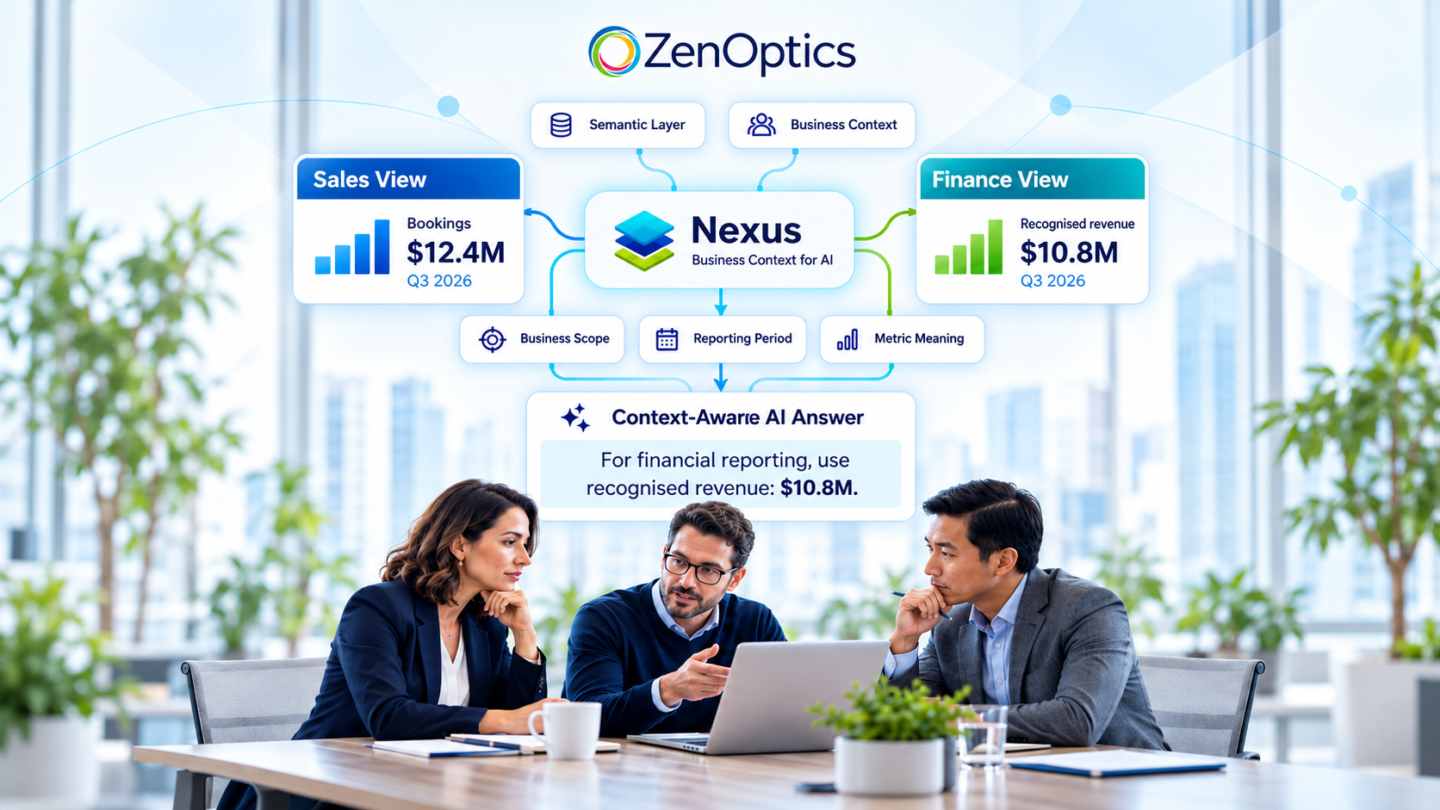
Finance reviews the answer and spots the problem. The assistant used an operational sales view that excludes discontinued products. The executive was asking about consolidated company performance.
The calculation was valid for the selected view. The interpretation did not fit the question.
This illustrative example explains why a semantic layer for AI is valuable, yet enterprise teams still need to examine the business context surrounding the metrics their agents consume.
For CIOs and analytics leaders, the practical challenge is making existing business meaning available to AI when it chooses sources, applies filters, and explains results.
What is a semantic layer?
A semantic layer maps technical data into shared business terms, metric definitions, and relationships. It allows connected applications to request information using concepts such as revenue, margin, customer retention, or product performance.
For example, a revenue definition might specify which transactions count, how returns are treated, and which accounting date determines the reporting period.
The layer can also represent dimensions and relationships so applications understand how to group a metric by region, product, or customer segment.
This reduces the need to recreate calculation logic in every consuming application. Consistency still depends on consumers using the appropriate definition, model version, filters, and data.
For AI, this provides an important foundation. It gives the application an explicit representation of business meaning rather than leaving it to infer calculations from table names.
Why semantic layers matter more as AI consumes analytics
An AI application interpreting a business question must make several choices before it can produce a useful answer.
It must identify the intended metric, select relevant evidence, establish the reporting period, and determine the scope of the comparison.
A semantic layer helps with those choices by exposing modeled definitions and relationships. However, a correct formula does not automatically resolve every ambiguity in the question.
In its March 11, 2026 data and analytics predictions, announced in Orlando, Gartner forecast that universal semantic layers would become critical infrastructure by 2030.
For enterprise analytics teams, that forecast reinforces the importance of shared business meaning. The implementation question is how to connect that meaning to the reports, dashboards, and business questions AI actually encounters.
A semantic layer example with two legitimate answers
Consider a hypothetical U.S. manufacturer.
Finance tracks consolidated recognized revenue across all business units. Sales tracks revenue from active product lines to assess current selling performance.
Both views can use the same underlying revenue calculation. Their filters and purposes differ.
| Business question | Relevant reporting context |
| How did total company revenue change? | Consolidated coverage, consistent accounting periods, and the treatment of discontinued products. |
| How are active products performing? | Active-product scope, relevant sales dimensions, and the operational reporting period. |
| Did regional performance improve? | Regional boundaries, comparable periods, and any changes in product coverage. |
An assistant that chooses a source because its title contains “revenue” may miss these distinctions.
An assistant with explicit context can identify the appropriate scope or ask a clarification question before answering.
The goal is to make that interpretation dependable enough that employees spend less time reconstructing what the assistant meant.
Four ways AI can misread a correctly defined metric
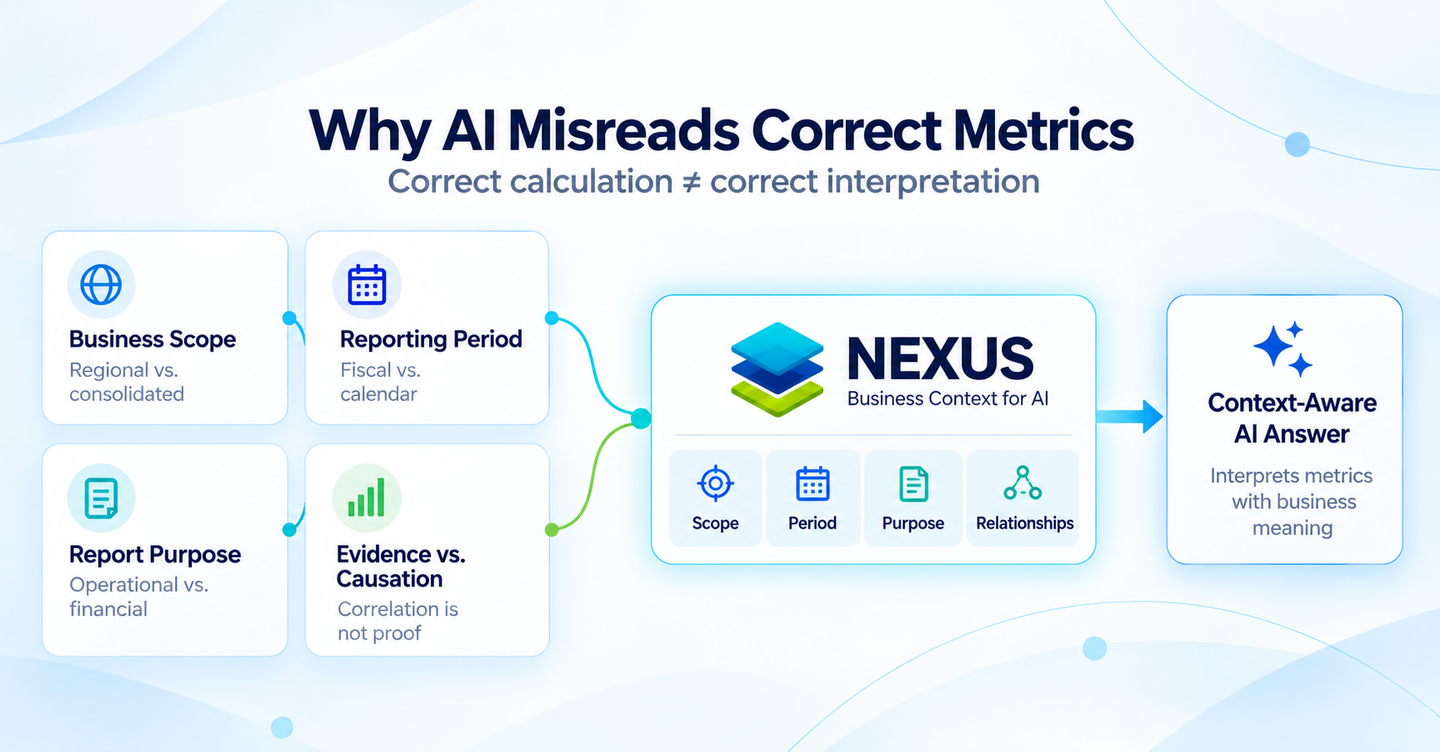
It selects the wrong business scope
A regional dashboard may be suitable for a sales manager and unsuitable for a consolidated executive review.
The AI application needs to understand which entities, products, customers, or locations the source includes. A familiar metric name does not establish that coverage.
It compares incompatible reporting periods
“Last quarter” can mean the previous calendar quarter, the previous fiscal quarter, or the most recently closed accounting period.
An application can apply a valid calculation to the wrong date range. The answer may look reasonable while failing to match the business request.
It overlooks the purpose of a report
A dashboard created to monitor daily operations may use provisional figures. A financial review may require closed-period results.
Both assets can be useful. Their intended use determines whether they are appropriate evidence for a particular question.
It explains a relationship the evidence does not establish
A revenue decline and a rise in delivery delays may occur together. That does not establish that delays caused the decline.
The assistant must distinguish observed changes from explanations supported by the available analysis.
NIST’s freely downloadable Generative AI Profile, published by the U.S. Department of Commerce in July 2024, discusses confabulation and information integrity among generative AI risks. For analytics teams, a useful application of that guidance is to evaluate whether an explanation is supported by its sources, alongside checking the numerical result.
What a semantic layer is not
A semantic layer is not automatically a complete inventory of every report the company uses. Assets built outside its consumption paths may contain independent calculations or additional assumptions.
It is also not a guarantee that an AI application will interpret every question correctly. The application must retrieve the relevant definitions and apply them appropriately.
A semantic model and a semantic layer are related terms, but their usage varies. A model describes a particular representation of metrics and relationships. A semantic layer describes the broader capability through which consumers access that business meaning.
For buyers, the useful question is less about terminology and more about coverage: which definitions and relationships are exposed, which applications use them, and what context remains elsewhere?
Semantic layer vs analytics context layer
A semantic layer primarily supports shared definitions and calculations. An analytics context layer represents business meaning and relationships around the analytics assets that people and AI consume.
The capabilities can overlap. Their responsibilities help identify what is missing.
| Capability | Question it helps answer |
| Semantic layer | How is this metric defined and calculated? |
| Analytics context layer | What does this metric or report mean in this business situation? |
| AI application | Which evidence fits the question, and what can reasonably be concluded from it? |
An enterprise may have a well-modeled revenue calculation while still lacking explicit information about which report supports consolidated performance reviews.
Connecting those elements helps the AI application interpret the metric in the setting where it will be used.
For a deeper architecture comparison, read Analytics Context Layer vs. Semantic Layer.
How Nexus connects BI meaning to AI interpretation
Your existing BI environment already contains valuable business knowledge.
Dashboards encode filters. Models represent dimensions. Reports reflect reporting periods and business scope. Descriptions explain terminology. Relationships between metrics reveal how teams examine performance.
Nexus, the ZenOptics analytics context layer, uses BI metadata to model relationships among analytics assets, metrics, and business domains.
This helps make business meaning represented in the analytics environment available for AI interpretation.
Where a semantic model already defines a metric, that definition should remain connected to the surrounding context. Teams should avoid creating a competing explanation of the same metric in a separate AI implementation.
The integration must then retrieve and apply the context appropriate to the question. The outcome should be evaluated against real business requests, including ambiguous questions and cases where the evidence cannot support a confident explanation.
Three questions to ask before expanding AI analytics
First, can the assistant explain which definition and reporting scope it used?
A source link alone may be insufficient if the reviewer cannot identify the relevant period, filters, or metric meaning.
Second, can it distinguish between plausible alternatives?
Present a consolidated financial report and a regional operational view. Ask questions that require the assistant to choose between them or clarify the request.
Third, does it acknowledge when the evidence cannot answer “why”?
A descriptive report can establish that performance changed. Explaining the cause may require additional analysis. The assistant should make that boundary clear.
Track how often employees need an analyst to resolve these issues. That review effort is a useful measure of whether the application is making analytics easier to use.
Bring one misunderstood business question to a ZenOptics demo
Choose a question that repeatedly sends employees back to the BI team.
It might concern revenue, customer retention, margin, or plant performance. Bring the metric definition and the reports people use to answer it.
Ask how Nexus can help connect the question to the relevant business meaning, reporting scope, and relationships in your analytics environment.
That gives the discussion a concrete objective: identifying the context the AI application needs to interpret the question correctly.
Request a Nexus demo focused on a business question your AI struggles to answer.
Frequently asked questions
What is a semantic layer for AI?
A semantic layer for AI exposes business definitions, metric calculations, and relationships that an AI application can use when interpreting questions and requesting data.
Why can AI return the wrong answer when a semantic layer exists?
The application may select the wrong metric, source, filters, or reporting period. It may also draw conclusions that the available evidence does not support.
Is a semantic layer enough for enterprise AI analytics?
It provides an important foundation for consistent calculations. The application also needs appropriate business context, source selection, and evaluation against the intended questions.
Published October 16, 2026Semantic Layer for AI Why Business Context Still Matters
A semantic layer defines your metrics, but AI can still misinterpret the question. Learn how analytics context connects calculations to business meaning.
Schedule a 15min demo call