


A quarterly business review gives the CIO a direct opportunity to connect analytics investment with the leadership agenda. The technology function can help executives arrive with a consistent comparison basis, evidence they can inspect and a clear record of what the previous review committed the business to do.
Consider an internal revenue QBR. Sales operations has a bookings view, finance has a recognized revenue view and regional leaders maintain pipeline summaries. The CIO’s role is to enable these perspectives to work together through trusted analytics and an agreed preparation process. Commercial leaders and finance retain responsibility for interpreting performance and making commitments.
This guide develops that executive reporting capability through a specific revenue review. It covers the CIO’s sponsorship decisions, the evidence and workflow requirements to commission, and a practical preparation sequence for RevOps and finance. AI assistance can support the work where suitable. The review timetable is illustrative and should follow the organization’s reporting cycle.
What the CIO should agree with the executive sponsor
Ask the QBR chair which decisions require cross-functional evidence and which figures must be approved before circulation. Establish responsibility for the common reporting basis, access to supporting assets and the record of actions. These are enterprise information requirements the CIO can sponsor even when RevOps coordinates preparation.
Choose the first improvement with the business sponsor. A more consistent source pack, a clearer comparison basis or a traceable action register may be a useful starting point. Fund AI assistance where it improves that process and can be reviewed, rather than making automation the definition of a successful QBR.
Define the decisions the QBR should produce
Begin with the decisions that belong in the room. They might include changes to territory coverage, investment in a segment or a response to a persistent conversion pattern. Distinguish these choices from updates that participants can read beforehand.
Ask the executive sponsor to identify the decisions that need cross-functional agreement. A regional sales leader may own an operating adjustment, while a larger resource commitment requires finance and executive approval. The QBR should expose that distinction before discussion begins.
Set the scope for the quarter. If the meeting covers revenue performance and the next-quarter outlook, avoid adding unrelated project updates simply because the relevant managers are present. A clear scope helps the preparation team choose which evidence deserves attention.
Agree the comparison basis before drafting commentary
Specify what the review compares: actual results with plan, the previous quarter or the corresponding period last year. Each comparison answers a different question. A seasonal business may need all three, with their purposes explained.
Record the treatment of currency, acquisitions and reporting cutoffs where relevant. Explain whether pipeline reflects the current snapshot or the position at the end of the quarter. These choices affect interpretation even when every underlying number is correct.
AFP’s variance analysis guidance discusses planned and actual performance. In a QBR, apply that basic discipline by keeping the comparison visible alongside the measure. Avoid letting an AI summary switch between baselines without explaining the change.
Assemble the core review pack
Build a small pack around the intended decisions. A revenue review may need an executive summary, a performance view, a pipeline view, a segment assessment and a record of prior commitments. Add detail where it changes the interpretation.
Provide links to the relevant source assets rather than copying a large collection of screenshots without context. Note which measures are approved and where figures remain provisional. Give reviewers a route to inspect the original report under the appropriate access permissions.
ZenOptics Atlas supports inventory and certification of analytics assets. That foundation can help RevOps and finance agree which reports belong in the QBR pack and who maintains them.
Use a review pack template with decision fields
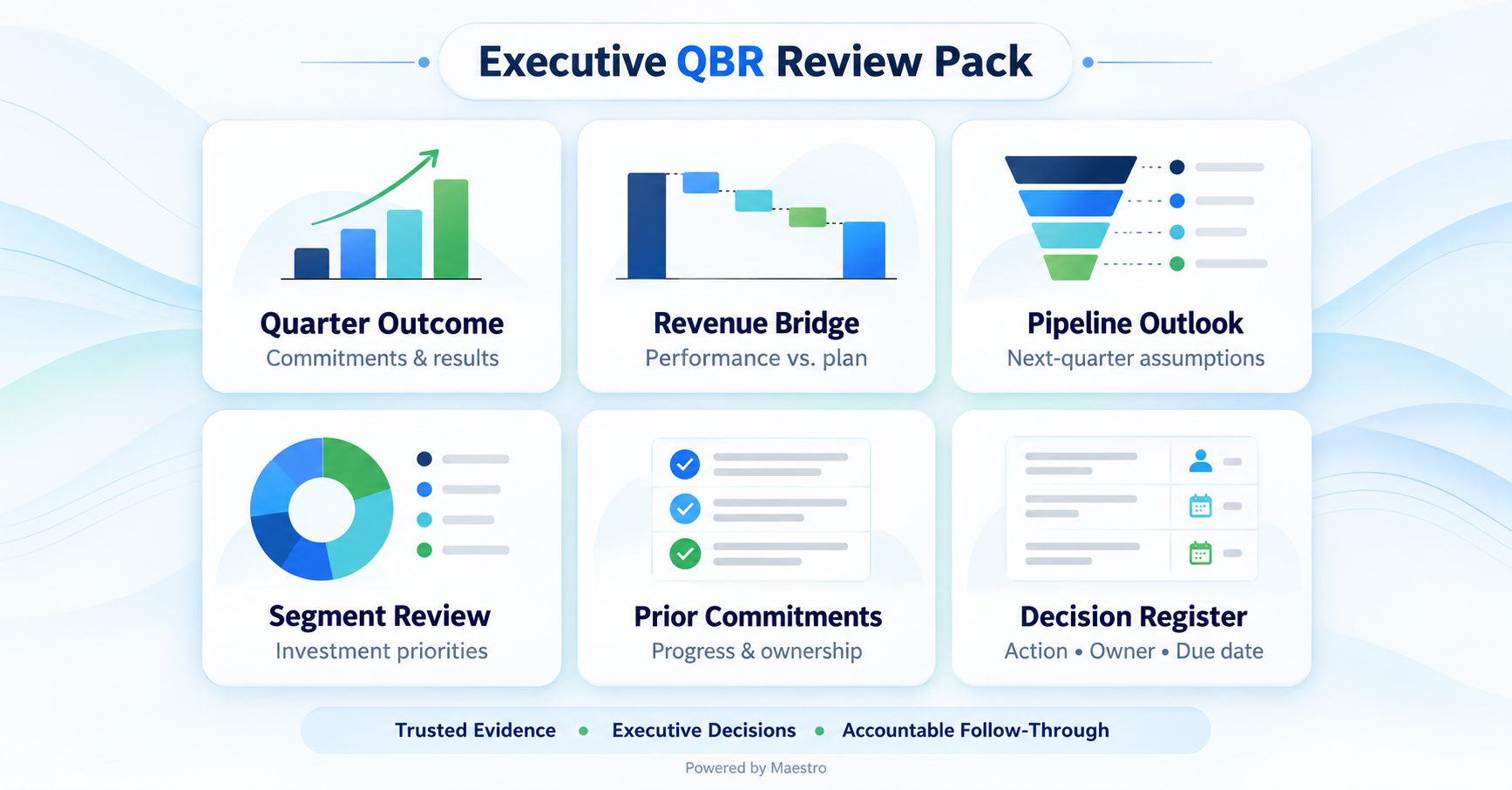
Each section should help a leader evaluate a choice. The template below illustrates how to give a familiar performance pack a clear management purpose.
| Pack section | Question for the review |
| Quarter outcome | Which commitments were achieved and which need discussion |
| Revenue bridge | What explains the movement against the selected comparison |
| Pipeline outlook | Which assumptions matter to the next quarter |
| Segment review | Where should coverage or investment change |
| Prior commitments | What happened after the previous QBR |
| Decision register | What was agreed and who owns the next step |
Keep the supporting detail accessible without making it the presentation’s main sequence. Participants should be able to inspect an assumption when needed while preserving time for decisions.
Draft a narrative that separates facts and hypotheses
An AI assistant can draft a first summary from the permitted evidence. Ask it to identify the reporting period, comparison basis and sources used. Require it to mark gaps rather than supply plausible explanations for missing information.
Separate observed performance from proposed causes. A decline in conversion is an observation. The view that a competitor caused it is a hypothesis until supported by suitable evidence. Reviewers can then decide which questions need further investigation.
ZenOptics Nexus organizes business meaning from governed metadata. That context can help distinguish bookings, recognized revenue and pipeline measures. It does not turn an unsupported commercial explanation into an established fact.
Use a preparation sequence with named reviewers
An illustrative sequence begins around ten working days before the meeting. RevOps confirms the agenda, decision list and evidence owners. Finance and the relevant commercial leaders then confirm the comparison basis and provisional figures.
In the following stage, the preparation team assembles the pack and drafts commentary. Reviewers check the sections they own, including material exceptions. Circulate the pre-read with enough time for participants to ask questions that could change the discussion.
Before the meeting, close straightforward data questions and record unresolved issues. State whether an unresolved issue affects a specific section or the entire decision. Adjust the timetable to the company’s close process. A deadline should not imply that unfinished financial information is final.
Give the AI assistant a bounded preparation task
A useful instruction names the task, evidence and limits. For example: prepare a draft internal QBR summary using the approved quarter-end reports, keep bookings separate from revenue and identify questions that need a business owner’s explanation.
Ask for source references and a list of assumptions. Do not authorize the assistant to send the pack to executives or change forecast commitments merely because it can draft the narrative. Distribution and approval remain separate workflow decisions.
NIST’s AI Risk Management Framework provides a broad reference for assessing AI use. The practical tests here should include an incomplete quarter, conflicting definitions, a restricted report and a question whose cause cannot be established from the pack.
Run the discussion around choices
Open with the decisions needed and any limits on the evidence. Spend less meeting time reading figures already available in the pre-read. Invite the relevant owner to explain the consequence of a finding and the options available.
For a proposed segment investment, compare the evidence supporting demand with the capacity and commercial assumptions required. Record the conditions under which the investment will be reviewed. A proposal becomes easier to evaluate when the organization can see what would change its view.
AFP’s finance business partnering overview connects planning, reporting and decision support. The QBR applies that relationship through a shared discussion between commercial leaders and finance, with each contributing its own expertise.
Capture the decisions in a usable form
Record the approved action, owner, due date and review condition. Preserve links to the evidence considered and explain any qualification. If a decision is deferred, name the information required and the person responsible for obtaining it.
ZenOptics Maestro publicly describes quarterly business review preparation among its workflow examples. Its structured workflows and decision provenance are relevant to connecting preparation with review and follow-through. Validate the required configuration for the enterprise’s process.
W3C’s provenance overview supplies general background for preserving relationships among evidence and responsible activities. A practical QBR record should allow the next meeting’s participants to understand what was decided under the conditions known at the time.
Measure the usefulness of the review
Track preparation effort, material corrections after circulation and unresolved questions at the meeting. These measures help the team improve the pack and preparation process. They should not be presented as proof of increased revenue by themselves.
At the next QBR, examine whether the commitments were implemented and whether their assumptions held. Some actions may be completed even when market conditions change the expected outcome. Preserve that distinction when assessing the process.
For a broader evaluation approach, link this work with the existing article on measuring AI’s impact on business decisions. That article explains outcome evaluation. This guide provides the specific revenue QBR preparation workflow.
Make the next quarter easier to prepare
Review whether the chosen segment cuts still answer the leadership questions. A total can remain stable while the mix of regions, products or customer groups changes. Agree which views deserve discussion and keep the populations comparable across periods. Where the population changed, explain the change next to the result rather than expecting each presenter to remember it.
Treat the pre-read as a controlled distribution. Pipeline and customer information may need a narrower audience than the executive summary. Confirm that the people receiving each section have the relevant access, including the links to supporting reports. An assistant should prepare only the material permitted for its assigned audience. This allows the team to share useful analysis without assuming that every participant needs every underlying detail. Keep an approved version of the circulated pack so meeting participants can refer to the same evidence, even if a source dashboard updates before the discussion.
Retain the approved pack structure, definitions and source references. Ask reviewers which questions they repeatedly had to resolve and add the relevant context to the maintained preparation process. Remove sections that do not inform a decision.
Avoid treating last quarter’s assumptions as permanent. Review the period, scope and ownership before reusing the pack. A territory change or acquisition may alter what a comparison means even when the report layout remains familiar.
The practical starting point is a single upcoming review. Agree the decisions, identify the supporting analytics and test the draft preparation process with RevOps and finance. Contact ZenOptics to explore how trusted assets, business context and review workflows could support your internal QBR.
The CIO action agenda
At the next QBR, ask whether leaders used the agreed evidence, which questions required reconciliation and whether prior commitments were easy to review. Sponsor the improvements that remove recurring preparation or interpretation work. Keep ownership of commercial assumptions with revenue and finance leaders. The CIO’s contribution is an information and workflow capability that makes their executive discussion better supported.
Frequently asked questions
What is an internal revenue QBR?
It is a quarterly leadership review of commercial performance, assumptions and priorities, ending with decisions and accountable follow-up.
How can AI assist QBR preparation?
It can help assemble evidence and draft a summary from approved sources. Business owners should validate interpretation, material assumptions and commitments.
What belongs in a QBR pack?
Include the outcomes, comparison basis, relevant performance and pipeline views, prior commitments and decisions required. Add supporting detail when it changes a choice.
Should QBR preparation be fully automated?
The appropriate level depends on the evidence and consequences. Review and approval of material conclusions should follow the company’s authority model.
Published October 28, 2026Make Your Next QBR a Decision-Making Meeting
Connect trusted analytics with your leadership priorities. Explore how ZenOptics can support AI-assisted QBR preparation, consistent business context and clear follow-through so your team can focus on the decisions that matter.
Schedule a 15min demo call