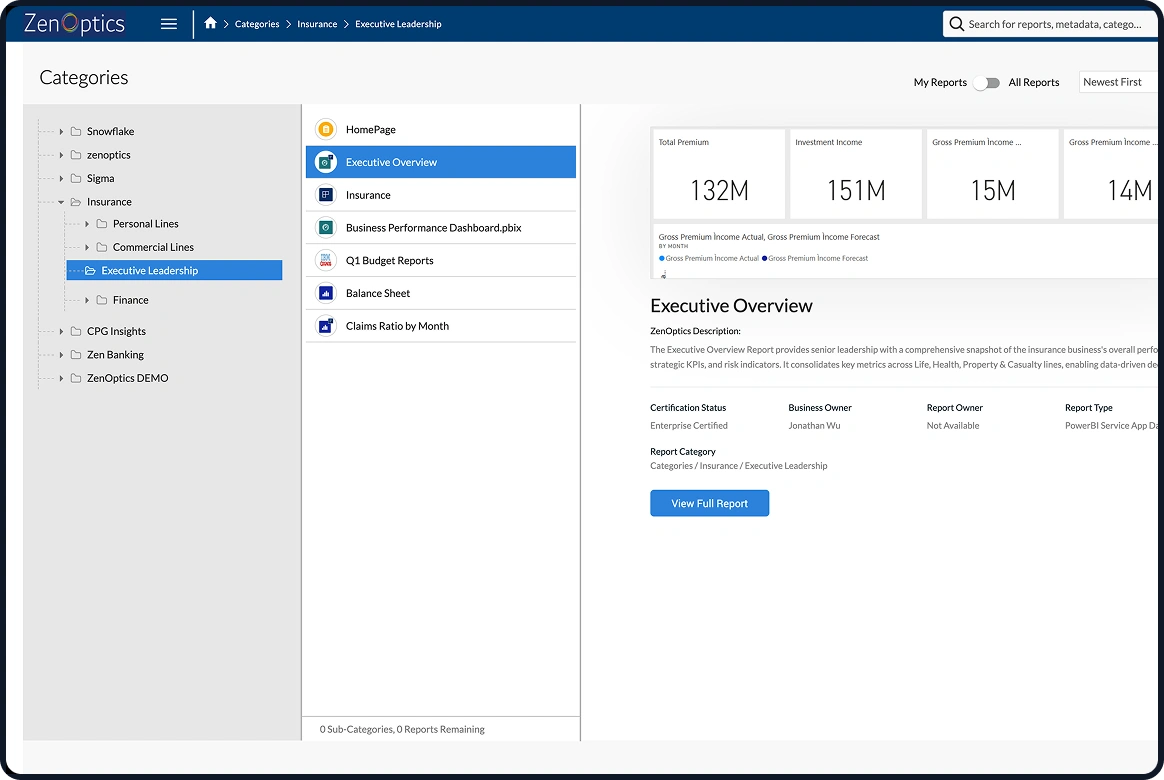



Enterprise copilots are being asked increasingly important business questions: What was our Q2 gross margin? Why did customer churn increase? Which product line drove last quarter’s variance?
Answering these questions reliably requires more than access to reports and dashboards. A copilot must understand which metric definition is authoritative, who owns it, where it came from, and whether it remains approved for the reporting context in question.
BI platforms can provide valuable governance within their own environments. The harder enterprise problem emerges when analytics span Power BI, Tableau, SAP BusinessObjects, and other platforms, each containing overlapping metrics, reports, certifications, and business definitions.This is where a governed analytics context layer becomes essential.
What "Knowledge Agent" Means for Analytics and Where the Frame Breaks
The knowledge-agent framing treats an AI copilot as a system that answers questions by finding and synthesizing relevant information from a corpus. This model can work effectively for enterprise content where authority can be inferred from signals such as the publisher, owner, version, approval status, and publication date. Official policies, product documentation, research reports, and company communications frequently contain these signals in forms that a retrieval system can evaluate.
When a knowledge agent is applied to analytics, it encounters a different kind of content. An enterprise BI estate contains certified KPIs, regional workaround reports, dashboard builds for specific projects, metrics calculated three different ways by three different business units, and certifications from previous governance cycles that may or may not reflect current business logic. These assets may coexist across multiple BI environments and become available through different retrieval paths. Without a unified authority model, the copilot may retrieve a relevant asset without understanding whether it represents the organization’s approved definition for that specific reporting context.
The distinction that matters for analytics is not in the content. A certified enterprise KPI for gross margin and an uncertified regional variant calculated without the corporate finance team's approval may look nearly identical as documents. Both have a metric name, a formula description, and a dashboard displaying a number. The difference is the governance record: one has been certified by the organization as authoritative for reporting, the other has not. That record is not in the text. It is in the analytics estate's governance metadata.
The analytics context layer was developed to address exactly this gap: the layer between raw BI content and the AI experiences that consume it, where governance signals must be made available in machine-readable form. Without it, an AI copilot encounters the same ambiguity a new analyst faces when deciding whether to use the finance-approved metric, a regional variation, or a project-specific calculation, but at enterprise scale.
Why the BI Layer Needs Different Grounding Than the Document Layer
Enterprise documents have authority signals a copilot can reason about: recency, author, revision history, official versus draft status. These signals are imperfect but present in the content structure. An AI copilot has reasonable heuristics for preferring a current document over a five-year-old one, or a final over a draft.
Analytics assets carry a different kind of authority that these heuristics cannot recover. A certified KPI approved last year may be more authoritative for current reporting than a metric definition updated last week, if the recent update was a project-specific workaround that was never submitted for certification review. A dashboard created four years ago as the official executive summary may be more trustworthy than a newer, more polished-looking report built for a regional pilot. Recency does not establish certification. Appearance does not establish governance.
The governance signals that make analytics assets trustworthy for AI are: certification status (is this metric currently certified as authoritative for this reporting context?), ownership accountability (is there a current, named owner responsible for this asset's accuracy?), and lineage integrity (does this metric's definition trace cleanly to the underlying data sources it claims to draw from?). When a copilot queries an analytics estate that lacks these signals, it cannot distinguish trustworthy from untrustworthy sources.
This is not a problem unique to copilot deployments: retrieval-only approaches have already demonstrated their limits in enterprise analytics when the underlying governance signals are absent, and whether graph-enhanced retrieval can substitute for governed analytics context resolves the same way. Adding more data to an ungoverned analytics estate does not reduce the ambiguity the copilot inherits. The governance signals must exist in the analytics estate before any query interface can surface them reliably.
This becomes particularly important for organizations using BI-native AI capabilities. Microsoft Power BI Copilot, Tableau Agent, and similar capabilities can use semantic models, certified data sources, endorsements, and other governance signals within their respective environments. However, they do not by themselves establish a unified authority model across the complete enterprise analytics estate.
When certified metrics and competing definitions are distributed across Power BI, Tableau, SAP BusinessObjects, and other platforms, each tool can govern what exists within its own boundaries. The remaining enterprise challenge is determining which definition should be treated as authoritative across platforms, business units, and reporting contexts. Better query interfaces alone do not resolve this cross-platform governance gap.
ZenOptics complements the governance capabilities within individual BI platforms by establishing the cross-platform analytics system of record and context layer needed to make governance signals consistent, machine-readable, and usable across enterprise AI experiences.
What Governed BI Context Requires for Copilot Deployments
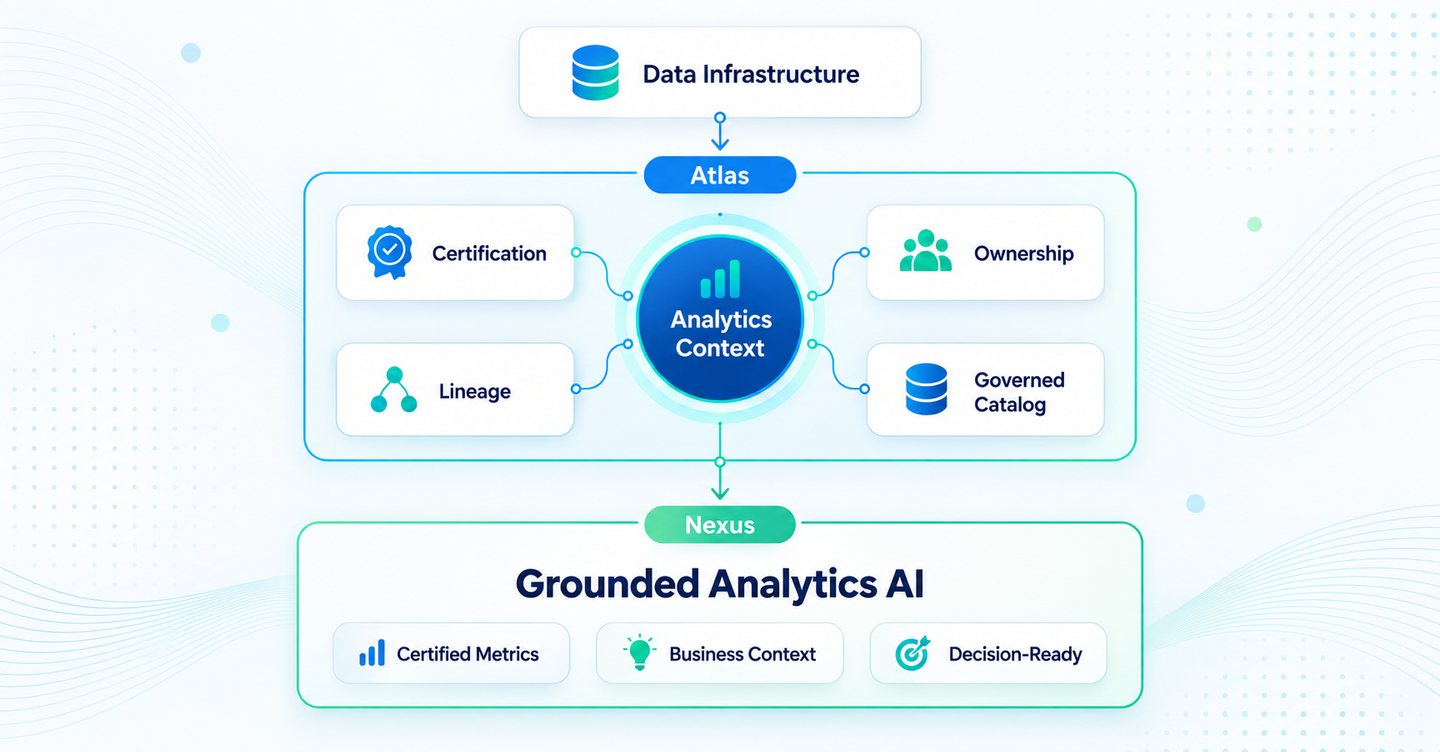
Grounding a copilot in the governed analytics layer requires four specific governance components, each of which addresses a distinct gap in the knowledge-agent model.
Certified metric definitions with designated authority. An enterprise may have multiple definitions of the same business metric in circulation across BI tools, regions, and business units. For a copilot to return an authoritative answer, there must be a designated authoritative definition for each metric in each reporting context, available to the copilot as structured context rather than as raw document text for it to synthesize. What metric certification requires goes beyond labeling: it involves a defined governance process, designated owners, and a review cadence that keeps certifications aligned with current business logic.
Ownership with accountability and review cycles. A metric definition certified eighteen months ago may reflect business logic that has since changed. Governed analytics context requires that each certified metric have a current, accountable owner responsible for keeping the certification current. Review cycles establish when certifications are revisited. Without these, certifications decay over time while the copilot continues to ground on outdated definitions. There is no mechanism for the copilot to detect that the governance record it is reading has not been reviewed since the business logic changed.
A cross-platform analytics catalog that distinguishes authoritative, contextual, and ungoverned assets. A copilot needs to understand which reports, dashboards, semantic models, and metrics are authoritative for a particular decision or reporting context. A governed analytics catalog provides these distinctions as structured metadata, allowing AI systems to prioritize certified assets, recognize contextual variations, and flag assets whose governance status is incomplete or uncertain.
Lineage from certified metrics to data-source dependencies. A certified metric that relies on a data source that has changed because of a schema migration, pipeline update, or source-system replacement may remain logically consistent while producing an unexpected result. Lineage makes these dependencies visible. It connects the certified metric to the datasets, reports, and upstream sources on which it depends. When a dependency changes, governance teams can assess the impact and determine whether the affected metric requires review or recertification. The governance failures that produce different classes of unreliable AI output include lineage breaks that AI systems cannot interpret correctly without explicit governance context.
Together, these four components define what "governed BI context" means in practice for a copilot deployment. They are not features of a BI tool's Copilot interface. They are properties of the analytics estate the copilot queries.
What Changes When Copilot Is Grounded in Governed BI
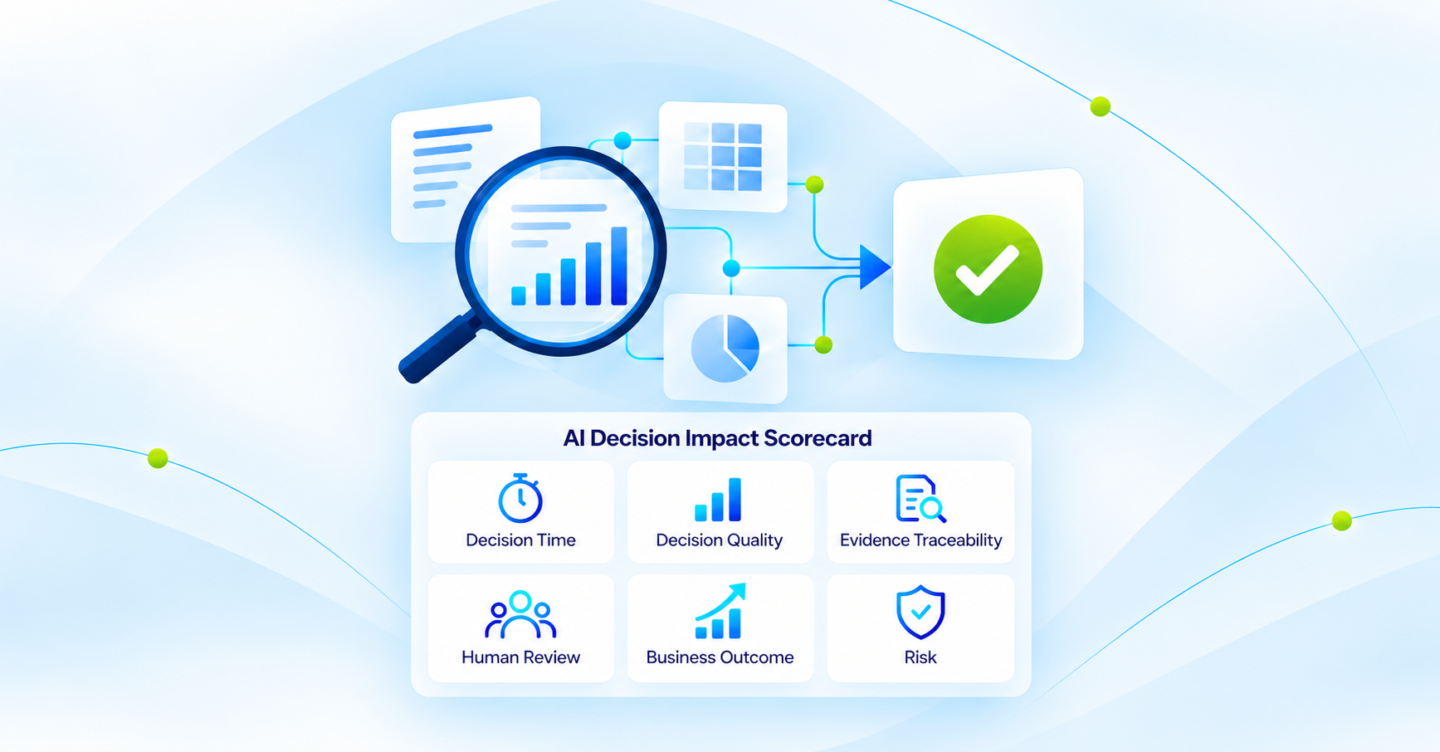
When an analytics estate contains certified definitions, accountable ownership, lifecycle governance, and traceable lineage, a copilot can operate with clearer authority signals. It can interpret a question using the appropriate certified metric, identify the governed analytics asset associated with that definition, and provide the ownership, certification, and lineage context needed to verify the response.
Instead of relying on whichever BI content appears most relevant, the copilot can interpret the question using the organization’s certified metric definition, query the appropriate governed analytics asset, and connect the resulting answer to its governance context. The output is not simply more confident. It is more traceable.
Model capability alone does not produce this outcome. The quality of the governed context the model receives is equally important. When a copilot produces inconsistent analytics answers, the model may not be the only source of the problem. The underlying analytics estate may lack the governed definitions, relationships, ownership, and authority signals required to interpret business questions correctly..
Atlas establishes the enterprise analytics system of record by cataloging reports, dashboards, KPIs, and metrics across BI platforms. It provides certification and approval workflows, ownership and accountability, lifecycle governance, usage intelligence, lineage, and dependency visibility.
Nexus builds on this governed foundation by transforming BI metadata and governance records into machine-readable business context. Through semantic curation and a knowledge graph, it helps copilots and AI agents interpret metrics, relationships, aliases, and business domains more accurately.
Together, Atlas and Nexus provide the governed analytics foundation that enterprise copilots need to understand not only which analytics assets exist, but also which definitions are authoritative and how they should be interpreted.
Five Questions to Ask Before Grounding Copilot in BI
Before expanding an enterprise copilot into analytics use cases, leaders should ask:
- Can the copilot identify the authoritative version of a metric across every connected BI platform?
- Can it distinguish enterprise definitions from regional, departmental, and project-specific variations?
- Can each metric and analytics asset be connected to a current, accountable business owner?
- Can users trace an answer to its certification status, source dependencies, and supporting analytics assets?
- Can the governance context remain current as reports, definitions, ownership, and dependencies change?
If the answers are unclear, the organization may have given its copilot access to analytics without providing the context required to interpret them reliably.
Frequently Asked Questions
Why do BI-native Copilot features (like Power BI Copilot) still leave governance gaps?
BI-native AI capabilities can use semantic models, certifications, endorsements, and other governance signals within their respective platforms. The remaining gap appears when analytics span multiple platforms. Power BI may contain one approved metric, while Tableau or another environment contains a regional or project-specific variation. Without a cross-platform analytics system of record, an enterprise copilot may lack a consistent way to determine which definition is authoritative for a particular business question.
What is the difference between a knowledge agent and a governed analytics context layer?
A knowledge agent retrieves and synthesizes information from a corpus. It is optimized for unstructured content where authority signals are in the text. A governed analytics context layer is structured governance infrastructure: certified metric definitions, ownership records, certification status, and lineage records that make analytics assets trustworthy for AI reasoning. The two serve different purposes and address different problems. An enterprise copilot deployed for analytics use cases benefits from both, but the knowledge-agent layer cannot substitute for the governance layer.
Does governing the analytics estate require replacing existing BI tools?
No. ZenOptics complements the BI and data platforms an organization already uses. Atlas connects to the analytics estate and establishes cross-platform cataloging, certification, ownership, lineage, and lifecycle governance. Nexus converts this governed metadata into business context that copilots and AI agents can consume. Existing BI platforms remain the systems where analytics are created and consumed.
How does metric lineage help a copilot return more reliable answers?
Lineage connects a certified metric to the datasets, reports, and upstream sources on which it depends. When a schema, pipeline, or source system changes, lineage helps governance teams identify the affected analytics assets and determine whether they require review or recertification. Making this context available to a copilot allows the response to be connected to the metric’s definition and supporting dependencies, giving users a clearer basis for verification.
Published September 7, 2026From Knowledge Agent to Governed Analytics
An AI copilot grounded in documents alone cannot reliably answer enterprise analytics questions. The BI layer requires its own governance: certified definitions, accountable ownership, lifecycle management, and traceable lineage. Without that governance, the copilot inherits the analytics estate's ambiguity and delivers it at scale. Atlas creates a governed, cross-platform system of record for enterprise analytics. Nexus transforms that foundation into machine-readable business context for copilots and AI agents. Together, they help organizations move from AI that can access analytics to AI that can interpret analytics within the correct business context, supporting decisions with greater consistency, transparency, and accountability. See How ZenOptics Makes Enterprise Analytics AI-Ready
Schedule a 15min demo call