

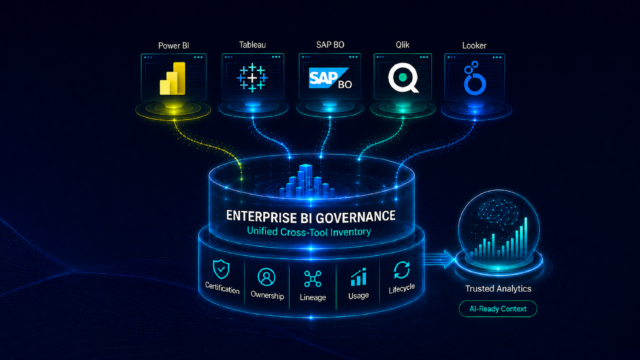
Power BI provides certification workflows, sensitivity labels, permissions, and integration with Microsoft Purview. Tableau offers data-source certification, project-level permissions, usage analytics, and workspace governance. SAP BusinessObjects supports folder-level security, publication governance, and granular access controls.
Each platform can govern the content within its own environment.
The challenge begins when an organization operates several of these platforms simultaneously.
Power BI sees Power BI. Tableau sees Tableau. SAP BusinessObjects sees SAP BusinessObjects. Qlik and Looker maintain their own administrative and governance boundaries.
But the enterprise does not make decisions within those boundaries.
A quarterly revenue metric may appear in Power BI, Tableau, SAP BusinessObjects, and a manually maintained spreadsheet. Each version may have a different owner, calculation, refresh schedule, or certification status. Yet no individual BI platform can show the organization how those versions relate across the full analytics estate.
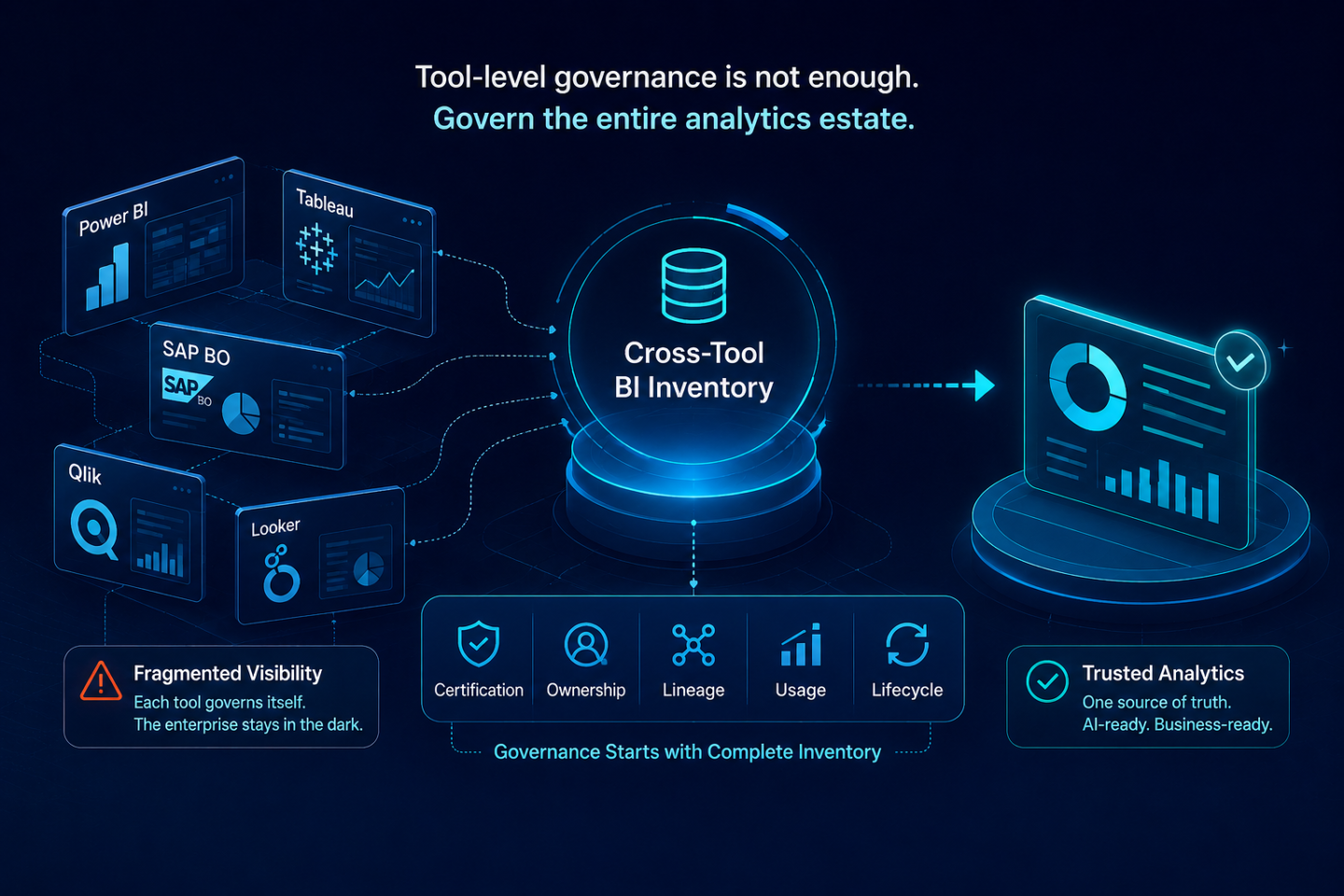
The problem is not that governance is absent. It is that governance is fragmented across tools, teams, and administrative models.
Enterprise BI governance therefore requires another layer: a unified, cross-tool inventory that shows what analytics assets exist, where they reside, who owns them, which versions are trusted, and how they are being used.
The Limit of Single-Tool Governance
The governance capabilities built into major BI platforms are valuable. A certified Power BI dataset signals that it has been reviewed and approved within the Power BI environment. A certified Tableau data source provides a similar trust signal within Tableau Server or Tableau Cloud.
These capabilities work within their intended scope.
The limitation is that their scope normally ends at the platform boundary.
A Power BI certification does not establish a relationship with a Tableau workbook using the same business metric. A report marked inactive in SAP BusinessObjects may still have a duplicate in Qlik. An ownership change recorded in Tableau does not automatically resolve ownership ambiguity for a similar dashboard in another platform.
This creates a misleading situation: an organization may have mature governance within individual tools while still lacking governance across the enterprise analytics estate.
Most large analytics environments did not become fragmented through a single technology decision. They accumulated over time through acquisitions, departmental preferences, regional requirements, modernization programs, and platform migrations that were never fully completed.
The result is an estate in which several BI platforms operate in parallel, each with its own content, owners, security model, definitions, and lifecycle.
Governance inside each tool remains necessary. But it is no longer sufficient.
Why Inventory Must Come Before Governance
Every governance action begins with two basic questions:
- Does the asset exist?
- Where does it live?
An organization cannot reliably certify a KPI without knowing how many versions of that KPI exist. It cannot assign ownership without identifying which reports are owned, which are orphaned, and which have duplicates across platforms.
It cannot retire an outdated dashboard if another version continues to circulate elsewhere. It cannot investigate analytics access or compliance exposure without visibility into assets and permissions across the connected estate.
In a single-platform environment, much of this information may be available through the platform administration interface.
In a multi-tool environment, no single source system has the complete picture.
A cross-tool BI inventory solves this visibility problem. It connects to the organization existing analytics platforms, reads the metadata made available through their supported APIs, and creates a unified view of reports, dashboards, datasets, KPIs, ownership, lineage, certification, and usage information.
This is not merely a point-in-time audit or another spreadsheet of reports. It is a maintained record of the analytics estate as assets are created, modified, certified, reassigned, or retired.
Without this foundation, governance remains partial.
Certification applies only within the platform where it was configured. Ownership records remain disconnected. Deprecation becomes difficult to coordinate. Duplicate content continues to accumulate. Different teams continue making decisions from different versions of the same metric.
Before an enterprise can govern its analytics, it must first know what it has.
The Business Cost of an Incomplete Inventory
The absence of a cross-tool inventory is not only an administrative inconvenience. It creates measurable operational and strategic costs.
Teams recreate dashboards because they cannot find existing ones. Analysts spend time reconciling conflicting numbers instead of producing new insights. Governance teams manually compare assets across systems. Technology teams continue supporting reports that no longer have active users or accountable owners.
The risk becomes even greater when AI is introduced.
Consider a finance leader asking an AI assistant for quarterly revenue. The assistant discovers three dashboards across Power BI, Tableau, and SAP BusinessObjects. All three contain a revenue metric, but each applies a different definition.
One includes intercompany transactions. One excludes them. One has not been refreshed recently.
The AI system may successfully retrieve a number, but it has no reliable way to determine which number the business trusts.
The problem is not model intelligence or data availability. It is the absence of governed analytics context.
An AI assistant that can access every report but cannot distinguish between certified and unverified content may produce an answer that is technically traceable yet operationally wrong.
Trusted AI therefore starts with trusted analytics.
What a Cross-Tool Inventory Makes Possible
Once an organization establishes a unified inventory across its connected analytics platforms, four important governance capabilities become possible at enterprise scale.
1. Estate-Wide Certification
Certification within one platform tells users which assets have been reviewed inside that environment. A cross-tool governance layer extends this visibility across the broader estate.
It provides an authoritative record of which reports, dashboards, KPIs, and metrics the organization recognizes as trusted. Governance teams can compare similar assets across platforms, resolve conflicting definitions, and establish which version should guide decision-making.
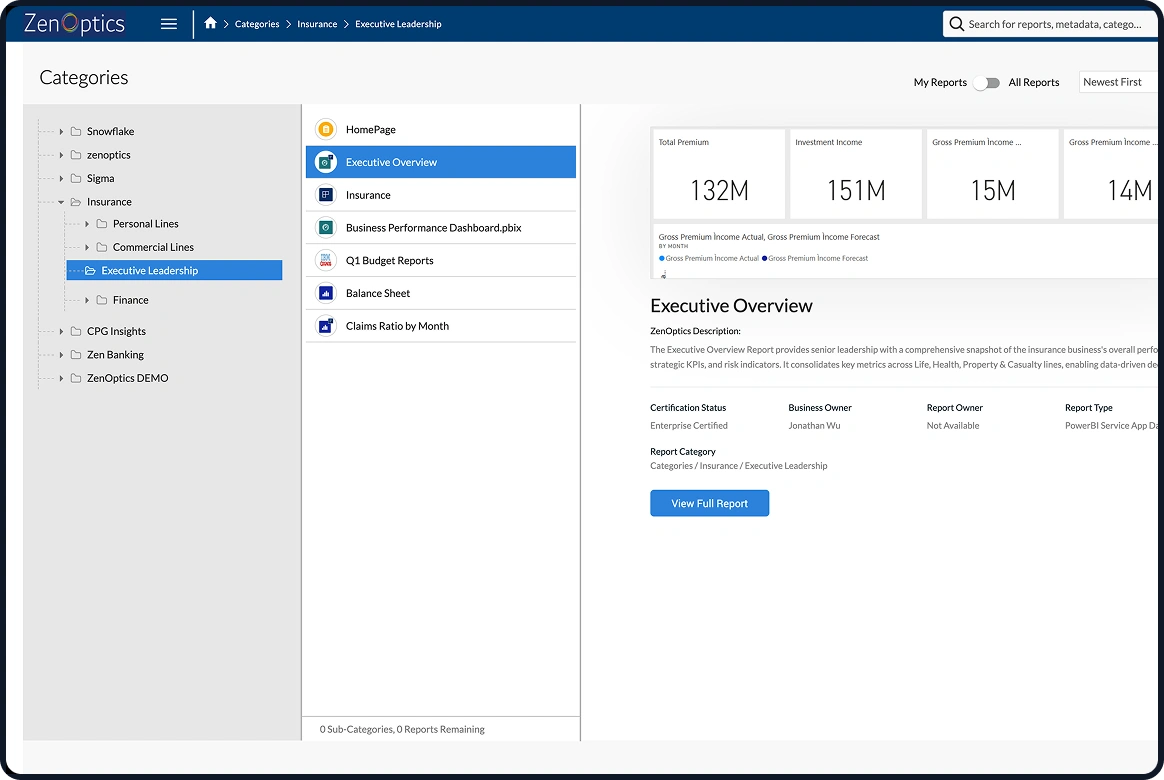
Users can then identify trusted assets through a unified analytics discovery and governance layer, regardless of where the content was originally created.
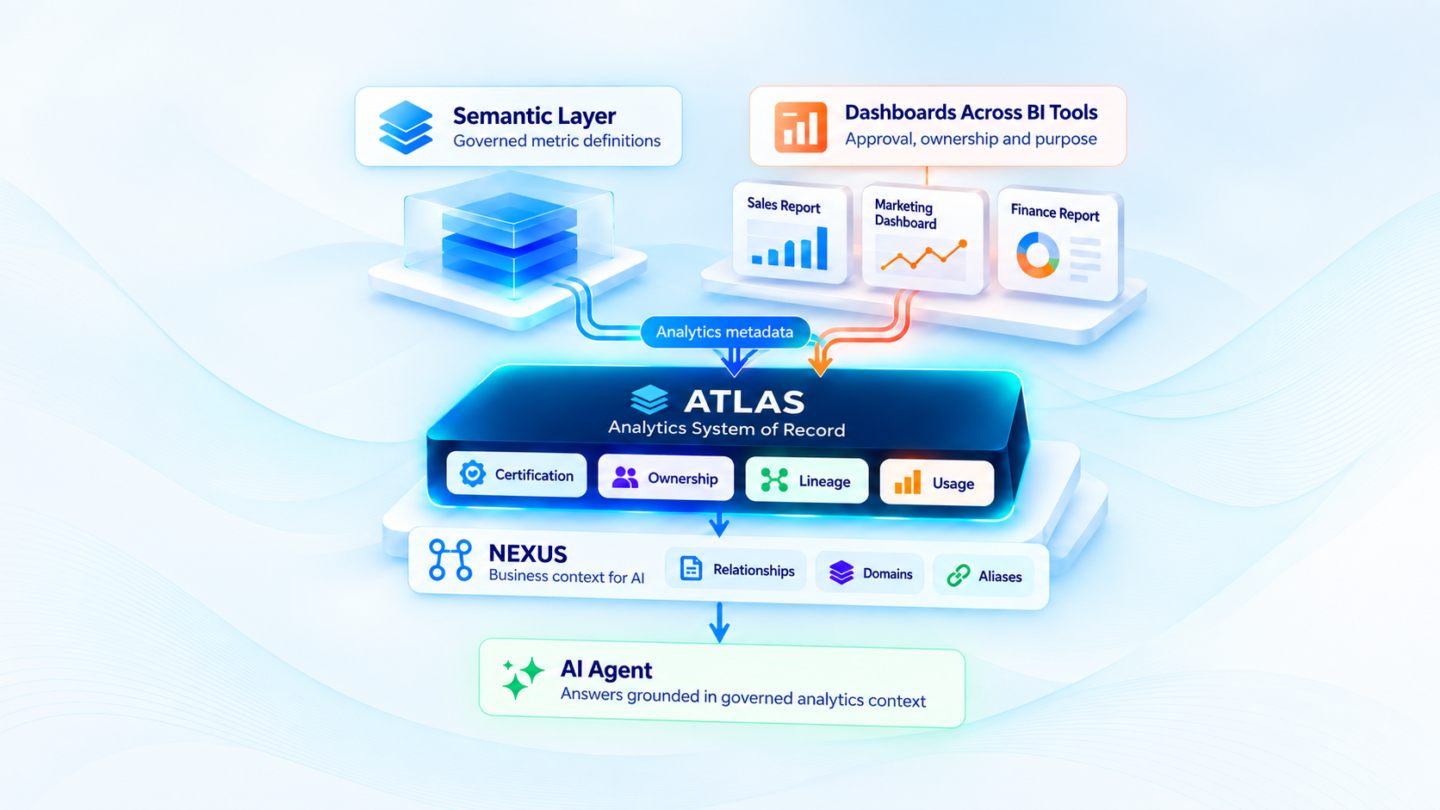
This also creates the governed foundation required for AI. Atlas establishes certification, ownership, lineage, and accountability across the analytics estate. Nexus transforms that governed analytics metadata into business context that AI assistants, copilots, and agents can interpret consistently.
Atlas establishes what the business trusts. Nexus helps AI understand what that trusted information means.
2. Clear Ownership and Accountability
A complete inventory allows governance teams to see which analytics assets have accountable owners and which do not.
This is particularly important in environments affected by employee turnover, organizational restructuring, acquisitions, and long-running migration programs. Reports frequently remain active after their original creators change roles or leave the organization.
A centralized ownership record helps teams identify these gaps and manage accountability consistently. It also makes ownership part of the asset lifecycle rather than information trapped inside separate administration interfaces.
When a metric is challenged, the organization can identify who owns its definition, who approved it, and which reports depend on it.
3. Lifecycle Management and Cleanup
Analytics estates grow easily but rarely shrink naturally.
New dashboards are created while older versions remain available. Business units recreate similar reports in different tools. Temporary analysis becomes permanent content. Assets remain accessible even after their owners and original purposes are no longer clear.
A cross-tool inventory makes it possible to identify:
- Duplicate and near-duplicate reports across platforms
- Assets without active owners
- Dashboards that have not been used within a defined period
- Metrics with inconsistent definitions
- Reports that should be reviewed, archived, or retired
- Dependencies that must be understood before an asset is changed
This allows lifecycle management to move from periodic cleanup exercises to an ongoing governance discipline.
4. Better Access and Compliance Visibility
Every BI platform remains responsible for enforcing its own permissions and security controls. A cross-tool inventory does not need to replace those systems of enforcement.
Its value is providing a consolidated view of the analytics assets, source-system permissions, ownership, and governance metadata available across the connected estate.
This visibility helps governance and security teams identify inconsistencies, investigate potential exposure, and coordinate remediation across platforms. It also reduces the need to assemble the same information manually whenever a compliance, audit, or access question arises.
The existing BI platforms continue enforcing access. The governance layer provides the estate-wide visibility needed to understand and manage it more effectively.
How Atlas Creates a Governed Cross-Tool Inventory
Atlas is the ZenOptics Analytics System of Record.
Through Smart Connectors, Atlas integrates with existing platforms such as Power BI, Tableau, SAP BusinessObjects, Qlik, Looker, and others. It reads the reports, dashboards, datasets, KPIs, ownership information, lineage, and usage metadata made available through each platform supported APIs.
Atlas brings this information into a unified analytics inventory that can be searched, governed, and maintained across the enterprise.
When new content becomes available through a connected platform, Atlas incorporates it into the inventory. When ownership, certification, usage, or lifecycle information changes, the governance record can be updated accordingly.
This gives organizations a maintained view of their analytics environment instead of a static snapshot that becomes obsolete shortly after it is created.
Atlas supports governance capabilities including:
- Cross-platform analytics discovery
- Certification and approval workflows
- Ownership and accountability
- Lineage and dependency visibility
- Usage-based lifecycle management
- Change governance
- Collaboration around analytics assets
- Trusted foundations for AI context
Most importantly, Atlas does not require an organization to migrate all its analytics into one platform.
Power BI remains Power BI. Tableau remains Tableau. SAP BusinessObjects, Qlik, Looker, and other tools continue operating in their existing roles.
Atlas sits above these environments as the Analytics System of Record, creating a governance and control layer across the tools the organization already uses.
From Inventory to AI-Ready Decision Intelligence
A cross-tool inventory is the foundation, but it is not the end of the journey.
Atlas establishes what analytics assets exist and which ones the business trusts. Nexus converts certified KPIs, metric definitions, ownership, lineage, and business relationships into governed context that AI systems can understand.
Maestro then connects trusted analytics and business context to governed workflows, approvals, actions, and decision provenance.
Together, these capabilities support a progression from fragmented BI environments to AI-ready decision intelligence:
- Atlas: Know what exists and what can be trusted.
- Nexus: Help people and AI understand what it means.
- Maestro: Govern how trusted insights are used to make and execute decisions.
Without Atlas, there is no complete record of the analytics estate.
Without Nexus, AI lacks consistent business context.
Without Maestro, decisions and actions lack the necessary governance, accountability, and traceability.
The cross-tool inventory is therefore more than an asset list. It is the foundation on which enterprise analytics governance, trusted AI, and governed decision-making are built.
Frequently Asked Questions
What is a cross-tool BI inventory?
A cross-tool BI inventory is a unified, maintained map of reports, dashboards, datasets, KPIs, and metrics across an organization connected BI platforms. It includes the ownership, certification, lineage, usage, and lifecycle metadata made available by those platforms.
How is a cross-tool inventory different from single-tool governance?
Single-tool governance manages analytics within one BI platform. A cross-tool inventory provides visibility across multiple platforms and creates a unified governance record for the full analytics estate.
It complements the governance functionality within Power BI, Tableau, SAP BusinessObjects, Qlik, Looker, and other systems rather than replacing it.
Does Atlas replace existing BI platforms?
No. Atlas connects to the tools an organization already uses and creates a governed Analytics System of Record above them. Reports and dashboards remain within their existing source platforms.
Does building a cross-tool inventory require migrating reports?
No. Atlas reads supported metadata from connected BI platforms through Smart Connectors. Organizations can build a unified inventory without moving reports or standardizing the entire business on one BI tool.
How does a cross-tool inventory support AI?
A cross-tool inventory helps establish which analytics assets, KPIs, and definitions are trusted. Atlas provides this governed foundation, while Nexus transforms the associated metadata and relationships into business context that AI systems can interpret consistently.
Does Atlas replace source-system security?
No. Connected BI platforms continue enforcing their own permissions and access controls. Atlas provides unified visibility into analytics assets and available governance metadata across the estate, helping teams identify inconsistencies and coordinate governance more effectively.
Published August 7, 2026Do You Know What Exists Across Your Analytics Estate?
Enterprise BI governance cannot operate effectively without a complete view of the reports, dashboards, KPIs, metrics, owners, and dependencies spread across the organization. Atlas connects to your existing BI platforms through Smart Connectors and creates a governed cross-tool inventory, without replacing your current tools or requiring report migration. Discover whether your analytics estate has the inventory, ownership, certification, and lifecycle controls required for trusted analytics and AI-ready decision-making. Request an Analytics Estate Assessment