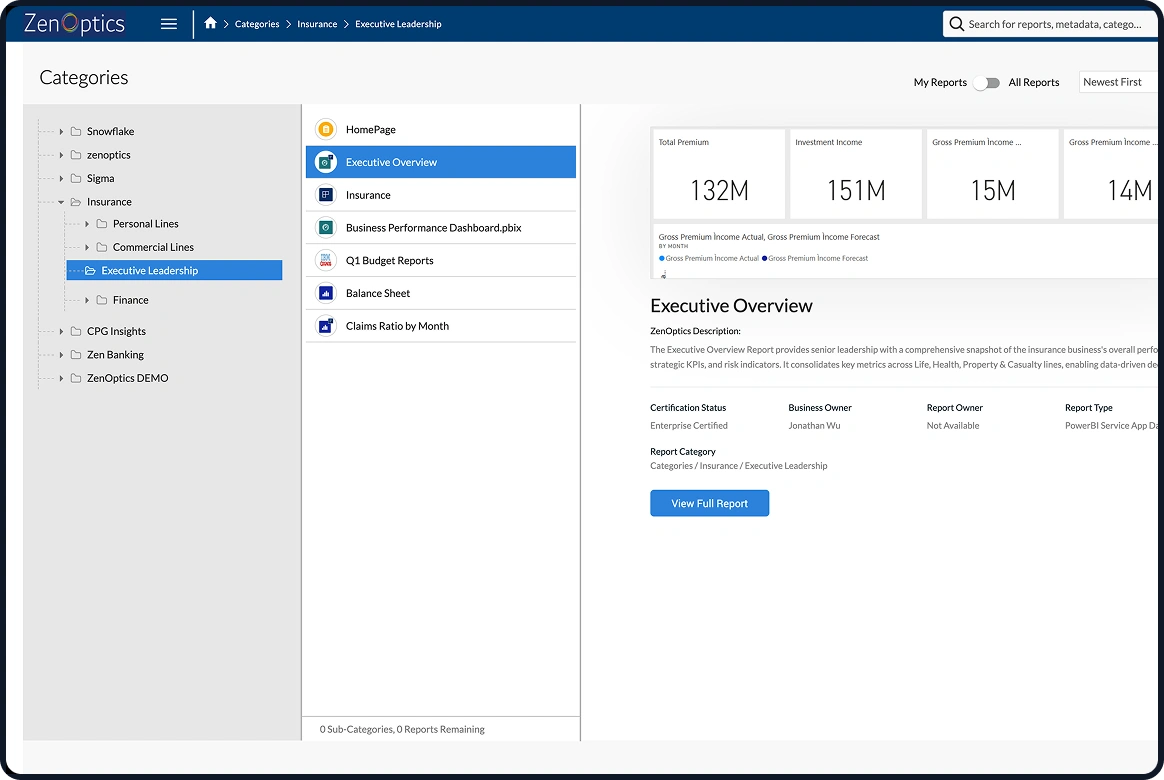


Many enterprises have improved report search within individual BI platforms and, in some cases, across multiple analytics environments. Discovery capabilities can help enterprises surface report inventories, index metadata and make analytics content easier to find. However, achieving consistent discovery across Power BI, Tableau, SAP BusinessObjects, Qlik and other environments remains difficult when metadata and governance are fragmented.
Finding a report tells an analyst that it exists. It does not tell them whether it is certified, who is responsible for its accuracy, whether the version they found is the authoritative one among three near-identical copies, whether the data lineage is current, or whether the report is a candidate for retirement that the governance team has not yet acted on. Discovery surfaces the inventory. Governance determines what to do with it.
What Report Discovery Does and Where It Stops
Report discovery tools solve the inventory problem. They index reports, dashboards, and KPIs across platforms and return search results against natural language or keyword queries. When an analyst needs a sales report, a well-implemented discovery layer can surface relevant content from Power BI, Tableau, and SAP BusinessObjects without requiring the analyst to know which platform contains the answer.
Good discovery tools surface more than names and locations. They capture usage signals: how often a report is accessed, when it was last viewed, and how many users interact with it. This is meaningful context. A report that nobody has opened in two years tells a different story than one accessed by forty people every Monday morning.
But usage signals are not the same as governance context. Basic discovery capabilities may show that a report exists and how frequently it is used, but they do not always provide consistent evidence that the report has been validated, that its metric definitions align with authoritative business definitions, or that its ownership and lineage remain current.
The question discovery answers is whether a report exists for a given business question. The questions it does not always answer are: Is this the right version? Is it certified? Who is responsible if the numbers are wrong?
The Three Gaps Discovery Leaves Open
In practice, three governance gaps consistently appear in organizations that have implemented analytics discovery without a governance layer above it.
The first is the certification gap. Discovery surfaces reports; it cannot identify which have been validated as authoritative by a governance authority. Without certification status visible in search results, analysts face a decision every time they find a report: invest time verifying whether the content is accurate, or use it without verification and accept the risk that the numbers are wrong. Many organizations find that their analysts default to a third path, building a new report from a known, trusted data source rather than using what the catalog surfaced. The catalog reduced search time. It did not reduce the recreation rate, because the underlying trust problem was never addressed.
The second is the ownership gap. Every report in a discovery index has a creator. That creator may have left the organization six months ago. Discovery tools surface creation metadata, not current governance accountability. When an analyst finds a report and has a question about whether the underlying data source has changed, there may be no one to contact. The owner is gone and no succession was recorded anywhere the discovery tool can surface. Accountability requires a clearly designated current owner and a governance process that keeps ownership records updated as roles and teams change.
The third is the lifecycle gap. Discovery is a point-in-time search against the current inventory. Discovery alone may not provide the workflows and governance signals needed to identify retirement candidates, track active reviews or show when an asset has been superseded by a newer certified version. The inventory grows because reports are easy to create. The governance layer that manages the inventory's lifecycle does not exist inside the discovery tool. Content accumulates, and analysts searching for a report encounter an expanding result set without any signal about which assets are current and which belong to the past.
What Governed Discovery Requires
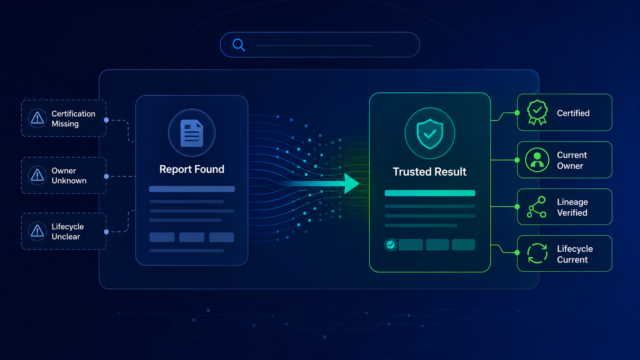
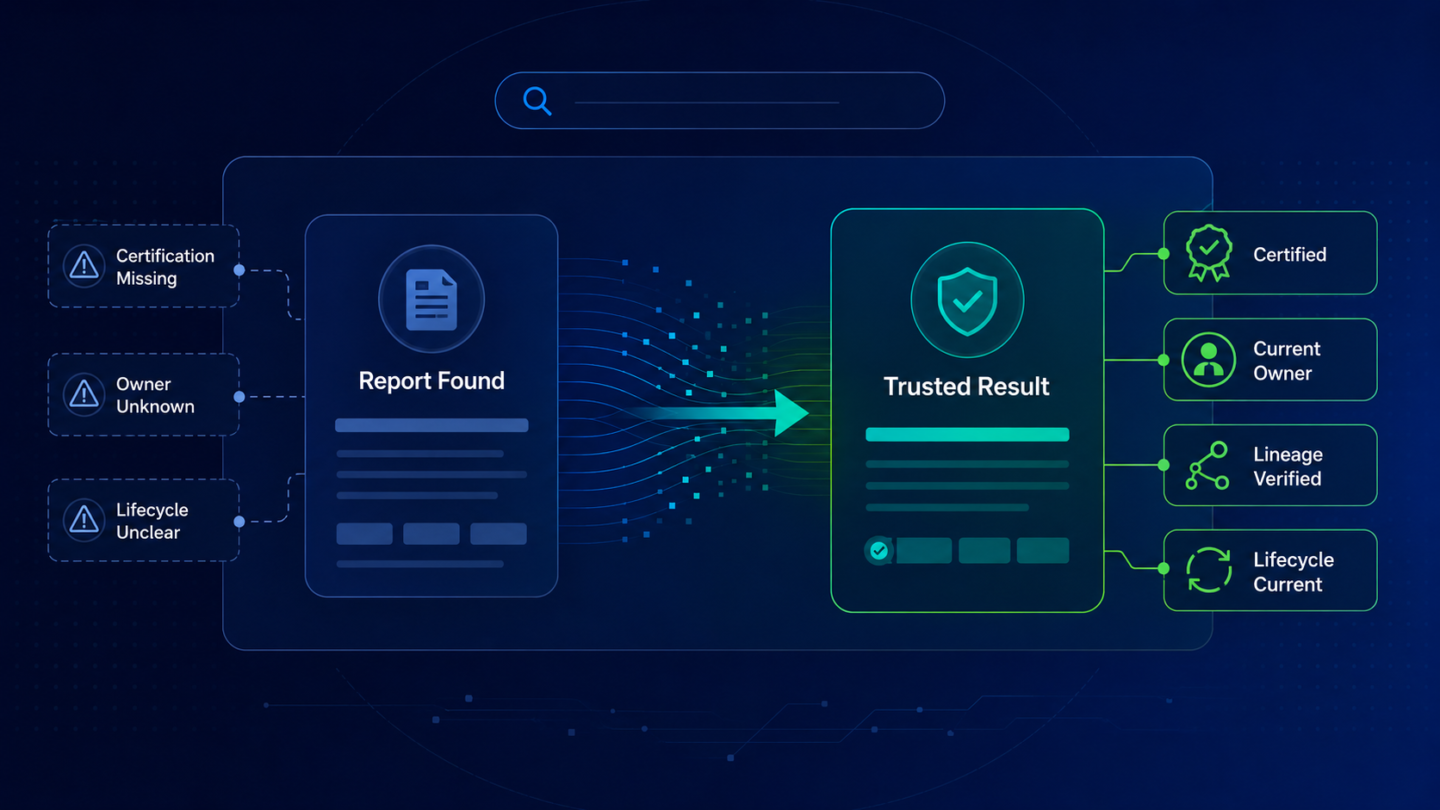
Governed discovery is discovery with governance context provided alongside the search result. When an analyst searches for a revenue dashboard, governed discovery surfaces the report's inventory entry and its governance status together.
That means certification status: whether a governance authority has validated this report as authoritative, and when that validation last occurred. It means ownership: who is currently accountable for the report's accuracy and when they last reviewed it. It means usage context: how many people in which teams are actively relying on this report, and what that usage pattern suggests about operational dependency. It means lineage: whether the report connects to certified data sources or whether there are breaks in the chain between the report and the underlying data it claims to represent. And it means lifecycle status: whether this report is current, under governance review, or a retirement candidate that the organization has not yet formalized a decision on.
These attributes cannot create trust merely by appearing as metadata fields. Their value depends on the governance processes behind them: certification workflows, ownership assignment, lineage management, periodic review and retirement decisions. Discovery tools show what exists. Governance processes are what make those results trustworthy.
How an Analytics System of Record Provides the Governance Layer
Atlas, the ZenOptics Analytics System of Record, creates a governed, cross-tool inventory across connected BI and analytics environments. It brings together discovery, certification, ownership, usage intelligence, lineage context and lifecycle governance so users can understand not only what exists, but what can be trusted and acted upon.
Where basic discovery primarily indexes what exists, Atlas maintains a governed record of each analytics asset, including its certification, ownership, usage, lineage and lifecycle status. Analysts searching for a report in Atlas see which versions are certified, who currently owns each, what the usage pattern looks like, and whether the lifecycle status is current or under review.
Atlas does not replace the organization's decision-making process. It provides the visibility and governance workflows needed to make that process informed, accountable, and repeatable.
The cross-tool BI inventory Atlas maintains addresses the recreation problem at the point it begins. When an analyst looks for an existing certified report before building something new, governed discovery surfaces authoritative content across all connected platforms, with certification and ownership information visible. Analysts build new reports when there is a genuine gap, not because they could not trust what the search returned.
The cost of ungoverned analytics sprawl accumulates across Power BI, Tableau, SAP BusinessObjects, Qlik, and any other platform in the estate. The cost of BI tool sprawl runs in parallel when duplicate and stale content crosses platform boundaries without a governance layer above them. Atlas connects to existing BI and analytics environments through 100+ Smart Connectors, maintaining the cross-platform inventory without requiring consolidation of tooling.
Governed discovery does not replace the organization's analytics experience. It provides the governance context that makes search results actionable, so that finding a report is the point at which a trust decision can actually be made.
Frequently Asked Questions
What is the difference between report discovery and analytics governance?
Report discovery answers whether a report exists and where to find it. Analytics governance determines whether that report is certified, who is accountable for it, whether it should continue to exist, and what lifecycle decisions have been recorded about it. Discovery and governance are complementary. Discovery without governance context returns a list of results. Governed discovery returns results with the information needed to act on them.
Why do analysts keep building new reports even when a discovery tool is in place?
The most common cause is the certification gap. When a discovery tool returns results without certification status, analysts have no reliable way to determine whether the reports they found are authoritative. Rather than verify each result manually, many default to building from a known trusted source. Governed discovery addresses this by surfacing certification status in search results, which gives analysts a basis for trusting what the catalog returns.
Can a data catalog provide the governance context that discovery tools lack?
Data catalogs are generally designed around data assets such as tables, schemas, pipelines and datasets. Some also index BI content, but organizations may still need analytics-specific governance capabilities that work consistently across reports and dashboards, including certification, accountable ownership, usage analysis and lifecycle workflows. An Analytics System of Record is designed for the analytics estate and the governance layer it requires.
What does governed discovery look like in practice?
In a governed discovery environment, an analyst searching for a revenue report sees results that include certification status, current owner, last governance review date, usage count and pattern, lineage status, and lifecycle disposition. The analyst can identify which result is the certified authoritative version, who to contact with questions, and whether any results are retirement candidates. The search result is actionable rather than a starting point for a separate verification process.
How does Atlas support governed discovery across BI platforms?
Atlas connects to Power BI, Tableau, SAP BusinessObjects, Qlik, and other platforms through 100+ Smart Connectors and maintains a governed cross-platform inventory with certification, ownership, lineage, and usage context for each asset. Analysts searching across the estate see governance context alongside inventory results. The governed record also helps prevent duplicate report recreation by making existing certified content visible and trustworthy at the point of search.
Published August 17, 2026Move from Report Discovery to Governed Analytics
Finding analytics content is only useful when people can determine whether it is current, authoritative and appropriate for their decision. Atlas connects cross-tool discovery with certification, ownership, usage intelligence, lineage context and lifecycle governance, helping organizations turn fragmented BI inventories into a trusted analytics estate. See Governed Analytics Discovery in Atlas