


When enterprise AI returns an analytics answer that no one can reconcile, the instinctive diagnosis is often a model failure. But trace the answer back through the analytics estate and a different pattern often appears: conflicting metric definitions, stale certifications, uncertified assets, or broken lineage. These failures may look like AI hallucinations at the interface, but the root cause sits in analytics governance. The more useful diagnostic question is: which governance failure produced the answer?
Four distinct analytics governance failures produce AI trust problems in enterprise environments. Each has a different mechanism, a recognizable pattern in AI outputs, and a specific governance intervention that resolves it. A certification program does not fix a lineage break. A governed catalog does not resolve a metric authority gap. Investing in the right governance capability requires diagnosing the right failure, and that diagnosis is not possible when all four failure types are grouped under "AI hallucination" or treated as a single undifferentiated governance problem.
Why the Hallucination Label Delays the Right Governance Investment
The hallucination label accurately describes one class of model behavior: a language model generating plausible content with no grounding in the source data it was given. In generative language tasks such as content summarization and research synthesis, this is a real failure mode that warrants model-level attention.
In enterprise analytics AI, however, the hallucination label does not always describe the underlying failure accurately. What enterprise analytics AI does when it returns a wrong answer is often different: it reads from an analytics estate and returns what the governance conditions in that estate allow. In many enterprise analytics use cases, the model may not be fabricating the answer at all. It may be reasoning over contradictions, conflicting definitions, stale assets, or incomplete governance signals already present in the analytics estate. What appears to be a hallucination at the interface may therefore originate in the environment the AI was asked to trust. Applying the hallucination label to this class of failure leads organizations toward model-level remediation that cannot touch the source condition. Prompt engineering improvements, model version upgrades, and retrieval-tuning efforts address model behavior in a well-governed environment. They do not address the estate condition that produced the wrong answer.
What changes when the governance failure is named correctly is that the fix becomes visible, ownable, and executable by the analytics organization. The case that enterprise analytics failures are governance problems rather than model failures covers how to make that initial diagnosis. The distinction matters because identifying governance as the root cause is only the first step. The next step is determining which governance failure is present. Different failure types create different patterns in AI outputs and require different governance interventions.
Four Analytics Governance Failures That Produce AI Trust Problems
| What you see in the AI answer | Likely failure | Governance response |
| Different teams recognize different versions of the answer | Metric Authority Gap | Certification + authority |
| Answer reflects an old business definition | Stale Certification | Ownership + review cycle |
| Answer traces to an abandoned or uncertified report | Uncertified Source Contamination | Catalog + lifecycle governance |
| Metric logic looks correct but underlying data is wrong | Lineage Break | Lineage + dependency governance |
Metric Authority Gap
A metric authority gap exists when no certified authoritative version of a metric has been designated for a specific reporting context. Multiple definitions of the same metric coexist in the analytics estate, each built by a different team and each reflecting a different interpretation of the business standard. None has been designated as the version the organization treats as final for a given purpose.
When AI agents query the estate for a metric with an authority gap, they encounter multiple definitions carrying equal status. Without governance signals identifying which definition is authoritative for a specific reporting context, the agent may select, combine, or reason across competing definitions without knowing which one the organization considers authoritative. The output reflects the estate's distribution of variants rather than the organization's correct business logic. The observable symptom is that every team partially recognizes the AI's answer: the commercial team sees a reflection of their definition, finance sees a reflection of theirs, and neither can fully reconcile the output with either version.
Prompt engineering addresses individual sessions by encoding one definition into the instruction context. It does not remove the other definitions from the estate. Each new session, the same definition variants enter the agent's context, and the authority gap produces the same class of output. What resolves the authority gap is certification: a designated authority confirming which version of a metric governs which reporting context, with a record of who confirmed it and when. Certified metrics and what certification requires is the governance foundation this failure type demands.
Stale Certification
A stale certification failure occurs when a metric was certified as authoritative at a point in time and the underlying business logic has since changed. Revenue recognition policy was revised. A customer segment definition was reorganized. A product line was reclassified. The certification record still shows the metric as authoritative. The AI reads that record and grounds its output on a definition that was correct when it was certified but no longer reflects the current business standard.
The observable symptom of stale certification is that the AI's answer corresponds to what was accurate 12 to 24 months ago. Finance or operations recognizes the calculation logic as a prior policy rather than the current one. If certification status is exposed without review dates, ownership, lifecycle state, or other freshness signals, an AI system may have no reliable way to distinguish a metric reviewed last month from one certified under a business standard that has since changed.
What resolves stale certification is not a better model but a review cycle: an organizational process that schedules certification review at defined intervals, flags the certification when the underlying standard changes, and suspends it when the definition is under active review. Current owner tracking ensures there is an accountable person to initiate or respond to that review. Without both, a certification that was meaningful at initial review becomes a governance liability as time passes. Both the review cycle and ownership tracking are components of the metric lifecycle governance covered in the certified metrics framework.
Uncertified Source Contamination
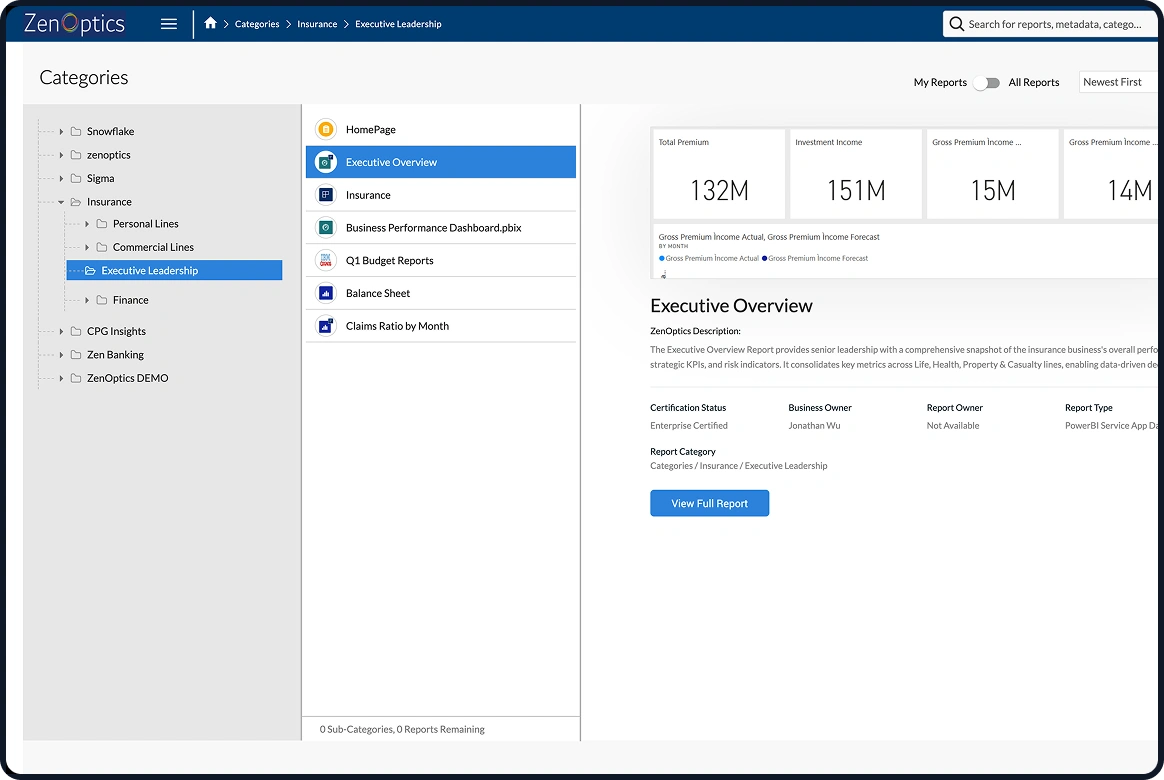
Uncertified source contamination occurs when an ungoverned analytics catalog presents certified authoritative assets and uncertified shadow assets with equal status. AI agents traversing an estate where all reports and dashboards appear equivalent have little basis for excluding legacy dashboards, regional workarounds, or retired reports from their reasoning paths. Organizations implementing ZenOptics typically find that 30 to 40 percent of their analytics estate consists of duplicate or conflicting reports. These assets can create additional risk for AI when ownership, certification status, and lifecycle context are unclear or unavailable.
The observable symptom of this failure type is that the AI's answer traces to a specific report or asset that no current team owns or recognizes as authoritative. Often the source is a report that was never formally retired: still technically present, still indexed, still readable, but reflecting a definition or data pipeline that has not been maintained.
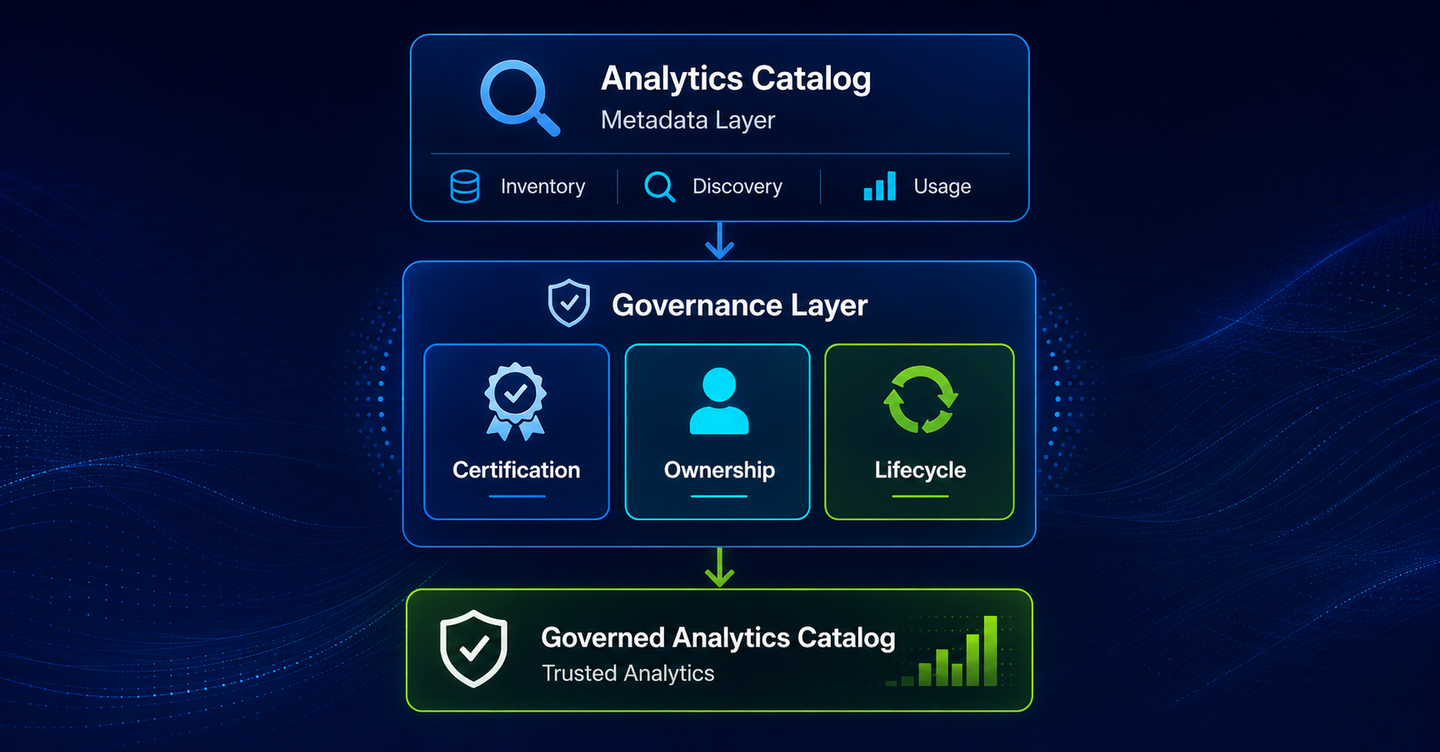
This failure type is what governed analytics catalogs address when they go beyond metadata. Certification status, current ownership, and lifecycle governance surfaced as context give AI agents the signals needed to weight certified authoritative sources above uncertified ones. Without a governance layer above the catalog inventory, source quality is invisible to the model.
Lineage Break
A lineage break occurs when a metric definition references a data source that has changed since the definition was written: a schema migration, a pipeline restructuring, a source system deprecation. The metric calculation logic is internally consistent. The data it reads is no longer what the definition assumed. The result is an answer that is structurally sound but grounded in the wrong underlying data.
The observable symptom of a lineage break differs from the three failure types above. The AI's answer is internally consistent and confident, but contradicts other governed sources in ways that do not map to the definition variant pattern. The inconsistency traces below the metric layer to the data pipeline beneath it. The analytics knowledge graph is the structure that encodes relationships between metrics and their underlying data sources, making lineage breaks visible before they propagate into AI reasoning paths.
Why Each Failure Requires a Different Governance Response
The four failure types share one characteristic: model improvements or prompt engineering alone cannot resolve them. Each originates in a condition within the analytics estate that must be addressed at the governance layer. Better models may improve reasoning, but they cannot independently establish which metric is authoritative, whether a certification is current, which asset should be trusted, or whether an underlying dependency has changed.
The governance interventions differ by type. Metric authority gaps require certification with designated authority: a process that confirms which version of a metric governs which context and records that designation so AI agents can follow it. Stale certification requires ownership tracking and a review cadence: organizational accountability that keeps certification current as business logic changes. Uncertified source contamination requires a governed catalog with certification status, current ownership, and lifecycle records surfaced above the inventory layer. Lineage breaks require lineage tracking: a maintained record of which data sources each certified metric depends on, and a governance process that flags or suspends certification when those dependencies change.
Data governance and analytics governance are related but distinct programs. The four failure types above are analytics governance failures: they live at the metric, report, and estate layer, above the data layer where data governance operates. Analytics context engineering is the organizational practice that builds and maintains the governance processes producing certified, current, and accountable analytics assets. Each of the four failure types has a defined intervention within that practice.
How Atlas and Nexus Address Each Failure Type
Atlas, the ZenOptics Analytics System of Record, provides a governance foundation for addressing these failure types across the analytics estate. Atlas brings analytics assets across tools into a governed inventory and supports certification and approval workflows, ownership and accountability, lifecycle governance, and lineage and dependency visibility. This gives organizations a consistent way to distinguish authoritative analytics from conflicting, outdated, or uncertified assets before those assets become inputs to AI.
Nexus, the ZenOptics Analytics Context Layer for AI, converts certified KPIs, metric definitions, ownership, lineage, and business relationships into governed context that AI systems can understand. Instead of exposing AI to metric definitions in isolation, Nexus helps provide the business and governance context surrounding those metrics: what they mean, how they relate to other business concepts, who is accountable for them, and which analytics can be trusted. This gives AI systems stronger grounding for interpreting enterprise analytics consistently.
This shifts the enterprise AI problem from trying to make every model compensate for an ungoverned analytics estate to creating governed analytics context that AI systems can consume consistently. Atlas establishes what exists and what can be trusted; Nexus makes that governed business context understandable to AI. The failure classification in this post makes the path from AI trust problem to specific governance investment visible. Each type points to a different governance capability. Each is resolvable through governance rather than model replacement.
Reliable AI grounding is only part of the governance challenge. As AI-generated insights begin influencing workflows, recommendations, and actions, governance must extend from analytics context into decision execution. Maestro extends this foundation by helping organizations govern how trusted insights move into decisions and actions, connecting governed analytics, AI context, and decision intelligence.
Frequently Asked Questions
What is the difference between AI hallucination and an analytics governance failure?
AI hallucination refers to a model generating plausible content with no grounding in the source data it was given. An analytics governance failure occurs when the source data the model reads is ungoverned: conflicting metric definitions, uncertified assets, stale certification records, or broken lineage. In these cases, the apparent hallucination may originate not from fabrication by the model, but from the conflicting, stale, uncertified, or incomplete analytics context the model was given. The two failure types require different fixes. The diagnostic for which type applies is whether the AI's answer can be traced to a specific asset or definition in the analytics estate. If the answer can be traced to a conflicting, stale, uncertified, or incorrectly connected analytics asset, that is strong evidence that analytics governance contributed to the failure.
How do I know which of the four governance failures I have?
Each type has a recognizable symptom. A metric authority gap produces outputs where every team partially recognizes the answer but cannot fully reconcile it with their version of the metric. Stale certification produces answers that correspond to a prior business standard rather than the current one. Uncertified source contamination produces outputs traceable to reports or dashboards no current team owns or recognizes as authoritative. A lineage break produces outputs that are internally consistent but contradict other governed sources in ways that do not trace to a definition conflict. These patterns distinguish the failure types even before a full governance audit.
Can the same AI output result from more than one failure type?
Yes. In estates with significant governance gaps, multiple failure types can be present simultaneously. An AI agent may encounter a metric authority gap for one KPI and an uncertified source in the reasoning path for a related one, producing an output that reflects both conditions. Governance programs that address only one failure type while leaving others unresolved will see partial improvement. The four failure types are distinct but not mutually exclusive, and an estate-level governance program typically needs to address all of them as coverage expands.
Why doesn't prompt engineering fix these governance failures?
Prompt engineering addresses a specific session by encoding context into the instruction the model receives. It works for controlled use cases where the metric and source environment are known and bounded. It does not scale to enterprise analytics environments where hundreds of metrics across dozens of business units all need consistent, governed definitions. A prompt can instruct an AI system to use one definition of revenue within a controlled interaction, but it does not resolve the competing definitions that continue to exist across the analytics estate. New queries, different AI tools, and multi-metric reasoning tasks all encounter the ungoverned conditions that the prompt did not address. Governance builds the infrastructure that makes the estate reliable for every session rather than patching one session at a time.
What does Atlas do for each of the four failure types?
For metric authority gaps, Atlas supports certification and approval workflows that help establish authoritative analytics. For stale certification, ownership, accountability, and governance workflows help organizations maintain trusted assets as business definitions change. For uncertified source contamination, Atlas provides a governed cross-tool inventory that surfaces certification, ownership, usage, and lifecycle context. For lineage breaks, lineage and dependency visibility helps teams understand how analytics assets connect to underlying sources and where changes may affect trusted outputs.
Published August 28, 2026From AI Trust Problem to Specific Governance Investment
Understanding which governance failure is present changes what an analytics organization does next. Each of the four failure types points to a specific governance capability rather than a general "governance program." Atlas establishes the governance foundation across the analytics estate through certification, ownership, lifecycle governance, and lineage visibility. Nexus turns that governed analytics foundation into business context AI systems can understand. Together, they help organizations move from simply connecting AI to enterprise analytics toward grounding AI in analytics the business has actually governed and trusted. See how Atlas helps establish certified, owned, governed, and traceable analytics before they become context for enterprise AI.
Assess Whether Your Analytics Estate Is Ready for AI