

Enterprise AI teams exploring how to ground AI in organizational knowledge are increasingly evaluating GraphRAG alongside semantic layers, knowledge graphs, and analytics context architectures. The technique adds graph structure to retrieval-augmented generation by extracting entity-relationship maps from unstructured document corpora, enabling multi-hop reasoning across large knowledge bases. It addresses a real limitation of standard RAG and has earned attention from enterprise architecture teams. The architectural question is not whether GraphRAG can support analytics-related use cases, but whether retrieval over text-derived relationships can provide the governed business context enterprise analytics AI requires.
The distinction matters because it determines which infrastructure gap actually gets closed. An organization that applies GraphRAG to analytics-related content may improve discovery and cross-document reasoning while still leaving critical trust questions unresolved: Which metric is authoritative? Is the asset certified? Who owns it? Is it current? What are its upstream and downstream dependencies? Understanding what each approach does, and what each was designed to solve, is what allows enterprise analytics teams to make the right architecture choice.
What GraphRAG Is and What It Was Built to Do
GraphRAG, introduced by Microsoft Research and supported through a growing ecosystem of graph and AI frameworks, extends retrieval-augmented generation by organizing text-derived entities and relationships into a graph that can support broader, multi-step reasoning across a corpus.
Standard RAG retrieves text chunks most similar to a query and passes them to a language model. For questions that require connecting ideas across many documents, standard RAG often misses the connections between relevant pieces. GraphRAG addresses this by first extracting entity-relationship maps from the document corpus, then using that graph structure to surface both individual documents and the relationships between them.
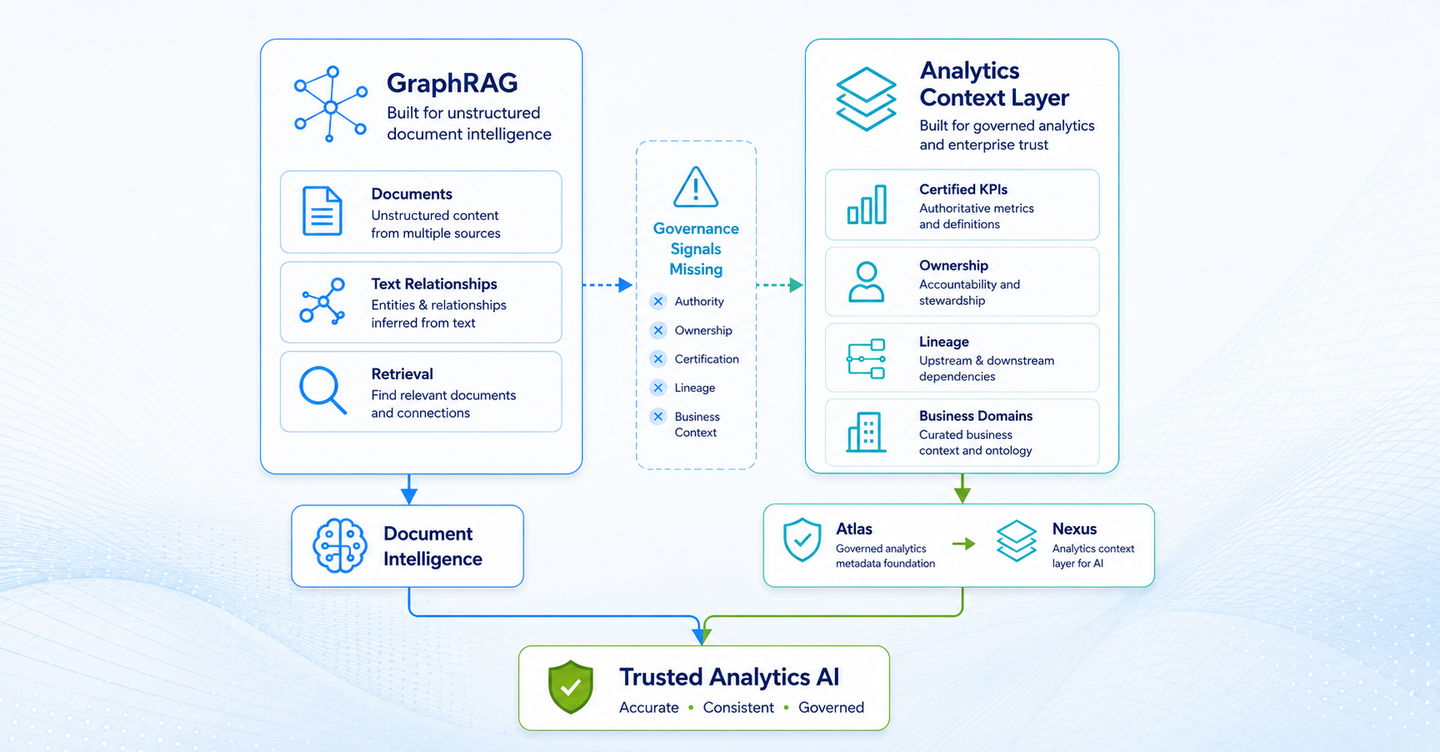
GraphRAG is primarily designed to improve reasoning across text-rich datasets, including enterprise knowledge bases, research archives, contract libraries, internal communications, and other document collections. The source of truth is whatever documents are in the corpus. GraphRAG can extract relationships from those documents, but it reads what it is given. If the corpus contains accurate information alongside misleading information, GraphRAG surfaces relationships between both. GraphRAG does not, by itself, establish enterprise-specific governance authority. Signals such as certification, ownership, approval status, and lifecycle state must be introduced through the underlying sources, metadata, or an integrated governance framework. That distinction must come from the documents themselves or from a separate governance layer applied to the source material.
This is a description of what GraphRAG was designed to do, not a critique of it. For unstructured document intelligence, GraphRAG is a meaningful advance over standard RAG. The problem arises when it is evaluated as a solution for a different problem: enterprise analytics AI.
What the Analytics Context Layer Is and What It Was Built to Do
The analytics context layer is not a retrieval technique. It is governed BI metadata infrastructure: a layer that sits on top of the certified analytics estate and makes structured enterprise analytics understandable to AI.
Where GraphRAG operates on unstructured documents, an analytics context layer operates on structured BI metadata: certified KPIs, metric definitions, dimensional hierarchies, ownership records, certification status, lineage dependencies, and business domain mappings. Its foundation is the governed metadata of the analytics estate: the inventory, definitions, ownership, certification status, lineage, usage, and business relationships associated with enterprise analytics assets.
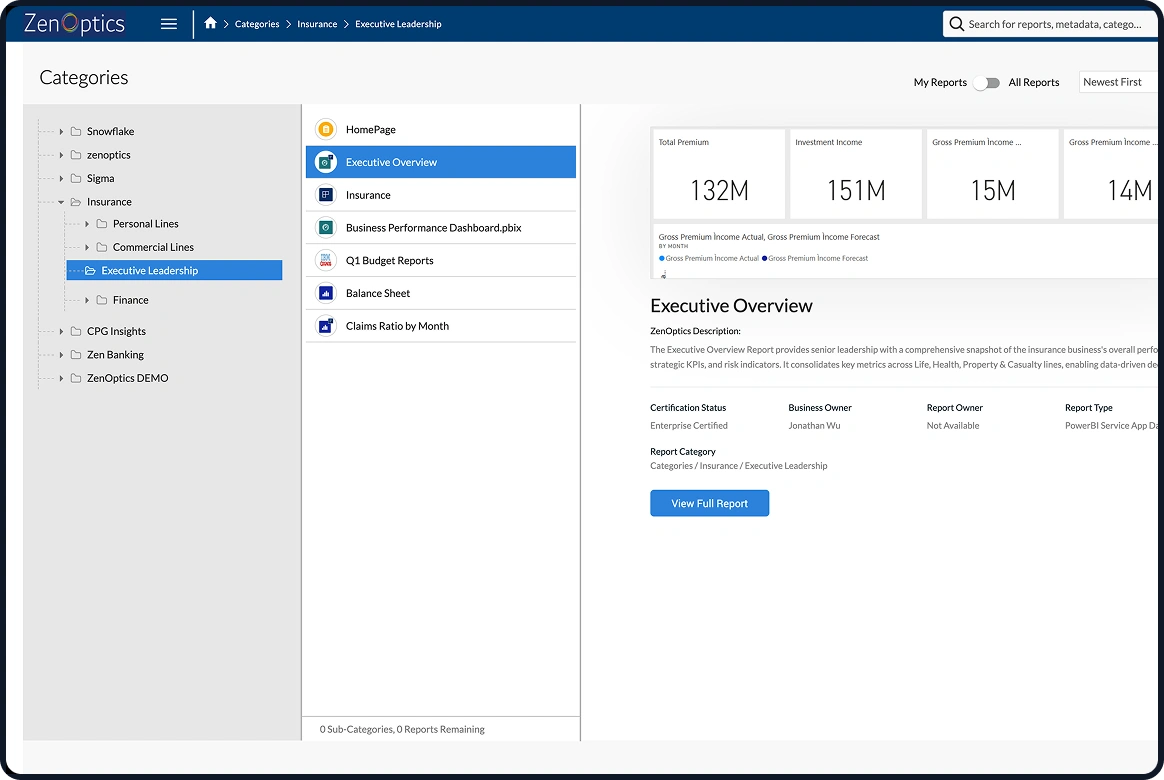
Nexus, ZenOptics's analytics context layer, is organized around three capabilities. Metadata and Domain Onboarding consumes governed analytics metadata from Atlas, which connects to BI and data platforms across the enterprise, while also identifying gaps such as missing descriptions, incomplete ownership, and uncertified assets. The Semantic Curation Studio resolves naming conflicts, manages business aliases, and maintains a curation health index across the estate. The Knowledge Graph maps analytics assets, KPIs, metrics, dimensions, and dependencies to business domains and ontologies. This enables AI systems to interpret analytics using curated business definitions and relationships rather than relying only on associations inferred from text.
Nexus addresses a foundational challenge in enterprise AI: enabling copilots, conversational interfaces, and intelligent agents to understand how the organization defines metrics, connects KPIs, structures business domains, and determines which analytics can be trusted. That distinction is not in the documents. It is in the governance records of the analytics estate. An analytics context layer makes those governance records available to AI in a machine-readable form. The Nexus Knowledge Graph is built from governed analytics metadata sourced through Atlas and enriched through semantic curation, business-domain mapping, ontology development, and human verification. This is what separates it from a graph built by extracting entity co-occurrences from a document corpus. The analytics context layer also differs from the semantic layer in that it adds certification status, ownership, lineage, and business relationships on top of the translation layer a semantic layer provides.
Why Confusing the Two Leaves the Core Problem Unsolved
Consider applying GraphRAG to documents and descriptions associated with a typical enterprise analytics estate. Those sources may reference certified dashboards alongside regional workarounds, current KPI definitions alongside outdated versions, and authoritative reports alongside project-specific assets that were never formally retired. GraphRAG extracts entity-relationship maps from all of these and surfaces the relationships between them.
Unless governance signals are explicitly supplied, GraphRAG cannot reliably determine which relationships represent approved business logic and which reflect duplication, outdated definitions, or other analytics debt accumulated across the BI estate. The governance failures that produce enterprise analytics AI trust problems, including metric authority gaps, stale certifications, uncertified source contamination, and lineage breaks, are not retrieval problems. They are governance problems. Improving retrieval without strengthening the underlying governance can make unsupported or outdated answers easier to retrieve and harder for users to recognize as unreliable. Each of these four governance failures requires a specific governance intervention that retrieval alone cannot substitute for.
This is the same limitation RAG without a governance layer has already demonstrated in enterprise analytics deployments. GraphRAG extends RAG's capabilities for unstructured corpora but does not change this fundamental relationship between retrieval and governance. Governance signals must be present in the source material for any retrieval technique to surface them. If those signals are absent from the analytics estate, the retrieval technique reads whatever it finds. What metric certification requires describes the governance foundation that makes those signals reliable.
One further distinction is worth drawing precisely. Both GraphRAG and the Nexus Knowledge Graph use graph structures, and the terminology can create an impression of equivalence where none exists. GraphRAG uses language models and text-analysis techniques to identify entities, extract relationships, organize them into communities, and generate graph-based representations of a text corpus. The Nexus Knowledge Graph is built from governed analytics metadata in Atlas (including definitions, ownership, certification status, dimensions, lineage, and dependencies) and is enriched through semantic curation and business-domain ontology mapping. It encodes relationships the organization has explicitly established through governance, not relationships inferred from what documents happen to say.
What the Right Architecture Looks Like
The question is not whether GraphRAG or an analytics context layer is better. They are built for different kinds of knowledge and different categories of AI use case.
GraphRAG is appropriate where the intelligence is in unstructured text: enterprise knowledge bases, research archives, policy documents, and communications. An analytics context layer is designed for AI use cases that require governed understanding of enterprise analytics: metric definitions, business KPIs, dimensions, ownership, certification, lineage, dependencies, and the relationships that explain how the organization measures performance.
A mature enterprise AI architecture may include both. Document intelligence against internal knowledge sources is a different AI capability from governed analytics reasoning against the certified BI estate. The risk is not deploying GraphRAG. The risk is treating GraphRAG as the analytics context solution and discovering, when AI trust problems persist, that the governance layer was never built.
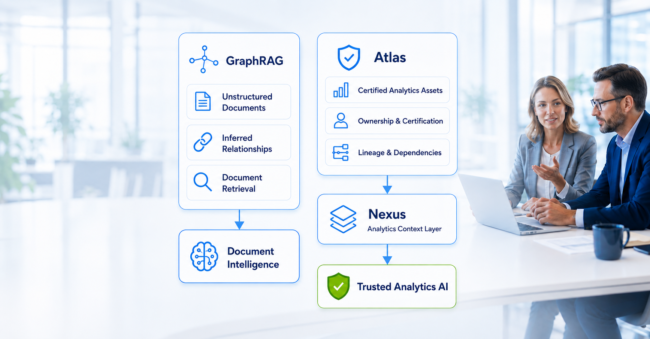
Atlas provides the foundation as the enterprise analytics system of record, cataloging analytics assets across tools and supporting discovery, certification, ownership, lifecycle governance, usage intelligence, lineage, and dependency visibility. Nexus builds on that foundation by transforming governed BI metadata into a living analytics context layer that gives AI systems the semantic clarity needed to interpret metrics, understand relationships, and align responses with the way the organization measures performance. Together, they address the governance gap that retrieval techniques (including GraphRAG) are not designed to fill.
Frequently Asked Questions
What is GraphRAG and how is it different from standard RAG?
GraphRAG is an extension of retrieval-augmented generation that adds graph structure to document retrieval. Standard RAG retrieves text chunks most similar to a query. GraphRAG first extracts entity-relationship maps from a document corpus, then uses that graph to enable multi-hop reasoning, surfacing both individual documents and the relationships between them. It was developed by Microsoft Research and is implemented across multiple frameworks. The primary use case is unstructured document intelligence: knowledge bases, research archives, contracts, and similar text-heavy corpora.
Can GraphRAG be used for enterprise analytics AI?
GraphRAG can be applied to an analytics estate, but doing so treats the enterprise analytics AI problem as an unstructured retrieval problem. It is also a semantic and governance problem that retrieval alone does not solve. An analytics estate contains certified and uncertified assets, current and stale definitions, authoritative and shadow reports. Without explicit governance metadata, GraphRAG may represent relationships across both authoritative and non-authoritative sources without knowing which definitions the organization has approved. The governance signals that make that distinction (certification status, ownership, lineage) must come from a separate governance layer that GraphRAG does not provide.
What is an analytics context layer and how does it differ from GraphRAG?
An analytics context layer is governed BI metadata infrastructure that makes structured enterprise analytics understandable to AI. It operates on certified BI metadata: KPIs, metric definitions, ownership records, certification status, and lineage dependencies, not on unstructured documents. Where GraphRAG extracts relationships from text, an analytics context layer encodes the governance relationships the organization has explicitly established through certification and ownership processes. Nexus, ZenOptics's analytics context layer, is built on top of the certified analytics estate that Atlas governs.
Are the Nexus Knowledge Graph and GraphRAG the same thing?
No. Both use graph structures, but they are built from different sources and serve different purposes. GraphRAG extracts entity-relationship graphs from unstructured document text through entity recognition and relationship inference. The Nexus Knowledge Graph is constructed from certified governance metadata in Atlas: ownership records, certification status, dimensional hierarchies, and lineage dependencies. It encodes relationships the organization has explicitly established, not relationships inferred from document content.
Does deploying GraphRAG remove the need for analytics governance?
No. The governance failures that produce enterprise analytics AI trust problems, including metric authority gaps, stale certifications, uncertified source contamination, and lineage breaks, are not retrieval problems. A better retrieval technique cannot establish which metric definition is authoritative, whether a certification is current, or whether a data source dependency has changed. These are governance conditions that must be addressed at the analytics estate layer. GraphRAG and an analytics context layer can coexist in an enterprise AI architecture, but GraphRAG does not substitute for the governance layer.
Published August 31, 2026From Document Retrieval to Governed Analytics
GraphRAG improves document intelligence. For enterprise analytics AI to produce trusted outputs, organizations need governed analytics context: the certification, ownership, lineage, and business relationships that tell AI systems what to trust and why. Atlas establishes the governed analytics system of record. Nexus transforms that foundation into a living analytics context layer, enabling AI systems to interpret enterprise metrics, relationships, and business logic with greater consistency and trust. See How Atlas and Nexus Prepare Enterprise Analytics for AI
Schedule a 15min demo call