

Six months after an analytics agent supplies a number for a board presentation, someone asks where it came from. The team finds the report in an execution trace. But the report has since changed, its owner has moved, and nobody can immediately establish whether it was certified when the answer was generated.
Identifying the source is the beginning of the investigation. Establishing its governance state at the time of use is what makes the evidence useful.
An AI agent analytics provenance audit connects an answer to the specific analytics assets it used, the definitions in force, and the governance evidence available when it used them. Agent traces and BI activity logs can contribute to that record. They do not automatically provide a complete one.
What Is Analytics Provenance for AI Agents?
Analytics provenance for AI agents is the record connecting an AI-generated answer to its analytics sources and the circumstances of their use. For a business metric, that includes the report or semantic model, the metric definition, relevant filters, the retrieval time, and the source’s approval status for the intended purpose.
Consider an agent answering, “What was net revenue last quarter?” Two reports may use different definitions: one subtracts returns; another also subtracts rebates. Knowing which report the agent reached helps explain the number. Knowing which definition finance approved helps establish whether it was appropriate for the question.
Certification is one part of that assessment. It does not, by itself, prove that a report is current, complete, or suitable for every decision.
What Agent Traces Record and What Still Needs to Be Added
Agent observability captures execution details. Depending on instrumentation, a trace may identify the agent, model, tool calls, and retrieved sources. Capturing a report’s precise identity and the content returned requires deliberate instrumentation; a source-system identifier alone may be insufficient.
The OpenTelemetry GenAI attribute registry illustrates the execution and source metadata available to instrumenters. Its documentation also points to the evolving GenAI conventions, so teams should check the version they implement.
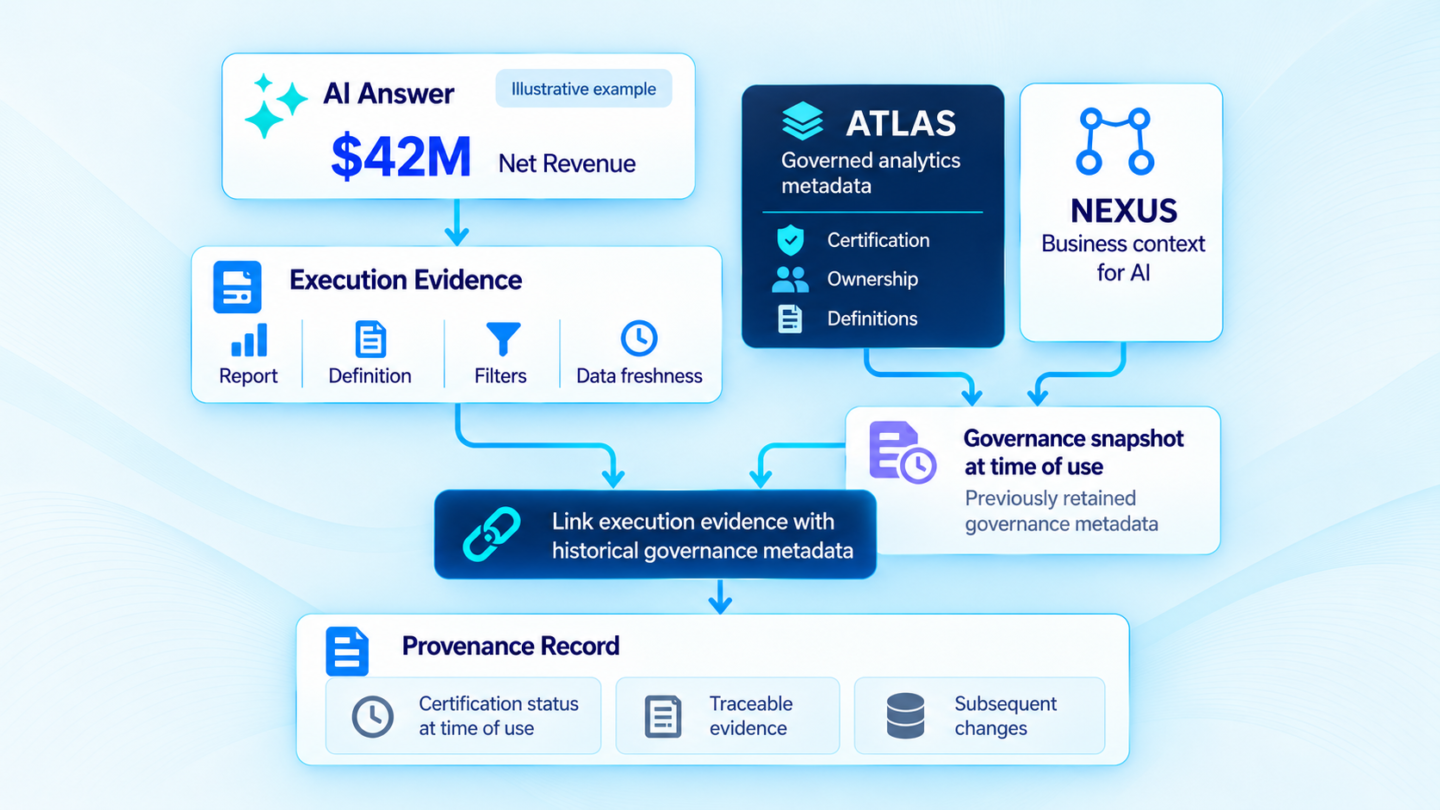
A trace containing a tool call or source identifier does not automatically establish the report’s certification status, accountable business owner, or approved use at that moment. Those facts must come from governance metadata and be linked to the execution record.
Observability systems can be extended to capture this information. The practical question is whether your deployment actually does so.
Why BI Audit Logs Need Governance Context
BI platforms contribute a second record: activity within the analytics environment. Microsoft’s Power BI and Fabric audited operation list includes report activity and separate operations for editing endorsement.
An access event and an endorsement-change event answer different questions. One establishes an activity; the other records a change. An operation list alone does not establish that every access event contains a complete snapshot of certification, ownership, and business approval.
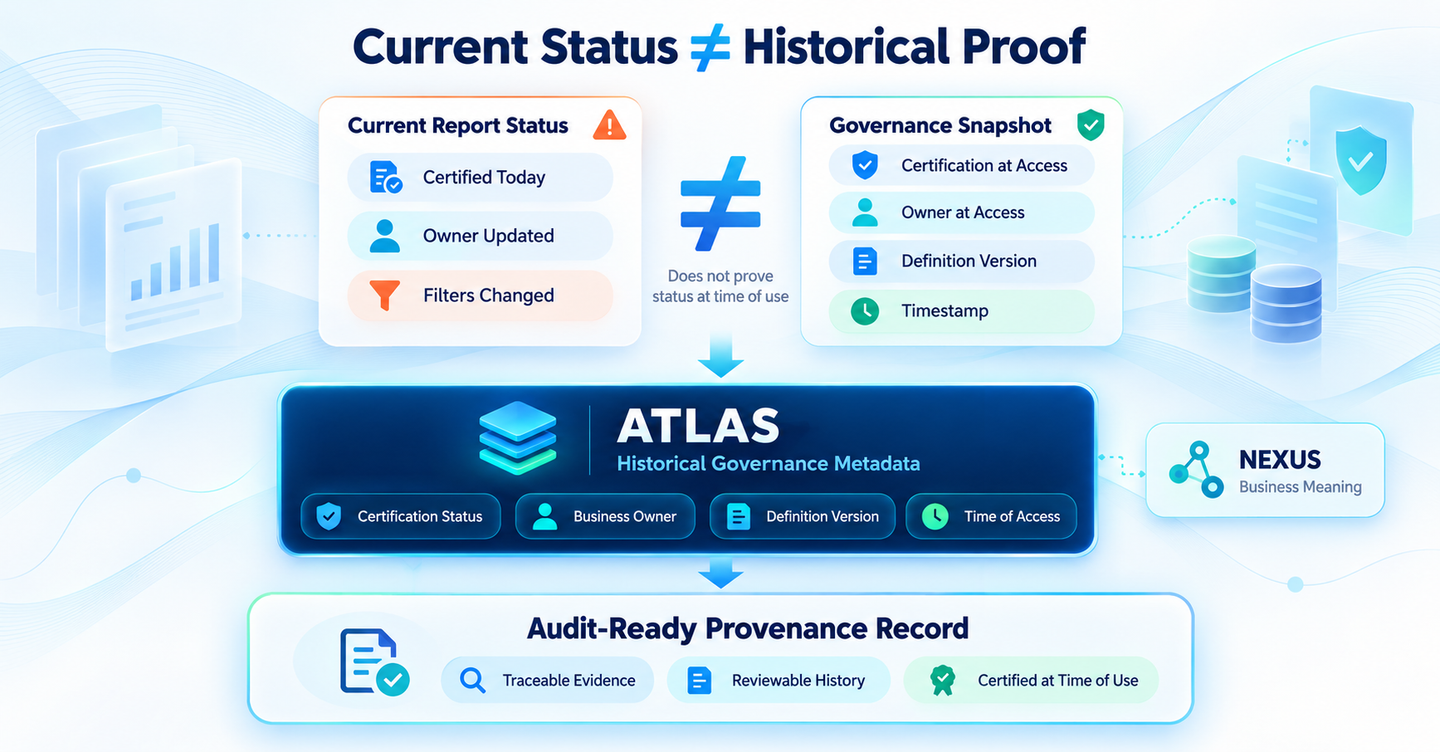
Teams should inspect their actual event payloads before deciding what is missing. Historical reconstruction may be possible when sufficient event details, a known starting state, and complete retained history are available. Without those, today’s certification status cannot establish the status on the day an agent used the report.
For example, a report certified today may have been uncertified three months ago. A report retired today may have been the approved source when an earlier answer was generated. The current badge cannot resolve either case.
How to Record Certification Status at Time of Access
A useful provenance record connects three kinds of evidence.
1. The Answer and the Asset
Record the answer or answer identifier, execution timestamp, trace identifier, and specific analytics asset identifiers. Include the metric definition or version, relevant query parameters, filters, and data refresh time when these affect interpretation. Preserve the returned value or a reference to retained evidence where appropriate.
A report URL alone is fragile evidence: its contents may change while the URL stays the same.
2. The Governance State When the Asset Was Used
Capture certification status, accountable ownership, the applicable approval scope, and the version or timestamp of the governance record. Record the policy decision that permitted or blocked use where the workflow applies one.
If approval cannot be established, record that uncertainty. Do not silently treat missing metadata as certification.
3. Subsequent Changes
Keep the original snapshot and connect it to later changes, such as revised definitions, withdrawn certification, or retirement. Subsequent changes belong in a continuing history; they cannot be captured in advance at the original retrieval time.
This lets a reviewer distinguish between an answer that used an approved source at the time and an answer that remains suitable for reuse today.
Reconstructing an AI Answer: A Practical Example
Suppose an agent reports quarterly net revenue of $42 million. Four months later, finance finds a different figure in its current reporting pack.
A useful investigation starts with the original answer identifier, then follows the trace to the report, semantic model, filters, and definition used. The governance snapshot shows whether that asset was approved for quarterly finance reporting at the time. The refresh timestamp helps establish how current the underlying information was.
The subsequent change history may show that finance revised the treatment of rebates after the original answer. That would explain why the figures differ without automatically making the earlier answer incorrect.
Alternatively, the record may show that the agent used a departmental report that was never approved for this purpose. The corrective action then concerns source selection and governance, as well as the answer itself.
This example is illustrative. The evidence retained in your environment determines which conclusions can actually be established.
Where ZenOptics Fits
Atlas, the analytics system of record, catalogs analytics assets across BI platforms and brings together certification, ownership, definitions, lineage, and usage metadata. That governed inventory provides source context to connect with an agent’s execution evidence.
Nexus, the analytics context layer for AI, uses governed BI metadata to organize business definitions and relationships between analytics assets. That context helps AI systems interpret metrics consistently.
For an audit-ready implementation, teams should explicitly design how execution records connect to governance metadata, how historical states are preserved, and how long evidence remains available. A current catalog entry alone does not demonstrate the asset’s historical state.
The distinction also matters when explaining a business decision: describing how an answer was generated does not establish that its sources were appropriate for the decision.
What to Check Before the Next Audit
Choose one answer from the previous quarter. Try to establish the exact asset it used, the applicable metric definition, certification status at time of access, and accountable owner. Note which facts are directly recorded and which depend on reconstruction.
Then compare retention across execution traces, BI events, governance history, and retained answer evidence. The shortest relevant retention window can limit the investigation.
Finally, assign ownership for the complete provenance record. BI, governance, and agent engineering teams each hold part of the evidence. Agree who maintains the connection and who retrieves it when a reviewer asks.
Frequently Asked Questions
Are agent observability tools enough for an analytics provenance audit?
They can form part of the solution. Standard execution traces need to be connected to asset identity, business definitions, and historical governance evidence. Custom instrumentation may capture those details directly.
Can Power BI audit logs prove a report was certified when an AI agent used it?
They may contribute evidence, particularly through activity and endorsement-change events. Whether they establish historical certification depends on the event payloads, starting state, retained history, and ability to correlate records. Validate this against your own environment.
Does certification have to be captured at read time?
A timestamped snapshot is a practical approach. A reliable historical governance store is another. Either way, the record must establish the state applicable when the asset was used, rather than only its current status.
Does a certified report guarantee a correct AI answer?
No. The agent can still misinterpret a metric, apply the wrong filters, or use stale information. Grounding AI in governed metrics addresses source trust; provenance records help establish what was actually used.
How long should analytics provenance evidence be retained?
Align retention with the decisions the answers support and applicable organizational requirements. Record the rationale and test whether all linked evidence remains accessible for that period.
Published October 9, 2026Record the Context Alongside the Answer
An agent trace can help establish which source was reached. An analytics provenance record should also establish what that source meant, whether it was approved for the purpose, and which governance state applied at the time. Before the next analytics agent goes live, test whether your team could reconstruct one of its answers six months later. The useful record is the one you can retrieve when the report, its definition, and its owner have changed. Explore Atlas for governed analytics assets and Nexus for business context that AI can use.
Schedule a 15min demo call