

Most analytics leaders can tell you where their organization sits on an analytics maturity model. They know whether the BI stack is primarily descriptive, whether predictive capability has been reached, whether AI is embedded in decision workflows. What most cannot answer with similar precision is a different question: what stage is the analytics estate that AI is reading from? The two questions look alike. They measure different things, and the cost of confusing them is documented in The Hidden Cost of an Ungoverned Analytics Estate.
Why Analytics Capability Maturity Doesn't Answer the AI Readiness Question
Gartner's five-stage model, TDWI's assessment, and the McKinsey five-dimension approach all measure what organizations do with analytics: how sophisticated the analysis is, how embedded data is in strategic decision-making, and how consistently insights move from generation to action. These are the right measures for analytics strategy.
They are the wrong measures for a specific question AI deployment makes urgent: will AI produce reliable outputs from this estate?
AI Agents Don't Read Data Warehouses. They Read Analytics Estates. established the architecture: enterprise AI copilots and agents do not query raw data. They read from the analytics estate: the reports, dashboards, KPI definitions, and certified metrics that sit above the data. Why Most AI Readiness Assessments Miss the Analytics Layer confirmed that standard readiness frameworks do not assess this layer. The governance state of the estate is absent from most assessments. As enterprise AI deployments have expanded through the first half of 2026, the practical cost of this gap has become measurable rather than theoretical.
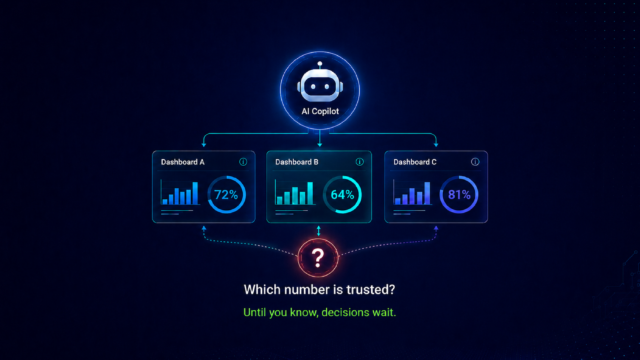
A CDO with Stage 4 analytical capability (predictive models in production, AI copilots deployed, executive reporting automated) can still have an analytics estate where those copilots return conflicting answers to the same business question. The analytical capability is real. The estate AI reads from is ungoverned. These are separate problems, and capability maturity frameworks do not surface the second one.
The dimensions that determine AI output reliability are not sophistication dimensions. They are governance dimensions.
The Four Dimensions of Analytics Estate Maturity
Four dimensions determine whether an analytics estate can reliably serve AI.
Inventory Completeness. Whether every active analytics asset across all BI tools is visible and tracked. This is the foundational dimension. Without a complete, cross-tool inventory, governance programs certify and govern only the fraction of assets that a single tool or manually maintained catalog can see.
Certification Coverage. The percentage of active analytics assets that have been formally reviewed, validated, and designated as authoritative. AI systems have no built-in mechanism to distinguish a certified metric from an abandoned or conflicting one. Certification coverage is the signal AI reads when determining which output to return.
Metric Governance. Whether KPI definitions, ownership, and calculation logic are formally assigned, documented, and consistently applied across tools and teams. This dimension determines whether AI returns one answer or several conflicting versions of the same answer. Inconsistent metric definitions across BI tools are the governance gap most directly responsible for reconciliation cycles that follow AI outputs.
Context Encoding. Whether the relationships between metrics, KPI definitions, and business logic are captured in machine-readable form. This is what allows AI to follow business reasoning rather than approximate it. Without encoded context, AI locates data; it cannot resolve business intent. (This dimension tends to surface an uncomfortable reality: business logic that analytics leaders assume is documented often exists primarily in the institutional knowledge of whoever built the original reports.)
The Four Stages of Analytics Estate Maturity
Each dimension progresses through four stages. An organization's overall AI-readiness stage is its lowest score across all four dimensions. The weakest dimension sets the ceiling.
Stage 1: Uncharted
No cross-tool inventory exists. Each BI tool maintains its own catalog or none at all. Certification is informal and inconsistent: some high-profile reports may be labeled authoritative, but the process is person-dependent. Metric ownership resides with whoever built the report; when that person moves on, the definition may be unrecoverable. Context encoding is zero. Business logic exists in documentation at best, in individual expertise at worst.
What AI experiences: AI reads whichever asset it locates first. There is no signal distinguishing an authoritative metric from an abandoned one. Every AI-generated output requires manual reconciliation before it can be acted on. This is the AI waste cost that accumulates across every active deployment at Stage 1. See The Hidden Cost of an Ungoverned Analytics Estate for the full breakdown.
Stage 2: Inventoried
A cross-tool view of the estate has been established. Active assets are distinguished from dormant or orphaned ones across BI tools. Some certification exists but is not systematic: major reports in high-visibility functions may be certified; the majority of the estate is not. Metric ownership is partially assigned; definitions often remain inconsistent across tools. Context encoding, if present, exists in documentation only.
From AI's perspective: AI locates assets more reliably and can identify some certified resources. For the bulk of the estate, it still cannot distinguish certified from uncertified at query time. Outputs improve compared to Stage 1, but reconciliation is still required for any metric that carries more than one definition across the BI environment.
Stage 3: Governed
Certification is applied systematically to the most-used analytics assets, with a review cadence established and maintained. Metric ownership is formally assigned; KPI calculation logic is documented and linked to certified assets. New assets enter a certification process before reaching end users. Context encoding is partial: some metric relationships are machine-readable; the full estate is not yet encoded.
What AI experiences: AI returns consistently certified outputs for the most-queried metrics. Conflicting answers still appear on lower-priority assets where governance has not yet reached. The gap between what AI can reliably answer and what the estate covers is visible and, in most cases, narrowing.
Stage 4: AI-Ready
Inventory is complete and continuously maintained through automated cross-tool ingestion. Certification coverage applies to the full active estate. All KPI definitions, metric ownership, and calculation logic are assigned, documented, and current. Context encoding is complete: machine-readable business logic is derived from the governed estate and kept in sync as the estate evolves. AI agents can follow business reasoning, not just locate data.
What AI experiences: AI reads from certified assets with full context. Business logic is accessible and encoded. Trusted answers are the default. The reconciliation cycles characteristic of Stages 1 through 3 close.
Analytics estate maturity at a glance:
| Dimension | Stage 1: Uncharted | Stage 2: Inventoried | Stage 3: Governed | Stage 4: AI-Ready |
| Inventory Completeness | Per-tool or none | Cross-tool view established | Complete and actively tracked | Automated, continuously synced |
| Certification Coverage | Informal or none | Partial, high-visibility only | Systematic across most-used assets | Full active estate |
| Metric Governance | Person-dependent | Partially assigned | Formally assigned and documented | Comprehensive, linked to context |
| Context Encoding | None | Documentation only | Partial machine-readable | Full, AI-actionable |
Your Stage Is the Lowest Score Across All Four Dimensions
An organization at Stage 3 on Certification Coverage, Stage 3 on Metric Governance, Stage 2 on Inventory Completeness, and Stage 1 on Context Encoding is at Stage 1 for AI-readiness purposes. The weakest dimension determines the ceiling.
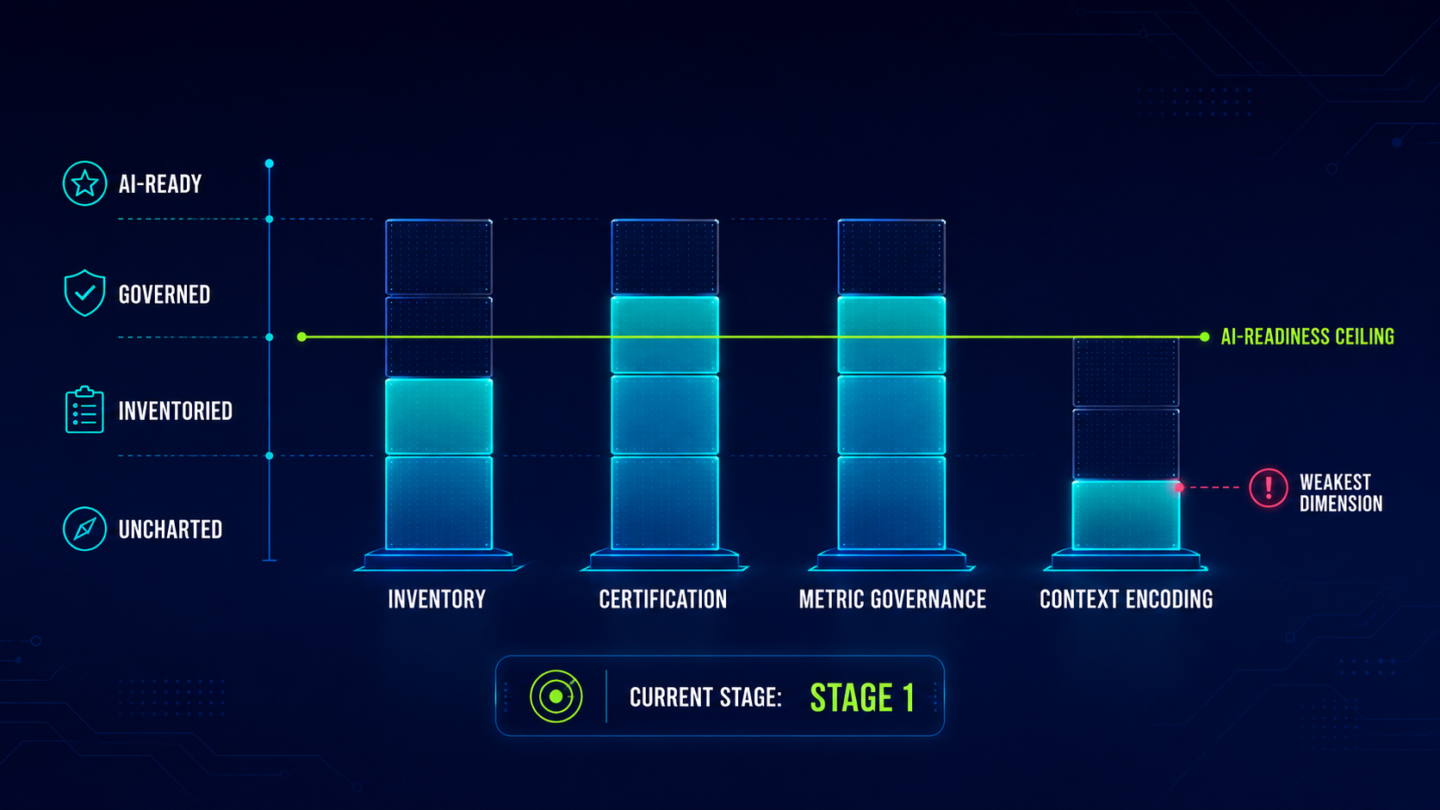
Some organizations run parallel workstreams across multiple dimensions rather than addressing them in sequence. That can work when the dimensions are loosely coupled. Inventory Completeness is rarely loosely coupled with the others: certification, metric governance, and context encoding each require a complete estate view to be meaningful. Until inventory is resolved, progress in the other three dimensions applies only to the fraction of the estate that is currently visible. Governing a fraction of the estate does not govern the estate.
Three questions locate your current stage without a formal assessment:
Can you produce a complete inventory of every active analytics asset across all BI tools within 24 hours? If not, Inventory Completeness is at Stage 1 or early Stage 2.
Do your AI copilots return the same answer to the same business question regardless of which report they locate first? If not, Certification Coverage or Metric Governance is below Stage 3.
When a senior analyst leaves after several years, does the business logic for their key metrics go with them? If yes, Context Encoding is at Stage 1 or Stage 2.
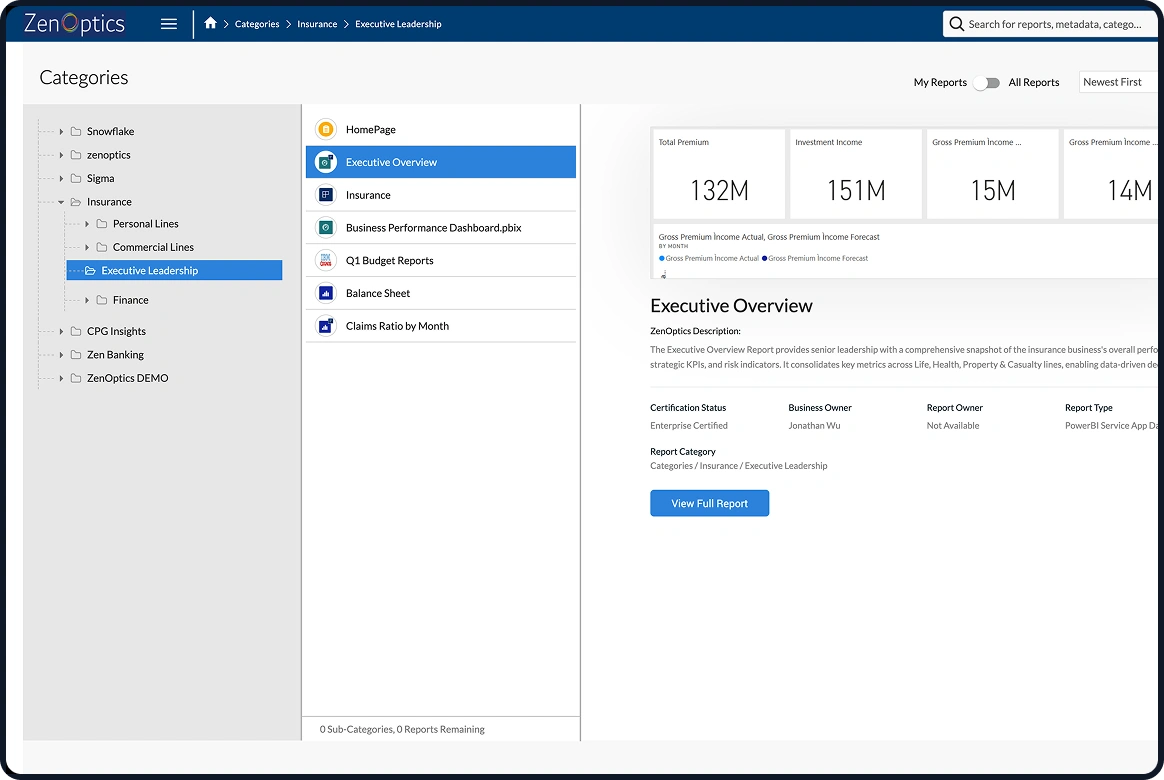
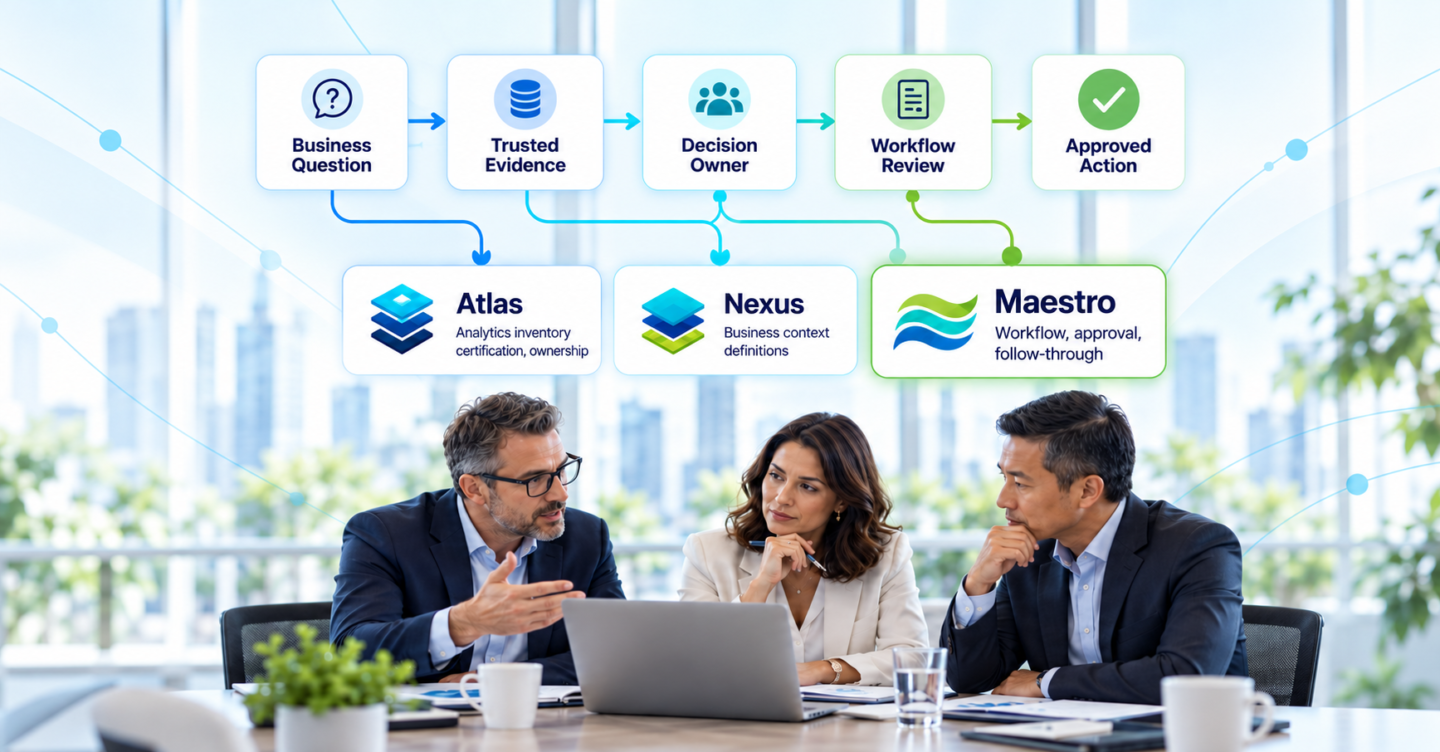
Stage transitions each have a concrete first move. The Stage 1 to Stage 2 transition requires cross-tool inventory: a complete, current view of every active analytics asset across all BI tools. Atlas builds this automatically through 100+ Smart Connectors, establishing continuous inventory from Power BI, Tableau, SAP BO, Qlik, and others. The estate becomes visible before governance begins, not after.
The Stage 3 to Stage 4 transition requires context encoding at estate scale. Nexus derives the analytics context layer automatically from the governed estate Atlas produces. Metric relationships, business logic, and KPI definitions are encoded from existing BI metadata without requiring a manual semantic rebuild from scratch. Organizations implementing this approach typically see a 20 to 40% improvement in analytics discovery speed and a 30 to 40% reduction in duplicate reports as they progress through the stages.
The full self-assessment across all four dimensions is in The AI Readiness Checklist Every Analytics Leader Should Complete.
Frequently Asked Questions
What is the difference between analytics estate maturity and analytics capability maturity?
Analytics capability maturity measures how sophisticated your analytics are: descriptive, diagnostic, predictive, prescriptive. Analytics estate maturity measures how reliably AI can use your analytics assets: whether the estate AI reads from is inventoried, certified, governed, and context-encoded. A Stage 5 capability organization can have a Stage 1 estate if the assets AI reads from are ungoverned. The two models measure different things and should be tracked separately.
How is analytics estate maturity different from data governance maturity?
Data governance maturity addresses raw data quality, lineage, and access at the source layer. Analytics estate maturity addresses the artifacts built on top of that data: reports, dashboards, KPIs, and certified metrics, and whether those artifacts are reliable for AI use. Both matter. Neither substitutes for the other. An organization can have strong data governance maturity and a Stage 1 analytics estate if the analytics layer above the data has not been governed.
What is the first dimension to address for an organization at Stage 1?
Inventory Completeness. Certification, metric governance, and context encoding all require a complete, current view of the estate to be meaningful. Without cross-tool inventory, governance programs certify only what they can see, which is typically a fraction of the full active estate in multi-BI-tool environments. A complete cross-tool inventory is the prerequisite for every other dimension to progress beyond Stage 1.
How long does it take to move from Stage 1 to Stage 4?
The Stage 1 to Stage 2 transition is fastest when inventory is automated rather than manual: a complete cross-tool inventory can be operational within weeks. Stage 2 to Stage 3 requires systematic certification coverage to be applied across the estate, organizational work that technology supports but does not replace. Stage 3 to Stage 4 depends on how much business context already exists in the governed estate. When context encoding is derived automatically from BI metadata, the timeline compresses significantly compared to manual semantic build approaches.
How does this model relate to the broader analytics governance maturity model?
The five-level analytics governance maturity model measures how mature the governance program is: policies, structure, tooling, enforcement cadence. The analytics estate maturity model measures how AI-ready the estate output is across four specific dimensions. The two frameworks are complementary. Organizations can use both in parallel: the governance model to track program maturity, the estate model to track AI-readiness outcomes as a direct measure of what AI deployments will experience.
Published July 17, 2026How to Measure Analytics Estate Maturity
The Analytics Estate Assessment identifies your current stage across all four dimensions and shows which gap to close first. Schedule a 15-minute session to run it with ZenOptics.
Schedule a 15min demo call