


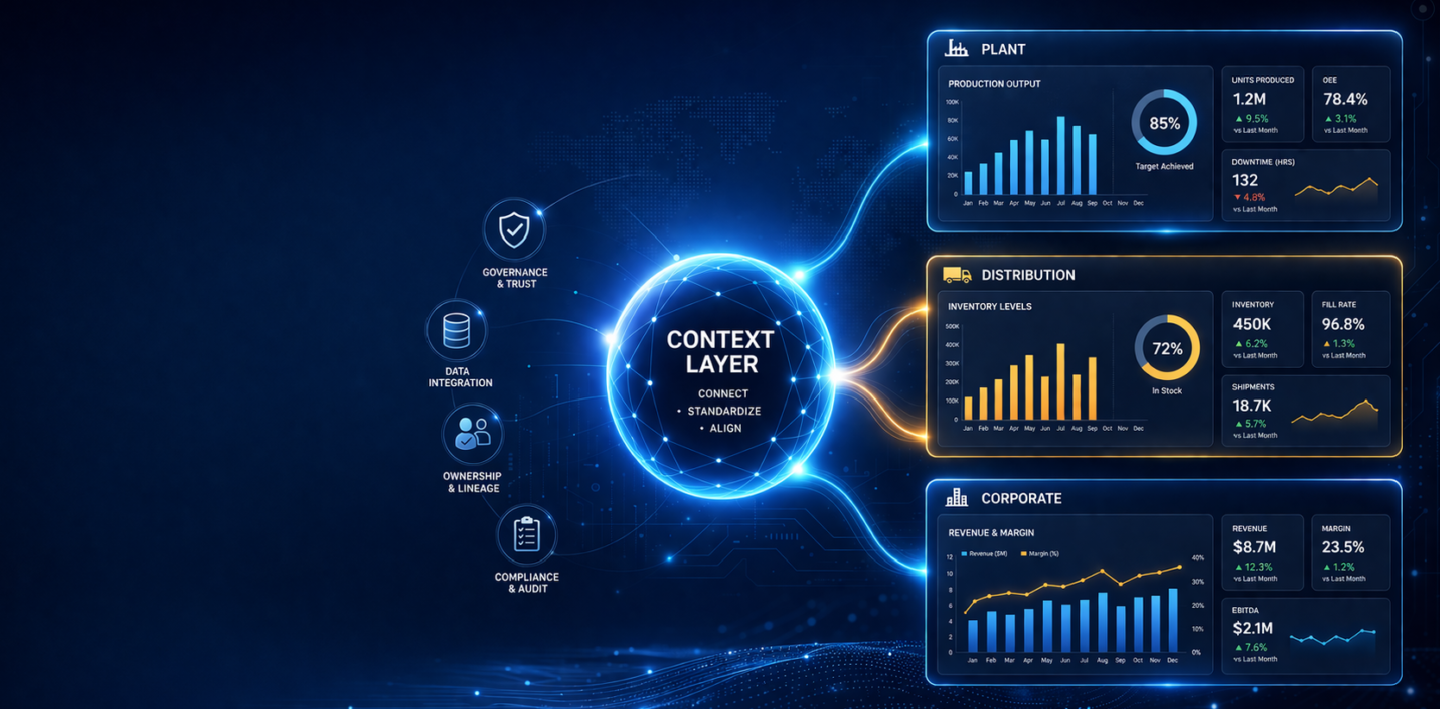
Modern enterprises face a profound paradox. Years of investment in business intelligence platforms were meant to improve decision-making. However, we often find ourselves in a maze of disconnected dashboards, duplicate reports, and competing metrics. The tools intended to unify knowledge have instead fragmented it into silos.
At the technical level, each department now seems to function like an independent processing unit, generating valuable insights in Power BI, Tableau, Qlik or bespoke applications. Without an integrating architecture, those insights
rarely, if ever, converge into shared insight or learning.
The human dimension is just as acute. Employees know reports exist, yet they cannot locate or trust them. This is more than inconvenience: it is a strategic liability.
The stakes rise sharply with the introduction of artificial intelligence. AI depends on consistent, high-quality data and shared definitions. If an enterprise cannot reconcile its own metrics or trace the lineage of its analytics assets, any AI initiative risks operating on a fragile foundation. Before organizations can harness AI to drive transformation, they should first resolve the fragmentation at the core of their information landscape.
This disconnect between ambitious technology investments and real-world practices manifests in predictable patterns, specifically at moments when the accumulated organizational or technical friction reaches a critical point.
These tipping points are signals that an organization has outgrown ad hoc solutions and requires a more systematic approach, such as an Analytics Catalog.
An analytics catalog is a centralized repository that consolidates all enterprise reporting and analytics assets into a single, searchable interface. Unlike data catalogs that focus on raw data sources, analytics catalogs specifically manage the business intelligence layer, including reports, dashboards, visualizations, and derived metrics from multiple BI tools and platforms.
In this field, ZenOptics distinguishes itself through its analytics-first approach, targeting finished analytics assets rather than raw data. The platform consists of five primary components:
So, how do you know when you have reached a tipping point that calls for this solution? The following five triggers represent the most common inflections where the hidden costs of fragmentation suddenly become visible, demanding immediate action.
1. “We Built It, But Nobody Uses It”
The Breaking Point: Your IT team spent months building a custom analytics portal, but adoption rates remain stubbornly low. Users complain about clunky interfaces, poor search functionality, and the lack of personalized experiences they’ve come to expect from consumer applications.
The Hidden Costs: Every unused portal represents not only wasted development resources but also ongoing maintenance expenses and the opportunity cost of delayed insights. When analysts bypass the official portal to email reports directly, you have lost control over version management and data governance.
The ZenOptics Advantage: ZenOptics provides visibility into the assets that exist across all underlying tools, enabling BI/Analytics teams to assess what may be duplicates, redundant, outdated, or unused. With AI-driven recommendations and intuitive interfaces designed for business users, ZenOptics delivers the consumer-grade experience users expect. Its federated search seamlessly spans Tableau, Power BI, and other platforms, ensuring users find what they need without needing to learn multiple systems.
2. “Our Portal Can’t Keep Up with Growth”
The Breaking Point: What started as a departmental solution now struggles under enterprise-wide demand. Your custom portal crashes during month-end reporting. Adding new data sources requires weeks of custom development. IT tickets pile up faster than your team can address them.
The Hidden Costs: Scaling custom solutions often requires architectural overhauls, specialized talent recruitment, and significant infrastructure investments. The lack of centralized oversight can lead to fragmented understandings and interpretations. Meanwhile, business users create workarounds that further fragment your analytics landscape.
The ZenOptics Advantage: Built on cloud-native architecture, ZenOptics scales elastically with your needs. Pre-built connectors eliminate integration backlogs, while automated metadata harvesting keeps your catalog up to date without manual intervention. Understanding these distinctions is crucial for organizations seeking to optimize their data management strategies.
3. “We’re Drowning in Duplicate Reports and Paying for Platforms We Hardly Use”
The Breaking Point: A recent audit revealed your organization maintains 15 versions of the “Monthly Sales Dashboard” across different departments. Business units or IT teams often tackle analytics projects using a range of tools and platforms. But this approach usually results in confusingly different versions of very similar dashboards or reports, each created without reference to what already exists in the business. As a result, license costs for underutilized business intelligence (BI) platforms continue to rise while actual usage declines.
The Hidden Costs: Beyond direct licensing fees, duplicate reports create confusion, erode trust in data, and waste countless hours as employees debate which version is “correct.” This undermines trust in the analysis and any decisions based on it. These additional artifacts consume ever more resources, including data storage, cloud compute and human effort, leading to inefficiencies and increased costs.
The ZenOptics Advantage: An analytics catalog facilitates governance by promoting certified assets for appropriate analysis, promoting trust in the data. Through comprehensive usage analytics and its ROAR (Report Optimization and Rationalization) methodology, ZenOptics identifies redundant content for retirement while establishing clear certification workflows for authoritative reports. Governance features ensure users naturally gravitate toward certified, trusted assets.
4. “Compliance is a Nightmare”
The Breaking Point: Auditors request access logs for sensitive financial reports. You scramble to piece together data from multiple systems, custom scripts, and manual records. Role-based access control exists in theory but not in practice across your fragmented landscape.
The Hidden Costs: Compliance failures risk regulatory penalties, but the larger cost may be the army of analysts manually tracking permissions and usage across disconnected systems. So it’s important to look carefully at your strategy and prioritization. Governance teams also need to review security guidelines and regulatory compliance for data use, protect sensitive information and maintain stakeholder trust.
The ZenOptics Advantage: The analytics catalog is a single, well-defined workspace for organizing and discovering analytics content, even when it is scattered across your infrastructure. Analytics catalogs should include features for managing user access and permissions, to ensure that only authorized users can view specific assets for a specific purpose. With granular permissions, comprehensive audit trails, and activity monitoring built in, ZenOptics transforms compliance from a scramble to a streamlined process.
5. “Our Data Team is Stuck Playing Help Desk”
The Breaking Point: Your highly paid data scientists spend 60% of their time fielding basic questions: “Where’s the latest inventory report?” “Which dashboard shows customer churn?” The backlog of strategic analytics projects grows while your team handles routine requests.
The Hidden Costs: When analysts become human search engines, innovation stalls. The opportunity cost of misdirected talent often dwarfs the direct salary expenses. Frustrated data professionals leave for organizations where they can focus on high-value work.
The ZenOptics Advantage: Enhanced Decision-Making: With access to current, relevant analytics assets that are curated in the analytics catalog, organizations can make data-driven decisions confidently. Self-service discovery capabilities empower business users to find their own answers. Embedded contextual guidance and intelligent search reduce repetitive queries, freeing your data team to focus on innovation rather than information retrieval.
Request a personalized ROI assessment to quantify the hidden costs of your current approach and project the value of a unified analytics catalog. Your data team and your business users will thank you.
Request assessmentOr, Why Packaged Solutions Outperform DIY
The total cost of ownership for custom portals extends far beyond initial development. Hidden expenses include:
In contrast, packaged solutions like ZenOptics deliver:
Speed to Value: ZenOptics establishes a centralized repository for end users to easily find and access analytics assets (such as reports, dashboards, spreadsheets, etc). Pre-built integrations mean weeks to deployment, not months of custom development.
User-Centric Design: Packaged tools invest heavily in adoption drivers (mobile access, social sharing features, and personalized feeds) that would be cost-prohibitive for internal teams to develop and maintain.
Continuous Innovation: Vendor R&D budgets dwarf what most enterprises can allocate to internal tools. You benefit from features driven by the collective needs of hundreds of customers.
Beyond solving immediate pain points, ZenOptics offers capabilities that transform analytics from a support function to a strategic advantage:
Analytics Observability: Analytics portals and catalogs often include capabilities to track usage metrics, such as views, downloads and user engagement. These measurements provide insights into the adoption and performance of analytics assets. Identify which reports drive decisions and which collect digital dust. Spot bottlenecks before they impact business operations.
Embedded Collaboration: Analytics catalogs – and related portals – enable teams to collaborate by sharing and commenting features built over the analytics content. Comments, annotations, and native Slack/MS Teams integration keep insights flowing without context-switching. Transform static reports into living documents that evolve with business needs.
Continuity Layer: This then becomes a “one-stop shop” for users, regardless of how often the applications or platforms may change behind the scenes with IT. The result is a continuity layer for end users to enjoy sustained productivity and efficiency. As your BI tool landscape evolves, ZenOptics provides stability for end users, insulating them from backend changes.
Use this checklist to assess whether you’ve reached a critical juncture in your BI strategy:
The journey from analytics chaos to clarity doesn’t require starting from scratch. Organizations can provide business users with a centralized portal to streamline the searchability, accessibility and use of analytics across their entire ecosystem of tools and applications.
Request a personalized ROI assessment to quantify the hidden costs of your current approach and project the value of a unified analytics catalog. Your data team and your business users will thank you.
Request assessmentImplementing an analytics catalog in a large organization requires careful planning, a methodical approach, coordination and execution. The benefits of an analytics catalog to those organizations that undertake such an endeavor include improved productivity and efficiency for business users and analytics teams, increased consistency of analytics usage and more insightful decision-making – thereby reducing risk and analytics infrastructure expenses. This blog highlights top recommendations for effectively implementing an analytics catalog in large enterprises.
Before diving into best practices, it’s essential to identify – and prepare to address – common challenges that large organizations face when implementing an analytics catalog:
Additionally, organizations may face challenges related to employee skill sets and knowledge gaps. ZenOptics is designed with “ease of use” in mind, allowing individuals to quickly adapt and utilize the analytics catalog with minimal training, ensuring a smooth transition and encouraging widespread adoption. Furthermore, internal politics and differing departmental priorities may create obstacles in reaching a consensus on catalog implementation.
Here are three recommendations to position your analytics catalog for success:
1. Assess Analytic and Reporting Needs
Begin by evaluating the current business intelligence and analytics landscape. Identify what types of analytics assets exist, how they are used, and the key stakeholders involved. Conduct surveys and interviews to gather insights into user needs and expectations.
2. Document Clear Objectives
Establish clear objectives for what you want to achieve with the analytics catalog. Whether it’s simplifying information discovery and access, enhancing governance, or streamlining reporting processes, having documented, well-defined goals and targets/milestones for reaching success will guide the implementation process.
3. Engage Stakeholders Early
Involve key stakeholders from various departments early in the process. Their input will be invaluable in understanding requirements and ensuring that the analytics catalog meets the diverse needs of the organization. Consider forming a cross-functional steering committee that includes representatives from IT, BI/analytics, governance, and business units to facilitate ongoing communication and alignment.
Below are a few tips to encourage widespread user adoption of the analytics catalog across different departments:
1. Provide Training and Support
Offering comprehensive training for users is critical for successful adoption. Provide resources and support to help users navigate the analytics catalog and maximize its benefits. Utilize a blended learning approach that combines online tutorials, live training sessions, and user guides to cater to different learning preferences. Additionally, provide ongoing coaching and support, such as office hours, frequent check-ins, and open channels of communication.
2. Encourage Feedback
Create mechanisms for users to provide feedback on the analytics catalog. Regularly assess user satisfaction and make improvements based on their input to foster a culture of continuous improvement. Implement a feedback loop that allows users to suggest new features or report issues, ensuring that the catalog evolves based on real user experiences.
3. Promote Usage Across Departments
Encourage departments to utilize the analytics catalog by showcasing its benefits. Highlight success stories and case studies to demonstrate how the catalog can improve decision-making and efficiency. Additionally, consider organizing internal webinars or lunch-and-learn sessions where teams can share their experiences and best practices related to using the catalog.
Implementing an analytics catalog in a large organization is a significant undertaking that requires careful planning, stakeholder engagement, and ongoing support. By following these best practices, organizations will improve analytics consistency and accessibility, and foster a culture of data-driven decision-making.
To learn more about the benefits and components of ZenOptics Analytics Hub, visit our Platform page.
Organizations are increasingly turning to analytics to gain insights and make informed decisions. However, according to McKinsey, fewer than 20% of companies have maximized the potential of advanced analytics at scale.
Modern data catalogs are essential for managing and utilizing metadata effectively, which is crucial for data-driven decision-making. However, as the proliferation of self-service business intelligence (BI), embedded analytics, and advanced analytics tools increases, many employees struggle to locate and utilize the analytics assets available to them. Data catalogs are not designed for these self-service users. This is where an analytics catalog comes into play to simplify the discovery and access of enterprise information in a single “one-stop” interface.
An analytics catalog serves as a single, centralized repository that curates, organizes, and manages analytics assets (such as reports, dashboards, visualizations, spreadsheets, etc.) from across an enterprise. Key features include:
Implementing an analytics catalog brings numerous advantages, including:
While both analytics catalogs and data catalogs serve to organize data, they differ in focus. An analytics catalog specifically curates analytics assets like reports and dashboards, while a data catalog encompasses all data sources, including raw datasets and databases. Understanding these distinctions is crucial for organizations seeking to optimize their data management strategies.
In summary, an analytics catalog is a fundamental component of modern data management, providing a structured approach to curating, organizing, and managing analytics assets such as reports, dashboards, and spreadsheets. By implementing an analytics catalog, enterprises can enhance their data discovery processes, improve decision-making capabilities, and extend robust data governance. As organizations continue to evolve in the face of increasing data complexity, the value of a well-implemented analytics catalog cannot be overstated.
In the field of data and analytics, the integration of Artificial Intelligence (AI) presents significant opportunities and challenges. Organizations often struggle with technical debt and information sprawl, underscoring the need for an effective solution to manage and prepare data for AI applications. Our guest speakers from “ZenTalk 9: How Will AI Impact Data and Analytics” discuss how to facilitate the integration of AI technologies into D&A programs.
Organizations today encounter numerous obstacles in data and analytics programs, including technical debt, which comprises legacy choices that inhibit technological advancement. As companies look to harness the potential of AI, they face a disconnect between the existing state of their D&A environments and the optimal conditions required for AI efficacy.
Steve Dine, head of data strategy at EXL and a panelist from the latest ZenTalk episode, emphasized the necessity for a centralized system that integrates metadata and business rules to ease the transition to AI readiness. This can be addressed, at least in part, with a platform that curates and centralizes trusted information, rendering it accessible, organized, and actionable for AI initiatives.
A critical step toward AI readiness is education. Organizations need to understand how to apply existing technologies effectively and realistically assess AI’s capabilities. Despite the potential of AI to transform operations through applications like chatbots, anomaly detection, and predictive analytics, it is crucial to set realistic expectations that align with your organization’s practical realities.
Panelist Saurbh Khera, CEO of ZenOptics, advocated for starting with small, focused projects to build momentum. By collecting relevant data and concentrating on specific use cases, organizations can make substantial progress. ZenOptics facilitates this approach by helping organizations organize and catalog their analytics, thus laying a strong foundation for future AI applications.
ZenOptics is instrumental in supporting organizations by offering a comprehensive analytics management solution that can prepare data and analytics assets for AI. The platform enhances the ability to curate and catalog analytics, providing a unified view that leads to simplified AI integration.
The panelists underscored the importance of aligning AI initiatives with organizational goals. By prioritizing education, understanding relevant use cases, and initiating manageable projects, organizations can effectively bridge the gap from current operations to future AI integration. ZenOptics is designed to support this transition, with a sustainable analytics and reporting environment that adapts as AI technologies evolve.
The path to successful AI adoption involves balancing ambitious goals with pragmatic strategies. While AI offers extensive possibilities, thoughtful implementation is crucial. Starting with smaller projects, educating stakeholders, and utilizing platforms like ZenOptics can enable organizations to manage the complexities of AI integration and achieve significant outcomes.
For additional insights and resources on data management and AI readiness, visit ZenOptics.com/resources. Join us for our upcoming ZenTalk sessions to continue exploring the advancements in data and analytics.
In episode #8 of ZenTalk series, Steve Dine, Head of Data Strategy at EXL, and Saurbh Khera, CEO of ZenOptics, discussed the evolving landscape of enterprise data management and analytics and shared their thoughts on making positive impacts.
For organizations, challenges arising from the proliferation of data sources and the integration of diverse analytics models. Steve highlighted the essential role of a unified marketplace for data and analytics assets as fundamental to addressing the complexity challenges and providing the ability to have informed enterprise decision-making.
“We are moving towards AI-driven analytics”, Saurbh added and pointed out the complexities and opportunities that advancements in artificial intelligence bring. He emphasized the necessity of merging disparate data sources into a single, cohesive platform that provides a reliable source of truth for all stakeholders.
The importance of user experience (UX) in enhancing productivity and fostering ownership among data users is the critical element to engagement. “We aim to provide a personalized marketplace experience,” Saurbh noted, underscoring the need to adapt analytics platforms to suit the varied requirements of strategic users, business analysts, and operational teams.
The crucial role of descriptive metadata and robust asset management in a data and analytics marketplace was addressed by Steve as well as advocating for a collaborative data governance approach that enables users to make well-informed decisions confidently.
Another important aspect for user engagement is the critical need to future-proof data and analytics infrastructures. “Flexibility and adaptability are essential,” Steve remarked, promoting agile development practices that can adapt to technological changes and incorporate new tools into existing systems smoothly.
ZenOptics’ Analytics Hub is a dynamic solution designed to adapt to organizational changes. “Our goal is to provide a continuity layer,” Saurbh stated, focusing on the platform’s ability to maintain operational efficiency amid technological advancements.
The importance of embracing change while ensuring continuity and trust within organizations was highlighted in ZenTalk 8. By prioritizing user experience, enhancing data governance, and future-proofing analytics systems, enterprises can confidently navigate the complexities of modern data and analytics management.
Listen to ZenTalk episode 8 with Steve Dine and Saurbh Khera here.
In the latest episode of our ZenTalk series, featured guest Stephen Dine (Steve), head of data strategy at EXL, and speaker Saurbh Khera, CEO of ZenOptics, delved into how organizations can effectively manage change, ensuring continuity and maintaining efficiency with their data and analytics programs.
The discussion began with an exploration of the dynamics of change in enterprise environments, particularly with data and analytics programs. Steve discussed the foundational role of architecture in managing change, from data structuring to managing transitions such as cloud migration. He highlighted the critical need for detailed planning to minimize disruption and prevent user dissatisfaction.
Steve also emphasized the importance of integrating effective change management strategies from the outset, focusing on helping users seamlessly adapt to new tools and processes. He argued that change management should be a core component of the development process, fostering a culture of continuous improvement and adaptability.
Saurbh built on this theme, emphasizing the need to be attentive to the user experience as a critical factor for sustained efficiency and productivity during organizational transitions.
The discussion also covered data and analytics governance and the importance of maintaining trust to ensure user confidence. Saurbh noted that disruptions or inconsistencies could lead users to seek alternative solutions, potentially derailing organizational objectives. He stressed the necessity of establishing a unified user experience and a continuity layer to build and sustain trust through collaboration and open communication.
Future-proofing was another key theme of the session. Steve and ZenTalk moderator Julie Langenkamp spoke about the importance of designing analytics systems and processes that are flexible enough to accommodate future changes, such as when adopting new tools or integrating AI-driven analytics. Ensuring systems are adaptable and can evolve with technological advances is crucial for maintaining continuity, trust, and facilitating user adoption.
ZenTalk 7 underscored the importance of embracing change while safeguarding continuity and trust within organizations. By weaving change management into data and analytics development processes, creating a cohesive user experience, and preparing for future advancements, organizations can successfully navigate transitions and achieve sustained success.
ZenOptics designed its Analytics Hub with these concepts in mind. ZenOptics establishes a centralized repository for end users to easily find and access analytics assets (such as reports, dashboards, spreadsheets, etc). This then becomes a “one-stop shop” for users – regardless of how often the applications or platforms may change behind the scenes with IT. The result is a continuity layer for end users to enjoy sustained productivity and efficiency. Learn more about the components of the Analytics Hub here.
Listen to the ZenTalk 7 discussion with Steve Dine and Saurbh Khera here.
While self-service BI tools have transformed data analysis by speeding up report generation, they also introduce complex issues: How can organizations manage the increasing volume of reports from various tools and maintain a unified source of truth? How do decision-makers integrate reports from different departments? These questions highlight underlying concerns related to BI governance, data security, and data ownership.
As Bernard Marr points out in his Forbes article, the lack of centralized oversight can lead to fragmented understandings and interpretations. This fragmentation from self-service analytics can cause organizations to overlook essential insights, misinterpret data, or make erroneous analyses.
To encourage meaningful discussions at leadership meetings, it is essential to standardize core management reports. According to a study published in the Journal of Big Data, organizations that operationalize data governance gain a competitive advantage. For instance, the collaborative project with the World Health Organization for managing and analyzing data about Neglected Tropical Diseases demonstrates the practical application of data governance.
Organizations need to adopt an integrated approach to report governance to fully capitalize on self-service analytics. A unified platform that allows both business users and decision-makers to access and organize content from various reporting and document management systems is essential. Such a platform should also provide customizable catalogs tailored to specific functional, business process, or organizational needs, enabling effortless access to actionable insights.
If your organization is overwhelmed by a flood of reports and struggles with governance and maintaining a cohesive reporting landscape, it is time to act. Many enterprises are successfully regaining control over their reporting landscapes without sacrificing the advantages of Self-Service BI.
Explore solutions that enable effective navigation of this report chaos, such as the ZenOptics platform, which allows business users and decision-makers to access and organize content from disparate reporting and document management systems into intuitive, personalized, and decision-focused views. It enables productivity, manageability, collaboration, and governance through a single interface and provides users with direct access to all analytics assets. These include reports, dashboards, spreadsheets, applications, and data.
You can learn more about this platform by contacting ZenOptics today.
At ZenOptics, we continually research the crucial aspects of managing data and analytics effectively within organizations, and we’ve been discussing these insights and observations in our ZenTalk webinar series with guest speakers. ZenTalk 6 with renowned industry expert Donald Farmer and ZenOptics CTO Heena Sood is a special example of this, as we share real-world approaches for analytics governance—particularly regarding the challenges governing a decentralized environment.
A pattern emerging in data and analytics organizations is the movement toward decentralized governance models. While centralization was once deemed necessary for effective data management, technological advancements such as data mesh and data fabric have shifted this preference toward decentralization.
Decentralized stewardship marks a significant development, allowing subject matter experts in business units to own their analytics assets within a comprehensive governance framework. This model enables teams to manage assets effectively, aligning with business objectives and enhancing accountability.
1. Create a KPI Command Center.
Establish a centralized repository of Key Performance Indicators (KPIs) and analytics assets where all the relevant indicators and metrics are curated, defined, and easily accessible for specific audience groups. This streamlines visibility over the KPIs/metrics while providing consistency in understanding them—regardless of where within various business units or functional areas the KPI originated. ZenOptics provides such a repository and subsequent dashboard from a list of certified KPIs/metrics in the Analytics Catalog.
2. Build confidence with governed, certified reports and analytics.
Starting with the KPI “Command Center” as mentioned above, create ties/links to certified reports and dashboards for supporting detail. The “Related reports” functionality in ZenOptics establishes linkages between relevant, trusted assets for further discovery and easy reference. When an individual is examining a KPI, they can then see the list of reports and dashboards where that particular KPI is being used.
3. Rationalize and optimize the reporting environment.
Rationalize the reports within your analytics environment upfront for a more targeted user experience. Then establish processes for ongoing report lifecycle management to maintain an optimized environment. With the ZenOptics “ROAR” (report optimization and rationalization) methodology and capabilities, ZenOptics provides visibility of the assets that exist in all the underlying tools, allowing the BI/Analytics teams to assess what may be duplicates, redundant, outdated, or unused. As a result, business end users spend less time finding the accurate, appropriate information they need to make business decisions.
4. A decentralized stewardship model helps drive governance at the organizational level, yet establishes individual accountability.
This provides guardrails for citizen developers or self-service analytics users to create and promote content in a governed manner. For some customers, ZenOptics becomes a centralized report catalog for promoting content from distributed content creation activities according to overarching policies and procedures.
The webinar also emphasized the need for strong platform capabilities to support decentralized governance, including:
Utilizing these capabilities allows for a systematic approach to analytics governance, fostering transparency, accountability, and informed decision-making.
To conclude our series on analytics governance, Donald and Heena emphasize these critical points:
The effective navigation of analytics governance in a decentralized framework demands a strategic approach, using appropriate tools and methods to synchronize business objectives with data-driven insights. CIOs, CTOs, CDOs/CDAOs, and analytics leaders must view governance as a fundamental element of organizational success moving forward. Watch the ZenTalk series with Donald Farmer here.
If you wish to learn more about ZenOptics and analytics governance, please request a demo.
Analytics governance is essential for informed decision-making, maintaining analytics and reporting integrity, and supporting consistent business decision-making processes. The ZenTalk 5 webinar with industry thought leader Donald Farmer of TreeHive Strategy and ZenOptics CTO Heena Sood provided an in-depth analysis of the challenges and importance of analytics governance in current business operations. The important insights from the discussion have been summarized for a quick read.
The role of information stewards is to be the experts who facilitate the collaboration between business units and IT departments. These individuals are critical in curating and managing analytics assets effectively for appropriate utilization by business users. The discussion outlined the importance of the stewardship role in formal governance structures, particularly for compliance and adapting to the changing nature of analytics technologies.
Strong governance is especially critical because of factors such as market consolidation, evolving technical architectures, and the growing complexity of analytics systems. Challenges like scalability, managing distributed systems, and self-service governance require strategic responses to uphold effective analytics governance.
Both Donald and Heena conveyed that governance should not be seen as a constraint but as a foundation for safe innovation. Properly implemented governance gives organizations the assurance to try new ideas and adapt to changes in business models and technology, and establishes confidence for end users that they are making decisions based on accurate and appropriate information.
Effective analytics governance involves selecting pertinent KPIs that align with strategic business goals, establishing solid report management procedures, and using analytics governance platforms to gain insights into the utilization of data and the life cycles of reports. Such platforms can provide visibility and insights regarding the overall analytics ecosystem, and will help with rationalization and cleanup efforts – as well as maintaining a clean, streamlined reporting environment over time.
The main takeaway of the webinar is that analytics governance is a critical element in managing data responsibly and with strategic intent. Governance enables organizations to approach analytics complexities with greater assurance and insight. Based on extensive experience and research, Donald and Heena offered substantial and prescriptive guidance on analytics governance, spurring important discussions on its application in organizations. Listen to the ZenTalk series with Donald Farmer here.
In the context of data-centric organizations, the significance of analytics governance is becoming increasingly apparent for guiding decision-making and ensuring data confidence. The ZenTalk 4 webinar provided an exploration of analytics governance, discussing its essential role in contemporary business practices. Below are the summarized insights and key points from the discussion with Donald Farmer, industry expert and Principal at TreeHive Strategy.
The webinar began with an explanation of analytics governance, highlighting its importance in creating an organized framework for managing analytics assets. The discussion detailed essential aspects of analytics governance, such as defining ownership and establishing governance processes, which are fundamental to a successful analytics governance strategy.
Rather than imposing constraints, analytics governance aims to enable effective decision-making. Through governance mechanisms, organizations can foster data accuracy, encourage standardized practices, and boost confidence in decision making. The importance of governance in fostering a culture of innovation and collaboration was a focal point of the discussion.
Technology is crucial in supporting analytics governance, with platforms like ZenOptics offering vital capabilities for enabling and supporting analytics governance processes efficiently. Technology aids in managing assets, defining ownership, and tracking usage, thereby enabling organizations to apply analytics governance policies effectively and generate data-driven insights.
Key aspects of analytics governance, such as asset quality, asset rationalization, ownership establishment, and lifecycle management, were examined during the webinar. Concentrating on these elements helps organizations streamline operations, minimize report sprawl, and provide decision-makers with accurate and pertinent information.
The aim of analytics governance extends beyond compliance; it is about enhancing efficiency and fostering innovation. Organizations can achieve higher productivity and sustainable growth by optimizing analytics workflows, proactively resolving issues, and standardizing processes for end users to use data and analytics.
As the organizations evolve, adapting analytics governance strategies becomes essential. The webinar stressed continuous improvement, change management, and effective communication as key to the ongoing success of analytics governance efforts.
The ZenTalk 4 webinar offered valuable perspectives on the significant role of analytics governance in business. With a systematic approach, effective technology use, and a focus on data and analytics quality and precision, organizations can adeptly manage the complexities of analytics lifecycle management and confidently make strategic decisions based on trusted analytics.
For a comprehensive understanding of analytics governance and its relevance to contemporary business practices, access the complete ZenTalk 4 recording.


