

When enterprises are asked to modernize analytics access, the starting point is almost always the same: a SharePoint site, a Confluence page, or an intranet hub with reports embedded from Power BI or Tableau. This setup can help employees access reports, but it is not natively designed to provide cross-platform analytics governance, certification, ownership, and usage intelligence. These are different problems, and the distinction becomes more important as organizations connect AI copilots and agents to their analytics environments.
The Intranet Was Not Built for Analytics
Intranets exist for internal communication, collaboration, document sharing, and knowledge management. SharePoint is the dominant platform: a content management and publishing system that became the default enterprise intranet across industries over the past two decades. When analytics teams needed to make BI reports accessible, SharePoint was the path of least resistance. Employees were already there. IT already managed the platform. Embedding a Power BI report in a SharePoint page required no new procurement, no new training, and no new vendor relationship.
The result is functional but architecturally limited. The intranet has no concept of an analytics estate. It treats a Power BI dashboard the same way it treats a quarterly HR update or a policy document: as a piece of content to be published and linked. Without custom integrations and analytics-specific metadata models, it does not provide a unified catalog across multiple BI tools. Unless organizations build and maintain custom governance logic, certified and actively maintained reports may appear alongside outdated or ad hoc content without a consistent trust signal. Organizing analytics assets by certification status, ownership, lineage, and usage generally requires custom development and ongoing governance processes.
What organizations end up with is a collection of department pages with embedded BI links. Employees who know where to look can find reports. Employees who don't know what they are looking for cannot. The BI team may still lack a complete cross-platform view of which reports are authoritative, who owns them, how they are used, and where duplicates exist.
What an Analytics Portal Actually Does Differently
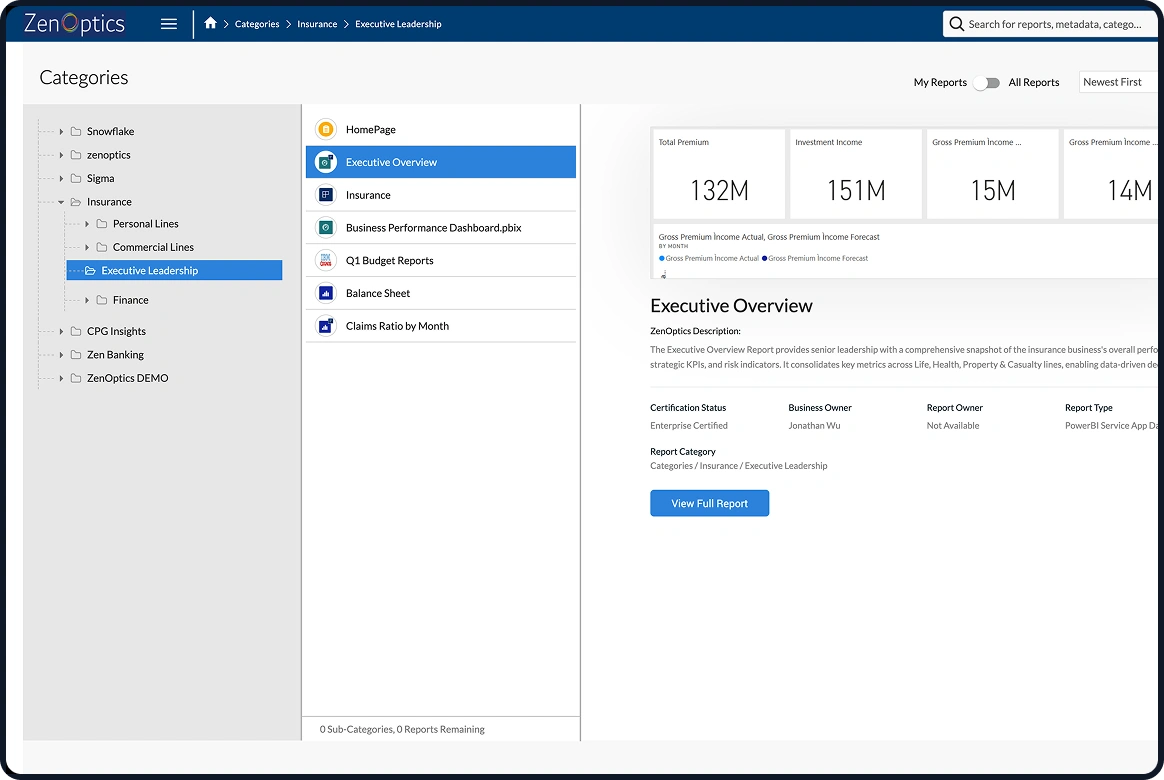
An analytics portal is a discovery and access layer built specifically for analytics assets, not for general content publishing. The architectural difference is meaningful.
Where an intranet treats a BI report as a content item to link, an analytics portal understands that its contents are analytics assets with specific properties: which BI tool produced them, whether they are certified, who uses them, and what role they serve. It organizes reports, dashboards, and KPIs across multiple BI tools simultaneously (Power BI, Tableau, SAP Business Objects, Qlik, and others) without requiring users to know which tool produced which report. It applies analytics-aware search: a user looking for "revenue by region" finds the right report, not a PDF that happens to contain that phrase.
A purpose-built analytics portal can respect permissions from connected BI platforms while providing a consistent discovery experience across tools..Certified reports can be surfaced distinctly from unverified ad hoc content. Usage patterns inform which reports get promoted to the front of the experience.
Organizations that moved from intranet-embedded analytics to a purpose-built analytics portal saw the improvement clearly. Analytics became findable and organized for non-technical users who had never known which BI tool to open. Discovery time dropped. Analyst time spent answering routine "where is the report?" questions decreased. These outcomes are real, and the improvement over an intranet-based setup is not marginal.
Modernizing Homegrown Analytics Portals: A Reference Architecture for SharePoint, .NET & Custom Intranets covers the full transition architecture for organizations starting from a homegrown portal setup.
Why Access-Only Portals Still Need a Governance Foundation
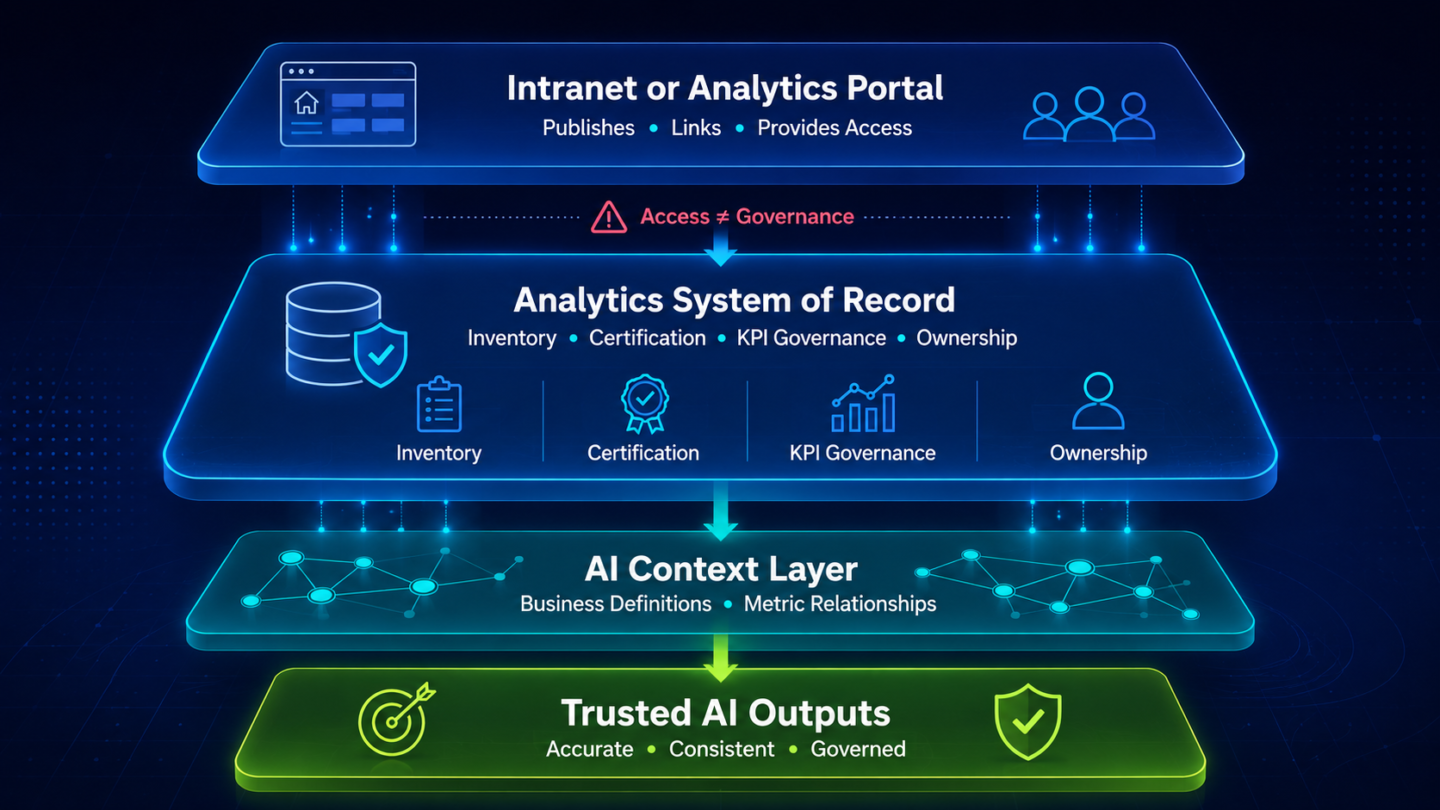
An intranet and an access-only analytics portal primarily function as distribution and discovery layers. Without an underlying analytics system of record, neither provides complete cross-platform governance of the analytics estate.. They organize and surface what already exists in the analytics estate. Unless governance capabilities are built into the architecture, these access layers may not consistently identify authoritative reports, assign KPI ownership, or manage conflicting definitions across BI platforms. The inconsistency when "revenue" means different things in the Power BI sales dashboard and the SAP Business Objects finance report goes unresolved. Both reports may be certified within their respective BI tools, while an access-only portal may lack the cross-platform governance needed to resolve the inconsistency.
For most of the past decade, this gap was manageable. Manual reconciliation absorbed it: finance teams comparing dashboards before every board deck, analytics teams maintaining a master metric definition document that was always slightly out of date. The process was expensive and slow, but organizations could absorb it. Many still do.
AI cannot absorb this gap.When an AI copilot or agent is connected to an ungoverned intranet or access-only portal, it may encounter analytics assets without sufficient certification, ownership, and business context to evaluate their trustworthiness. It encounters multiple versions of the same metric with no signal about which is authoritative. The output requires the same manual reconciliation the AI was supposed to eliminate. The Hidden Cost of an Ungoverned Analytics Estate documents what organizations pay for this. AI Agents Don't Read Data Warehouses. They Read Analytics Estates. explains the specific architectural reason.
The gap cannot be solved by access and discovery alone. It requires an analytics governance foundation that establishes trust across the entire analytics estate.
The Architecture That Closes the Gap
The analytics system of record underpins the access experience and governs the analytics assets that the portal surfaces.. An analytics system of record catalogs, certifies, and governs analytics assets across connected BI tools. The portal can then surface a governed estate with clearer signals for certification, ownership, relevance, and usage.
The foundation of this architecture begins with two connected capabilities: an analytics system of record and an AI-ready context layer.
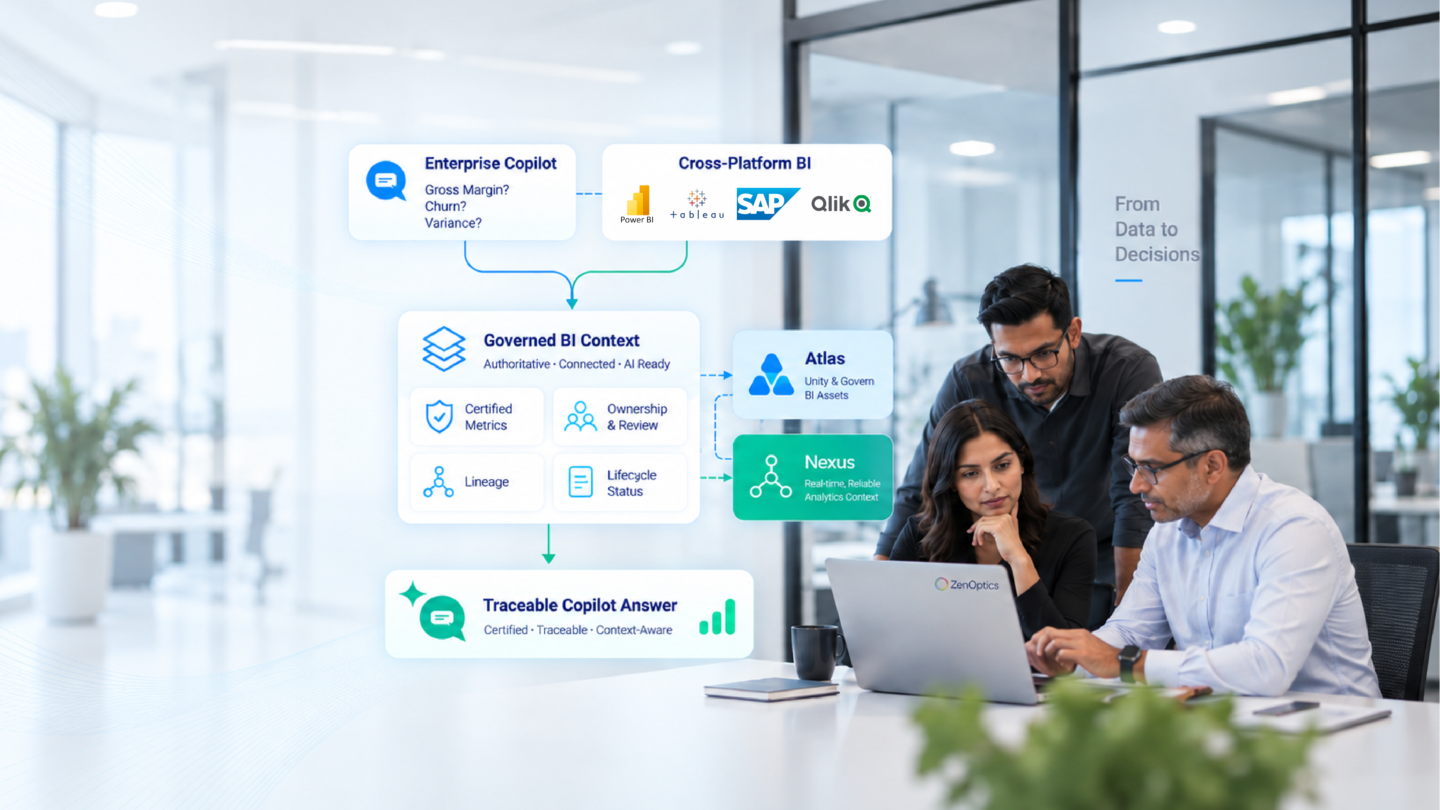
The analytics system of record maintains a complete cross-tool inventory of every active report, dashboard, and KPI across Power BI, Tableau, SAP Business Objects, Qlik, and other BI environments. It applies certification, designating which assets are authoritative and tracking ownership over time. It governs KPI definitions, ensuring "revenue" resolves to a consistent calculation regardless of which tool it originates from. Atlas connects across leading BI and analytics environments to build a governed, cross-platform inventory of reports, dashboards, KPIs, and metrics.
The AI context layer converts the governed estate into machine-readable form, encoding metric relationships, business logic, and ownership so AI agents can follow reasoning rather than simply locate data. Nexus builds this layer from governed Atlas metadata, using AI-assisted curation and human verification to establish business definitions, semantic relationships, and trusted context.
Organizations do not need to retire their intranet or replace their existing analytics portal to make this shift.The governed analytics foundation can support the distribution experience that already exists, including SharePoint, a custom intranet, or an enterprise analytics portal.. What changes is what that surface draws from: a governed, certified estate instead of an unverified collection of reports. How to Measure Analytics Estate Maturity defines the four stages that track progress from an uncharted estate to a governed, AI-ready one.
Atlas and Nexus establish the governed analytics and business-context foundation. From there, organizations can use Maestro to connect trusted analytics to governed workflows, approvals, actions, and decision provenance—extending the architecture from analytics discovery to traceable execution.
Frequently Asked Questions
What is the difference between an intranet and an analytics portal?
An intranet is an internal communication and collaboration platform, designed for content publishing, document management, and employee communication. An analytics portal is a discovery and access layer built specifically for analytics assets across multiple BI tools. The two serve different architectural purposes. An intranet can embed BI reports as content items. An analytics portal is built to catalog, organize, and surface analytics assets with awareness of the BI context they come from, including certification status, tool of origin, and usage.
Can SharePoint serve as an enterprise analytics portal?
SharePoint can host embedded BI reports and function as a basic analytics access layer for teams that already know where to look. SharePoint can provide a useful analytics access experience, but it is not natively designed to deliver cross-platform analytics cataloging, certification, ownership, lineage, and usage intelligence at enterprise scale.Delivering cross-platform cataloging, BI-level certification signals, analytics-aware search, ownership, lineage, and usage intelligence through SharePoint generally requires custom integrations and ongoing engineering.. Organizations that rely on SharePoint as their primary analytics access layer typically find that discovery gaps, duplicate content, and certification ambiguity compound as the estate grows.
Why does an analytics portal still fall short of what AI agents need?
An access-only analytics portal primarily organizes and surfaces existing analytics assets. Without an integrated governance foundation, it may not resolve conflicting metric definitions, establish cross-platform ownership, or determine which analytics are authoritative. It does not certify which assets are authoritative, assign ownership to KPI definitions, or resolve inconsistencies between the same metric as defined across different BI tools. When an AI agent reads from an analytics portal, it finds assets it cannot evaluate for trustworthiness. The result is conflicting outputs that require manual reconciliation, which is precisely the problem AI was deployed to solve.
Do we need to replace our intranet to build a governed analytics estate?
No. Building an analytics system of record does not require replacing an intranet or retiring an existing analytics portal. The governance layer operates beneath whatever distribution surface already exists. Atlas connects to existing BI environments through Smart Connectors, builds a governed cross-tool inventory, and applies certification and metric governance across the full estate. The intranet or portal above it continues to function, but what it surfaces becomes a governed estate rather than an unverified collection of reports.
What is the first step to moving from an intranet-based analytics setup to a governed analytics estate?
The first step is cross-tool inventory: a complete, current view of every active analytics asset across all BI tools in the estate. Organizations that begin certification or governance before completing a cross-tool inventory risk governing only the portion of the analytics estate they can currently see. Inventory completeness is the prerequisite for every subsequent governance and AI readiness step.
Published July 24, 2026Your Intranet Isn't Your Analytics Portal
Discover where your analytics estate stands across inventory, certification, metric governance, ownership, and AI-ready context. Schedule a 15-minute ZenOptics Analytics Estate Assessment to identify the gaps affecting trust, efficiency, and AI readiness.
Schedule a 15min demo call