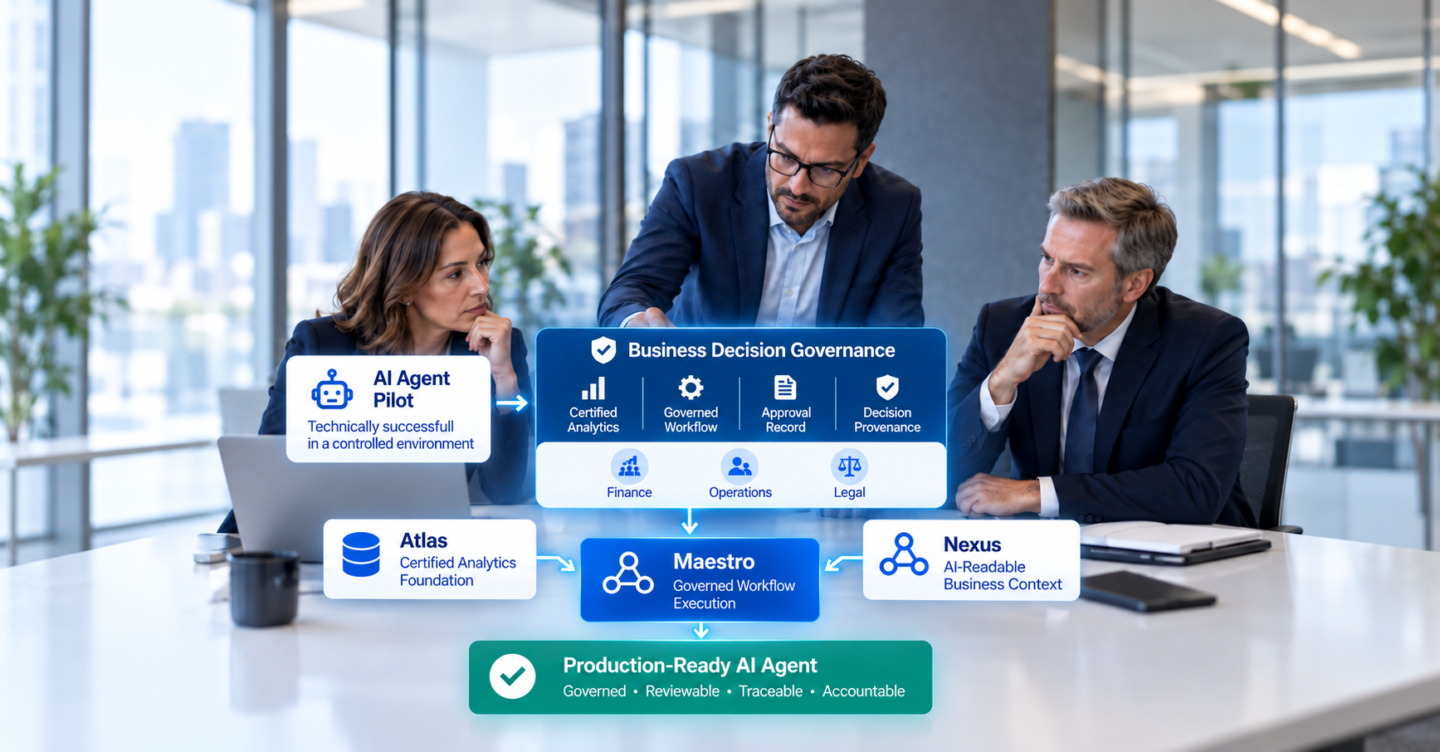


Many AI agent pilots perform well in controlled environments but struggle to progress into production. The challenge is not always technical. Enterprises must also determine how an agent’s actions will be governed, reviewed and explained once the agent becomes part of a consequential business process.
Much of the discussion about stalled AI agent pilots focuses on technical explanations: models are not reliable enough, evaluation tooling is immature, data quality is insufficient. These are real challenges. They do not explain why AI agent pilots that technically work, that produce accurate outputs in controlled settings, still cannot get organizational approval to scale.
Even after the technical questions have been addressed, another barrier remains: business accountability. Before approving an AI agent for an important business process, operations, finance and legal teams need to understand how its actions will be governed, reviewed and traced.
Why Technically Successful AI Agent Pilots Still Stall
Gartner projects that 40% of enterprise applications will include task-specific AI agents by the end of 2026, up from under 5% in 2025. Many enterprise organizations are currently experimenting with AI agents in controlled environments.They have AI agents running in controlled settings: routing approvals, flagging variances, executing workflow steps in finance, operations, or HR. Initial results may look promising. The agent may perform well within the pilot’s defined scope, and the underlying data may already be governed.
And then the request to scale hits operations. Or finance. Or legal. And it stalls.
These functions are not only asking, “Is the model accurate enough?” The pilot may provide evidence of performance, but production introduces broader questions about control and accountability. The question is: "When this agent makes a wrong call on a CapEx routing, marks the wrong close step as complete, or flags the wrong variance for escalation, what record do we have of what the agent did, on what basis it acted, and who is accountable for the outcome?"
This is a different question. Model monitoring, evaluation tools and data-governance logs provide important evidence, but they may not capture the complete business context behind an agent’s action. That requires a business decision record showing: what certified analytics the agent referenced, what workflow step governed its action, what authorization condition was satisfied or escalated, and what the measurable outcome was. Understanding the governance requirements for enterprise AI agents makes clear that the accountability question is a governance architecture question, not a model performance question.
Deloitte’s 2026 research found that only 21% of surveyed organizations reported having a mature governance model for autonomous AI agents, while nearly three in four expected to use agentic AI at least moderately within two years. This gap between adoption plans and governance maturity helps explain why some pilots struggle to progress.
The Question Finance, Operations, and Legal Are Actually Asking
Before any consequential automated process reaches production scale, the organizational functions responsible for that process ask a version of the same accountability question. The wording varies. The underlying concern does not.
Finance asks it about budget variance reviews and month-end close steps: if an AI agent marks a reconciliation step complete and the close is later found to be in error, what is the audit record that shows what the agent referenced, what the agent did, and what process governed the action? A clean model output log does not answer this question. An API audit trail does not answer this question. A decision governance record does.
Operations asks it about approval workflows and process exceptions: if an AI agent routes a CapEx request to the wrong approver or at the wrong threshold, what is the governance record that explains why the agent made that routing decision? Operations does not need to know what the model's confidence score was. Operations needs to know what the agent referenced, what rule or workflow governed the action, and what the record shows.
Legal asks about regulatory compliance and audit readiness. For organizations operating in regulated environments requirements around record-keeping, transparency and human oversight make traceability increasingly important. The EU AI Act, for example, introduces specific obligations for AI systems classified as high-risk. A model card explains how the agent was trained. It does not explain what business decision the agent made, what analytics governed it, and what process authorized it.
What the decision record must contain answers this question at the architecture level: a certified analytics basis, a governed process record, an authorization record, and an outcome connection. From a ZenOptics perspective, a useful business decision record connects four elements: the governed analytics referenced, the process step executed, the applicable review or authorization, and the outcome that followed. These elements may exist across different systems, but they are rarely connected in a single business decision record.
Why IT Governance Alone Is Not Enough
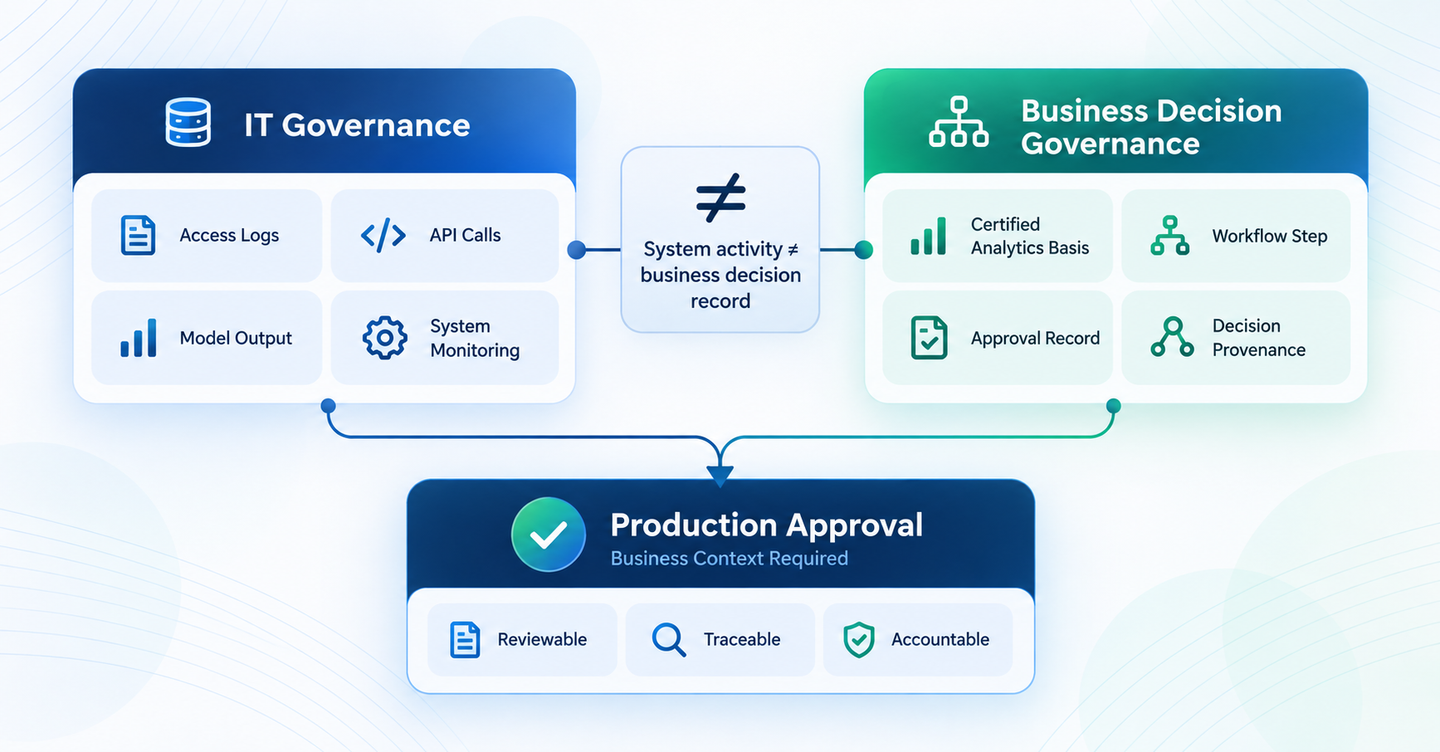
Many enterprise AI governance frameworks focus primarily on system-level controls: access management, API logging, SIEM integration, model monitoring, principle of least privilege, bias auditing, and explainability frameworks. These are appropriate, necessary controls at the system layer. They answer: "What did the agent access? What tools did it invoke? What data did it read? What did the model output?"
These controls are essential, but they may not provide the complete business context that operations, finance and legal teams need. The system-layer audit trail documents agent behavior at the technical level. The business accountability question is at a different layer: what business decision did the agent make, on what certified analytical basis, within what governed process, with what authorization, and with what measurable outcome?
These are different governance objects. An IT audit log documents a tool invocation. A business decision governance record documents a business action: the certified revenue metric that triggered a variance flag, the Maestro workflow step that governed the flagging action, the escalation threshold that was satisfied, and the outcome that followed.
Understanding decision governance for AI agent workflows makes the distinction precise: IT governance addresses the AI system. Decision governance addresses the business decision the AI system makes when it executes a workflow step. Both are necessary. IT governance addresses the system, while decision governance adds the business context needed to review and defend the actions that follow.
What Business Decision Governance Requires for AI Agent Deployment
Business decision governance for AI agents operating in enterprise analytics workflows has four components. Together, these four elements can help operations, finance and legal evaluate an agent’s actions with greater clarity. Without this context, obtaining production approval becomes more difficult.
A certified analytics basis. When an AI agent references a metric or analytical threshold during a workflow step, that analytical input must be certified: reviewed and approved by a designated business owner, with a current certification status and a defined scope. What metric certification requires goes beyond data governance. Certification is an analytics governance act that produces an ownership record, a scope definition, and a status. When the agent references a certified metric, the certification becomes part of the decision record. When the agent references an uncertified source, that is a governance signal requiring escalation rather than silent execution.
A structured workflow context. The agent must operate within a defined business process, not autonomously outside a governed structure. An AI agent executing a step within a governed workflow operates under defined process logic, defined ownership, and defined escalation paths. The governed workflow execution layer is what converts an agent action from an autonomous decision into a governed process step. Without a workflow structure, the agent action has no process record and no auditable context.
A governance approval record at each step. Whether a workflow step is completed by a human analyst or an AI agent, the governance condition at that step (the required review, approval threshold, or escalation trigger) must be captured as part of the execution record. A step completed without a governance record is an unaccountable action at the business layer, regardless of what the system-layer audit log captures.
A decision provenance record that closes the accountability loop. The agent's action must be connected to the certified analytics input that triggered it, the workflow step that structured it, the governance condition that was satisfied, and the measurable outcome that followed. Without this connection, organizational accountability for AI agent decisions rests on assertions: "we believe the agent acted correctly." With it, accountability rests on records that can be retrieved, reviewed, and defended at audit.
How Maestro Supports Governed AI Agent Execution
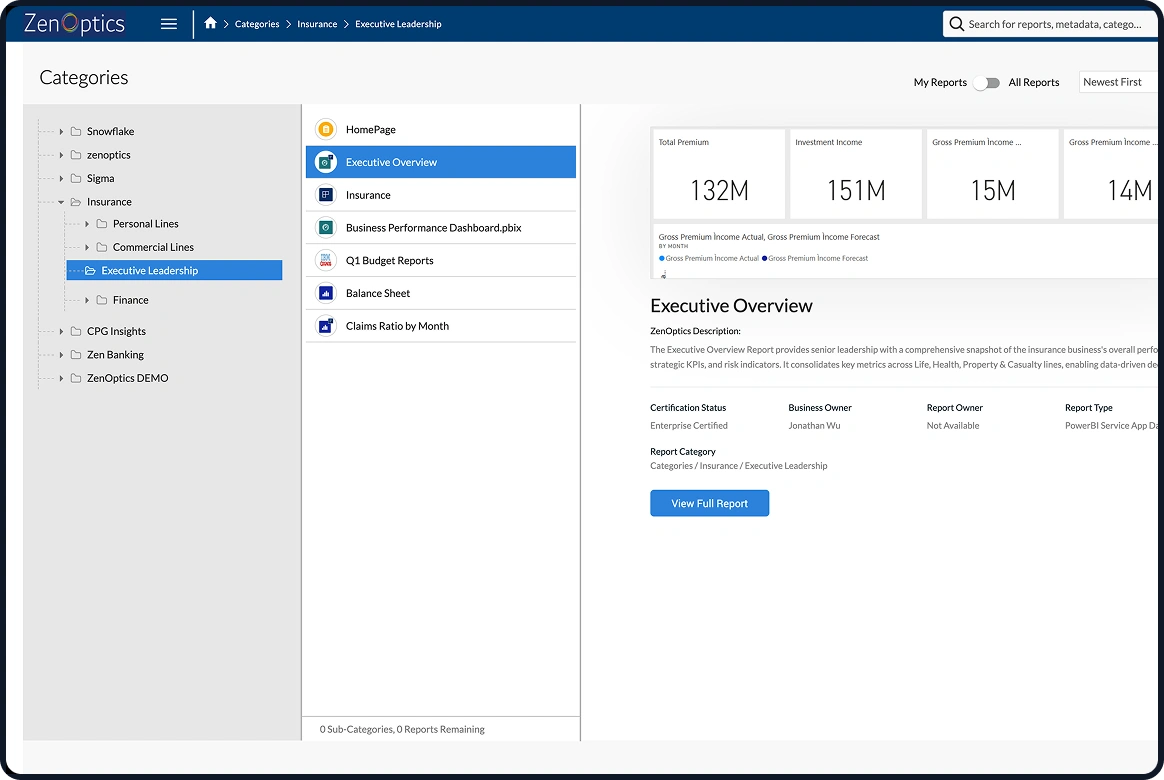
Maestro turns analytics into structured, governed workflows that guide teams from insight to action while preserving the context behind each decision. Its Business Process Workflow Library organizes workflows across functions such as Finance, Legal, HR, Sales and IT. It includes prebuilt and customizable workflows for processes such as CapEx approvals, cash-flow forecasting, month-end close, QBR preparation and vendor payments.
When people and AI agents operate within Maestro workflows, governance and accountability can be built into execution instead of being added as documentation afterward.
The certified analytics foundation at each step is provided by Atlas: ZenOptics's analytics system of record, where KPI definitions are governed, ownership is assigned, and certification status is maintained across the enterprise analytics estate. Maestro workflows can map decision steps to governed analytics from Atlas, giving teams a stronger foundation for consistent execution. Certification status is part of the context the agent operates within.
Nexus transforms governed metadata from Atlas into business context that AI systems can interpret.This helps agents understand relevant metrics, business terminology and relationships as they participate in Maestro workflows.
Maestro brings governance into execution by allowing reviews, approvals, rejections and escalations to be defined within the workflow. Actions are recorded and steps remain visible, helping teams understand what was done, by whom and when.
By connecting analytics, workflow steps, actions and approvals, Maestro helps preserve the provenance behind a business decision. This gives operations, finance and legal teams a clearer record of the workflow, the actions taken, the people involved and the governed analytics connected to the process.
This does not remove every barrier to production. It does, however, give stakeholders a clearer and more defensible record of how work was executed and governed.
Frequently Asked Questions
Why do AI agent pilots stall at the production approval stage?
AI agent pilots can stall for several reasons, including technical limitations, security concerns, unclear business value and insufficient governance. Even when technical performance is promising, production approval may be delayed if stakeholders cannot determine how the agent’s actions will be reviewed, governed and traced.
What is the difference between IT governance and business decision governance for AI agents?
IT governance addresses the AI system: access controls, API logs, model monitoring, and system audit trails. It documents what the agent accessed and invoked. Business decision governance addresses the business decision the agent makes: what certified analytics the agent referenced, what workflow step governed the action, what authorization condition was satisfied, and what the outcome was. Both are necessary. Business decision governance complements technical controls by connecting an agent’s actions with the relevant analytics, workflow, authorization and outcome.
What does business decision governance require for AI agents?
Business decision governance for AI agents requires four components: a certified analytics basis at each workflow step, a structured workflow that governs what the agent does at each step, a governance approval record captured as the step completes, and a decision provenance record connecting the certified analytics input to the agent's action to the measurable outcome.
How does Maestro enable AI agent deployment to reach production?
Maestro provides structured workflows for analytics-driven enterprise processes. Decision steps can be mapped to governed analytics from Atlas, while Nexus provides business context that AI can interpret. Maestro allows reviews, approvals, rejections and escalations to be incorporated into execution, while recording actions and maintaining visibility across workflow steps.
Is this a compliance requirement or an operational requirement?
It can be both. In regulated or high-risk use cases, organizations may face formal requirements related to record-keeping, transparency and human oversight. Even when a specific regulation does not apply, teams still need clear records of actions, approvals and ownership to manage operational risk. Business decision governance can support these requirements, but compliance depends on the use case, jurisdiction and applicable regulation.
Published September 15, 2026Production Readiness Requires More Than Model Performance
Strong model performance is only one part of production readiness. Enterprises must also understand what an agent did, what information informed its action, what process governed it and who remained accountable. Model monitoring, data governance and IT audit logs remain essential, but they may not provide the full business context behind an agent’s actions. A business decision governance layer helps connect those actions with governed analytics, workflows and accountability. Atlas governs the analytics foundation. Nexus makes that context interpretable to AI.Maestro brings governance into the workflows and decisions that follow. Together, they build the business decision governance infrastructure that turns a technically successful pilot into a production-ready deployment. Explore Governed AI Agent Workflows with ZenOptics
Schedule a 15min demo call