

Enterprise organizations have spent years building data governance programs: lineage tracking, quality rules, metadata catalogs, policy frameworks. When AI copilots arrived, many enterprise analytics teams assumed their governance investment would carry over, that a well-governed data estate would translate to well-grounded AI analytics answers.
It did not. As enterprises deploy AI copilots and analytics agents, many are encountering a difficult problem: AI can return inconsistent or misleading answers even when the underlying data is clean and governed. Teams blame the model. They revisit data quality. They adjust retrieval configurations. The wrong answers persist.
The problem is not always the underlying data. In many cases, it is the gap between data governance and analytics governance. Many enterprise AI deployments have one without the other.
The Gap No One Expected: When Governed Data Does Not Produce Accurate AI Analytics
The instinct when AI returns a wrong metric is to look at the data. If Revenue comes back wrong, check the underlying revenue data. If Headcount is off, audit the HR system. This instinct is understandable, because it works for traditional BI failures. When a report shows the wrong number, it is usually because the data feeding it is wrong.
But not every AI analytics failure follows this pattern. In some cases, the underlying data is clean and the source figures are correct. The revenue figures are correct in the source systems. The headcount data passes every quality rule. And the AI still returns the wrong Revenue number when asked for Q3 performance, or the wrong Headcount figure when asked for organizational strength by region.
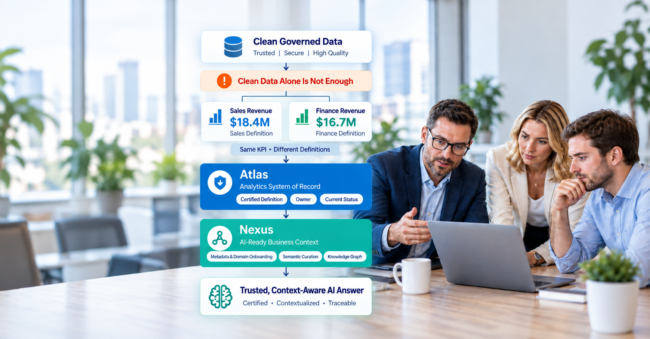
The reason is that the AI is not reading wrong data. It is reading the right data through the wrong definition. It retrieved a version of "Revenue" that is accurate in its own context but is not the certified definition the finance team designated as authoritative for Q3 reporting. The data is fine. The analytics context layer (the governed business meaning attached to that data) is absent.
This explains why an organization can have mature data governance and still struggle to produce trusted AI-generated analytics. Governing the data estate does not automatically give AI access to certified metric definitions, business ownership, scope and reporting context.
Data Governance and Analytics Governance Are Not the Same Discipline
This distinction is at the core of why enterprise AI analytics deployments fail even in well-governed organizations.
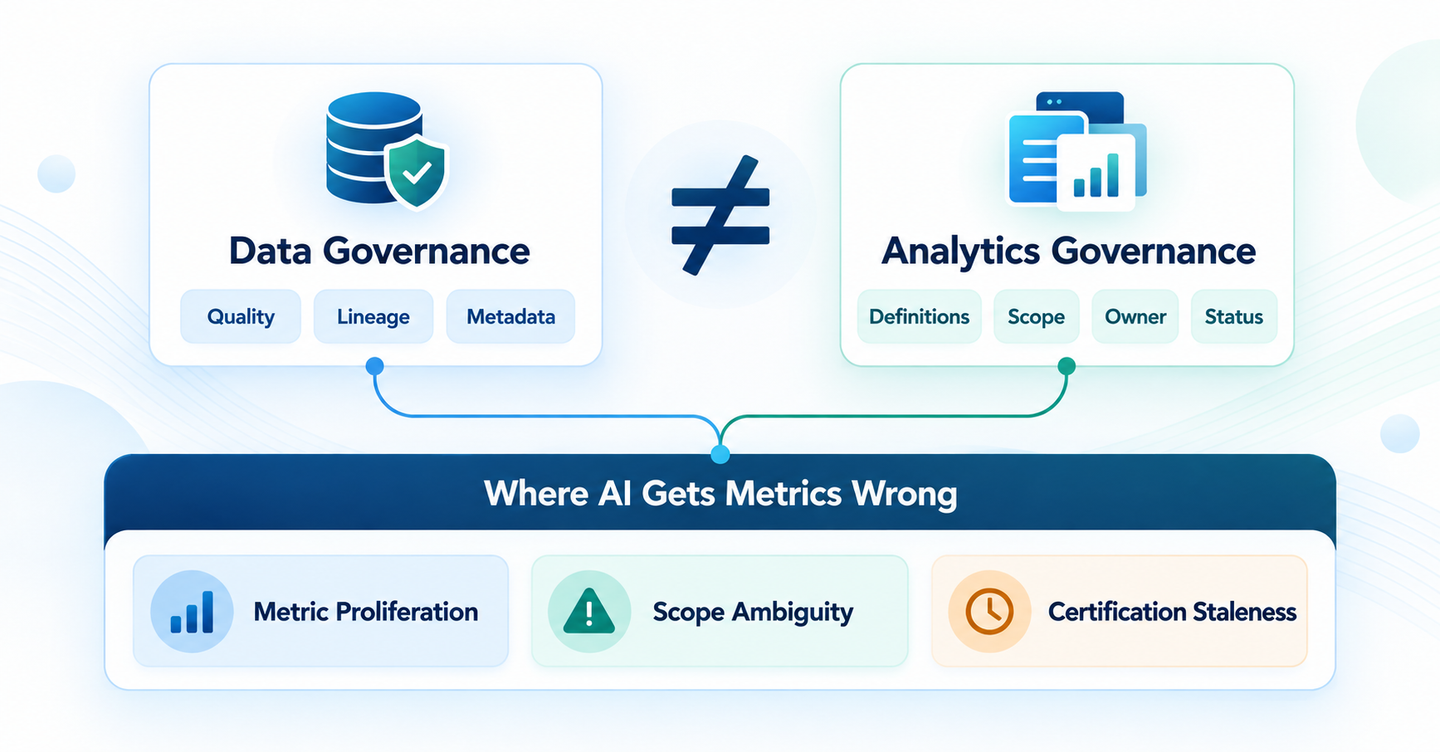
Data governance certifies the data layer: that source data is accurate, complete, consistent across systems, and traceable through its lineage. A mature data governance program ensures that the revenue figures in the data warehouse match the revenue figures in the source transactional system, that field definitions are documented, that access policies are enforced, and that changes to source data are tracked. This work is essential, but by itself it may not govern the dashboards, reports, KPIs and business definitions through which people and AI consume analytics.
Analytics governance certifies the analytics layer: that business metrics (Revenue, ARR, EBITDA, Headcount, Cost per Acquisition) have authoritative definitions, designated business owners, defined scope and calculation rules, and current certification status. "Revenue" in a large enterprise BI estate may exist in multiple forms across four BI tools. Each form draws from governed data. None of those forms is inherently "wrong" at the data layer. But only one is the certified definition for a given reporting context: the one finance designated as authoritative for board reporting, or the one sales operations designated for pipeline analysis.
When AI reads that BI estate without analytics governance context, it cannot distinguish the certified definition from the uncertified one. It may retrieve a definition based on technical relevance rather than business authority because conventional retrieval does not automatically understand certification status or reporting context.
Model Context Protocol can connect AI systems to tools and information, but connectivity alone does not determine which metric is authoritative. AI still needs governed business context to interpret enterprise analytics consistently. For ZenOptics, the missing layer is analytics governance: the certified definitions, ownership and business context surrounding reports, dashboards and KPIs.
The Three Failure Modes: Why AI Reads a Governed Estate and Still Gets Analytics Wrong
Three common failure patterns help explain why AI can produce inaccurate analytics answers in governed organizations.
Metric proliferation. A large enterprise BI estate accumulates metric definitions over time. Power BI reports built by the finance team define Revenue one way. Tableau dashboards built by sales operations define it another. SAP BusinessObjects reports used by the executive team draw from a third calculation. All of these are reading from governed source data. All of them are "accurate" in their own context. The enterprise has never designated which definition is authoritative across contexts. When AI retrieves “Revenue,” it may select a definition based on technical relevance rather than business authority because conventional retrieval does not automatically understand certification status or reporting context. The answer is data-accurate but analytically wrong.
Scope ambiguity. Even when a metric definition is consistent, its scope varies across reports. Revenue by geography. Revenue by product line. Revenue by GAAP treatment. Revenue excluding discontinued operations. An AI query for "Q3 Revenue" may retrieve any of these scope variants. Without analytics context that maps which scope is canonical for which reporting context, the AI returns a scoped figure without disclosing its scope. The finance director reviewing the answer does not know whether the AI included discontinued operations or excluded them, and neither does the AI.
Certification staleness. Metrics are not static. A definition that was certified in Q1 may be under review for Q2 as the business changed its calculation methodology. AI retrieves metric definitions without certification status timestamps. It returns a metric that was certified but is no longer current, with no indication that the certification is under review. The answer reflects a governance state that no longer applies.
Understanding what metric certification requires makes clear why these failures persist: certification is not a label applied to a metric record. It is a governed process that produces an ownership record, a scope definition, a calculation rule, and a current status. These attributes are not always governed consistently through traditional data governance programs. They require analytics governance infrastructure. The analytics knowledge graph that maps relationships between metrics, scopes, and ownership records is what allows an AI system to navigate a complex BI estate without retrieving the wrong definition.
What Analytics Context for Enterprise AI Actually Requires
Closing the enterprise AI analytics accuracy gap requires four components working together. Together, they constitute what "analytics context" means at the enterprise level, and why it is a different, harder problem than data context.
Certified metric definitions. The business must designate, for each analytically significant metric, which definition is authoritative for which reporting context. This is an analytics governance decision made by a designated business owner with documented authority, not a data governance artifact. When AI can reference a certified metric definition, it is better positioned to align its response with the definition the business has approved.
Business ownership records. Certification without ownership is unenforceable. Each certified metric definition requires a designated owner: the business role or individual who has authority to certify, modify, or retire the definition. When AI returns a metric answer, the ownership record is part of the context. The answer is traceable to the person who certified it, not only the data that produced it.
Scope and calculation rules. The metric definition must specify the scope (which business units, time periods, product lines, geographies, and accounting treatments the certified figure includes or excludes) and the calculation methodology that produces it. Without this, AI returns a metric figure without disclosing whether it is GAAP or non-GAAP, consolidated or unconsolidated, trailing twelve months or point-in-time.
Current certification status. A certified metric definition must carry a status indicator: active, under review, or superseded. AI needs to understand whether a metric’s certification is current. A definition that is under review should be flagged as such in the AI's context so that users understand the certification basis of the answer they receive.
The certified analytics foundation that these four components depend on is Atlas, ZenOptics's analytics system of record, where KPI definitions are governed, ownership is assigned, and certification status is maintained across the enterprise analytics estate.
Not every inaccurate AI analytics response is a traditional model hallucination. In some cases, the model may be using real information but applying an uncertified, outdated or contextually inappropriate metric definition. This makes it an analytics context problem, rather than simply a model accuracy problem.
How retrieval architecture affects analytics accuracy is a distinct but related question: the retrieval mechanism determines what the AI finds, but without analytics context layer governance, even optimal retrieval cannot distinguish the certified metric definition from an uncertified one.
How Nexus Closes the Analytics Context Gap for Enterprise AI
Nexus is ZenOptics's analytics context layer: the infrastructure that makes certified analytics context available to AI in machine-readable, governed form.
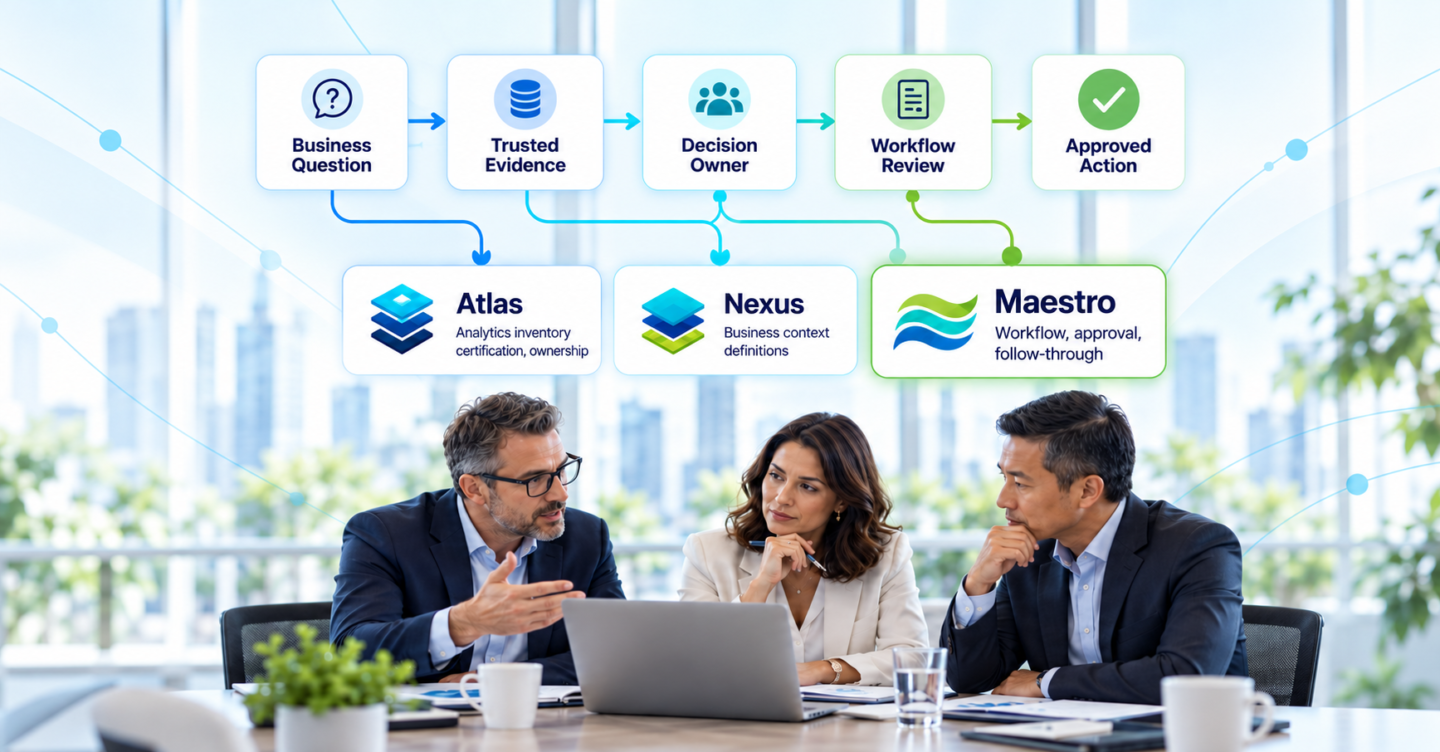
Atlas and Nexus play complementary roles. Atlas serves as the analytics system of record, where analytics assets, definitions, ownership and certification are governed. Nexus transforms this governed metadata into business context that AI systems can interpret. Nexus has three components, each addressing a distinct part of the analytics context gap.
Metadata and Domain Onboarding consumes governed metadata from Atlas and organizes analytics assets by business domain. It captures structural metadata, identifies gaps such as missing descriptions, incomplete ownership and uncertified assets, and prepares that context for AI consumption. This gives AI the starting point for analytics retrieval: a governed map of the analytics estate rather than a raw connection to BI schema.
Semantic Curation Studio is where technical metadata is transformed into business-meaningful context. Data stewards resolve naming conflicts, curate descriptions, standardize aliases and verify that analytics assets are logically consistent for AI consumption. Working with the governed foundation provided by Atlas, the Semantic Curation Studio enriches technical assets with business-friendly descriptions and human-verified terminology. This reduces the ambiguity that causes AI to misinterpret natural-language analytics questions.
Knowledge Graph connects analytics assets, KPIs, business domains and their relationships, helping AI understand how enterprise analytics fit together. When an AI system encounters a question about revenue or sales performance, the Knowledge Graph helps it understand the relevant business domain, related KPIs, analytics assets and upstream relationships.
Atlas provides the certified analytics foundation that Nexus makes AI-consumable: the analytics system of record where KPI definitions are governed, BI inventory is managed, and ownership records are maintained across tools and business functions.
This gives AI systems access to richer, governed analytics context. They are better positioned to reference certified metrics, understand relevant relationships and align responses with the way the organization measures performance. The underlying data does not change. The analytics context does, from absent to governed.
Frequently Asked Questions
Why does enterprise AI return wrong analytics answers when data is governed?
Data governance certifies the data layer: accuracy, lineage, and consistency at the source. Analytics governance certifies the analytics layer: which metric definitions are authoritative, who owns them, what scope they apply to, and whether their certification is current. Enterprise AI deployed without analytics governance context retrieves whichever metric definition its retrieval mechanism surfaces, not the certified one. The data is clean. The analytics context is absent.
What is the difference between a data catalog and an analytics context layer?
A data catalog documents the data estate: what data assets exist, where they come from, and who owns them at the data level. An analytics context layer governs the analytics layer: which metric definitions are certified, what their calculation scope is, who certified them, and whether they are current. These are different governance objects. An enterprise can have a mature data catalog and no analytics context layer. When AI operates on that estate, the data catalog does not prevent analytics accuracy failures.
What does analytics context for enterprise AI require?
Analytics context for enterprise AI requires four components: certified metric definitions (which definition of each metric is authoritative for which reporting context), business ownership records (who certified the definition and with what authority), scope and calculation rules (what the certified figure includes and excludes and how it is calculated), and current certification status (whether the certification is active, under review, or superseded).
What is Nexus's role in enterprise AI analytics accuracy?
Nexus is ZenOptics's analytics context layer. Its three components (Metadata and Domain Onboarding, Semantic Curation Studio, and Knowledge Graph) build a governed, machine-readable representation of the certified analytics estate. Nexus makes governed analytics metadata from Atlas available as business context for AI. This helps AI systems interpret metrics, relationships and business terminology more consistently.
Is this an analytics hallucination problem?
Not every inaccurate AI analytics response is a traditional model hallucination. In some cases, the model may be using real information but applying an uncertified, outdated or contextually inappropriate metric definition. This is an analytics context problem, not simply a model accuracy problem.
Published September 11, 2026The Governance Layer That Makes Enterprise AI Analytics Accurate
Clean data is necessary. It is not sufficient. Enterprise AI deployed on a governed data estate without an analytics context layer may retrieve the wrong metric definition, apply the wrong scope and produce an unreliable answer, not because the model is wrong, but because the analytics governance layer that makes metric retrieval accurate is absent. Atlas governs and certifies the analytics foundation. Nexus transforms that governed metadata into business context AI can interpret. Together, they build the analytics context infrastructure that translates a well-governed data estate into accurate, trustworthy AI analytics answers. See How Atlas and Nexus Bring Governed Analytics Context to Enterprise AI
Schedule a 15min demo call