

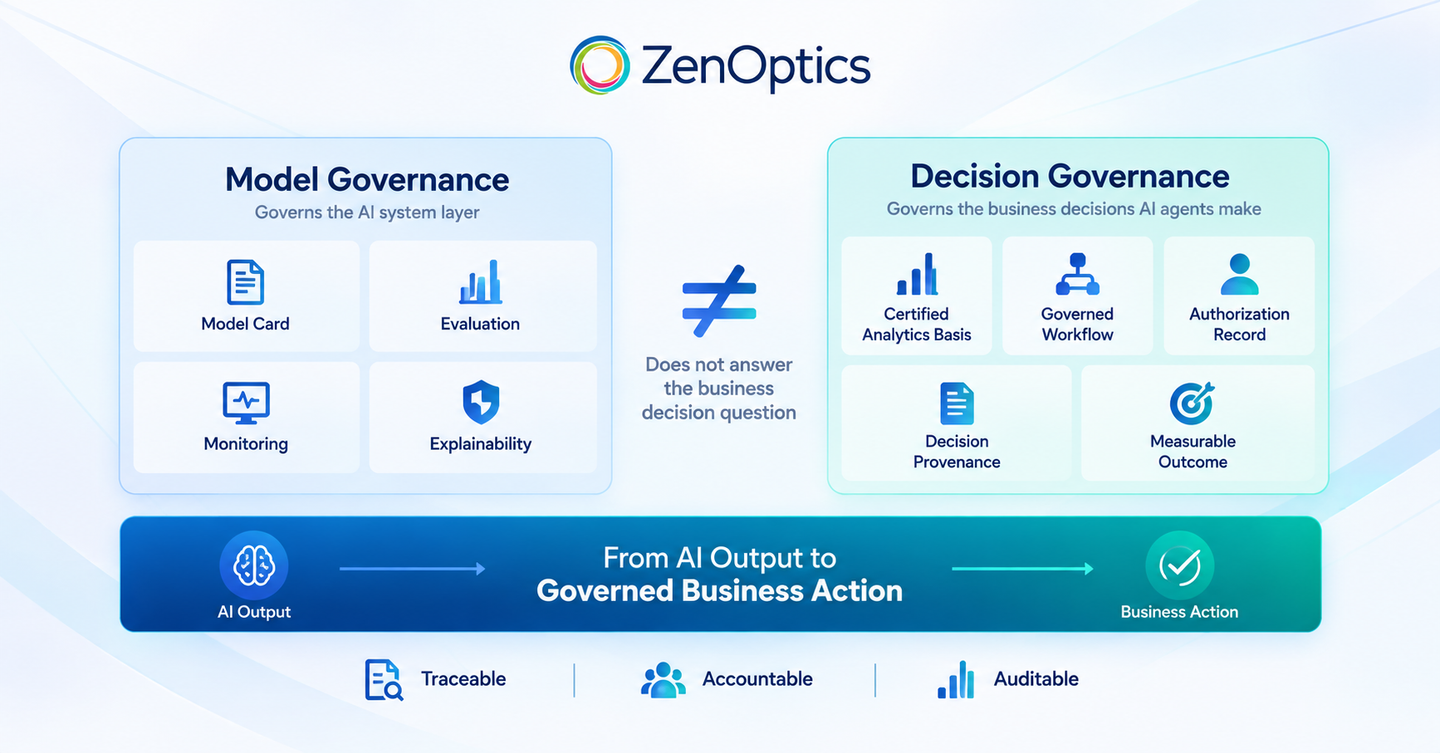
Most enterprise AI governance programs focus on two layers. Data governance addresses the quality, lineage, and accessibility of the data AI systems use. Model governance addresses how AI models are developed, evaluated, monitored, and explained. Both are essential, but neither fully governs what happens when an AI agent acts on an insight inside a business process.
A third layer is therefore becoming essential: decision governance. When an AI agent routes a CapEx request, completes a month-end task, or escalates a budget variance, it influences or executes a business decision. That decision requires governance: not model governance, but decision governance, covering the certified analytics basis, the structured workflow, the authorization record, and the measurable outcome.
What Decision Governance Is, and Why AI Agents Make It Urgent
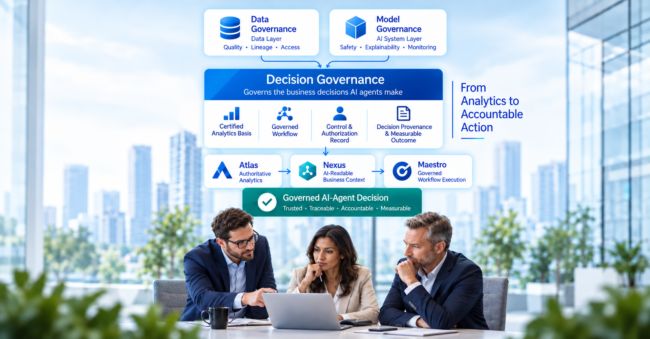
Decision governance is the discipline of ensuring that consequential business decisions are grounded in trusted analytics, executed through accountable processes, and recorded in a way that connects actions to outcomes. It is distinct from data governance, which governs the data layer, and from model governance, which governs the AI system layer. Decision governance governs the decision layer: what was decided, on what analytical basis, under what process, by whose authority, and with what result.
The decision traceability requirement for enterprise AI agents is a governance-level constraint, not a technical one. When an AI system participates in a consequential enterprise workflow, its actions should be explainable, attributable, and traceable to the analytics and policies that informed them. This is not a requirement that model documentation satisfies. Model documentation records how an AI system was built. Decision governance records what that system did when it operated in a business process, and whether that action was governed, certified, and traceable.
AI agents intensify this requirement because they can execute workflow steps without a human initiating each action. When an AI agent completes a workflow step, the workflow should capture what happened, which inputs informed the action, what governance conditions applied, and whether human review was required. Without this structure, evidence may remain fragmented across logs, applications, emails, and manual documentation. The decision intelligence framework requires a decision governance layer because agents can operate at a speed and volume that makes informal recordkeeping unreliable and difficult to scale.
Why Model Governance Alone Does Not Cover It
Much of today's AI governance investment focuses on model governance: documenting models, monitoring outputs, testing for bias and drift, and improving explainability. These investments are appropriate for the model layer. They do not address the decision layer.
A model card documents training data, evaluation methodology, and known limitations. It does not record whether the analytics the model referenced were certified, what process governed the resulting decision, who authorized the action, or what the outcome was. When a compliance review asks how an AI agent's CapEx routing was governed, model documentation does not answer that question. What the decision record must contain is a decision provenance artifact: the certified analytics asset, the governed process, the authorization, and the outcome.
This gap is most visible in enterprise analytics workflows where AI agents are most actively deployed. A governed analytics-to-action workflow requires a governance layer that extends from the certified analytics asset through the structured process and into the outcome record. Model governance remains essential, but it must be complemented by decision governance that connects trusted analytics, governed execution, authorization, and outcomes.
What Decision Governance Requires When AI Agents Execute Workflow Steps
Decision governance for AI agents operating in enterprise analytics workflows has four components. Together, they produce the governance record that makes agent-executed decisions auditable and defensible.
A certified analytics basis. When an AI agent references a metric during a workflow step, that metric must be certified: reviewed and approved by a designated business owner, with a current certification status. What metric certification requires is a formal governance record attached to the metric itself. When the agent references a certified metric, the certification status becomes part of the decision record. When an agent references an uncertified source, that is a governance signal requiring escalation rather than silent execution.
A governed workflow context. The agent should operate within a defined process framework that establishes permitted actions, ownership, controls, approval thresholds, and escalation paths. This creates the process context needed to govern and evaluate each agent action. An agent acting outside a governed workflow may leave its actions disconnected from the process context, ownership, and controls needed for effective auditability. The certified analytics foundation provides the governed metrics the agent draws from; the workflow provides the governed process the agent executes within.
A control and authorization record for consequential steps. For consequential workflow steps, the execution record should capture the applicable control (such as an approval, review, policy check, or escalation threshold) and whether that condition was satisfied. A governed workflow can preserve the applicable authorization, review, or policy-check record as part of the execution history.
A decision provenance record that closes the loop. The agent's action must be connected to the certified analytics input that triggered it, the workflow step that structured it, the governance condition that governed it, and the measurable outcome that followed. Without this record, organizational accountability for AI agent decisions rests on assertions rather than records. With it, organizations can trace agent-executed decisions from the analytics input and workflow context through to the resulting action and outcome.
How Maestro Provides Decision Governance for AI Agent Participation
Maestro is ZenOptics' governed workflow execution layer. When AI agents participate in Maestro workflows, the workflow structure can connect trusted analytics, execution context, governance controls, and decision provenance in one governed process.
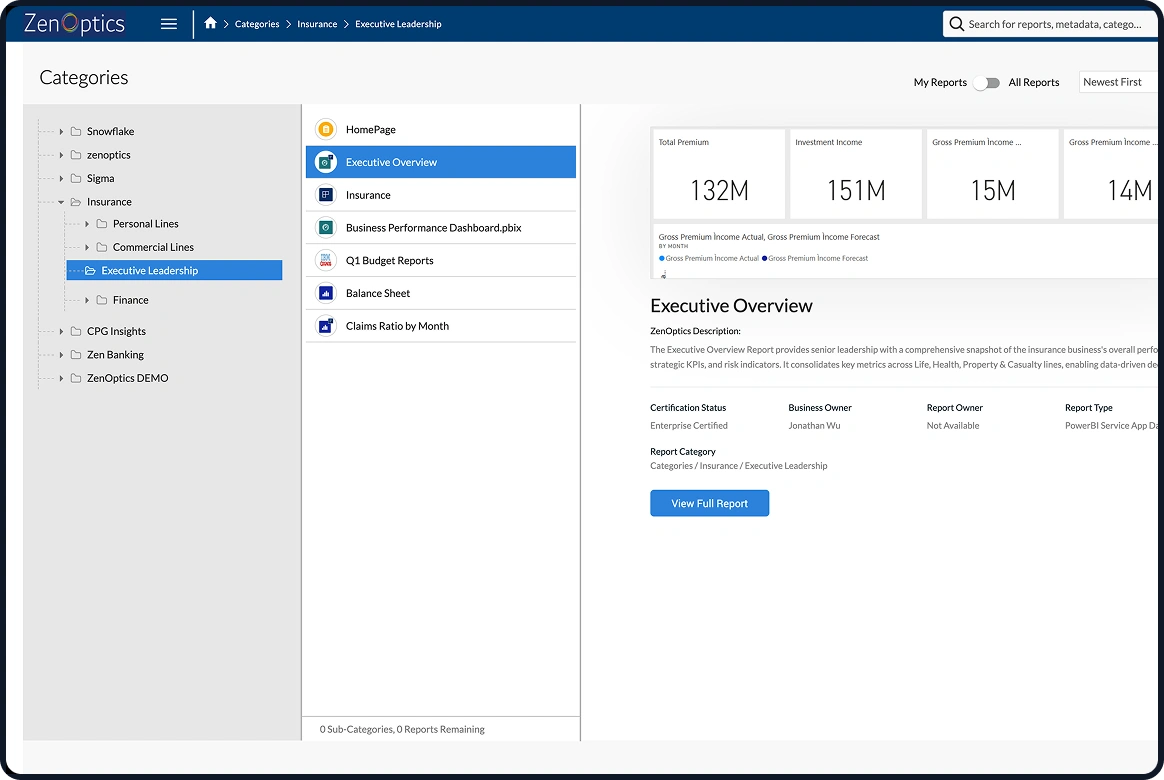
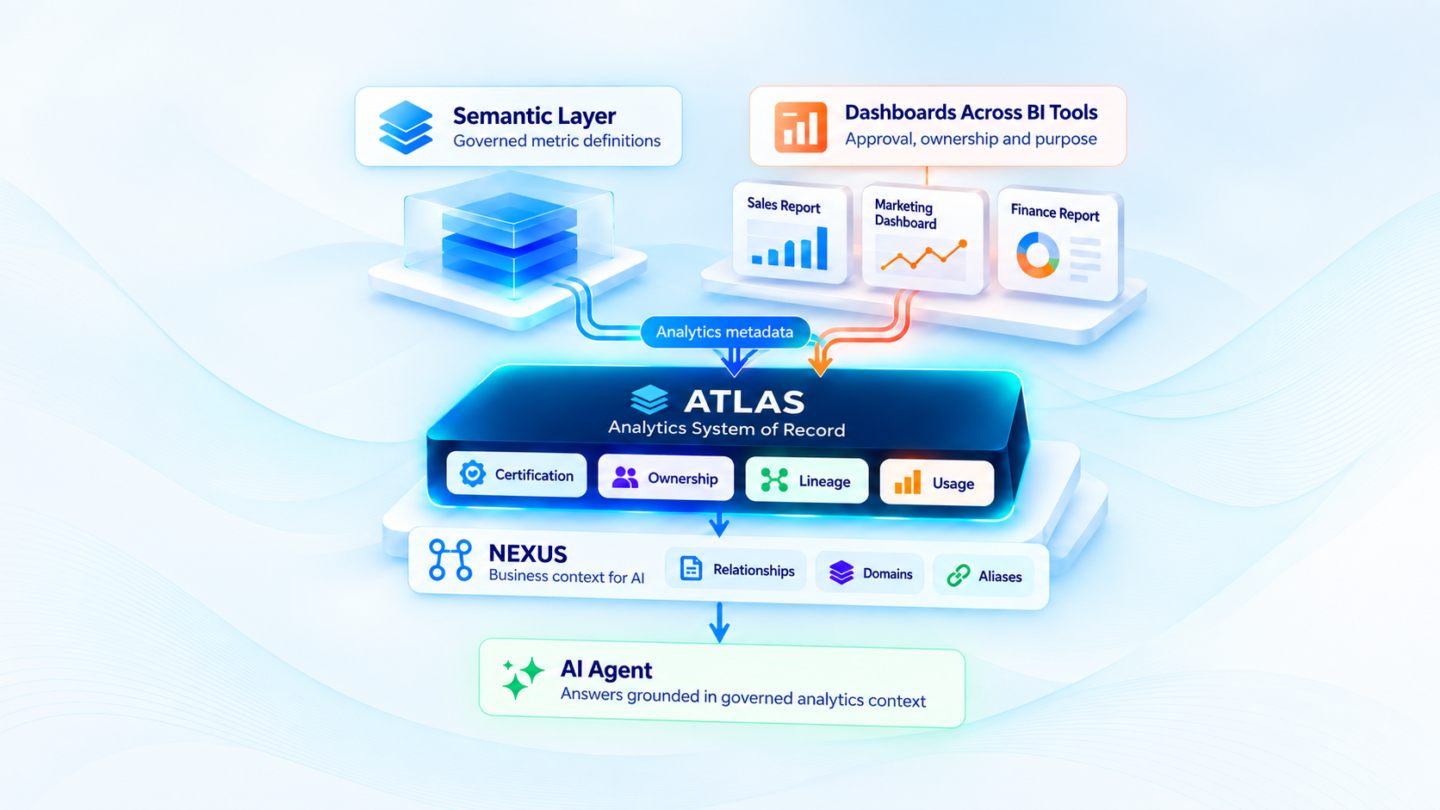
Atlas provides the analytics system of record that catalogs and governs reports, dashboards, KPIs, and metrics across the enterprise. Within a Maestro workflow, teams can connect process steps to authoritative analytics assets, along with their definitions, ownership, lineage, and certification status.
Nexus transforms governed BI metadata from Atlas into business context that AI systems can interpret. It helps agents understand metric definitions, relationships between KPIs, business domains, and the logic surrounding enterprise analytics.
Maestro embeds governance into workflow execution by structuring reviews, approvals, rejections, escalations, ownership, and action history within the process. This creates a clearer record of what happened, who (or what) performed the action, and when it occurred. When an AI agent completes a step, Maestro can preserve the applicable governance condition, the relevant analytics context, and the action taken within the workflow history.
Together, Atlas, Nexus, and Maestro establish a connected foundation for decision governance. Atlas provides authoritative analytics, Nexus adds business context for AI, and Maestro structures execution, controls, and decision provenance. This allows organizations to govern AI participation through the same accountable processes used for consequential human decisions.
Frequently Asked Questions
What is the difference between AI governance and decision governance?
AI governance is the broader framework for managing the risks, responsibilities, and controls associated with AI systems. Model governance is one part of it, focused on how models are developed, evaluated, monitored, and explained. Decision governance governs the business decision layer: the trusted analytics basis, the structured workflow, the authorization record, and the measurable outcome. Where AI governance addresses the AI system, decision governance addresses what that system does in a business process.
Why is model governance not enough when AI agents execute business decisions?
Model governance documents how an AI system was built. It does not record whether the analytics it referenced were certified, what process governed the decision, who authorized the action, or what the outcome was. When a compliance review asks how an AI agent's workflow action was governed, model documentation does not answer that question. Decision governance provides the records that do: the certified analytics basis, the governed process, and the decision provenance record.
What does decision governance require for AI agents specifically?
Decision governance for AI agents requires four components: a trusted analytics basis, a governed workflow context, control and authorization records for consequential steps, and decision provenance connecting actions to their analytical inputs and measurable outcomes. Together, these allow organizations to govern and evaluate agent-executed decisions with appropriate accountability.
How does Maestro govern AI agent decisions?
When AI agents participate in Maestro workflows, Atlas provides authoritative analytics, Nexus adds the business context AI needs to interpret those analytics, and Maestro structures the workflow, controls, ownership, and action history. Together, these capabilities help organizations trace how an agent action was informed, governed, and executed.
Is decision governance a compliance requirement?
Governance obligations vary by jurisdiction, industry, risk level, and use case. Organizations may need to demonstrate oversight, traceability, accountability, or explainability for certain automated decisions. Decision governance helps create the operational records and controls needed to support these requirements, but it should complement, not replace, legal, risk, and compliance review.
Published September 21, 2026From Governed Analytics to Governed Action
Data governance establishes trust in enterprise data. Model governance establishes controls around how AI systems are developed and evaluated. Decision governance extends that accountability into the business processes where humans and AI agents act. ZenOptics connects these layers across the decision lifecycle. Atlas establishes an authoritative analytics foundation. Nexus gives AI the business context needed to interpret that analytics correctly. Maestro turns insights into structured, governed, and traceable execution. Together, they help enterprises move beyond governing AI models to governing the decisions and actions those models influence. See How ZenOptics Connects Governed Analytics to AI-Driven Action
Schedule a 15min demo call